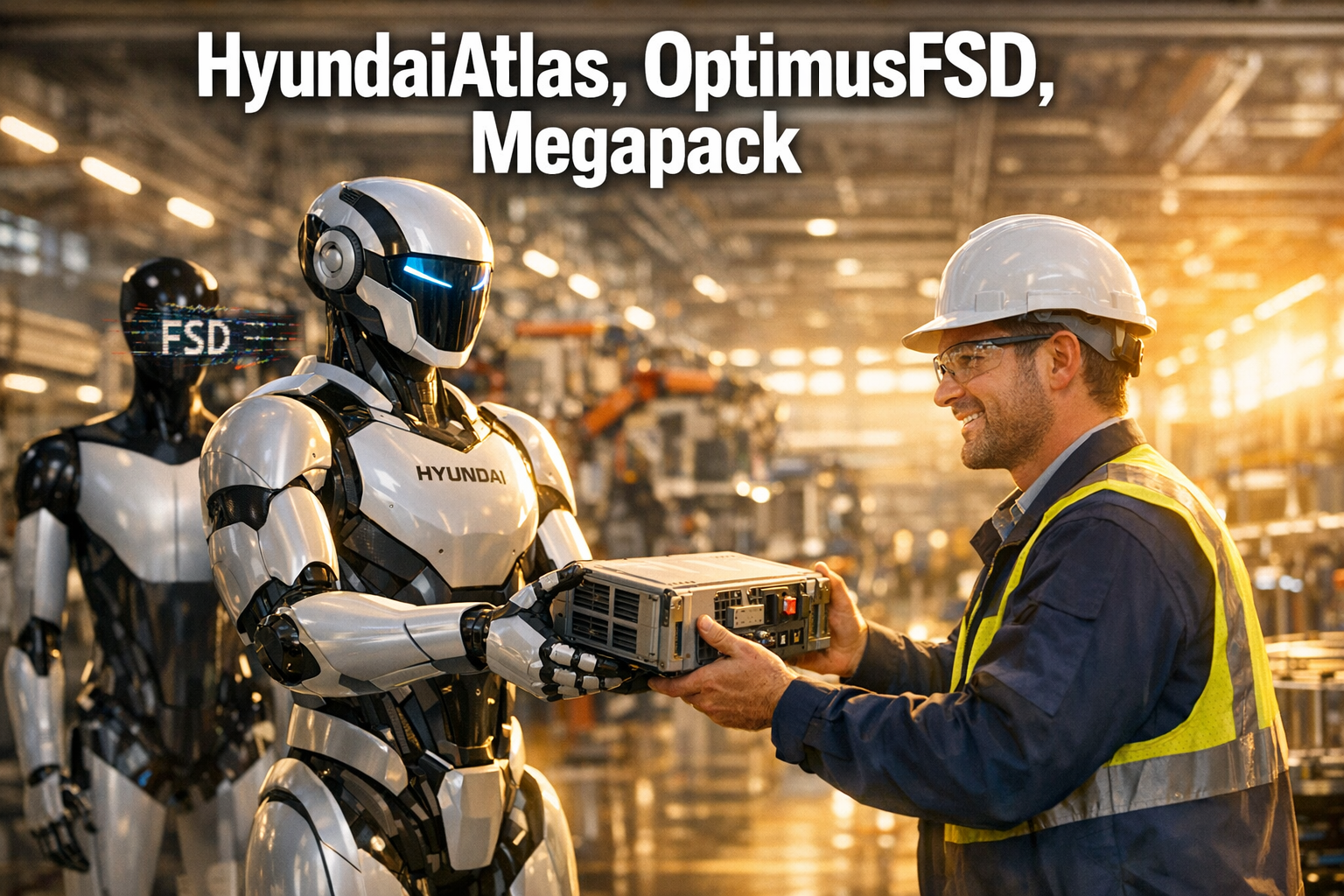
● Hyundai Humanoid Shock, Tesla FSD Manners, Megapack Power Grab
Bloomberg’s Real Rationale for “Hyundai Robots Beat Tesla,” and the Underappreciated Investment Catalyst
This note consolidates four topics:1) Hidden pitfalls behind headline metrics in the Hyundai (Boston Dynamics) “Atlas” vs Tesla “Optimus” comparison
2) Why spec contests such as “50 kg vs 20 kg” may miss the core value proposition
3) The significance of Tesla FSD beginning to learn “social driving behavior” for robotics/physical AI
4) How the AI data-center buildout structurally links to power infrastructure demand (Megapack)
1) News Briefing: Key Points in Report Format
1-1. Bloomberg: Framing Hyundai Motor as the practical humanoid leader
Bloomberg argues that while attention remains concentrated on Tesla Optimus and US–China AI competition, Hyundai may have a more credible near-term monetization path in humanoids. The rationale cited includes a concrete scale-up/deployment timeline and a partnership strategy (NVIDIA + Google DeepMind).
1-2. Hyundai Atlas: Hardware specification emphasis
Atlas highlights lifting capacity (50 kg), high/low temperature tolerance, and joint flexibility. Bloomberg interprets these as industrial deployment-oriented attributes, and references analyst views that operating costs (converted to an hourly cost framework) could become competitive versus human labor.
1-3. Tesla: FSD detects tailgating and yields autonomously
Recent FSD behavior reportedly identifies tailgating and adjusts speed/lane positioning to “yield.” This is positioned as a shift beyond basic lane changes/overtakes toward learning “social interaction” behaviors.
1-4. Tesla Energy: Megapack selected for a 400 MW-class AI data center in Brazil
A 400 MW-class AI data center project in the Uberlandia region of Brazil is reported to adopt Megapack as a core power solution. In grids with high renewable penetration and higher volatility, ESS supports data-center power reliability, reinforcing the role of storage in AI infrastructure.
1-5. Tesla China: Shorter delivery times and extended zero/low-interest financing
Model 3/Y delivery lead times reportedly shortened to 1–3 weeks, with financing promotions extended. The market debate is whether this reflects improved production efficiency or demand softening. China’s EV market is characterized by intensified competition (e.g., BYD, Xiaomi) and heightened price/financing rivalry.
2) Atlas vs Optimus: Determinants Beyond “Specs”
2-1. How many workflows require a “50 kg-lifting” humanoid?
In many repetitive industrial settings, occupational safety standards limit repetitive manual lifting, while heavy-load transfer has long been addressed by forklifts, fixed industrial robots, and AMRs. A humanoid investment thesis anchored primarily on strength may be structurally weak.
2-2. Humanoid “killer value” likely centers on dexterity and on-site autonomy
The adoption case for expensive humanoids is replacing labor in irregular tasks that are difficult to automate: cable management, fine assembly, mixed-model line adaptation, and exception handling. The competitive axis is more plausibly: (i) manipulation precision and (ii) the ability to resolve exceptions safely with minimal human intervention.
2-3. Hyundai (partner-led) vs Tesla (vertical integration) strategy
Hyundai’s approach is to accelerate commercialization via best-in-class partners (NVIDIA compute, DeepMind collaboration). Tesla’s approach is vertical integration across chips/training/deployment to drive unit costs down and pursue mass adoption. This divergence can influence valuation: partner-led models may execute faster but retain licensing/component dependencies, while vertical integration may take longer but can lock in cost and margin structure.
2-4. “Borrow Google’s brain” risk: physical AI requires different data
Digital AI (text/images) and physical AI (friction, inertia, slippage, collisions, long-tail exceptions) operate under different constraints. Real-world environments generate frequent long-tail exceptions, and the ability to resolve them autonomously is central to productivity and safety.
2-5. Reversal risk: Hyundai may also seek Tesla-style operating know-how
Reportedly, Boston Dynamics hired a key Tesla Optimus figure as an advisor. This suggests that partnerships alone may be insufficient and that internal capabilities in robot autonomy/control/training pipelines remain critical.
3) Why FSD’s “Social Behavior Learning” Matters for Robotics
3-1. The next step is not compliance, but social interaction
Driving requires inference of intent (urgency, threat, yielding), not only rule-following. Yielding behavior under tailgating conditions signals movement toward modeling implicit human interaction patterns.
3-2. Link to Optimus: real-world understanding is equally required in factories
Factory robots face the same class of problems: misaligned parts, slippery floors, nearby human traffic, and unmodeled variables. The key capability is continuing work safely without stalling when conditions deviate from manuals. FSD’s accumulated real-world data, intent inference, and exception handling experience supports the credibility of a broader physical AI platform narrative.
4) AI Data Centers and Power Infrastructure: Faster Monetization Path
4-1. The AI buildout bottleneck is electricity
AI infrastructure increasingly behaves as a combined “compute + power” procurement. Data centers are energy-intensive, and ESS becomes more critical in regions with unstable grids. This constitutes a comparatively visible, structurally supported demand driver.
4-2. Implication of Brazil Megapack: higher-renewables systems require more ESS
As solar/wind penetration rises, output variability increases, elevating the need for ESS. AI data centers require 24/7 stable power; therefore, the combination of renewable expansion and AI capex can accelerate ESS standardization.
4-3. Investor checkpoints
Megapack functions as a power stabilization solution with project-based revenue and repeatable reference builds. Key determinants include execution capability, delivery reliability, and operational performance, not only technical specifications. Accumulated references can shift buyer preference toward validated suppliers and potentially improve pricing power.
5) Core Points Often Underemphasized
5-1. Humanoid winners may be defined by locked-in unit economics, not peak strength
Industrial adoption is fundamentally a spreadsheet decision. Total cost of ownership (CAPEX + OPEX including maintenance, software, parts, and licensing) versus labor substitution economics is likely the primary determinant.
5-2. Partner-led robots can scale faster but carry supply-chain and control risks
Dependence on third parties introduces chip availability, licensing cost, update policy, and data ownership issues. These are bargaining-power and margin-structure questions, not purely engineering concerns.
5-3. AI data-center capex increasingly equals power-infrastructure capex
Viewing the AI cycle only through GPU shipments is incomplete. Grid upgrades, ESS, cooling, and substation equipment capture a growing share of the investment stream. Power stabilization behaves more like a necessity, supporting continued project formation even under rate volatility.
5-4. FSD “sociality” maps to robot on-site autonomy
The key signal is not entertainment value but the learning of implicit human norms. This capability is required for robots operating alongside humans in factories, logistics, and hospitals.
5-5. The strategic frame is not “Hyundai vs Tesla,” but competing physical AI operating models
Hyundai is effectively underwriting faster commercialization via partnerships, while Tesla is underwriting lower-cost mass deployment via vertical integration. The key question is which market segment achieves product–market fit first: industrial specialization vs generalized labor substitution.
6) Forward Monitoring Checklist (Roadmap Format)
1) Humanoids: disclosure of field KPIs (uptime, failure rate, task success rate), not demo videos
2) Costs: TCO competition including unit price, maintenance, and software/chip licensing
3) Data: who collects more real-world physical data faster and at lower cost
4) AI infrastructure: conversion of data-center buildouts into grid/ESS purchase orders
5) China EVs: whether promotions indicate demand support or margin pressure, to be validated in quarterly results
From a global macro perspective, accelerating AI infrastructure investment may add to inflationary pressure at the margin, affecting rate paths and widening sector dispersion in US equities (power/utilities/industrials vs consumer). Manufacturing automation also links to semiconductor demand (accelerators, edge compute, sensors, power semiconductors), making humanoid robotics a macro-relevant theme rather than a standalone novelty.
< Summary >
Bloomberg positions Hyundai Atlas as a representative of “faster commercialization via partnerships.”
However, the core of humanoid value is less about peak lifting capacity and more about dexterous manipulation and autonomous exception handling.
Tesla FSD’s emerging yielding behavior suggests accumulating real-world interaction and exception-handling capability relevant to physical AI.
The AI data-center boom is constrained by power, and ESS such as Megapack may standardize more rapidly alongside renewable penetration.
[Related…]
- https://NextGenInsight.net?s=FSD
- https://NextGenInsight.net?s=robot
*Source: [ 오늘의 테슬라 뉴스 ]
– 블룸버그, 현대 로봇이 테슬라를 이겼다? 현대 아틀라스와 테슬라 옵티머스의 진짜 승자는?
● Tesla FSD Europe Breakthrough,Nvidia AI Bubble Jitters,Jack Dorsey AI Purge
Tesla FSD Europe (Netherlands) “Approval D-Day” + The Core Driver Behind the AI Bubble Debate + The Signal Embedded in Jack Dorsey (Block)’s Layoffs
This report consolidates three themes:1) The Netherlands approval timeline that could enable Tesla FSD to break through in Europe for the first time (key reference: the 3/20 remark).
2) The valuation mechanics behind market volatility even after exceptional Nvidia earnings (the issue is not disbelief in AI, but limited measurability in financial terms).
3) A frequently overlooked point: Jack Dorsey’s ~50% headcount reduction at Block should be read less as a recession-driven restructuring and more as a statement that the operating model has shifted toward AI.
1) Why the market appeared dislocated: not negative news, but valuation
1-1. Nvidia was not “wrong”; the market’s question changed
Nvidia’s pullback was not driven by weak fundamentals. The market response reflected a different question:
“Has this level of growth already been priced in?”
The key point is that valuation on realized earnings (roughly P/E-like framing) has moved materially higher versus historical ranges. Under these conditions, even strong results can coincide with price corrections when expectations are elevated.
This is not limited to Nvidia. The broader AI complex is facing the same question:
“AI appears transformative, but will that transformation be sufficiently larger to justify today’s price?”
This regime typically becomes more volatile when paired with:
- Interest-rate moves (discount-rate sensitivity), and
- Inflation path uncertainty.
1-2. “AI is transformative” and “equities will re-rate higher” are separate questions
AI is improving productivity and expanding the production of apps, content, and code. Equity markets, however, price expectations relative to fundamentals rather than the fundamentals alone.
Key framing:
- AI innovation speed: accelerating (observable)
- Market focus: how quickly and how much that translates into corporate earnings (visibility)
- Implication: caution is driven less by disbelief than by limited measurability
This is a standard driver of AI and mega-cap volatility in US equities.
2) Meaning of Block’s ~50% layoffs: not recessionary, but an AI operating-model reset
2-1. The key point: layoffs despite strong business conditions
Large layoffs typically follow deteriorating performance. Here the stated rationale is different: the business remains strong and growing, but work processes are changing structurally due to AI, prompting a decisive reorganization.
This matters because it signals AI shifting from a revenue-support tool to a technology that forces operating-structure redesign.
2-2. The under-discussed point: a single-step reduction rather than gradual trimming
The implied choice set:
- (Option A) Reduce headcount gradually to spread organizational shock
- (Option B) Execute a one-time reduction and restart operations on an AI-centric model
Selecting the latter implies management believes the pace of AI-driven change exceeds the organization’s ability to adapt incrementally.
This pattern may repeat across technology and fintech, particularly where productivity gains flow directly into the cost base (high fixed-cost organizations).
3) Tesla key catalyst: weight of the “March 20” Netherlands FSD approval remark
3-1. Why the Netherlands could be the entry point for European expansion
Elon Musk stated in an interview that “based on what I heard, approval in the Netherlands is on March 20.” If accurate, this would represent an initial opening for broader European FSD deployment.
In November, Dutch authorities reportedly characterized the current phase as testing rather than approval, and there was a related email-contact controversy. Against that backdrop, the significance is not the date itself, but that Musk cited a specific approval timeline, implying higher confidence in internal and regulatory communications.
3-2. Investor framing: “approval = revenue” is less relevant than “approval = expansion optionality”
Approval should be viewed as increasing regional expansion optionality rather than as a direct revenue event. Because FSD is software, once permissions are granted, operating leverage can increase rapidly.
Relative to purely digital AI, Tesla’s stated objective centers on real-world AI, which could carry greater downstream impact; this thesis depends on execution and regulatory pathways.
4) Cybertruck: demand acceleration driven by the USD 60,000 model
4-1. The mechanism: product appeal constrained by price; USD 60,000 as a threshold
The core point is a price-demand threshold. Cybertruck’s appeal existed, but higher pricing limited mass adoption. The introduction of a USD 60,000 model reportedly triggered a surge in reservations.
A stated reservation backlog extending to April 2027 should be treated as a qualitative indicator of demand strength relative to current production capacity.
4-2. Why “prices will rise” can further stimulate reservations
A price-increase signal can change consumer behavior:
- Expectation of securing a better price or earlier delivery position by reserving now
- Reinforcement of both real demand and expectation-driven demand, extending the queue
For the company, this supports demand visibility. For the market, the focus shifts to whether margin, production ramp, and supply-chain execution can keep pace.
5) Cybercab (robotaxi), Tesla Semi, and Giga Berlin: where expansion and regulation intersect
5-1. Cybercab production references: “hundreds built” + “large-scale system in April” + “full production by year-end”
The timeline is described in three phases:
- Hundreds already produced internally
- Large-scale production system from April
- Full production by year-end
This can be interpreted as separating manufacturing readiness from regulatory/operational approvals. Cybercab’s lack of steering wheel and pedals directly increases regulatory sensitivity.
5-2. Tesla Semi in Europe: wording indicates uncertainty
Musk’s phrasing that he “hopes” to launch in Europe suggests a non-committal posture, consistent with regulatory, labor, and political constraints.
5-3. “No expansion” at Giga Berlin: constraints on European manufacturing scale-up
Musk indicated Giga Berlin expansion is close to infeasible, while also stating there is no plan to close. References to external labor involvement and conflicts underscore that manufacturing expansion optionality in Europe may be more costly than expected.
This lowers expectations for European capacity additions and increases the probability that incremental capex is allocated toward regions with more flexible labor and policy environments.
6) The “work becomes optional in 10 years” remark: why markets cannot ignore it
6-1. The core issue is not a forecast, but identity and societal risk
The material point is not income, but purpose. If AI and robotics perform most work, the primary question becomes human meaning and role, indicating a broader societal and industrial transition.
6-2. Investor takeaway: prioritize structure over delivery
The relevant discipline is to focus on underlying structural change rather than presentation:
- Not who communicated better
- But what is changing operationally, and what is monetizable
This is particularly important during volatility regimes.
7) Key points often underemphasized in mainstream coverage
7-1. The “priced-in AI” debate is less about “bubble vs innovation” than measurability
The market’s practical concern:
- AI creates value
- The timing and placement of that value within company financial statements remains uncertain
- This drives repeated cycles of overheating and correction
This reflects difficulty translating AI adoption into accounting outcomes rather than a simple underestimation of AI.
7-2. Block’s layoffs signal a break in the “growth = hiring” rule
Reducing headcount by ~50% while growing indicates a shift in how organizations scale. The implication is structural: AI-driven productivity can decouple growth from hiring.
7-3. Netherlands FSD approval is less a near-term revenue event than a regulatory reference point
The primary value is not the first approval itself, but the process, criteria, and precedent that could be leveraged for expansion across other European jurisdictions.
If established, Tesla’s software rollout velocity in Europe could change materially, subject to regulatory replication.
< Summary >
AI-linked equities can remain volatile even with strong earnings when valuation is heavily forward-priced.
Block’s ~50% layoffs should be interpreted as an AI operating-model reset rather than a recession-driven cut.
Tesla FSD may face a key inflection point in the Netherlands following a referenced 3/20 approval timeline, potentially serving as a first step toward broader European expansion.
Cybertruck demand appears sensitive to a USD 60,000 pricing threshold, with reservations accelerating relative to current capacity.
Cybercab timelines reflect parallel management of manufacturing readiness and regulatory approval, while Giga Berlin expansion constraints remain pronounced.
[Related links…]
- https://NextGenInsight.net?s=FSD
- https://NextGenInsight.net?s=엔비디아
*Source: [ 허니잼의 테슬라와 일론 ]
– [테슬라 속보] 드디어 유럽진출의 시작 네덜란드 FSD가 뚫린다! 지금 시장이 정신을 못차리는 이유는?
● KOSPI 6000 Breakout, Semiconductor Boom, Value-Up Fuel, ETF Surge, Bond-Yield Shock Risk
Can the KOSPI Sustain a “True” Break Above 6,000: Semiconductor Earnings, Policy, Flows, and Rates—Key Inflection Points Shaping the 2026 Investment Landscape
This note addresses:Why the KOSPI can extend gains despite appearing “semiconductor-heavy.”What explains the “optical illusion” of a quiet-looking U.S. equity market.Whether foreign selling reflects genuine outflows or leverage-driven margin calls.How to prepare for drawdowns by monitoring signals (focus: U.S. Treasury yields), not dates.One additional high-priority point that is often omitted in mainstream news and video commentary.
1) One-line market summary (news brief)
The current KOSPI uptrend is a multi-factor rally driven by “semiconductor earnings upgrades + government value-up initiatives + ETF-led retail/institutional allocations + a qualitative rotation within foreign flows.”
In the U.S., the index appears calm largely because the “Magnificent 7” are consolidating; the broader market is near record levels, so the overall U.S. market is not clearly weakening.
The more material near-term risk is not geopolitics but liquidity stress signals such as a sharp rise in U.S. Treasury yields.
2) The primary driver lifting the KOSPI: semiconductor earnings upgrades are more aggressive than expected
Semiconductors remain the dominant factor.
The key is not price optimism but the pace of earnings revisions: operating profit forecasts have been revised up at a rate approaching a near-doubling within roughly two months.
For mega-cap constituents, upward earnings revisions mechanically lift index-level fair value and performance.
An additional point: this is not a single-theme market. Strength centered on semiconductors is spreading into financials and other policy-sensitive sectors, indicating rotation/breadth.
Breadth is a typical condition for a more durable uptrend, and current market action is consistent with that condition.
From an SEO perspective, this phase typically aligns “KOSPI outlook” with “semiconductor supercycle” search themes.
3) Why government value-up policy can support the index downside
Key policy items discussed include commercial code reform, initiatives to revitalize the secondary market, and tax/regulatory improvements within a broader “value-up” agenda.
These measures function less as short-term catalysts and more as drivers of re-rating expectations.
When policy re-rating is effective, participation broadens beyond semiconductors (e.g., financials), increasing index elasticity.
This reduces reliance on a single stock/sector and can lower volatility, except during overheating phases.
4) Explaining why the U.S. market looks quiet: index-level distortion
The core framework is to split the S&P 500 into two segments:
- An ETF concentrated in the top 7 mega-cap technology names (outsized index weight)
- An ETF tracking the S&P 493 (excluding the top 7), which is closer to record highs
This suggests the U.S. is not broadly deteriorating; rather, mega-cap consolidation makes the headline index appear subdued.
Drivers for the mega-cap pause:① Extremely large AI capex, raising concerns about shareholder returns (buybacks/dividends) and margins
② Intensifying competition and profitability uncertainty in subscription-oriented software models (a large U.S. listed segment)
③ Part of the AI value capture shifting toward private companies, reducing the listed-market “felt” impact at the index level
Key implication: the U.S. is seeing internal “AI winners vs. losers” within listed equities, while Korea more directly reflects hardware/supply-chain upside.
This environment requires joint interpretation of “U.S. equities” and “rates,” a typical feature of the 2026 regime.
5) 2026 view: Korea vs. U.S. is a sector/stock decision, not a market call
Summary of the positioning logic:
- In the U.S., AI infrastructure exposures (power equipment, memory/storage, and related supply chains) remain constructive.
- For incremental allocations, Korea was argued to be relatively attractive due to:
- Tax structure (relative comparison)
- Trading convenience (information familiarity/time zone)
- Most importantly, a direct linkage from U.S. AI capex to Korean corporate earnings
This is not a “U.S. is finished, Korea is the answer” framing. The decision hinges on where AI capex spending ultimately flows.
6) Foreign selling: potentially margin-call selling rather than a structural exit
This is a common misinterpretation risk.
Observed alongside periods of significant foreign selling:
- Nov 2025: sharp Bitcoin drawdown
- Early 2026: declines in gold and silver
The proposed mechanism:A large share of global flows are algorithmic/hedge-fund in nature, often using high leverage in assets such as Bitcoin and precious metals (leverage cited at 50–100x).
When those assets fall sharply, collateral shortfalls can force sales of liquid equities (including Korean equities) to raise cash.
Under this interpretation, the selling motive is not “Korea-specific deterioration” but forced deleveraging elsewhere.
Therefore, foreign selling should not be treated as a definitive peak signal.
In contrast, longer-duration investors may be increasing ownership, supported by references to disclosed stake-building in major semiconductor names.
Conclusion: “foreign investors” should be segmented by flow type (systematic/levered vs. long-term).
7) The substance of institutional buying: ETF-driven retail allocations
Market-structure point:
While the flow tape may show “institutions (brokerage/proprietary)” as buyers, research suggests a meaningful portion is ETF-driven.
This implies:
- Retail capital is increasingly allocated via index and sector ETFs (including retirement/pension accounts), rather than single-stock selection.
- The flow profile may be more structural/medium-term than purely thematic.
Additional support cited includes a surge in new account openings (example: a brokerage reporting 210k last year versus 250k+ in January this year), consistent with broader participation and potential structural inflows.
8) Beyond KOSPI 6,000: focus on variable direction rather than point targets
A 7,500 target from a foreign broker was referenced.
The more relevant issue is why research targets continue to be revised upward:
- Semiconductor earnings expectations continue to rise
- Corporate commentary is shifting materially on a short cadence (as frequently as biweekly), skewing positive
- Traditional cycle-based models appear insufficient to explain current dynamics
Implication: index “gravity” is increasingly shaped by an AI investment cycle rather than a conventional macro cycle.
An additional framing: modest economic cooling can lower financing friction for large-scale investment, which may be equity-supportive in certain regimes.
9) “Will the AI bubble burst?”: the view presented remains that the cycle has further runway
Core logic:
As AI services improve and adoption expands
→ compute demand increases
→ semiconductor/power/infrastructure demand rises
→ supply-chain beneficiaries (notably Korea) monetize the buildout
The argument is supported by the claim that many AI experts still characterize the phase as “early.”
A related interpretation: at CES, the emphasis on “no supply constraints (chips secured)” was viewed as a signal that physical supply availability remains a binding constraint alongside technology competition.
The bubble debate may therefore shift from “demand collapse” toward questions of supply normalization, pricing/margin reversion, and capex efficiency.
10) Drawdown preparedness checklist: primary trigger is a sharp rise in U.S. Treasury yields
Corrections can occur at any time; the critical issue is their type:
- Corrections accompanied by a sharp rise in U.S. Treasury yields
→ higher probability of larger and longer drawdowns - Corrections without yield spikes
→ higher probability of short-lived volatility
A key risk is not merely “rate cuts delayed (still expected)” but a tone shift toward “cuts no longer necessary; hikes become plausible.”
This can trigger volatility typical of mid-cycle phases where both growth and yields rise before conditions tighten.
These dynamics should be assessed jointly with liquidity and FX, given the sensitivity of foreign flows to exchange rates.
11) Iran–U.S. tensions: the market pathway is oil → inflation → rates, not headlines
A large market shock would require the following chain:Hormuz Strait risk → crude oil surge → inflation pressure → delayed/paused cuts (or renewed hike risk)
The view presented assigns lower probability to structurally higher oil prices, arguing that domestic political incentives prioritize energy-price stability and inflation control.
Conclusion: geopolitics is a headline driver, but investment impact is best evaluated through its effect on rates.
12) The single most important point often missed: reframing foreign selling
The central differentiator is the proposed reframing of foreign selling.
Most commentary treats foreign selling as a straightforward “Korea peak” signal; this view emphasizes the opposite possibility:
- A significant portion of foreign selling may reflect collateral management after leveraged assets (Bitcoin/gold) move sharply, rather than Korea-specific fundamentals.
Why this matters:As leverage-driven volatility increases globally, Korea can experience “unexplained” selloffs that are flow-driven rather than fundamental.
Interpreting such drawdowns as liquidity events may improve decision-making versus reflexive risk-off behavior.
13) Practical investor checkpoints for 2026
- Semiconductors: monitor whether earnings upgrades slow or stop (including pace deceleration)
- Flows: segment foreign selling by actor type (systematic/hedged vs. long-term)
- ETFs: verify whether increased “institutional” buying is ETF-mediated (structural inflows can strengthen downside support)
- Rates: treat a sharp rise in long-end U.S. yields (e.g., 10Y) as the primary warning signal
- Oil: focus less on geopolitical headlines and more on whether oil shifts inflation and rate expectations
< Summary >
The KOSPI rally around 6,000 reflects the overlap of semiconductor earnings upgrades, government value-up initiatives, and ETF-led inflows.
The U.S. appears quiet largely due to mega-cap consolidation; the broader market is not uniformly weak.
Foreign selling may be driven by deleveraging and collateral calls rather than a structural exit from Korea.
The main trigger for a deeper correction is a sharp rise in U.S. Treasury yields, indicating liquidity stress.
[Related posts…]
Semiconductor supercycle: the phase where 2026 earnings estimates re-rate
*Source: [ Jun’s economy lab ]
– 코스피 6000 돌파 더 오를수 있을까?(ft.AFW파트너스 이선엽 대표 1부)