● KOSPI Liquidity-Fueled Rally, AI Paywall Moment, Trump Shock Risk, Won Surge, KOSDAQ Cleanup
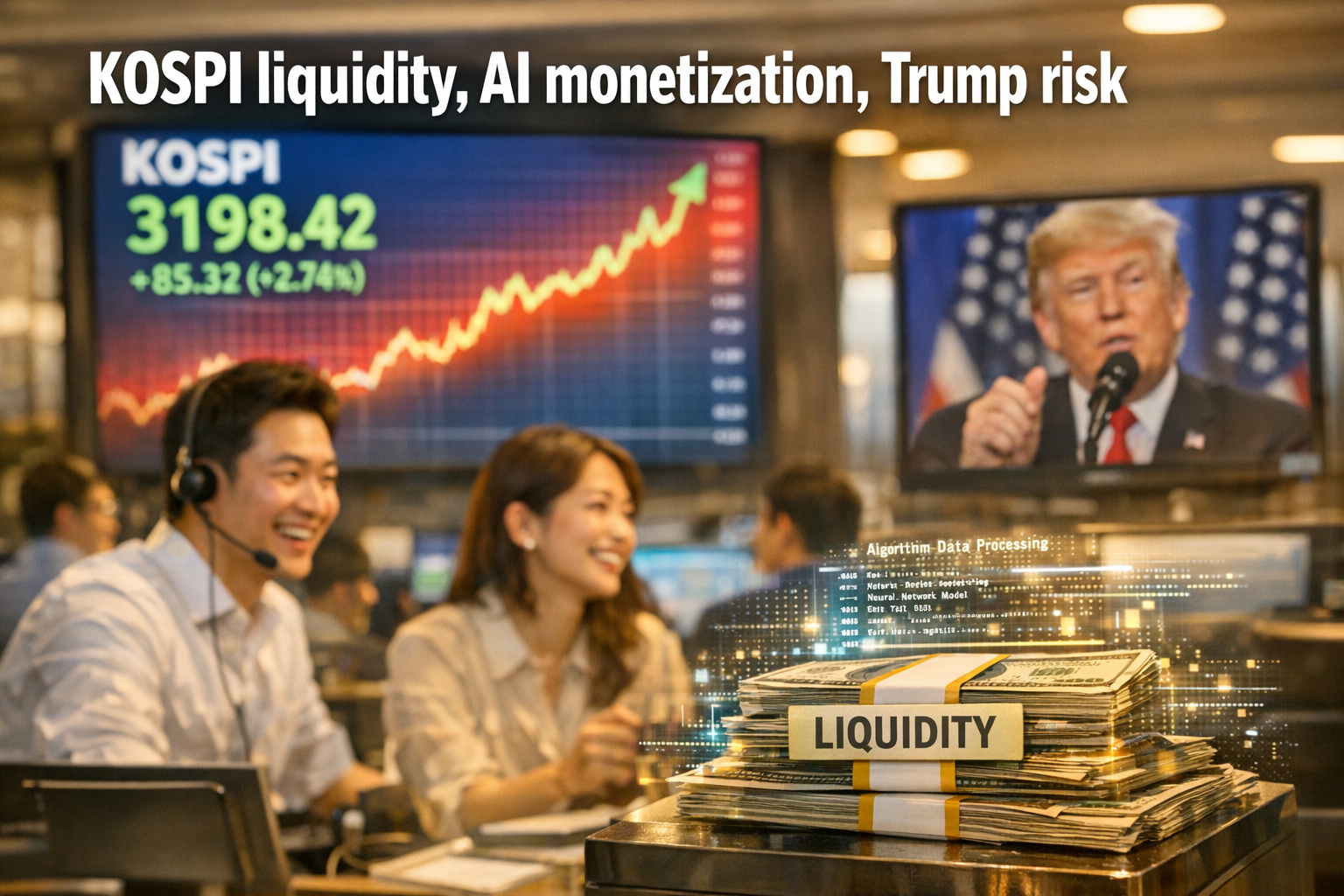
The Claim That “2026 Forecasts Are Meaningless” Misses the Actual Point: A Structured Read on the KOSPI Liquidity/Policy Rally, AI Monetization, Trump Risk, KRW FX, and KOSDAQ Credibility
The central issue is not whether the KOSPI rises further, but identifying the structural drivers currently moving the market.
- The nature of the current “policy + liquidity” regime: ETF inflows (fuel) plus value-up measures / commercial law reform (tailwind)
- Three reasons global capital is reassessing Korea: easing deglobalization pressure, persistence of the AI megatrend, and renewed semiconductor competitiveness
- The core of the AI bubble debate: not “collapse vs. no collapse,” but the transition from adoption to paid usage (durable payment rails)
- Primary risk: Trump’s unpredictable actions and the midterm-election cycle as potential volatility triggers
- Next potential catalysts for Korea: KRW strength (FX stability) and restoration of KOSDAQ trust via removal of unfair/low-quality issuers
1) Market Briefing: Korea Equities Are in a “Risk-On” Phase (Liquidity + Policy)
The discussion frames the current market as an upswing driven by the combination of liquidity and policy reform.
-
Fuel = ETF inflows
A key point is the inflow not only from domestic retail ETF reallocation but also from global foreign retail flows. Korea is described as shifting from a purely trading-oriented market perception toward a market attracting more durable allocation interest. -
Tailwind = value-up initiatives, commercial law reform, and related measures
Policy is treated as a catalyst for valuation re-rating. Liquidity alone can be transient; policy support increases the perceived durability of the move.
This matters because the conditions to compress the “Korea discount” are viewed as aligning simultaneously.
2) Three Reasons Global Capital Is Reassessing Korea (Core Takeaways)
The discussion outlines three drivers behind renewed attention to Korea:
1) Easing intensity of deglobalization pressure
Since 2018, Korea has been viewed as disproportionately exposed to fragmentation risks due to its deep integration with global trade. The argument is that such pressures are not constant in intensity, and recent rhetoric is less dominant in driving markets than before.
2) Persistence of the AI megatrend
AI is treated as a structural direction rather than a short-lived theme. Capital concentration is attributed to limited country-level exposure to the AI value chain (e.g., the US, China, Korea, Japan, the Netherlands).
3) Renewed semiconductor competitiveness (especially memory)
As AI infrastructure scales, memory and supply-chain positioning regain prominence versus early-stage focus on models and algorithms. The argument is that if peers with less competitive positioning are re-rated, Korea’s leading memory players become difficult for global investors to ignore.
3) The AI “Bubble” Debate: The Real Gate Is Adoption -> Monetization (Payment Rails)
The discussion deprioritizes the binary “bubble vs. no bubble” framing. The key checkpoint is whether paid usage becomes structurally embedded.
- Free consumer experimentation can reflect enthusiasm rather than fundamentals.
- Enterprise integration with ongoing paid usage is the basis for durable fundamentals.
The stance presented is that valuation volatility is plausible, but a full structural collapse is less likely if adoption, payment, and productivity benefits continue to accumulate.
4) Why “2026 Forecasts Are Meaningless”: Methodology Over Point Estimates
The approach is not anti-forecasting; it treats forecasts as decision tools rather than “single-answer” predictions.
- Define multiple scenarios
- Assign probability weights
- Derive a reasonable expected value for positioning
An example referenced is using a scenario range (e.g., 6,000 to 7,000) and applying weighted averages to reach an approximate central estimate (e.g., ~6,600) as a framework for assessment rather than certainty.
5) Primary Risk: Trump’s Unpredictability + Midterm Elections as Volatility Triggers
The risk message is explicit: the top downside trigger is “Trump risk.”
- Trump is characterized as a figure likely to pursue rapid, attention-driven reversals based on incoming data.
- The midterm-election cycle may incentivize dramatic actions, hawkish statements, or unexpected moves that amplify volatility.
- The emphasis is on guarding against non-linear shocks rather than only baseline scenarios.
The discussion notes that this is not purely a US issue: global flow rotation (US to ex-US) is described as already in motion. Korea may benefit in risk-on phases but is also vulnerable to synchronized drawdowns during shocks.
6) Two Additional Potential Drivers: KRW FX Stability + KOSDAQ Credibility Restoration
Later segments emphasize practical catalysts centered on stability and trust.
1) KRW strength / FX stability
A stable KRW can strengthen the case for foreign and institutional investors to increase Korea exposure. Growth narratives (AI/semiconductors) are less effective if FX volatility shortens investor holding periods. FX stability is framed as increasing “time-in-market” for international capital.
2) KOSDAQ credibility restoration (removal of unfair/low-quality activity)
The argument is that before discussing index targets, KOSDAQ requires cleanup of unfair trading, manipulation, and structurally low-quality listings (including micro-priced “penny” equities) to lift average market quality.
This is positioned as important for retaining domestic capital within a growth ecosystem for AI software, robotics, physical AI, and secondary value-chain beneficiaries. If KOSPI outperforms while KOSDAQ remains distrusted, capital formation for innovative firms weakens and the growth narrative becomes less investable.
7) Most Underemphasized Point: Shifts in the Unit of Value and Payment Architecture
Beneath the surface topics (KOSPI, AI, Trump), the discussion implies a deeper shift in monetary and value-measurement frameworks.
-
A view that “money is not scarce”
Under fiat and credit expansion, growing money/credit aggregates can drive asset prices alongside fundamentals, increasing sensitivity to monetary structure changes. -
AI-era unit economics may center on “tokens”
The “token” concept is framed as a usage-based billing unit that can become central to value measurement as AI embeds into workflows. The key is not speculative narratives, but the redesign of economic charging mechanisms via usage-based pricing. -
Therefore, AI’s critical test remains monetization
Markets may ultimately anchor on “cost per token vs. value per token (ROI).” If enterprise adoption expands and payment rails stabilize, AI may be re-rated as standard infrastructure rather than a transient bubble.
< Summary >
- Korea equities are in a “liquidity + policy” regime: ETF inflows (fuel) combined with value-up measures and commercial law reform (tailwind).
- Global capital is reassessing Korea due to easing deglobalization pressure, persistence of the AI megatrend, and renewed memory-semiconductor competitiveness.
- For AI, the central issue is not “bubble vs. no bubble,” but the transition from adoption to durable paid usage; volatility is possible, but a complete collapse is viewed as less likely under continued monetization and productivity capture.
- The primary risk is Trump-driven unpredictability and midterm-election dynamics; scenario-based probability weighting is emphasized over point forecasts.
- Additional potential catalysts include KRW FX stability and KOSDAQ credibility restoration through cleanup of unfair trading and structurally low-quality listings.
[Related Articles…]
- https://NextGenInsight.net?s=AI
- https://NextGenInsight.net?s=FX
*Source: [ 경제 읽어주는 남자(김광석TV) ]
– [풀버전] 2026 전망 의미없다. “트럼프의 행동에 시장 흔들릴 것” | 경읽남과 토론합시다 | 오종태 대표
● Hormuz Tanker Strike Sparks Oil Stocks FX Shock
Tanker Strike Near the Strait of Hormuz: Five Key Points That Could Move Oil, Equities, and FX Simultaneously on Monday
This development is not limited to a modest oil-price increase.
① The Strait of Hormuz risk has escalated from rhetoric to a confirmed kinetic incident (strike).
② The IRGC appears positioned to pursue a protracted, attritional approach that benefits from time.
③ A sharp rise in oil prices can influence US policy expectations, interest-rate pricing, and growth assessments.
④ Monday trading could trigger sequential sector reactions from oil to defense, shipping, refining, and airlines.
⑤ A frequently overlooked variable is Oman-related signaling, which may represent a genuine inflection point.
1) Incident Summary (Briefing): What a “Tanker Strike Near the Strait of Hormuz” Signals
Key point: A tanker attack near the Strait of Hormuz shifts geopolitical risk from elevated tensions to actionable disruption.
– The Strait of Hormuz is a critical chokepoint for global seaborne oil and gas flows.
A single strike can be quickly priced through higher insurance premiums, higher freight rates, and perceived supply-disruption risk.
– This event increases the probability that partial or full chokepoint disruption returns to the market’s core scenario set.
– WTI has already reacted, and Monday volatility may extend beyond crude futures to the broader energy, defense, transport, and chemicals value chain.
2) Why Oman Matters: Pressure on a Mediator Alters the Signal
A key variable is Oman’s role as a mediator in US-Iran communications.
Strikes or warnings affecting areas associated with Oman (e.g., port infrastructure) carry different implications than direct bilateral signaling.
– In many escalatory frameworks, actors target principal adversaries directly.
Pressure on a mediator or buffer state can be interpreted as reducing the scope for neutral channels and de-escalation.
– If diplomatic off-ramps weaken, markets typically maintain risk premia for longer durations.
This increases the likelihood of persistence at elevated oil-price levels rather than a short-lived spike.
3) IRGC Perspective: Not a Structure That Necessarily Stops With Leadership Decapitation
A central point is that Iran’s operational structure may not halt solely due to leadership targeting.
– The IRGC is widely assessed to function as both a military organization and a key economic actor with influence over funding, logistics, and procurement networks.
– As a result, “short-duration strike then resolution” scenarios may be less effective than assumed.
– A prolonged cycle can raise political and economic costs for the US and its partners, particularly through sustained energy-price pressure.
Market implication:
The risk shifts from a short-term event premium to a potential longer-duration risk premium.
4) Monday Market Checklist: Typical Transmission When Oil, Equities, and FX Move Together
This event links multiple macro-sensitive variables, including inflation expectations, interest-rate pricing, FX positioning, and recession risk.
① Crude (Brent/WTI) and volatility
– Initial impulse: perceived supply risk plus higher shipping/insurance costs → upward pressure on prices.
– Key focus: duration of elevated pricing may matter more than the first-day magnitude.
② Indirect impact on US rates and policy expectations
– Higher oil prices can re-accelerate inflation concerns.
– Markets may reprice toward delayed rate cuts or prolonged restrictive policy.
– This can weigh on duration-sensitive growth and technology valuations.
③ USD strength and pressure on KRW (FX)
– Geopolitical stress typically increases demand for USD liquidity and safety.
– Energy-import-dependent economies may face additional FX pressure via the terms-of-trade channel.
④ Equity sector rotation
– Potential beneficiaries: energy (refining/upstream), defense, selective shipping/logistics (freight-rate sensitivity), commodity-linked exposures.
– Potential laggards: airlines/travel (fuel costs), chemicals/manufacturing (margin pressure), high-multiple growth (rate sensitivity).
⑤ Interpreting “oil up while equities hold”
This configuration can reflect either:
– a market view that disruption will be short-lived and risk premia should be capped, or
– delayed equity repricing that may occur during Monday cash-session liquidity.
5) Oil Price Scenarios: 90–100 vs. 120+ and the Differentiating Conditions
The critical variable is not the targets themselves but the conditions that produce them.
Scenario A: 90–100 (higher but manageable)
– The strait is not fully closed and disruption remains intermittent.
– Maritime security measures sustain baseline throughput.
– Markets adapt quickly and reduce the duration of the risk premium.
Scenario B: 120+ (shock regime)
– Repeated strikes, sharply higher insurance costs, and broader rerouting convert risk into a physical bottleneck.
– Mediated negotiation channels weaken and credible de-escalation signals fade (hence the Oman variable).
– Retaliation cycles harden escalation expectations.
6) Investor Implementation: Volatility Management Into Monday
Operational priority: define buy/sell conditions before the open to reduce exposure to headline-driven volatility.
– Geopolitical outcomes are difficult to forecast; risk management and drawdown control are primary.
– Momentum chasing after sharp spikes increases adverse selection risk.
– “Buy-the-dip” heuristics can be unreliable under event-driven tail risk.
A simplified conditional framework:
– If oil breaks above a key level and holds: reassess inflation and rate risk; consider reducing rate-sensitive growth exposure.
– If oil spikes and quickly retraces: consider a short-term overshoot; implement staged positioning rather than all-at-once execution.
7) Key Items Often Underemphasized
1) The primary risk may be quasi-blockade effects rather than formal closure
Even without an official blockade, repeated incidents can raise insurance and freight costs, slow logistics, and reduce effective capacity.
This can sustain prices longer than headlines suggest.
2) Oman-related signaling may narrow diplomatic off-ramps
Pressure on intermediaries can weaken negotiation channels and extend uncertainty, which markets typically price adversely.
3) For the US, consumer inflation effects may be more consequential than battlefield outcomes
Higher oil prices transmit into household costs and political constraints, increasing the incentive to prioritize price stability in energy markets.
4) Equity resilience is not necessarily a “safe” signal
If weekend or thin liquidity limits repricing, risk can be reflected later in Monday’s regular session.
5) This can shift the macro regime, not merely create a short-term theme
If elevated oil prices persist, inflation, rates, FX, and growth concerns can re-emerge simultaneously, requiring reassessment of portfolio baseline assumptions.
< Summary >
A tanker strike near the Strait of Hormuz indicates escalation from elevated tensions to realized disruption risk.
If Oman-related signaling reduces diplomatic exit options, oil may remain elevated rather than mean-revert quickly.
Sustained oil strength can reprice inflation and rate expectations, reinforce USD strength, increase FX pressure on importers, and drive sector rotation, raising the probability of elevated Monday volatility.
A condition-based approach anchored to whether oil breaks and holds key levels may improve risk control versus discretionary forecasting.
[Related]
- Strait of Hormuz Risk and Global Oil Outlook
- How Oil Price Increases Affect Inflation, Rates, and Equities
*Source: [ Jun’s economy lab ]
– 호르무즈해협 유조선이 피격됐습니다, 유가는 괜찮을까?
● Iran Regime Collapse Fear, US Airpower Surge, Mexico Cartel War 2 0 Shockwaves
Iran “Regime Collapse” Narrative to US–Mexico “War on Drugs 2.0”: Three Pressure Points Now Simultaneously Shaking Global Macro and Security
This note consolidates three issues:
1) Why Iran is being discussed in scenarios extending from “air strikes → no-fly zone → regime change.”
2) What the US approach of concentrating global airpower signals to markets.
3) How the Mexico cartel issue links to supply chains, inflation, and risk premia rather than remaining a narrow public-safety topic.
1) News Briefing: Reframed into a News-Style Core Summary
1-1. US–Mexico: “Eliminating kingpins accelerates cartel militarization”
The central point is that the US “War on Drugs,” ongoing since the Reagan era, has coincided with Mexican cartels evolving beyond criminal networks into quasi-military organizations.
Messaging such as “the people are not the enemy; the government is” indicates attempts at de facto local governance through information operations and coercive control.
If domestic US politics incentivize stronger rhetoric (including the possibility of military involvement), Mexico-related risk could be elevated from crime to a border-security and military-option issue.
1-2. Middle East: “Largest airpower concentration since Iraq—Iran strike risk”
The emphasis is on US forces being redeployed by drawing air assets from multiple theaters toward the Middle East.
References to specific mission platforms (e.g., F-16s from Misawa Air Base in Japan) suggest posture consistent with operational preparedness rather than routine rotation.
For markets, airpower-centric concentration tends to translate quickly into perceived energy and logistics risk (straits, sea lanes, insurance costs).
1-3. Iran Domestic: “Economic stress and renewed unrest; post-strike objectives could expand to no-fly zone and regime change”
The framework assumes domestic economic strain and the potential for large-scale instability if strikes occur.
The key market variable is less the strike itself than the extent to which post-strike political objectives broaden.
A no-fly zone typically implies effective degradation of air and air-defense capabilities and can serve as a platform for sustained intervention; at that point, markets tend to price a medium-term regime risk rather than a short-lived event.
2) Analytical Reinterpretation: How These Issues Transmit into the Economy
2-1. Core linkage: Channels through which security shocks enter financial markets
Geopolitical risk typically propagates through three steps:
(1) Commodity volatility (especially energy)
(2) Higher logistics and insurance costs → margin pressure
(3) Risk-off dynamics → stronger USD / weaker EM assets → tighter financial conditions
Once active, these channels influence central-bank policy transmission (rates, liquidity, inflation expectations).
2-2. Why “airpower concentration” is a higher-sensitivity market signal
Markets often respond more sharply to movements in air, missile, and air-defense assets than to ground deployments.
Airpower deployment signals compressed timelines for kinetic action, making negotiation and deterrence phases more prone to rapid regime shifts.
Consequently, rates, oil, shipping, and defense equities may reprice faster.
2-3. How Mexico cartel risk becomes a supply-chain risk premium
Mexico is a major node in the North American manufacturing supply chain.
As security conditions deteriorate or military-intervention debate intensifies, the first-order effect is often rising transport-route risk, insurance, and security spending rather than immediate production shutdowns.
Accumulated cost pressure tends to be passed through to prices, limiting disinflation and embedding a persistent risk premium into global supply chains.
3) Investor and Policy Checklist: Indicators to Monitor
3-1. Energy: Focus on risk premium, not spot price alone
Middle East tension can lift oil prices; more important is the magnitude of the uncertainty premium.
Signals include strait/sea-lane headlines, tanker insurance rates, and evidence of route diversions.
If inflation expectations destabilize, rate expectations can reprice in tandem.
3-2. Financial markets: USD trends and emerging-market spreads
Rising geopolitical stress typically strengthens safe-haven demand, supporting the USD and widening EM credit spreads.
This should be read as tightening global financial conditions, not only as an FX story.
3-3. Industry: Defense, cyber, and AI converge
Modern conflict is increasingly data-centric across ISR-to-strike-to-defense, with drones, satellites, communications, and electronic warfare as critical enablers.
Accordingly, demand can extend beyond defense procurement into cybersecurity and AI infrastructure for analysis, surveillance, warning, and decision support.
This dynamic may represent a sustained “national-security digital transformation” rather than a short-lived theme.
4) AI Trend Implications
4-1. Defense AI: Shifting from model performance to system integration
In defense and security, the differentiator is increasingly the operational pipeline rather than a single high-performing model:
Sensor ingestion → real-time analytics → command-and-control (C2) → integration with weapons systems
As air deployments intensify, government demand for real-time decision support (alerts, target identification, risk forecasting) tends to rise.
4-2. Supply-chain risk AI becomes a required cost
Simultaneous Mexico security stress and Middle East risk shift corporate priorities from lowest-cost sourcing to continuity of supply.
AI use cases increasingly emphasize:
Risk scoring (region/route/counterparty) / alternative sourcing recommendations / inventory optimization
5) Underappreciated Core Point
5-1. “Even with an agreement, it may not hold”: Objective may be endurance depletion, not behavior change
The implication is that the primary objective may not be a discrete diplomatic outcome, but a prolonged campaign combining sanctions, military pressure, and information operations to erode state capacity.
If this frame applies, markets may face elevated volatility in the Middle East, commodities, and rates for an extended period rather than a single shock.
5-2. Air deployments often function more as negotiating leverage than as a trigger for war
Force movements are frequently designed to maximize leverage rather than to initiate conflict.
However, higher leverage games also raise miscalculation risk, a key driver of volatility.
5-3. Mexico is a structural cost variable for North America (wages + logistics + insurance), not only a security headline
As cartels become more militarized, firms may consider footprint diversification, but relocation is slow.
In the near term, security, insurance, and logistics costs tend to be absorbed into operating expenses, reinforcing inflation persistence.
6) SEO-Relevant Macro Keywords Embedded in the Narrative (5)
Interest rates, exchange rates, inflation, oil, supply chain.
< Summary >
- The US–Mexico anti-drug campaign can increase cartel militarization, elevating a public-safety issue into supply-chain cost pressure and inflation pass-through.
- US airpower concentration in the Middle East is a market-relevant signal that can expand energy and logistics risk premia.
- Iran-related scenarios may extend from strikes to no-fly-zone discussion and broader regime risk, shifting market pricing from event risk to medium-term uncertainty.
- The critical variable is not the presence or absence of an agreement, but the possibility of a prolonged pressure framework that sustains elevated volatility.
[Related Posts…]
- https://NextGenInsight.net?s=Iran
- https://NextGenInsight.net?s=Supply%20Chain
*Source: [ 달란트투자 ]
– 하메네이 정권 완전 붕괴. 발칵 뒤집힌 이란 초비상 사태| 김대영 군사평론가 2부