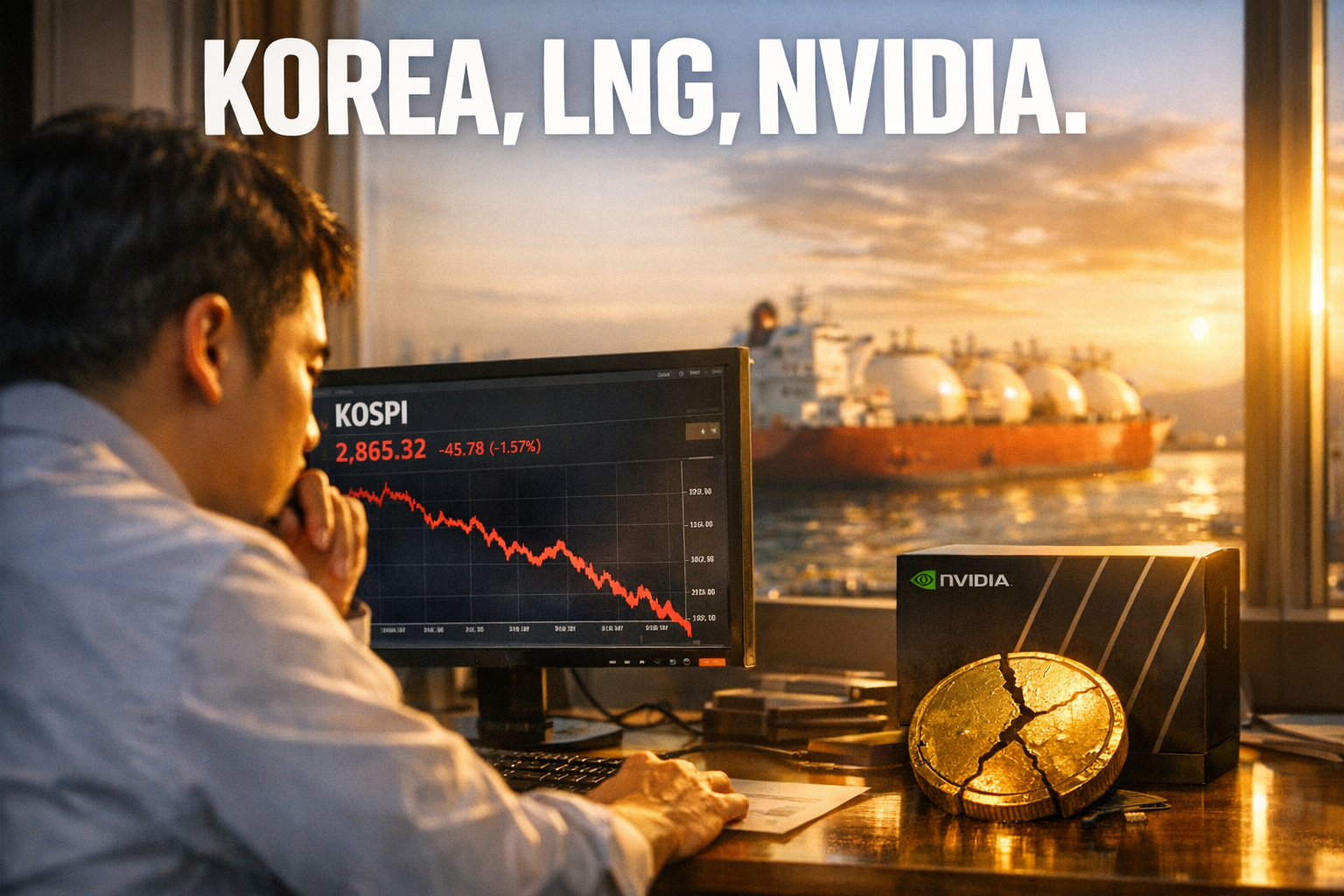
● Korea Stocks Crushed, LNG Shock Looms, Nvidia Optics Bet Ignites AI Boom
Why Korean Equities Are Under Disproportionate Pressure: What Markets Are Actually Pricing In (Nasdaq, EWY, Oil, LNG, Nvidia and Optical Interconnects)
This report covers:
Why US equities remain comparatively resilient despite war-related headlines.
The structural sources of downside pressure implied by EWY and their relevance to the Kospi.
How Hormuz-related risk can transmit more forcefully through LNG, electricity pricing, and industrial input costs than through crude oil alone.
Why Nvidia’s direct equity investments in optical components are a key signal within the AI capex cycle.
1) Global Equities: Why “War = Broad Risk-Off” Is Not the Base Case
– 1-1. Why the US (Nasdaq, S&P 500) Is Holding Up
Futures initially sold off, but the Nasdaq turned positive during regular trading.
Market pricing suggests a base case closer to “low probability of a prolonged conflict.”
A key differentiator is US energy self-sufficiency.
Relative to Europe and Asia, the US is less exposed to energy-price pass-through that could re-accelerate inflation.
This supports higher shock-absorption capacity for US risk assets during geopolitical events.
– 1-2. Why Europe Reacts More Negatively
Equity declines of approximately 1–2% in markets such as Germany and the UK reflect higher energy dependence.
Europe’s natural gas/LNG procurement structure is more sensitive, making Middle East supply disruptions translate more directly into a cost shock.
The transmission channel from energy supply to inflation to rates is more immediate than in the US.
– 1-3. What Gold, Oil, and Bitcoin Indicate About Risk Sentiment
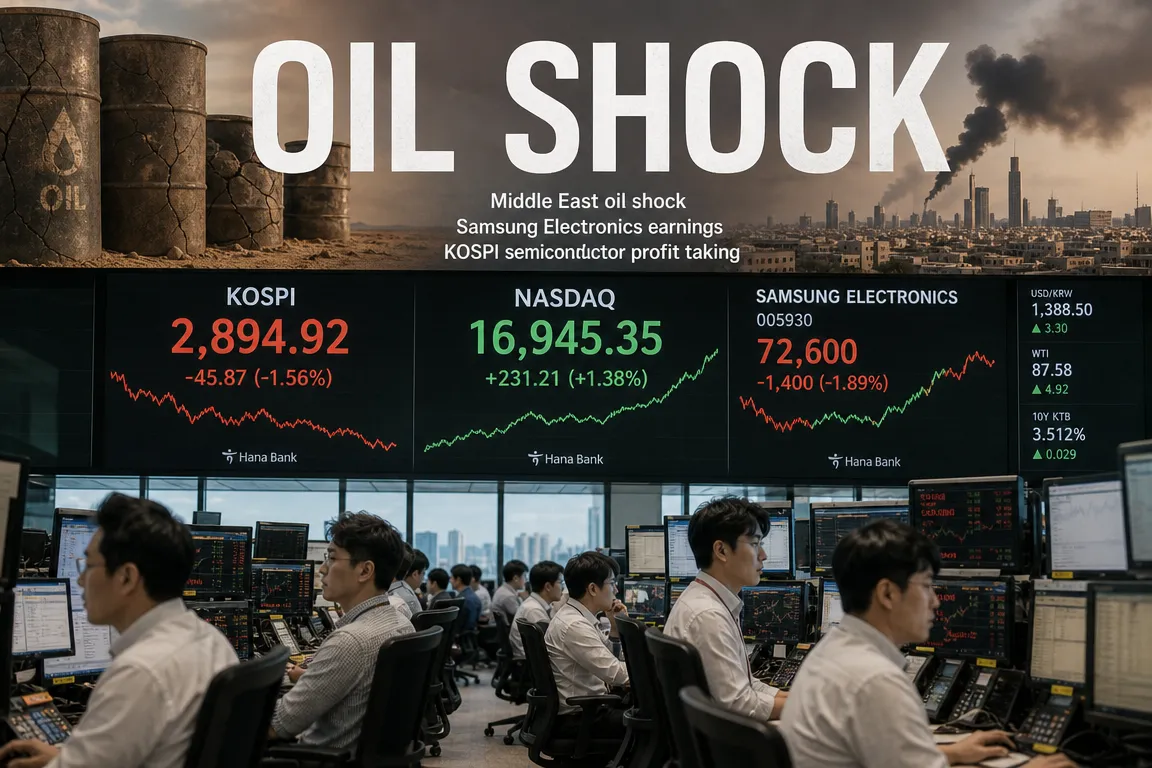
Brent oil surged (mid-single digits) but with moderating momentum, implying markets assign a lower probability to worst-case outcomes.
Gold rising only around 1% is inconsistent with a full-scale panic regime.
Bitcoin gaining roughly 5% reflects relatively risk-on positioning and an event-driven adjustment rather than broad capitulation.
2) Why Korea Is Weaker: Three Structural Vulnerabilities Highlighted by EWY
– 2-1. Higher Exposure to Middle East Energy
An EWY decline in the low-to-mid single digits implies comparable gap-down pressure for the Kospi, conditional on FX assumptions.
Korea’s import structure retains significant dependence on Middle Eastern crude and LNG; any disruption, plus higher freight and insurance costs, feeds quickly into corporate input costs.
The more direct channel may be industrial electricity and gas pricing rather than spot crude alone.
Korea’s manufacturing-heavy index composition increases sensitivity to energy-cost inflation.
– 2-2. China as a Major Buyer of Iranian Crude and a Partial Buffer
Given China’s role as a major buyer of Iranian exports, its procurement shock may be smaller than Korea’s in certain scenarios.
China can also damp near-term volatility via policy tools and market management (including FX), which may be perceived as a short-term stabilizer by global investors.
– 2-3. Foreign Investor Lens: Korea = “Geopolitical Premium + Export Cyclicality”
During periods of heightened geopolitical risk, foreign investors typically apply an incremental risk premium, compressing valuations.
Korea carries an idiosyncratic security overhang and a high export share, making it more sensitive to trade slowdowns and logistics disruption.
As a result, markets can price Korea as a combined exposure: energy importer risk, trade cyclicality, and geopolitical premium.
3) The Core Transmission Risk May Be LNG Supply-Chain Bottlenecks More Than Crude Oil
– 3-1. Hormuz: Even Without a Full Blockade, Risk Premiums Can Be Economically Material
A full closure may be unlikely, but missile/drone threats can still force vessel avoidance and sharply reduce volumes.
A reported drop in ship counts from 56 to 7 underscores the operational sensitivity.
Even absent a blockade, higher insurance, freight, and rerouting costs raise real-economy expenses.
This can lift global supply-chain costs and revive inflation concerns.
– 3-2. Qatar LNG Production Halt: More Direct Transmission to Korea
Following damage to facilities, Qatar reportedly declared a full halt in LNG and related product output.
Ras Laffan represents roughly 20% of global LNG supply.
Crude can be partially buffered via strategic releases, alternative supply, and rerouting; LNG is materially harder to replace quickly due to capacity and infrastructure constraints.
This asymmetry can drive outsized moves in European gas prices (e.g., ~40%).
If Korea has meaningful Qatar LNG import exposure, domestic electricity and gas cost expectations can rise, pressuring earnings expectations and equities.
– 3-3. Saudi Refining Infrastructure: Tail-Risk to Oil Upside
Reports of drone attack attempts and precautionary shutdowns near major Saudi refining assets increase perceived disruption probability over time.
Even without a spike, repeated incidents can create a “sticky” price floor, limiting oil’s downside and sustaining higher input-cost expectations.
4) Street Scenarios: Duration Is the Dominant Variable for Oil and Gas Pricing
– 4-1. Goldman Framework (As Cited)
A one-month disruption to Hormuz transit could double European gas prices under certain assumptions.
For crude, a full disruption scenario is associated with approximately +$15/bbl, while a case incorporating releases/alternatives suggests roughly +$10/bbl.
Market pricing appears anchored to a short-duration scenario (e.g., resolution within about one month).
If duration extends, the framing can shift from pure price shock to a combined growth downgrade and inflation upgrade (stagflation risk).
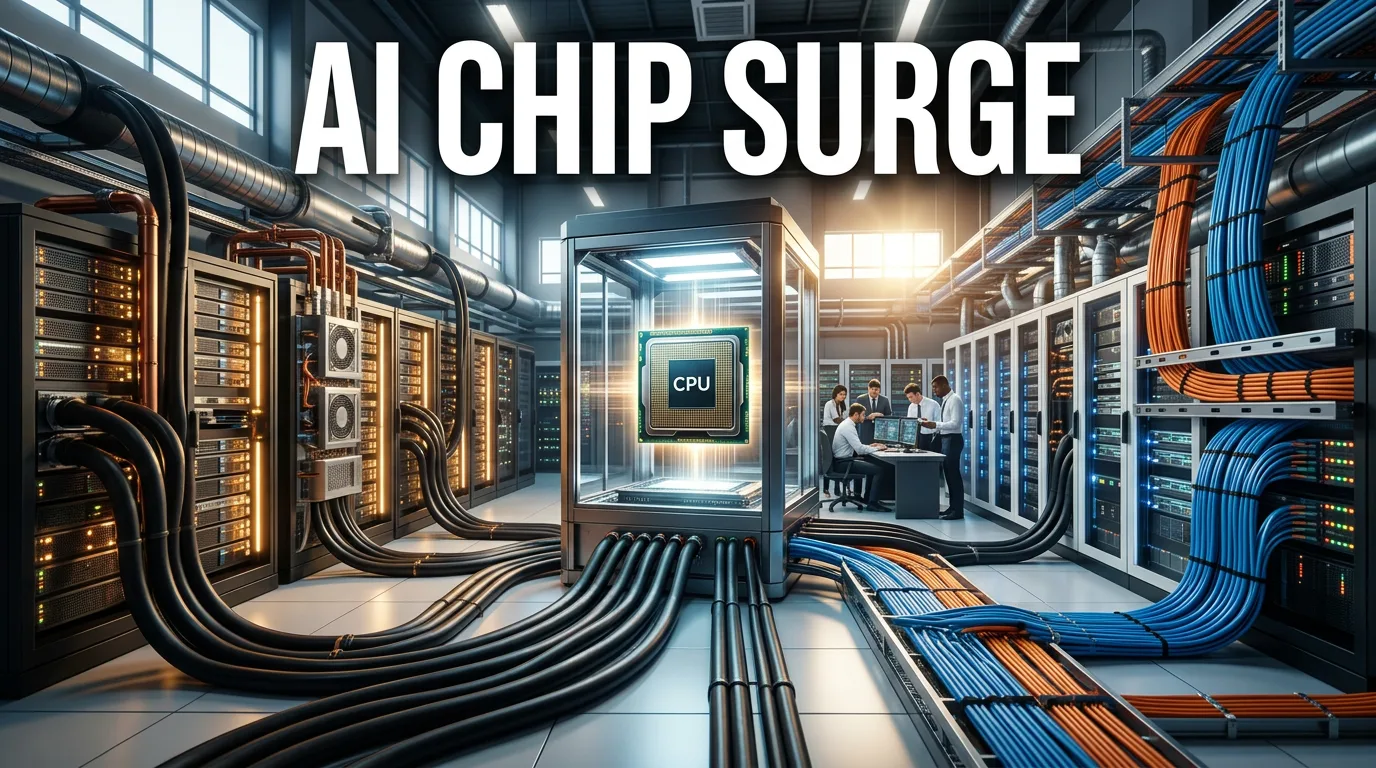
5) AI Trend: Why Nvidia’s Direct Move Into Optical Matters
– 5-1. Equity Stakes: Lumentum and Coherent as the “Circulatory System” of AI Data Centers
Nvidia taking equity stakes in Lumentum and Coherent is strategically notable.
AI performance is increasingly determined not only by GPU capability but by the speed and scale of GPU-to-GPU interconnection.
As server-to-server and rack-to-rack connectivity increases, copper-based links face distance and bandwidth constraints.
Optical interconnect becomes critical infrastructure; Nvidia’s investment indicates an effort to secure and de-risk a key bottleneck in the supply chain.
This supports the interpretation that AI data-center investment is not purely episodic and is expanding into infrastructure layers.
– 5-2. Morgan Stanley’s Reinstatement of Nvidia as a Top Pick: Implications
Two core points were emphasized:
(1) Underperformance is more consistent with sentiment/positioning dynamics than with fundamental deterioration.
(2) AI demand remains strong, with indications of extended lead-times and forward ordering across memory and broader supply chains.
This suggests that concerns about a near-term peak in demand may diverge from procurement behavior that secures multi-year capacity.
If sustained, the AI capex cycle may lengthen and broaden toward infrastructure-centric spending.
– 5-3. March GTC: The Next Market Checkpoint
GTC typically provides updates on roadmaps, products, and ecosystem expansion, increasing both expectations and volatility.
Given recent optical-related moves, messaging may shift emphasis from GPUs alone toward networking, optical connectivity, and rack-scale architectures.
6) Key Points Potentially Under-Discussed in Mainstream Coverage (Analytical Summary)
– 6-1. The Primary Shock Vector May Be LNG’s Limited Near-Term Substitutability, Not Crude
Crude oil can be partially cushioned via policy tools, strategic reserves, incremental production, and routing flexibility.
LNG has a longer chain (production, liquefaction, shipping, regasification) with multiple bottlenecks, limiting rapid supply response.
For Korea, volatility in LNG and electricity pricing can more directly pressure manufacturing margins and earnings estimates.
– 6-2. EWY Weakness Reflects a Composite Risk Premium Rather Than Pure Fear
Korea can be repriced quickly when multiple sensitivities align: geopolitical premium, energy-import exposure, and export cyclicality.
This structure can lead to front-loaded and occasionally disproportionate drawdowns during global shocks.
– 6-3. Nvidia’s Optical Investments Indicate AI Has Entered a Physical Infrastructure Phase
Scaling AI requires building data centers that function as a single, tightly connected compute fabric; networking becomes a binding constraint.
Direct equity investment signals internal prioritization of optical bottlenecks as a determinant of next-cycle performance and capacity.
This supports an AI cycle that extends beyond software into global hardware supply chains spanning components, materials, and equipment.
7) Practical Monitoring Checklist
Whether European natural gas pricing and LNG spot indicators become more sensitive leading indicators than WTI/Brent.
Whether the key risk manifests as sustained ship avoidance and higher insurance premiums rather than an explicit closure of Hormuz.
Whether USD/KRW amplifies EWY-linked downside via foreign flows.
How frequently Nvidia emphasizes “networking,” “optical,” and “rack-scale” themes at GTC.
Within semiconductors, monitor not only GPUs but also HBM memory, optical interconnects, and power/cooling infrastructure.
< Summary >
US equities appear supported by energy self-sufficiency and market pricing for a low probability of prolonged conflict.
Europe remains more exposed due to energy dependence and a faster transmission path into gas prices, inflation, and rates.
Korea faces compounded sensitivity from Middle East energy exposure, export cyclicality, and a persistent geopolitical risk premium, consistent with EWY-implied pressure.
Hormuz risk can be economically meaningful through risk premia (insurance, routing, logistics) even without a formal blockade.
Qatar LNG disruption risk may transmit more directly to Korea and Europe than crude oil via electricity and industrial cost channels.
Nvidia’s equity investments in optical suppliers reinforce that AI scaling is expanding from GPUs into data-center connectivity infrastructure.
[Related Articles…]
- How FX Volatility Impacts Kospi Flows and Practical Positioning Approaches
- Post-GTC AI Semiconductor Roadmap: After GPUs, the Next Constraint Is Networking
*Source: [ 내일은 투자왕 – 김단테 ]
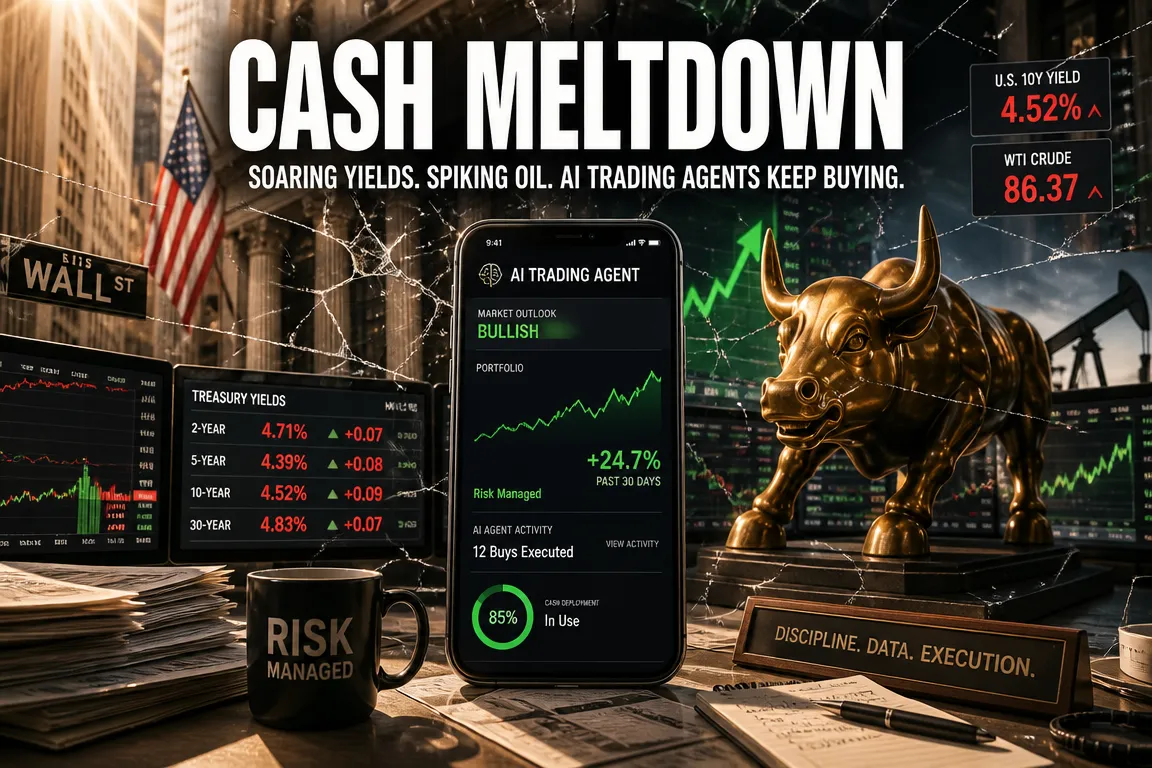
– 왜 국장만 더 힘든 것인가??● Middle East War Escalation Panic Oil Spike Dollar Surge Stocks Slide AI Defense Boom
If the Middle East War Signals Escalation: A Consolidated View of Crude Oil, USD/KRW, Equities (and AI-Defense)
This note consolidates four items in a single, news-style framework:
1) How markets typically react—in sequence—when the conflict path diverges into escalation vs. short-term de-escalation
2) Why international crude oil prices can spike even without immediate supply disruption (and what OPEC+ output increases actually imply)
3) Why USD/KRW can become unstable again, and why a move toward 1,500 is possible but not a base case
4) Why equities are broadly pressured, while defense + AI may remain a relative exception
The final section addresses a frequently under-covered point: how war-driven fiscal regime shifts and accelerating military adoption of AI can reshape the investment landscape.
1) Situation Summary: Markets Price the Probability of Escalation More Than the Conflict Itself
The core issue is not whether the conflict is “good” or “bad,” but whether uncertainty resolves quickly (short-term de-escalation) or persists and intensifies (escalation).
Markets tend to reprice most aggressively when unpredictability rises. As escalation probability increases, risk markets typically shift toward risk-off positioning. This dynamic links global equity volatility, USD strength, and interest-rate expectations, and can reinforce concerns about global growth deceleration.
2) International Crude Oil: Why Prices Move Before Actual Supply Disruptions
In Middle East-related risk events, the first variable to monitor is oil.
A critical observation is that crude can rally sharply even without immediate physical supply disruption. Oil pricing reflects not only current supply-demand balances but also forward-looking risk premia.
This matters because:
- If no disruption materializes, the move can partially reverse as risk premia fade.
- If shipping lanes, logistics routes, or production facilities are affected, the market can shift from a risk premium to a physical supply shock.
2-1) OPEC+ Output Increases: A Downside Tool That Often Acts as a “Damper” During War Risk
OPEC+ signaling or implementing higher output is mechanically a bearish input for oil. In practice, during conflict risk regimes it is often interpreted differently:
- Many producers remain highly sensitive to oil-linked fiscal balances; fiscal pressures have increased for several countries.
- If prices are expected to rise, producers have incentives to sell more into strength to reinforce fiscal positions.
- As a result, incremental supply may function less as a price cap and more as a moderator of the pace of increases.
Higher oil can also revive inflation concerns, complicating expected monetary policy paths and driving volatility in rate expectations.
3) Risk Assets (Equities and Crypto): Broad Pressure With Select Sector Exceptions
Geopolitical conflict is generally not supportive for capital markets. As safe-haven demand strengthens, appetite for risk assets (equities/crypto) typically weakens, implying baseline near-term correction pressure.
3-1) The Key Exception Window: Defense + AI (Military AI, Drones, Missile Systems)
When warfare evolves toward drones, missile systems, and advanced weapon platforms, governments often move toward higher defense spending. Markets may reflect this via earlier valuation repricing in defense-related equities.
Separately, the use of commercial AI by defense agencies indicates a shift from “AI as consumer software” toward AI as national security infrastructure (intelligence, operations, decision support).
Companies positioned at the intersection of AI and defense procurement can show relative strength during heightened geopolitical risk. This is often driven by forward expectations of budget allocation and procurement rather than immediate contract expansion.
4) USD/KRW: The Dollar’s Safe-Haven Bid Reasserts Under Geopolitical Stress
The typical transmission channel is:
- Geopolitical risk rises
- Safe-haven demand increases
- Gold appreciation and potential USD strength (higher DXY)
- KRW depreciation pressure increases and USD/KRW volatility rises
While the USD may not be viewed as a “perfect” safe haven relative to gold, in acute stress episodes global capital often still rotates into USD liquidity.
4-1) USD/KRW 1,500: Possible, but Not a High-Probability Outcome
A move through 1,500 is theoretically possible, but not a base case. A key real-world constraint is official intervention.
In particular, an overshoot above the high-1,400s could trigger more forceful smoothing operations aimed at stabilizing market psychology. Under a stable macro backdrop, the USD/KRW path would be expected to normalize gradually; geopolitical shocks can, however, cause temporary sharp spikes.
5) News-Style Summary: Six Key Headlines
[Headline 1] The market reacts more to escalation probability than to the conflict itself.
[Headline 2] Oil gains are often driven first by risk premia rather than immediate supply disruption.
[Headline 3] OPEC+ output increases can temper the speed of oil upside rather than fully suppress it during war risk.
[Headline 4] Risk-off positioning pressures equities and crypto in the near term.
[Headline 5] Defense and military AI may show relative strength as budget expectations are priced in early.
[Headline 6] USD/KRW can re-enter an unstable regime; 1,500 is possible, but intervention is a key limiting variable.
6) Under-Covered but Material: Fiscal Regime Shifts and the Speed of Military AI Adoption
6-1) War as a Fiscal Regime Shift, Not a One-Off News Event
The more durable implication is not short-term sector rotation, but changes in national budget allocation.
Although defense budgets are typically set annually, escalation risk can accelerate spending through supplementary budgets, emergency procurement, and multi-year contracting. This can alter medium-term growth profiles for defense-adjacent industries such as defense platforms, cybersecurity, satellite/communications, and AI-driven intelligence analytics.
6-2) Military AI: The Bottleneck Is Not Model Quality but Data, Security, and Operational Integration
As generative AI enters defense/government workflows, the critical requirements extend beyond model capability:
- Air-gapped or restricted-network deployment and security accreditation
- Data governance for sensitive information handling
- Operational integration (command-and-control, decision support, real-time analytics)
Budget execution and procurement contracts tend to follow vendors that can deliver security, data infrastructure, and operating platforms, not only applications.
6-3) Oil Upside Can Pressure AI Growth Equities via Inflation, Rates, and Valuation
Conflict-driven oil increases can revive inflation expectations and delay rate normalization, which can pressure growth-equity valuations, including AI-related names. AI positioning in this regime requires monitoring macro variables (inflation, rates, FX) alongside technology narratives.
7) Actionable Checklist (Near-Term Market Monitoring)
- International crude: whether the move remains a risk premium or transitions into physical disruption
- Gold and USD co-strength: a practical gauge of safe-haven intensity
- USD/KRW: policy stance and the intensity of smoothing operations during spikes
- Equities: whether defense/cybersecurity/intelligence-analytics AI demonstrates relative strength amid index weakness
- Volatility: whether escalation probability remains elevated or fades as headlines stabilize
< Summary >
The key driver is escalation probability rather than the conflict itself. Rising escalation risk can lift crude through risk premia, strengthen safe-haven demand, and pressure equities and crypto. USD/KRW can become unstable under a stronger USD bid; a move toward 1,500 is possible but less likely given intervention constraints. Defense and military AI (analytics, operating systems, security) may remain relative beneficiaries as markets price higher defense budgets and faster adoption pathways.
[Related Links…]
- https://NextGenInsight.net?s=MWC
- https://NextGenInsight.net?s=USD-KRW
*Source: [ 경제 읽어주는 남자(김광석TV) ]
– [LIVE] 중동전쟁 확전… 환율과 주가는? (feat. 스페인 바르셀로나) [즉시분석]