● Meta Slumps Nvidia Cheaper Oil Shock Fed Risk
Morgan Stanley Cuts Meta Target, Nvidia Valuation at Cycle Lows, and the Key Global Macro Variables Investors Should Monitor
This development should not be viewed as isolated single-stock news. The full picture requires linking: (i) the rationale behind the Meta target cut, (ii) why Nvidia’s lowest P/E since 2019 can be interpreted as an opportunity signal for some investors, and (iii) the macro drivers currently influencing U.S. equities and the global economy—oil supply risk, Middle East geopolitics, inflation, rates, and U.S. dollar strength.
This report focuses on:
- The underlying drivers of the current correction in AI-linked growth equities
- Re-rating dynamics in semiconductors
- The transmission mechanism between energy prices and the U.S. economy
- Practical investor checkpoints that are often underemphasized in mainstream coverage
A separate section highlights key points that are frequently omitted in short-form news and video commentary.
1. Key Market Developments (Snapshot)
The market focus centers on three themes:
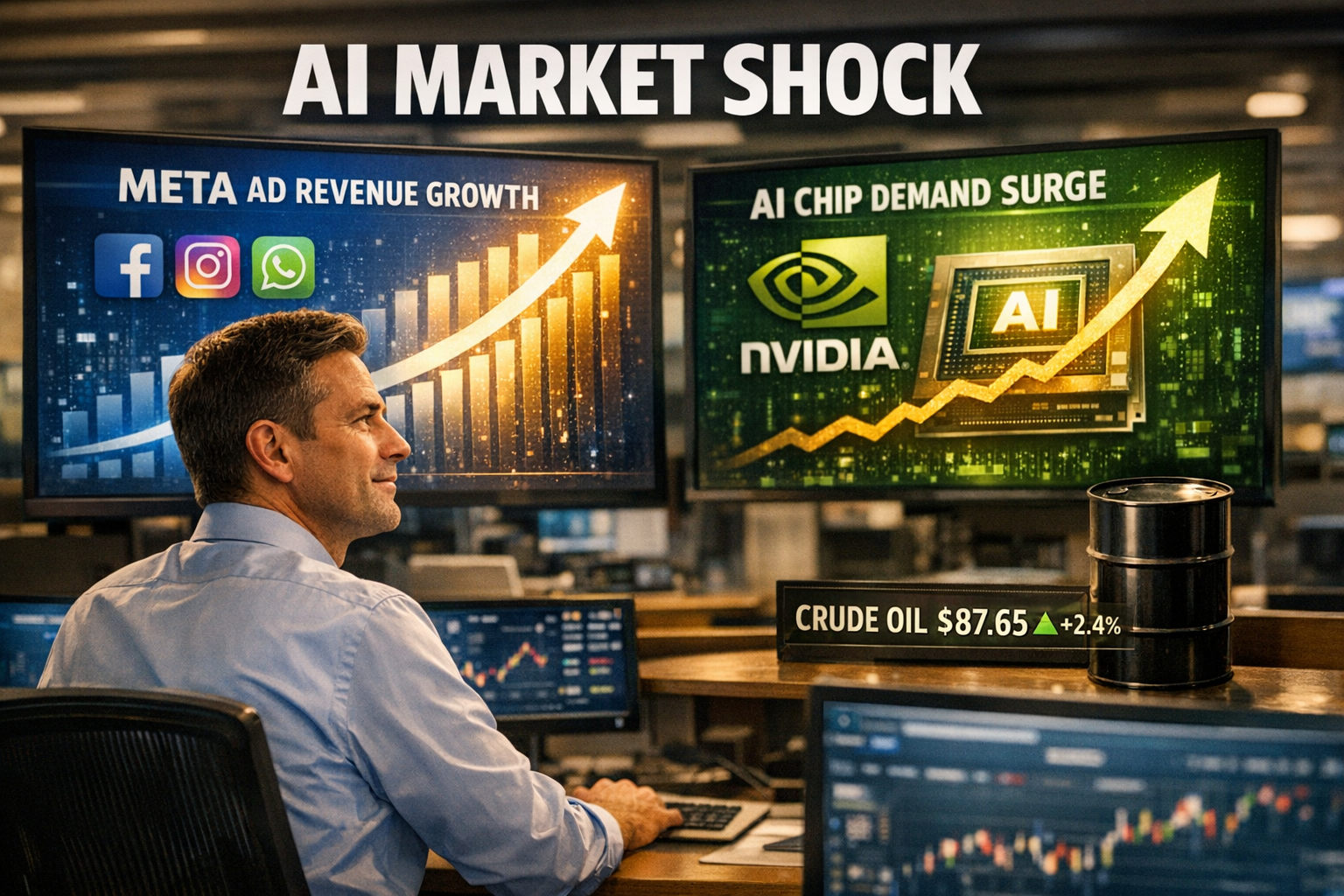
- Morgan Stanley lowered Meta’s target price to $775
- Nvidia’s P/E ratio fell to its lowest level since 2019
- Oil supply risk, Middle East geopolitical risk, and renewed upward pressure on energy prices have re-emerged as critical macro variables
While the headlines read as overlapping risk factors, the market appears to be repricing two items simultaneously:
- A reset in growth-equity expectations
- A reintroduction of macro risk premia into asset prices
2. Morgan Stanley: Implications of Lowering Meta’s Target to $775
2-1. The key issue is expectation resetting, not deterioration in the business model
Target price revisions often reflect reassessment of forward upside after substantial price appreciation, rather than sudden fundamental impairment.
Meta has benefited from:
- Advertising recovery
- Stronger AI-driven recommendation systems
- Cost discipline
- Increased engagement
- Expectations for generative AI monetization
The market is increasingly focused on how much of the positive narrative is already embedded in valuation.
2-2. Why Wall Street’s stance is shifting
Key drivers cited by the market:
- Advertising recovery expectations largely priced in
- Higher capital expenditures tied to AI investment
- Regulatory overhang and potential platform growth deceleration
- Rising valuation sensitivity across mega-cap technology
Aggressive AI infrastructure spending can strengthen long-term positioning, but can also pressure near-term margins and free cash flow.
Overall, the target reduction is best interpreted as a statement that even structurally advantaged AI-era platforms face constraints on multiple expansion.
2-3. Investor checkpoints
More relevant than the target number:
- Whether advertising revenue growth re-accelerates
- Timing and visibility of AI monetization
- Degree of loss containment at Reality Labs
- Evidence that higher capex translates into durable returns
- Interest-rate sensitivity of Meta’s valuation within the broader U.S. equity complex
3. Nvidia’s Lowest P/E Since 2019: Risk Signal or Opportunity
3-1. Lower multiples can reflect earnings acceleration, not only price weakness
A P/E trough is notable for Nvidia given its historical premium as the flagship AI semiconductor exposure. The multiple compression can be driven by earnings growth outpacing share-price gains.
3-2. Drivers behind the lower valuation multiple
- Material upward revisions to earnings estimates due to AI chip demand
- Continued data center revenue momentum
- Sustained AI infrastructure capex by hyperscalers
- High near-term substitutability barriers supporting market share
The P/E decline is not solely a function of price decline; it also reflects rapid earnings expansion.
3-3. Why investor concern persists
The market continues to focus on:
- Duration of the AI server investment cycle
- Risk of capex overshoot by large technology buyers
- Whether high U.S. rates constrain growth-equity premiums
- Export controls and geopolitical supply-chain risk
- Broader semiconductor profit-taking and sector-wide de-rating
Nvidia appears to be transitioning from “expensive due to narrative” to “fundamentally strong, but with uncertain terminal premium.”
3-4. Core interpretation
Nvidia’s P/E trough is less a simple undervaluation marker and more a sign that the AI trade is shifting from expectation-driven pricing to sustainability and earnings durability assessment.
4. The Macro Backdrop: Oil Supply, Middle East Risk, and Inflation
4-1. Why oil is regaining market sensitivity
Oil supply disruption risk and geopolitical escalation can lift energy prices, reinforce inflation risk, and delay expected Fed easing. This is a direct headwind for long-duration growth equities, including mega-cap technology.
4-2. Transmission mechanism
- Increased Middle East risk
- Higher probability of oil supply disruption
- Upward pressure on crude prices
- Renewed inflation concerns
- Reduced likelihood or delayed timing of rate cuts
- Higher valuation headwind for growth stocks
- Increased risk of Nasdaq-led drawdowns
Meta and Nvidia are therefore influenced not only by company fundamentals but also by oil and rates.
4-3. U.S. dollar strength must be monitored concurrently
Geopolitical risk and energy shocks can increase safe-haven demand, supporting a stronger dollar. Dollar strength affects:
- EM capital flows
- Commodity pricing
- Global liquidity conditions
- Earnings translation for U.S. firms with significant foreign revenue
In a slowing global environment, a firm dollar can reinforce risk aversion.
5. Highest-Value Macro Interpretation
5-1. The market is more concerned about “higher for longer” than recession
The primary market constraint is not necessarily a sharp recession, but persistent high inflation and elevated rates. This combination can:
- Gradually compress earnings expectations
- Reduce growth-stock premia
- Limit broad-based multiple expansion
5-2. The AI rally is transitioning into a second phase
The initial phase was expectation-led. The next phase is likely to be differentiated by:
- Measurable monetization outcomes
- Evidence of return on AI investment
- Cost control while maintaining growth
- Ability to manage regulation and supply-chain constraints
Dispersion within AI-linked equities may increase across semis, platforms, and cloud.
5-3. A strong U.S. economy can still be a valuation headwind
Resilient activity supports earnings, but can also slow disinflation and reinforce the case for prolonged tight policy—limiting equity upside via valuation channels.
6. Report Summary (News-Style Implications)
6-1. Meta: fundamentals intact; valuation increasingly expectation-driven
Advertising recovery and AI capability remain supportive, but the target cut suggests the market is reassessing how much upside remains after prior rerating. Monetization cadence and cost discipline are likely to gain importance.
6-2. Nvidia: headline “cheaper” valuation, but sustainability testing begins
The lower P/E can be constructive, but investors are prioritizing the durability of AI demand and the capacity of customers to maintain capex levels.
6-3. Macro: oil and rates may regain market leadership
Oil supply risk and Middle East geopolitics can reintroduce inflation risk, potentially tightening financial conditions and pressuring growth equities.
7. Underemphasized High-Impact Points
7-1. The central issue is the discount rate rising
The market focus on target prices and P/E levels can obscure a more important variable: the discount rate and risk premium applied to future earnings. If rates and oil risk rise, growth multiples can compress even with strong fundamentals.
7-2. AI capex is both a growth driver and a cost pressure
AI competitiveness requires substantial spending on:
- Data centers
- GPUs
- Power and networking
- Talent
Markets are likely to reward quantified monetization and capital efficiency over broad AI positioning statements.
7-3. Energy and AI are structurally linked
As AI scales, data center power demand increases, raising sensitivity to energy costs and energy security. Sustained energy price pressure can indirectly raise the cost of AI infrastructure expansion.
8. Practical Investor Checklists
8-1. Meta checklist
- Advertising revenue growth trend
- Timing of AI monetization
- Capex trajectory
- Regulatory risk direction
- Downside resilience during broader equity drawdowns
8-2. Nvidia checklist
- Continuity of data center revenue growth
- AI capex plans of key customers
- Pace of competitive encroachment
- Export-control impact
- Sector-wide semiconductor rerating/de-rating dynamics
8-3. Macro checklist
- Crude oil trend
- Escalation risk in the Middle East
- U.S. CPI and PCE trajectory
- Shifts in Fed easing expectations
- Persistence of U.S. dollar strength
9. Conclusion: Markets Are Shifting from AI Narrative to AI Earnings and Macro Constraints
- Meta’s target cut signals a reset in mega-cap expectations rather than a break in the core business thesis.
- Nvidia’s P/E trough reflects valuation normalization amid rapid earnings expansion, alongside increased scrutiny of demand durability and capex efficiency.
- The dominant drivers for U.S. equities may increasingly be oil, geopolitics, inflation, rates, and the dollar.
In this regime, broad thematic exposure is less effective than evaluating company-specific earnings resilience and macro sensitivity.
< Summary >
- Morgan Stanley’s lower Meta target is primarily an expectation reset after significant rerating.
- Nvidia’s lowest P/E since 2019 indicates reduced valuation pressure relative to earnings, while signaling a transition to sustainability and ROI scrutiny in AI demand.
- U.S. equities, particularly Nasdaq-heavy growth exposure, may be more influenced by oil, Middle East risk, inflation, rates, and the dollar than by single-stock narratives.
- The most important framework variables are: rising discount rates, the cost side of AI investment, and the structural linkage between energy conditions and AI infrastructure.
[Related Articles…]
- https://NextGenInsight.net?s=Nvidia
- https://NextGenInsight.net?s=Meta
*Source: [ Maeil Business Newspaper ]
– 모건스탠리, 메타 목표가 775달러로 하향ㅣ엔비디아 PER 주가배수, 19년 이후 최저ㅣ홍키자의 매일뉴욕