● Tax Bonanza, Pay Down, Share Out, Invest Boldly
KRW 100T+ Revenue Overrun: Repay Debt, Distribute, or Invest — The Real Choice Is Not “One of Three,” but Priority Design
The core issue is not simply how to use a KRW 100 trillion-plus revenue overrun. The material question is how to connect fiscal sustainability, economic growth, and distribution policy without creating structural conflicts.
This report consolidates the discussion beyond the typical framing (“repay debt vs. distribute cash vs. invest in semiconductors”), covering: statutory allocation order, durability of the semiconductor upcycle, structural decline in potential growth, China’s memory catch-up risk, and second-order effects spanning KOSPI performance and sovereign debt dynamics.
1. Why the KRW 100T+ Revenue Overrun Debate Matters
The debate is sensitive not only because revenue exceeded expectations, but because the overrun appears driven by the semiconductor cycle.
A sharp increase in operating profits at Samsung Electronics and SK hynix expanded tax capacity, creating near-term fiscal space. The key uncertainty is whether this inflow is recurring or cycle-driven and temporary. Policy design should therefore prioritize durable fiscal management over short-term political preferences.
2. Issue Snapshot
2-1. Option 1: Repay
Use the overrun to retire government bonds and reduce sovereign debt burden.
Rationale: Korea has operated with structurally higher expenditures than revenues for multiple years, and aging-related spending pressures (welfare, healthcare, pensions, care services) are likely to intensify. Using temporary fiscal space to slow debt accumulation can reduce intergenerational burden.
2-2. Option 2: Distribute
Allocate funds to vulnerable households, low-income groups, small merchants, and SMEs.
Rationale: Gains concentrated in semiconductors/AI and large corporates have not fully translated into broad-based sentiment or demand. With FX and input cost pressure, SMEs and lower-income groups remain more exposed, supporting the case for stronger redistribution as an economic stabilizer.
2-3. Option 3: Invest
Reinvest into future growth capacity.
Targets include semiconductors, AI infrastructure, system semiconductors, advanced manufacturing, talent development, and R&D. The intent is to convert current windfalls into drivers of future revenue capacity rather than one-off consumption.
3. Statutory Process: National Finance Act Comes First
World surplus (including revenue overruns) follows a baseline allocation sequence under the National Finance Act, Article 90.
3-1. Step 1: Settlement of Local Allocation Tax and Local Education Grants
Local fiscal settlements take priority. Central government cannot freely allocate the full overrun to discretionary programs without this settlement process.
3-2. Step 2: Repayment of Public Funds or Government Bond Redemption
Next is debt management. Bond redemption can ease issuance needs and support rate stability, with spillovers to corporate financing conditions, foreign investor risk appetite, and sovereign credit perception.
3-3. Step 3 and Beyond: Supplementary Budget, Carryover, Investment, Distribution
Only after statutory allocations does policy discretion expand. The practical question is how to allocate remaining resources within a coherent strategy.
4. Fiscal Sustainability: Why Debt Management Has Re-emerged as a Priority
4-1. Korea’s Fiscal Structure Is Already Tight
Persistent deficits imply reduced flexibility as demographic pressures rise. If structural deficits become entrenched, policy options narrow in downturns.
4-2. The Core Issue Is Debt Growth Rate vs. Economic Growth Rate
Debt is not inherently negative; risk increases when debt grows faster than GDP, lifting the debt-to-GDP ratio and increasing market scrutiny of fiscal capacity.
4-3. Social Insurance Increases the True Fiscal Load
Pension and health insurance dynamics are directly affected by aging. Treating cyclical windfalls as permanent revenue materially raises medium-term fiscal risk.
4-4. Bond Redemption Is More Than “Paying Down Debt”
It can stabilize the bond market, reduce interest burden, improve corporate credit issuance conditions, and support external credibility. Fiscal sustainability can function as a long-term growth enabler.
5. Distribution: Why Targeted Support Remains Material
The semiconductor rebound does not automatically translate into broad-based improvement. Current conditions resemble K-shaped divergence across industries, regions, and income groups.
5-1. Equity Strength Can Diverge From Real-Economy Sentiment
KOSPI and large-cap tech strength may coexist with weak conditions for self-employed and domestic-demand sectors, reflecting widening gaps between financial and real indicators.
5-2. Lower-Income Groups Face Higher Shock Elasticity
Higher-income households benefit more from asset appreciation and financial income, while lower-income groups bear higher sensitivity to inflation and fixed-cost increases.
5-3. SMEs Are More Exposed to FX and Cost Inflation
Export-oriented large caps can benefit from a weaker currency; SMEs often face higher import costs with limited pricing power, especially within concentrated supply chains.
5-4. Distribution Can Operate as a Macro Stabilizer
Broad universal transfers may be less efficient than targeted support for vulnerable groups and structurally impacted sectors, improving fiscal efficiency while reducing economic fracture risk.
6. Growth: Why Investment Is Emphasized by Many Analysts
The key question is whether the overrun is treated as a one-time fiscal event or deployed to build future revenue-generating capacity.
6-1. Structural Issue: Declining Potential Growth
Potential growth, not short-term prints, reflects underlying economic capacity. A declining trend implies weakening fundamentals.
6-2. Decomposition: Labor, Capital, Total Factor Productivity (TFP)
Labor input expansion is constrained by demographics. Capital formation may become more conservative or shift offshore. This increases reliance on productivity improvement.
6-3. Raising Productivity Requires Technology-Linked Investment
R&D, AI infrastructure, advanced manufacturing, semiconductor ecosystems, software capability, power grids, and talent pipelines directly support TFP.
6-4. Consuming the Seed Corn Reduces Future Output
High near-term satisfaction from consumption-heavy allocations can weaken competitiveness, reducing future tax base, employment creation, and capital market attractiveness.
7. Semiconductor Upcycle: Durability Risks
Because the overrun is semiconductor-driven, the quality and sustainability of semiconductor profits are central.
7-1. Profit Expansion Is Largely Price-Driven
Operating profit gains appear driven more by memory price recovery than by volume expansion, indicating cyclical sensitivity.
7-2. Memory Pricing Is Inherently Cyclical
DRAM pricing can rise quickly and correct quickly. Treating current revenue as structural is a material policy risk.
7-3. Sustainability Depends on Next-Generation Advantage
Maintaining leadership across HBM, advanced packaging, AI server memory, and system semiconductors is critical. Otherwise, the current cycle may represent a transient peak band.
8. Competitive Catch-Up: Primary Risk Is Memory Challengers
For Korea, the most direct strategic threat is the speed of catch-up in memory semiconductors.
8-1. Micron’s Competitive Presence Is Increasing
Micron’s DRAM positioning and HBM supply competition are meaningful and constrain complacency.
8-2. China’s CXMT Combines Capital With Policy Support
China’s memory players operate with state capital and industrial policy support, enabling rapid scale-up. IPO financing, DRAM capacity additions, and HBM entry attempts are non-trivial signals.
8-3. Loss of Share Impacts Exports, Tax Base, and KOSPI
Semiconductors represent a high share of exports and underpin broader electronics and manufacturing. Market share volatility can propagate through exports, equities, and fiscal revenue.
9. The Market Is Shifting Toward AI Data Centers
Future semiconductor competition is increasingly defined by control over components and infrastructure for the AI data center era.
9-1. AI Servers Have Different Demand Characteristics
They require more HBM, higher power efficiency, advanced packaging, and resilient supply chains—ecosystem competitiveness matters beyond capacity.
9-2. System Semiconductors and Non-Memory Are Also Critical
Long-term leadership requires integration across GPUs/accelerators, power semiconductors, fabless design, EDA tooling, and packaging.
9-3. Government’s Role Is Primarily Enabling Infrastructure
Rather than direct chip production, policy can support power, water, tax, permitting, R&D frameworks, talent development, and academia-industry collaboration platforms—high-leverage uses for windfall resources.
10. Capital Markets: Why Two Mega-Caps Function as Macro Proxies
Samsung Electronics and SK hynix carry outsized weight in Korea’s equity market; their trajectory influences KOSPI direction.
10-1. Foreign Flows Price Future Advantage
Foreign investors focus on 2–3 year competitiveness and durability, not only near-term earnings.
10-2. R&D Is the Most Credible Signal of Future Value
Market credibility is earned through observable R&D, capex, talent acquisition, and capacity plans.
10-3. Strategic Allocation Can Support Market Confidence
Policy support for industrial competitiveness can transmit beyond corporate earnings to national valuation, investment attractiveness, and market stability.
11. Practical Framework: Not One Choice, but a Three-Stage Split
A binary framing is operationally weak: exclusive debt repayment, universal distribution, or single-sector concentration each introduces risk. A staged approach is more robust.
11-1. Priority 1: Statutory Settlement and Fiscal Credibility
Execute local fiscal settlements and reflect bond redemption consistent with legal requirements and institutional credibility.
11-2. Priority 2: Targeted Support for Vulnerable Groups and Structurally Hit Sectors
Favor means-tested and sector-targeted measures over universal transfers to improve efficiency and stabilization impact.
11-3. Priority 3: Strategic Investment That Rebuilds Future Windfalls
Allocate meaningfully to semiconductors, AI, power infrastructure, advanced manufacturing, talent, and national R&D platforms to raise the probability of recurring revenue capacity in 2027–2028.
12. Under-Discussed Points With High Policy Relevance
12-1. The Overrun May Reflect Cyclical Optics, Not Structural Strength
Distinguish structural growth from memory price-driven effects before committing to durable spending.
12-2. Semiconductor Windfalls Can Mask Weakness Elsewhere
Aggregate strength may reflect concentration in a narrow set of industries rather than broad recovery.
12-3. The Primary Risk Is Converting One-Off Revenue Into Permanent Spending
Locking temporary inflows into recurring expenditures raises downside risk in the next downturn when revenue falls but spending cannot adjust.
12-4. Industrial Policy and Fiscal Policy Are Interdependent Here
The allocation decision is not only budgeting; it intersects with national industrial strategy and resilience.
12-5. Time-Phased Design Outperforms Attempting Simultaneous Maximization
Near term: stabilize vulnerable groups. Medium term: restore fiscal headroom. Long term: invest to lift productivity and growth capacity.
13. Conclusion: This Is Directional Allocation, Not a Simple Spending Decision
The KRW 100T+ overrun is an opportunity, but outcomes depend on allocation design. Debt reduction, targeted distribution, and growth investment are all relevant; sequencing and sizing are decisive.
A portfolio-style allocation that preserves fiscal credibility, mitigates inequality-driven fragility, and funds productivity-linked investment is the most internally consistent framework.
< Summary >
The KRW 100T+ revenue overrun debate is not about selecting one of debt repayment, distribution, or investment. Under statutory sequencing, settlements and bond redemption are addressed first; remaining resources are best split between targeted support and strategic growth investment.
Given the windfall’s likely semiconductor-cycle sensitivity, treating it as permanent revenue is high risk. A balanced strategy should simultaneously consider potential growth recovery, semiconductor and AI competitiveness, and fiscal sustainability.
[Related Articles…]
- https://NextGenInsight.net?s=semiconductors
- https://NextGenInsight.net?s=AI
*Source: [ 경제 읽어주는 남자(김광석TV) ]
– 100조원 초과세수, 어떻게 써야 하는가? 성장 Vs 분배 Vs 재정건전성 [경읽남 246화]
● US-Iran Shock, China on Alert, Korea Front and Center
The United States’ Final-Stage Option, Heightened Alert in China and Iran, and Why South Korea Is an Unexpected Focal Point
This is not a standalone Middle East conflict update. It links (i) a potential US pressure campaign on Iran, (ii) China’s maritime logistics exposure, (iii) the UAE’s deepening alignment with South Korea, (iv) implications for US Forces Korea and South Korea’s defense posture, and (v) second-order impacts on South Korea’s defense, energy, and shipping industries.
The current environment is better framed as a simultaneous shift across five vectors: (1) global economic reconfiguration, (2) energy price volatility, (3) supply-chain risk expansion, (4) defense-export opportunity, and (5) AI-enabled modernization of warfare.
1. Key Developments at a Glance
Recent discourse centers on a US approach that prioritizes precision disruption of the IRGC’s command, logistics, maritime transport, and financing networks rather than a large-scale ground invasion.
China faces elevated sensitivity due to its energy and trade linkages to Iran and broader Middle East maritime routes; disruptions would raise costs across manufacturing and export competitiveness.
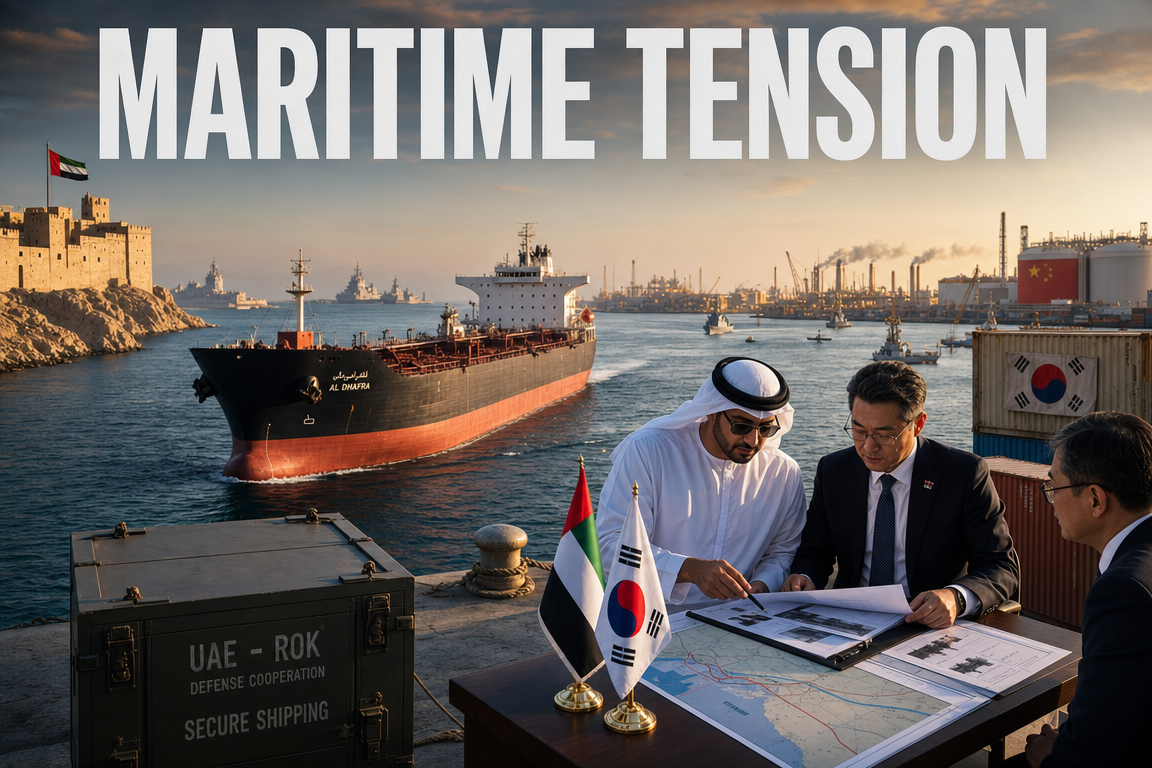
The UAE has signaled strong confidence in South Korean air-defense systems and broader military cooperation, implying potential expansion from arms sales to a longer-term security partnership.
2. US Operational Concept: Why Disrupting Iran’s “Neural and Circulatory Systems” Matters
2-1. Why Network Disruption Can Outperform Direct Confrontation
Modern conflict outcomes are increasingly determined by the integrity of integrated systems: command-and-control, communications, port operations, maritime transport, financial settlement, drone operations, and missile-launch architectures.
A network-focused approach can reduce kinetic exposure while materially increasing the adversary’s operating costs, with direct spillovers into global markets and risk pricing.
2-2. Target Sets Likely to Be Prioritized
First, maritime logistics. The Strait of Hormuz and adjacent sea lanes are central to regional energy flows; instability can move both crude prices and freight rates.
Second, command and intelligence networks. Degradation of ISR, communications, electronic warfare, and satellite-enabled linkages lowers missile and drone effectiveness.
Third, financing channels. Sanctions and financial controls compound over time and can influence FX dynamics, commodities, and emerging-market risk sentiment.
3. Why China Could Be on High Alert
3-1. China’s Key Vulnerability: Maritime Dependence
China’s energy imports and export-oriented logistics remain heavily sea-lane dependent. Stable inflows of crude and LNG are inputs to industrial output and external competitiveness.
As long as the US maintains maritime control capacity across the Middle East, Indian Ocean, South China Sea, and chokepoints such as the Malacca Strait, China retains structural exposure.
3-2. Implications of Tanker/Commercial Shipping Confrontation Scenarios
References to potential standoffs between Chinese commercial vessels and US naval assets should be treated as illustrative rather than definitive without verification. The investment-relevant signal is that China’s maritime logistics can be pressured.
Likely transmission channels include higher marine insurance premiums, delivery delays, increased energy procurement costs, commodities volatility, and rising input costs. A China growth slowdown would have second-order effects on South Korean exports.
3-3. China–Iran Linkages Extend Beyond Diplomacy
China views Iran as part of a broader energy-security and strategic portfolio, including balancing US influence and supporting Belt and Road priorities. Material disruption in Iran can therefore reverberate through China’s regional posture.
With US–China competition expanding beyond trade into energy, semiconductors, shipping, defense technology, and data governance, Middle East risk becomes a higher-impact variable for China.
4. The UAE’s Strong Signal Toward South Korea: Why It Matters
4-1. Significance of Air-Defense Performance Validation
Positive assessment of South Korean air-defense systems is relevant because defense exports typically bundle training, sustainment, integration, intelligence-sharing, and political alignment.
Demonstrated performance can increase the probability of follow-on procurement, upgrades, joint exercises, and industrial collaboration.
4-2. Implications of Special Operations and Military Cooperation
Operational cooperation suggests partner-country validation of readiness, doctrine, and crisis-response capability, potentially extending into air-defense networking, naval defense concepts, base protection, critical-infrastructure security, and unmanned-systems collaboration.
4-3. The Role Middle East Partners May Expect from South Korea
Regional partners may perceive South Korea as an industrial and security partner that is less politically conditional than some alternatives, operationally responsive, and supply-chain reliable. Potential downstream opportunities include energy import stability, EPC contracts, defense deals, smart-city projects, AI security systems, and semiconductor/battery cooperation.
5. Direct Economic Implications for South Korea
5-1. Crude Prices and Inflation Sensitivity
Escalation in regional tension typically reprices crude first. As an energy-import-dependent economy, South Korea faces concurrent pressures on inflation, production costs, logistics costs, and FX.
Given the manufacturing share of GDP, higher energy inputs can compress margins and raise consumer price levels, affecting rate expectations.
5-2. Re-Expansion of Supply-Chain Risk
Beyond oil, heightened risk can disrupt petrochemical feedstocks, shipping schedules, insurance costs, port dwell times, and defense logistics.
Firms may reprioritize resilience over unit cost, reinforcing re-shoring, friend-shoring, and higher inventory buffers.
5-3. Opportunity Set for Defense and Shipbuilding
Increased investment by Middle East, European, and Asian countries in air defense, missile defense, counter-drone systems, and naval capabilities can be supportive for South Korean defense exporters.
Greater emphasis on maritime security can expand markets for naval vessels, auxiliaries, special-purpose ships, and MRO. South Korea’s integrated shipbuilding–defense industrial base is structurally positioned for such demand.
6. US Forces Korea and South Korean Security: Assessing “Immediate Shock” Claims
6-1. The Underlying Point Behind Overstated Language
Claims that withdrawal would cause immediate collapse are often rhetorical. The more material issue is the role of US Forces Korea in ISR, missile defense, air power, naval integration, and extended deterrence signaling.
The core risk is disruption to combined operational architecture rather than simple troop-count reduction.
6-2. Practical Response Direction for South Korea
South Korea faces a dual requirement: strengthen indigenous defense capacity while maintaining allied integration across ISR and missile-defense interoperability.
Priority areas include cyber defense, space domain awareness, unmanned forces, and AI-enabled target analysis. The key variable is networked integration of sensors, C2, and effects, with increasing automation.
7. Renewed Focus on Submarine-Based Strategic Assets
7-1. Submarines as Strategic, Not Symbolic, Capabilities
High-end submarine capabilities provide endurance, survivability, and strategic uncertainty for adversaries, functioning as an element of deterrence.
Drivers include North Korea’s missile threat, China’s naval expansion, Indo-Pacific strategy requirements, and protection of distant sea lines of communication.
7-2. Material Constraints Remain
Such programs face complex technical, fuel-cycle, diplomatic, fiscal, and regulatory constraints and are not near-term decisions.
The investment-relevant signal is the shift from coastal defense toward broader maritime security and strategic deterrence planning.
8. Ukraine War Lessons and Implications for South Korea
The war has reinforced the centrality of drones, satellite-enabled ISR, precision strike, electronic warfare, and real-time data fusion. Implications include emphasis beyond a small number of high-cost platforms toward:
- Small unmanned systems
- AI-enabled target recognition
- Counter-UAS architectures
- Distributed fires
- Ammunition production capacity
Operational underperformance in conventional mass can reflect deficits in agile ISR-to-fire integration.
9. AI Trend: The Investable Point
9-1. The Core Is Not “AI,” but AI-Integrated Systems
Beyond generative AI, the defense and industrial relevance centers on decision-support AI, ISR analytics, drone swarm control, cyber anomaly detection, and predictive maintenance.
Transformation occurs through integrated ecosystems spanning sensors, communications, cloud infrastructure, semiconductors, and software.
9-2. Emerging Markets for South Korean Firms
South Korea combines semiconductors, telecom equipment, batteries, robotics, shipbuilding, defense, and software, creating optionality in AI-enabled defense, smart ports, energy optimization, unmanned surveillance, and satellite data processing.
As Middle East states shift from energy rent models toward technology and security-state capabilities, opportunities expand in AI security, smart infrastructure, and networked air-defense systems.
10. News-Style Checklist: Priority Items to Monitor
First, the US approach to Iran may tilt toward disruption of command, logistics, maritime transport, and financing rather than occupation-scale warfare.
Second, China’s dependence on Middle East energy and sea-lane logistics increases exposure as Iran-related risk rises.
Third, the UAE’s alignment with South Korea should be read as a signal of expanding strategic partnership, not only defense exports.
Fourth, South Korea faces risks via crude prices, FX, and supply-chain instability, while opportunities may expand across defense, shipbuilding, energy infrastructure, and AI security.
Fifth, common drivers across modern conflict and industrial competitiveness include data, AI, network integration, and precision response.
11. The Most Material Point Often Missed in Mainstream Coverage
The central issue is less “US vs. Iran” and more the ability to control energy flows, maritime routes, financial networks, military information systems, and industrial supply chains under stress.
Competitive advantage increasingly depends on resilience to oil disruptions, speed of supply-chain substitution under shipping constraints, and the pace of operationalizing AI-enabled ISR and unmanned systems.
South Korea’s position is asymmetric: energy-import vulnerability coexists with strategic value derived from capabilities in semiconductors, shipbuilding, defense, batteries, and applied AI.
12. Monitoring Checklist for South Korea
1) Developments around the Strait of Hormuz and regional maritime transport conditions
2) Crude prices, marine insurance premiums, and freight-rate volatility
3) China’s moves to diversify crude import sources
4) Additional defense procurement by the UAE and other regional states
5) Expansion of South Korea’s investment in missile defense, naval strategy, and unmanned forces
6) Policy support for AI-enabled defense and security industries and stronger civil–military technology collaboration
< Summary >
US pressure on Iran may focus on network disruption rather than direct large-scale warfare.
China’s reliance on Middle East energy and maritime logistics increases sensitivity to Iran-related risk.
The UAE’s deepening engagement with South Korea signals potential expansion from defense sales to strategic partnership.
South Korea faces downside risk from higher crude prices and supply-chain instability, alongside potential upside in defense, shipbuilding, energy infrastructure, and AI security.
The core variable is control and resilience across energy, shipping, financial, and information networks.
[Related Articles…]
- https://NextGenInsight.net?s=defense-industry
- https://NextGenInsight.net?s=AI
*Source: [ 달란트투자 ]
– 미국 최후의 작전 개시. 중국 이란 초비상 걸렸다 | 김종대 교수 풀버전