● Tesla FSD Breakthrough
Tesla’s FSD Enters a New Phase in Europe Following Dutch RDW Approval: Implications Extending to Korea’s Model Y and Model 3
This development should not be viewed as a single-country regulatory approval. The key point is the first formal institutional recognition within the European regulatory framework that Tesla’s FSD-related system can be deemed acceptable for real-road operation.
This report summarizes the significance of the Dutch RDW approval, the pathway for expansion across 27 European countries, potential implications for FSD eligibility on Korea-delivered Model Y and Model 3 vehicles, the context behind Tesla Korea’s recent price increases, and the investor-relevant inflection point toward software-driven revenue growth.
1. Key Update: The Netherlands RDW Approved Tesla FSD-Related Authorization
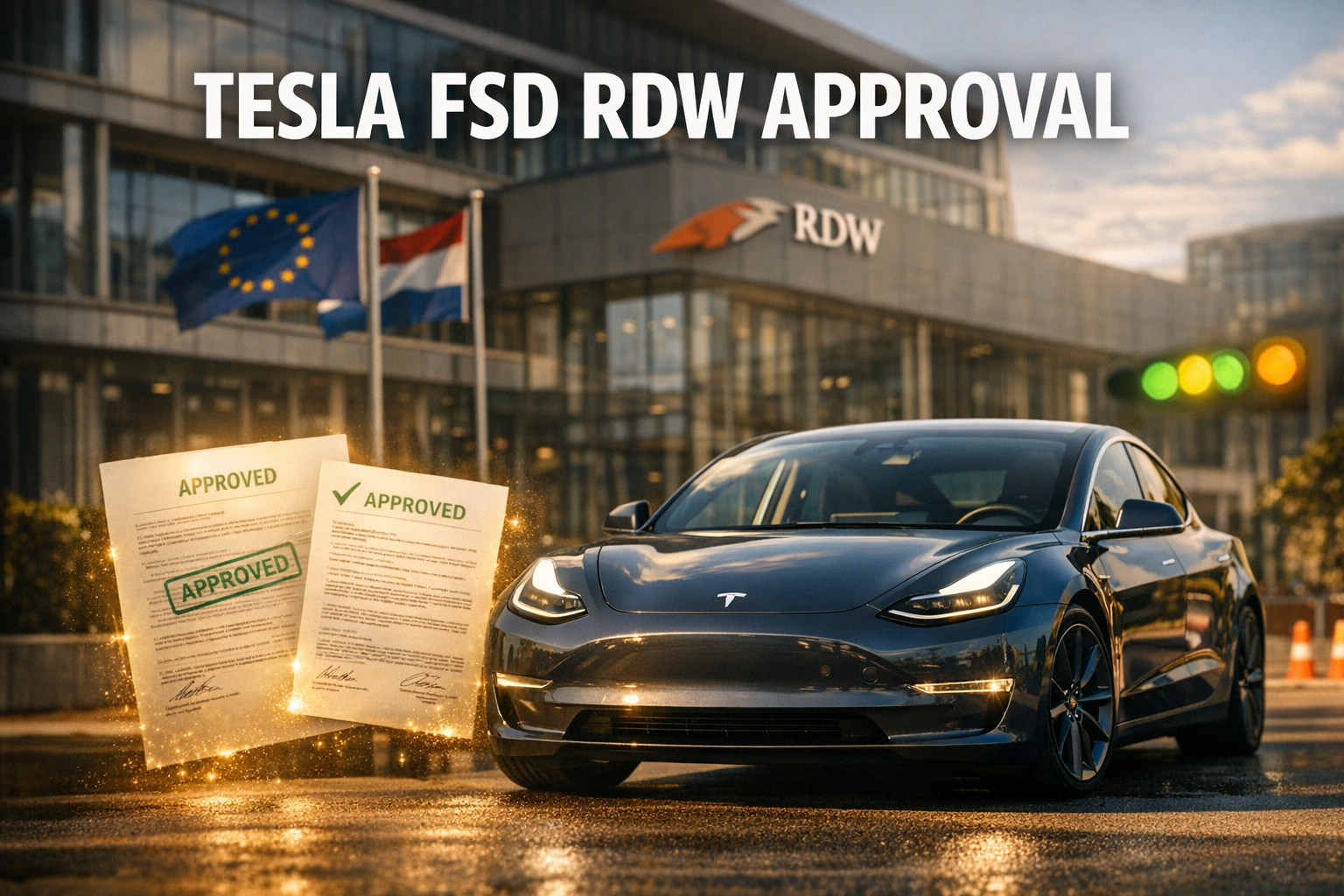
The Netherlands’ RDW has issued an approval relevant to Tesla’s FSD, effectively opening the first official gate for broader autonomous-driving enablement in Europe.
The importance lies less in the approval itself and more in the precedent: within Europe’s regulatory system, a competent authority has concluded that Tesla’s FSD-related system can meet acceptability thresholds for public-road use.
The market had anticipated a decision around March 20, but document review and regulatory verification extended the timeline to April 10. Concerns around further delays persisted until the approval was reported after market close, shifting sentiment materially.
2. Why the Dutch Approval Matters Disproportionately
The Netherlands has played a practical and symbolic role in Tesla’s European type-approval history.
In practice, RDW approval is not only a domestic permission signal; it can serve as a reference point for other European jurisdictions. As a result, this action is widely interpreted as the first step toward unlocking the broader European market.
If major markets such as Germany, France, and Italy initiate follow-on recognition processes, Tesla’s European business model could shift from hardware-led sales toward expanding subscription-based software monetization. This is both an EV sector development and a platform-economics development.
3. Expected Sequence Following the Approval
1) The Dutch RDW cleared Tesla’s FSD-related approval process.
2) The outcome can be communicated within Europe as a basis for follow-on recognition.
3) Major markets (Germany, France, Italy) may move comparatively quickly.
4) Expansion into Northern Europe and other countries could materially increase FSD subscription revenue outside North America.
5) A precedent emerges for vehicles aligned with EU safety standards, including those sold in Korea under similar compliance regimes.
6) The core signal is the opening of a global market for AI-based recurring software revenue, rather than incremental vehicle sales.
4. Expansion Across 27 European Countries: How Realistic?
Immediate pan-European activation is unlikely; however, the probability of broader adoption has increased materially.
European countries retain jurisdiction-specific administrative steps and pacing. Once a leading authority completes a full review, other regulators may face reduced burdens versus restarting evaluation from zero.
Market expectations typically range from 4–8 weeks for faster-moving jurisdictions to 2–3+ months for slower ones, depending on administrative capacity, political context, legal interpretation of road-traffic rules, and safety-evidence requirements. The critical change is directionality, not uniform speed.
5. The Approval Was Not Procedural: Evidence and Documentation Burden
The approval process appears to have required extensive validation. Reported inputs include approximately:
- 18 months of European-road testing
- 1.6 million+ km of testing
- 13,000+ customer ride demonstrations
- 4,500+ track tests
- 400+ compliance items addressed
- Thousands of pages of documentation
For highly conservative regulatory environments, the implication is that AI systems can be evaluated and accepted through data-backed evidence and structured documentation. In macro terms, competitive advantage increasingly includes regulatory execution capability, data accumulation, and standards alignment—not only technical performance.
6. Why This Is Directly Relevant to Korea’s Model Y and Model 3
A large portion of Model 3 and Model Y vehicles sold in Korea are sourced from Tesla’s Shanghai production. These vehicles often follow compliance pathways closely aligned with EU safety standards, which has been associated with constraints on enabling certain FSD core functions.
By contrast, U.S.-built Model S and Model X have historically operated under a different certification context, contributing to functional differences by origin and approval regime.
The Dutch RDW approval establishes a precedent that EU-aligned vehicles can receive road-legal enablement under a European regulatory decision. This strengthens the regulatory rationale for Korea-delivered EU-aligned Model Y and Model 3 configurations, at least at the level of legal interpretation and policy justification.
7. Korea: Not an Automatic or Immediate Enablement
Dutch approval does not automatically translate into Korean activation.
Korea would still require interpretation and action by the Ministry of Land, Infrastructure and Transport, including regulatory alignment, stakeholder review, rulemaking procedures, and safety assessment. Commercial deployment may therefore require time.
However, one of the strongest prior counterarguments—“if Europe does not allow it, Korea cannot”—is materially weakened. The issue is shifting from feasibility to timing and procedure.
8. Tesla Korea Price Increases: Context and Timing
Tesla Korea implemented price increases across select trims (including Model 3 Performance, Model Y Long Range, and others), with reported increases approaching KRW 5 million in some cases. The adjustment drew consumer attention, particularly for recently popular variants.
From a business perspective, Tesla has historically used demand-responsive pricing: lowering prices to stimulate demand and raising prices as demand visibility improves. If local demand reached levels such as monthly sales exceeding 10,000 units for imported vehicles, price increases can be interpreted as consistent with prior global behavior.
If FSD enablement expectations rise, perceived optionality of future functionality may also begin to be reflected in pricing and product positioning.
9. Investor Implication: From Automotive Manufacturing to AI Software Monetization
The central investor-relevant point is the market’s ongoing shift in valuation focus: from hardware unit volumes toward scalable, recurring software revenue.
While EV demand normalization, European sales pressure, and macroeconomic softness remain relevant, FSD is structurally positioned as a recurring revenue stream via subscription and feature upgrades rather than a one-time hardware margin event.
Accordingly, RDW approval should be framed as a regulatory milestone enabling Tesla’s AI-based recurring revenue model to expand beyond North America.
10. Counterpoint: If European Adoption Is Low, Does It Matter?
Adoption rates may remain modest in the near term. Even in North America, FSD attach and subscription penetration is not uniformly characterized as explosive, and Europe may exhibit slower uptake due to driving culture, road environments, and regulatory conservatism.
Near-term financial impact could therefore be limited. However, the strategic importance lies in market access. A closed market yields zero software revenue; an opened market provides an option value that can expand over time as regulation, user experience, and pricing evolve.
11. Current State of FSD Technology
Recent North American releases have been associated with reported improvements in response time and behavioral smoothness. Mentioned changes include an AI compiler restructuring cited as improving response time by approximately 20%.
Observed user-reported improvements include parking-lot navigation, traffic-signal handling, and reduced hesitation. The system remains supervised and requires driver attention and intervention. For investors, the relevant variable is the rate of iterative improvement enabled by data-driven model updates and OTA deployment cadence.
12. Broader Macro and AI Implications
This development extends beyond a single-company EV headline and reflects three concurrent structural trends:
1) Manufacturing sectors are shifting toward software-driven revenue, with subscription services and data-based features increasing in importance relative to one-time product sales.
2) AI competitive dynamics are shifting from technical feasibility to regulatory acceptance and commercial deployment; “permitted AI” increasingly defines realized value.
3) National regulatory barriers are increasingly influencing earnings trajectories and valuation multiples across semiconductors, robotics, autonomous driving, cloud, defense, and biotech.
13. Most Material Underappreciated Point
The primary significance is not “approval equals feature availability,” but rather that European regulators are increasingly treating Tesla’s AI driving system as something that can be evaluated through data, test protocols, and auditable safety logic.
This implies that competitive advantage may accrue to firms capable of building regulator-acceptable safety cases and executing institutional adoption—not only to those with technical capability.
For Korean investors and consumers, this is not merely about unlocking an option; it can affect vehicle utility, perceived value, resale dynamics, and the feasibility of future subscription-based services.
14. Key Watch Items Going Forward
1) The speed and scope of follow-on recognition actions in Germany, France, and Italy.
2) Activation of FSD subscription flows and early user feedback within the Netherlands.
3) Signals from Korea’s Ministry of Land, Infrastructure and Transport regarding policy interpretation and rulemaking momentum.
4) Tesla Korea’s linkage of FSD options, OTA rollouts, and vehicle pricing strategy.
5) Disclosure in earnings materials regarding potential European software revenue contribution.
6) Longer-term integration with Tesla’s AI roadmap (Cybercab, Optimus, robotaxi).
15. One-Line Conclusion
The Dutch RDW approval is a European inflection point that weakens institutional barriers for EU-aligned Model Y and Model 3 deployments in Korea and provides an early regulatory signal that supports Tesla’s transition toward an AI software platform with scalable recurring revenue.
< Summary >
The Netherlands RDW approval increases the probability that Europe’s autonomous-driving software market will open meaningfully. It can serve as an initial reference point for expansion across 27 European countries and strengthens the regulatory rationale for EU-aligned Model Y and Model 3 vehicles sold in Korea. While immediate Korean enablement is not implied, the core constraint appears materially reduced. For investors, the central focus is the potential expansion of recurring software subscription revenue rather than incremental vehicle deliveries.
[Related Articles…]
- https://NextGenInsight.net?s=autonomous%20driving
- https://NextGenInsight.net?s=AI
*Source: [ 오늘의 테슬라 뉴스 ]
– 속보! 네덜란드 RDW 드디어 승인! 한국 모델Y FSD 걸림돌이 사라졌다!
● Rental Shock, Rate Spike, Policy Gamble
Leasehold Deposits Are Disappearing, Monthly Rents Are Rising: The Real Battleground for the Real Estate Market in H2 (News-Style Brief)
What matters most in the current market is not a simple home price outlook, but the following:
- Contraction in leasehold-deposit (jeonse) supply
- Acceleration of the shift to monthly rent
- Potential reforms to property holding taxes and capital gains taxes
- Lack of an exit pathway for multi-home owners
- Policy signaling for H2 real estate
While headlines focus on whether prices rise or fall, the primary market drivers are structural changes in the rental market and the direction of taxation.
This cycle may represent a turning point: a transition from a deposit-based rental system to a monthly-rent-centered system.
1. Key Market Headline: Deposit-Based Leases Are Shrinking; Monthly Rents Are Likely to Rise
The central consensus:
As multi-home owners reduce holdings, deposit-lease listings decline, and the resulting shock can translate into higher monthly rents.
A significant share of deposit-lease supply has historically been provided by individual multi-home owners. Policies that pressure multi-home ownership can disrupt not only transactions but the rental supply structure itself.
2. Why Deposit-Lease Listings Decline: The Structural Mechanism
Mechanics:
- Many multi-home owners lease units via deposit leases or hybrid deposit-plus-rent structures.
- If policy pressure rises (higher holding taxes, acquisition-tax surcharges, capital-gains-tax surcharges), owners tend to:
- hold,
- sell, or
- convert to monthly rent.
The market impact extends beyond sale inventory. When a unit that would have renewed as a deposit lease moves to the for-sale market, the tenant must seek another deposit lease.
If that tenant cannot convert into a buyer, the result is:
- deposit-lease supply falls
- deposit-lease demand remains
- deposit levels rise
- displaced demand shifts into monthly rentals
This is a structural bottleneck caused by limited buyer absorption during an ownership transition.
3. Why Multi-Home Owner Exit Alone Does Not Stabilize the Market
Reducing multi-home ownership can be directionally consistent with housing policy objectives, but the execution risk is material.
The key question: Who absorbs the units after multi-home owners exit?
Stabilization typically requires at least one of the following:
- expanded financing capacity for owner-occupiers
- public-sector acquisition and leasing capacity
- institutional rental providers scaling supply
Absent a replacement supply mechanism, the deposit-lease market is likely to destabilize first.
4. The Primary Near-Term Risk May Be the Rental Market, Not Sale Prices
Price movements in prime districts often dominate public discourse, but household-level impact typically appears first in rentals.
For lower-income renter households, a lack of available deposit leases and rising monthly rents can be more disruptive than moderate transaction-price adjustments.
A cited example from new-town areas indicates that tenants with limited cash buffers (approximately 30–50 million KRW equivalent) can be constrained by lending restrictions, reducing their ability to move into new-build deposit leases.
This implies that policies perceived as targeting prime districts can transmit stress to peripheral areas and mid-to-lower priced rental segments.
5. Is the Monthly-Rent Surge Cyclical or Structural?
A near-term spike in monthly rents is plausible.
Why monthly rent tends to rise in the short term
- deposit-lease supply declines
- deposit levels rise
- tenants priced out of deposit leases shift to monthly rent
- monthly-rent demand increases
- monthly rents rise further
Post-fraud risk aversion has also increased preference for monthly rent over large deposits, reinforcing demand.
Why the market may re-balance in the medium term
If planned sales do not clear, landlords may revert to deposit leases to restore liquidity. Competitive pricing between deposit leases and monthly rent can re-establish a conversion equilibrium.
This suggests sustained strength is possible, but uniform, indefinite rent escalation across all segments is not structurally implied. The adjustment period, however, can impose acute stress on renters.
6. Core Policy Claim: Raise Holding Taxes, Lower Capital Gains Taxes
The repeated message:
Raising holding taxes without reducing capital gains taxes risks renewed inventory lock-in.
If both holding and capital gains taxes rise simultaneously:
- transaction volume contracts
- listings become constrained
- market distortions can increase
A policy mix that increases holding costs while offering a practical exit can increase supply to the market and support normalization.
Practical policy concepts raised
- capital-gains-tax relief for multi-home owners selling at a defined discount level
- tax incentives when owner-occupiers purchase the units
- capital-gains-tax relief for selling in major cities and relocating to non-core regions
- mechanisms for public or institutional buyers to absorb selected inventory
These are framed as behavior-shaping design tools rather than purely restrictive measures.
7. Can a Singapore-Style Model Be Applied Directly?
Direct transplantation is not considered realistic due to structural differences.
Key features of the Singapore model
- the state controls most land
- a very high public-housing share
- constrained private market operation
- very high acquisition taxes for foreigners
- low or no capital gains and inheritance taxes
These foundations differ from a private property-centered market structure.
Elements that may be relevant as references
- differentiated taxation for residents vs. non-residents
- clear separation between primary-home and multi-home tax regimes
- stronger acquisition taxes for foreign buyers
- functional recalibration of holding taxes while redesigning transaction taxes to reduce distortions
The central lesson is not scale public ownership, but precision in aligning tax and supply design with policy objectives.
8. H2 Policy Timing: The Key Window Is July Through November
Tax reforms typically follow a calendar:
- July–August: policy direction reconnaissance
- around September: signals begin to be priced in
- October–November: market positioning intensifies
- December: confirmation or reversal drives repricing across sales and rentals
A key driver may be less the final tax rate and more policy ambiguity, which suppresses transactions and amplifies sensitivity to messaging.
9. Why Governments May Prefer Strategic Ambiguity Over Immediate Tightening
Immediate large holding-tax increases are not guaranteed due to:
- high tax resistance
- political costs
- limited justification if the market is stable
- legislative uncertainty
If prime districts re-accelerate, tightening pressure increases. Policy is shaped by market reaction and political scheduling as much as by stated principles. In H2, warning signals and calibrated statements may precede firm measures.
10. Market Outlook: Where H2 Direction Is Likely to Be Determined
The decisive variables are structural and policy-linked, not only price direction:
1) Re-acceleration in prime districts (e.g., core metropolitan areas)
Policy intensity typically tracks prime-market overheating.
2) Renewed surge in deposit-lease pricing
Rental stress has high political and social sensitivity.
3) Actual listing release by multi-home owners
Requires coherent tax burden and exit design to revive transactions.
4) Ability of non-owners to convert into buyers
If financing and affordability constraints persist, rentals may tighten even if listings rise.
11. Positioning by Household Type
Owner-occupier non-owners
- prioritize cash-flow capacity, time horizon, and debt serviceability
- avoid momentum-driven buying
- stress-test borrowing assumptions conservatively
Deposit-lease tenants
- assess beyond headline pricing: local move-in supply, credit availability, and submarket rental balance
- expect divergence between core areas and outer metro submarkets
Temporary two-home households
- elevated exposure if resident vs. non-resident distinctions tighten
- if cash flow is constrained, pre-plan scenarios ahead of policy clarity
Multi-home owners
- prioritize exit planning and liquidity management over expansion
- monitor holding-tax reform risk, especially for prime and high-value assets
- re-evaluate after-tax returns versus policy and financing risk
12. Underemphasized but Material Points
1) Rental-market disruption may precede transaction-price changes
Renter cohorts are impacted first, especially lower-income and younger households.
2) Policy success depends on who replaces private landlords as rental suppliers
Without a substitute supply channel (public, institutional, or finance-enabled), rental stability is fragile.
3) H2 may be driven more by ambiguity than by finalized rules
Messaging intensity and timing can produce volatility even before legislation.
4) The practical takeaway from Singapore is design discipline, not public-housing scale
Resident/non-resident differentiation, foreign-buyer controls, and transaction-tax redesign are the relevant levers.
5) Tax policy alone is insufficient
Rates, supply, credit, politics, and sentiment interact; single-tool regulation is unlikely to be decisive.
13. Interpretation: H2 Is a Structural Contest More Than a Price Contest
The central question is shifting from “Will prices rise?” to “Who bears the transition cost?”
If multi-home owners exit:
- owner-occupiers must be able to absorb supply, or
- rental supply must be replaced institutionally or publicly, or
- deposit-lease and monthly-rent markets tighten first
The decisive factor is whether policy arrives as a coherent package across transaction taxes, holding taxes, credit, and rental supply substitution.
14. Conclusion: Prioritize Structure Over Short-Term Conviction
The H2 market is best understood as a policy transition period with material second-order impacts on household rental costs, consumption, and portfolio allocation.
Key emphasis: rentals over transaction prices, exit pathways over punitive signaling, and execution design over declarations.
< Summary >
- The decline in deposit-based leases and the rise in monthly rent are likely structural transition effects rather than purely temporary noise.
- Reducing multi-home ownership may be directionally coherent, but without buyer conversion capacity and rental-supply substitution, the deposit-lease market can destabilize first.
- Key H2 variables: holding-tax and capital-gains-tax reform, resident vs. non-resident differentiation, prime-district re-acceleration, and deposit-lease pricing trends.
- The Singapore model is more relevant as a reference for resident-focused tax design and stronger foreign-buyer controls than as a direct template.
- The core of the H2 real estate outlook depends less on price direction and more on rental-market dynamics and the completeness of the policy package.
[Related Links…]
- https://NextGenInsight.net?s=real-estate
- https://NextGenInsight.net?s=AI
*Source: [ 경제 읽어주는 남자(김광석TV) ]
– [풀버전] 전세는 사라지고 월세는 폭등한다. 이재명 정부의 싱가포르식 부동산 정책, 집값의 진짜 승부는 하반기에 갈린다 | 경읽남과 토론합시다 | 한문도x김인만_하편
● Rich, Disciplined, Win
Why “Hard” Cards Appear Around the Wealthy: Key Takeaways Reframed Through 2026 Investment Psychology and Asset Allocation
This content is more useful when interpreted as a framework for decision-making rather than as fortune-telling.
It consolidates practical insights on: how wealthy individuals make decisions, differences between equity- and real estate-driven wealth, asset allocation and risk management, investment psychology, and execution frameworks that matter more than prediction.
It also highlights why some investors repeat the same errors, why others preserve and compound capital through volatility, and why high-performing allocators ask not “What should I do?” but “How do I increase the probability of this plan succeeding?”
A separate section isolates the most material underlying message, often omitted in mainstream commentary.
1. The single most important line: The wealthy validate probabilities rather than ask about luck
The central thesis is consistent:
Wealthy investors do not outsource their life or portfolio decisions.
They do not ask, “What should I do?” They arrive with a plan and ask, “What must be checked to raise the probability of success?”
This difference compounds into material wealth gaps.
The same applies to macro views. Investors study rates, FX, USD liquidity, global growth, US equities, KOSPI, and AI not to obtain a definitive answer from others, but to stress-test and improve the survival odds of their own scenarios.
This framing is particularly relevant for 2026 because the environment is less about a single clear directional call and more about building portfolios and decision rules that remain resilient under volatility.
2. Executive summary: Core points at a glance
2-1. Common traits among the wealthy
Wealthy investors tend to be reality-based and less emotion-driven.
In the source framework, this is described as a “Pentacles” orientation: practical judgment, long-term accumulation, disciplined focus on controllables.
In investment terms, long-term capital builders typically prioritize:
- cash flow over noise
- structural drivers over trends
- sustainability over short-term excitement
2-2. Equity wealth and real estate wealth differ materially
Equity-driven wealth is described as “Swords”: analytical, fast decision cycles, strong volatility response and timing sensitivity.
Real estate and business-driven wealth aligns more with “Pentacles”: slower compounding, stability, and structural accumulation.
In practical allocation terms:
- Equity-oriented: strong information processing, timing, liquidity management, volatility response
- Real-estate-oriented: accumulation, endurance, stability, preference for tangible assets
- Business-oriented: people, systems, cash flow, scaling strategy
There is no single path to wealth. Aligning asset classes with behavioral fit increases the probability of sustained success.
2-3. Why failure repeats: stable behavioral patterns
A recurring emphasis is repetitive choice patterns. While framed initially through relationship examples, the investment mapping is direct:
- consistently chasing momentum
- inability to cut losses
- entering after consensus forms
- buying at peaks during euphoria and selling at lows under fear
- reacting to emotion rather than market structure
The relevant question is not “Why is my luck bad?” but whether the same stimulus repeatedly triggers the same response.
From a behavioral finance perspective, long-term results are often driven less by information and more by correcting recurring decision errors.
3. 2026 investor reframing: Why this should be read economically
3-1. The issue is not “luck,” but the decision framework
Many investors seek different outcomes without changing their decision architecture, producing the same results.
In equities, repeated losses are frequently driven by process, not instruments, for example:
- no entry criteria
- no exit criteria
- no defined return targets or loss limits
- no portfolio construction
- no risk management discipline
In favorable markets, such portfolios may perform temporarily. Under recession risk, rate shocks, or FX volatility, they tend to fail.
In the current global setup, management often matters more than prediction.
3-2. The wealthy do not consume “advice”; they conduct validation
A key observation: investors who have already built capital ask structurally different questions.
They do not ask, “What should I do?” They ask:“I plan to execute this strategy. What risks and probability drivers must be validated?”
This is directly applicable to 2026 macro monitoring:
- pace and timing of US rate cuts
- USD direction and liquidity conditions
- KRW depreciation risk
- AI equity valuation levels
- Nasdaq overheating risk
- strength of domestic export-cycle recovery
Outlooks are inputs; execution accountability remains internal.
3-3. “Hardness” comes from reality focus
What is described as “earth energy,” realism, and rationality can be translated into:
- prioritizing cash flow
- understanding leverage fragility
- resisting unrealistic expected returns
- trusting time and compounding
- favoring sustainable strategies over short-term stimulus
In 2026, with elevated AI-growth narratives, theme-following alone is insufficient. Investors must integrate:
- earnings quality
- valuation discipline
- industry transmission mechanisms
- policy direction
- liquidity flows
“Hard cards” functionally represent a realism-based operating posture.
4. It appears like lifestyle counseling but is fundamentally decision psychology
4-1. Investors often lose to their own patterns
A repeated message: people respond according to stable traits; those responses drive outcomes.
Investment analogs include:
- impatience leading to repeated buying of peaks
- avoidance preventing loss realization
- overconfidence eliminating diversification
- dependency on external recommendations
In many cases, knowing one’s failure modes is more valuable than consuming large volumes of news.
4-2. In uncertainty, managing priors matters more than seeking certainty
If investors anchor on deterministic statements, they stop observing markets objectively, e.g.:
- “This asset will definitely rise”
- “AI must go up”
- “The USD cycle is over”
- “Real estate has bottomed”
For 2026 positioning, conditional scenario planning is more robust than strong conviction narratives, e.g.:
- if rate cuts are delayed, growth equity volatility may increase
- if USD strength persists, EM risk appetite may weaken
- AI equities may have strong long-term growth but remain vulnerable to near-term valuation compression
- domestic equities may exhibit larger dispersion between export-linked and domestic-demand sectors
5. Why the wealthy’s questioning method matters: A 2026 response framework
5-1. Portfolio structure precedes security selection
Most retail investment media emphasizes themes and picks. Portfolio structure is the primary variable.
A practical translation of the “probability-check” approach is prioritizing:
- target cash allocation
- weights across equities, bonds, gold, USD exposure, and alternatives
- growth vs value balance
- domestic vs US equity balance
- explicit downside hedges and drawdown controls
These questions are prerequisite to resilience under recession risk and volatility expansion.
5-2. Five macro variables to monitor closely into 2026
Although the original frame is consultative, a market-oriented reading requires systematic monitoring of:
- Rates: the timing and speed of cuts directly affect growth equities, Nasdaq sensitivity, and real estate sentiment.
- FX (KRW/USD): drives foreign flows, import inflation, and domestic equity performance.
- USD: central to global liquidity and risk-asset appetite.
- Global growth: US slowdown risk, China recovery momentum, and European demand weakness transmit into export earnings.
- AI: a durable secular theme, but valuation and earnings validation become increasingly binding constraints.
The practical implication: focus on structure and flow rather than intuition, deterministic narratives, or theme-only positioning.
6. The most material message rarely stated explicitly
The core point is not that wealthy investors believe in superior prediction. It is that they operate with a durable personal operating system.
Mainstream summaries often reduce wealth to routines, reading, frugality, or networking. The deeper elements are operational:
6-1. They do not outsource decisions
They listen to advice but retain decision authority, which is a primary defense against fraud and crowd behavior.
6-2. They select wealth-building mechanisms aligned with temperament
Some are structurally advantaged in equities, others in real estate, others in business. The priority is fit-to-process, not imitation.
6-3. They audit structure, not emotions
Under stress, most people seek certainty. Wealthy allocators seek checklists.
6-4. They invest in long-term pattern correction
Persistent underperformers repeat errors. Persistent outperformers locate causes internally and repair decision systems. This is a prerequisite for compounding.
7. Practical applications for investors
7-1. Five questions to audit immediately
- What emotional pattern appears when markets become unstable?
- Is my approach closer to equities-driven, real-estate-driven, or business-driven wealth building?
- Am I repeatedly outsourcing decisions to others?
- Can my portfolio withstand recession risk and volatility expansion?
- Am I searching for picks, or building a system?
7-2. 2026 implementation guidance
AI exposure remains relevant, but indiscriminate AI buying is not a strategy.
Key variables include rates and liquidity, earnings validation, policy transmission, supply chains, competitive intensity, and valuation.
USD and KRW/USD must be monitored. For Korea-based investors, FX direction can dominate realized returns in local currency terms.
The priority is not a single high-conviction forecast, but asset allocation designed to avoid failure across multiple scenarios.
8. Conclusion: Wealth is built by management, not by perfect prediction
Despite the surface narrative, the substance is operational.
Long-term wealth tends to be built by investors who understand temperament, manage probabilities, stay reality-based, and compound through structure.
In reading 2026 outlooks, the objective is less “finding the correct answer” and more “building a survival architecture.”
Opportunities remain, but they are more likely to be captured through disciplined audits, diversified portfolios, sustainable execution, and systematic correction of recurring behavioral errors.
< Summary >
The key message is that wealthy investors validate probabilities rather than rely on luck.
Equity-driven wealth emphasizes analytical decision-making and volatility response; real estate and business wealth emphasize stability and accumulation.
Repeated failure is more often driven by recurring behavioral patterns than by luck.
The 2026 playbook prioritizes asset allocation, risk management, and monitoring rates, FX, USD liquidity, and AI valuation/earnings validation over security recommendations.
Wealth is less about prediction accuracy and more about building and managing a durable decision system.
[Related Posts…]
-
https://NextGenInsight.net?s=AI
Key points: 2026 AI industry outlook and US equity investment strategy -
https://NextGenInsight.net?s=FX
2026 global macro scenarios interpreted through FX and USD dynamics
*Source: [ Jun’s economy lab ]
– 부자들은 이 타로카드가 뜹니다 (ft. 최한나 영타로마스터, 운명전쟁49)