
● Space Datacenter Supercycle
Google’s unprecedented bet that turned 10 million won into 1 billion won, and the chilling real reason hidden behind the Tesla and SpaceX merger rumors.
From now on, I will thoroughly uncover the true economic viability of ‘space data centers,’ which other YouTube channels or news outlets never cover deeply, and the reality of humanity’s largest tollgate business monopolized by Elon Musk.If you read this article to the end, you will perfectly understand what opportunities we must seize amid the approaching massive supercycle, going beyond a simple space theme.Now, let’s get right into it.
Google’s 100-fold profit myth and AI data centers that went to space
Data centers kicked out of Earth find the answer in space
Did you know that Google acquired about a 7.4% stake in SpaceX for 1 trillion won in 2015?At that time, SpaceX’s corporate value was around 10 trillion won, but looking at its value ahead of a potential listing now, Google has practically made a whopping 100-fold profit.Even reports analyzing recent global economic forecasts are calling this massive asset multiplication case the ‘greatest event in human history.’But why are big tech companies around the world, including Google, so desperate for space?Last year, Nvidia’s Jensen Huang said he would sell 260,000 GPUs to South Korea, but the problem is that there is a shortage of land to build data centers to run these massive machines.Data centers consume enormous amounts of electricity and emit heat, getting branded as undesirable facilities, so there are more than a few places where construction is halted due to opposition from local residents.However, there is exactly one perfect place where no one hangs up banners and stages protests.That is ‘space,’ which is endlessly vast and where you don’t need to care about what others think.
AI is actually running in space (Reality, not SF)
If you think this is just a story like a sci-fi movie set in the distant future, you are mistaken.Just four months ago, an American startup called Star Cloud loaded Nvidia GPUs onto a SpaceX rocket and went up to space.There, they succeeded in running Google’s AI model, Gemma, and AI learning and inference actually took place in orbit.China even went a step further, announcing that it formed a network with 12 satellites to run Alibaba’s AI model in space.The space race between the US and the Soviet Union in the 1960s has now been resurrected as a ‘space data race’ among the US, China, and giant corporations heading into 2026.This is the frontline AI trend and reality that we are facing right now.
[Exclusive core point summary] The real problem others don’t talk about: “So, is it profitable?”
Technology is done, now it’s a strict battle of ‘costs and tollgates’
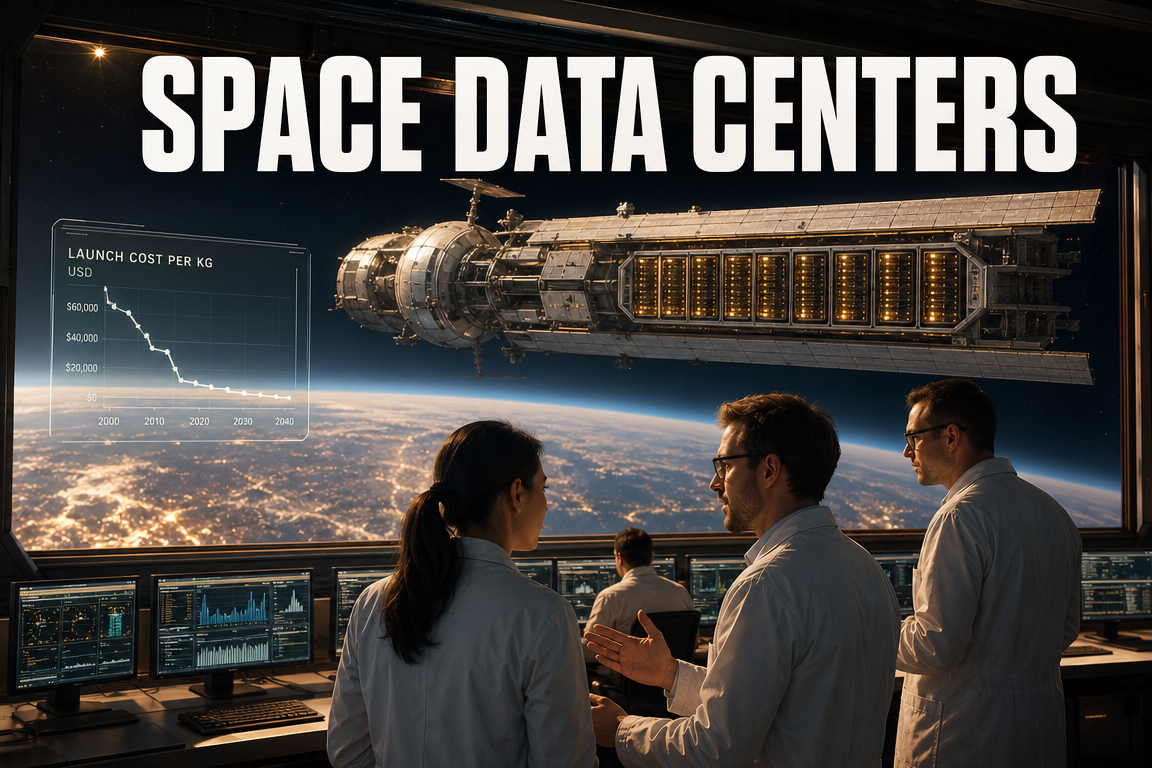
YouTube and the news may brightly package the facade of running AI in space, but the truly important core point lies elsewhere.The question of whether space data centers are technologically possible is already over, and it has now shifted to a strict money battle of “Is this more economically viable than on the ground?”To cool down the immense heat of GPUs in space, physically speaking (Stefan-Boltzmann law), a heat sink the size of Yongsan-gu in Seoul, measuring 4 kilometers in width and 4 kilometers in length, must be unfolded in space.If you add solar panels to this, the weight of a single satellite easily exceeds at least 400 kilograms.The ‘launch cost’ of shooting this heavy object into space is the absolute variable that determines the life or death of this business.Doing the math, the required launch cost to compete with ground data centers must be around 200 dollars per kilogram.However, the current unit price of SpaceX’s main rocket, the Falcon 9, is 2,600 dollars per kilogram.This means it is still absurdly expensive.
The universe’s only transit pass held by Musk, ‘Starship’
Here, Elon Musk’s truly terrifying plan emerges.It is the next-generation super-heavy rocket ‘Starship’ currently under development by SpaceX.If the Falcon 9 is a local bus that carries 20 tons at a time, the Starship is a space freight train that packs 200 tons at once.When Starship goes into full operation, the launch cost per weight will plummet to the bottom, making it highly likely to break the 200-dollar threshold.Ultimately, the economic viability of the massive new business known as the space data center is 100% tethered to the success of SpaceX’s Starship.All companies, including Google, want to go to space, but the only ‘tollgate’ to space is owned by Musk, and the toll fee is also decided by Musk.This overwhelming monopoly structure is the real reason why SpaceX receives a crazy valuation of 2 trillion dollars.
The chilling truth behind the Tesla and SpaceX merger rumors
Everything was a ‘Lego block’ for a single picture
Recently, Bloomberg mentioned the risk of organizational collapse after SpaceX’s IPO, causing an uproar as rumors of a merger with Tesla erupted.Is it simply because of money issues? No, imagine the aftermath when the space-bound Starship arrives at the Moon or Mars.Autonomous vehicles to run on the rough surface of Mars, humanoid robots (Optimus) to build space bases, and ESS batteries to store massive amounts of power.Which company makes all of these the best? Yes, it is Tesla.In the end, all the companies led by Musk were assembly Lego blocks designed to complete the single massive goal of humanity’s multi-planetary migration.This can be seen as the ultimate finalized form of the 4th Industrial Revolution that completely destroys and recreates the existing industrial ecosystem.
South Korea’s current status and the space supercycle we should target
We are late on launch vehicles, but we can monopolize the core contents
So, where does South Korea stand right now?Objectively speaking, the launch cost of our country’s Nuri rocket is about 35 million won per kilogram, which is more than 10 times more expensive than SpaceX’s Falcon 9 (about 3 million won).Once Starship is mass-produced, this gap will widen by more than 100 times, so it is true that we are far behind in the battle for the main body of space rockets.However, there is absolutely no need to despair, and rather, it is time to smartly revise our investment strategy.When space data centers enter orbit, ‘ultra-low power AI semiconductors’, ‘HBM’, and ‘space communication equipment’ that must withstand cosmic radiation and extreme temperatures will be essential components.This means that even if Musk launches the outer shell, which is the launch vehicle, a completely new space supercycle market can open wide for South Korean companies in the most vital core point contents and advanced materials sectors that fill the inside.Whether SpaceX’s valuation is a bubble or not, the massive trend of humanity trying to preemptively secure space infrastructure for survival has already become an unstoppable reality.
< Summary >
- Google’s stroke of genius: Generating a 100-fold profit through its 2015 SpaceX investment, the competition among big tech companies to secure space data centers has begun in earnest.
- Reasons for space data centers: The arrival of an era where AI models are run directly on satellites to avoid Earth’s power shortages and the NIMBY phenomenon.
- Core point economic indicators: The key is the launch cost (targeting 200 dollars per kilogram). The only key to solving this is the commercialization of SpaceX’s super-heavy rocket ‘Starship’.
- Musk’s big picture: The merger rumors between Tesla (autonomous driving, robots, batteries) and SpaceX ultimately signify the combination of essential infrastructure for the pioneering of Mars.
- South Korea’s opportunity: Although lagging in the rocket launch vehicle competition, there are new supercycle opportunities in the ‘core contents’ market, such as ultra-low power AI semiconductors, HBM, and communication equipment that will go into space data centers.
[Related articles…]SpaceX listing imminent, analysis of related value chains that overseas stock retail investors should pay attention to
Data centers heading to space: Prospects for a new supercycle that AI semiconductor HBM will face
*Source: Softdragon SOD