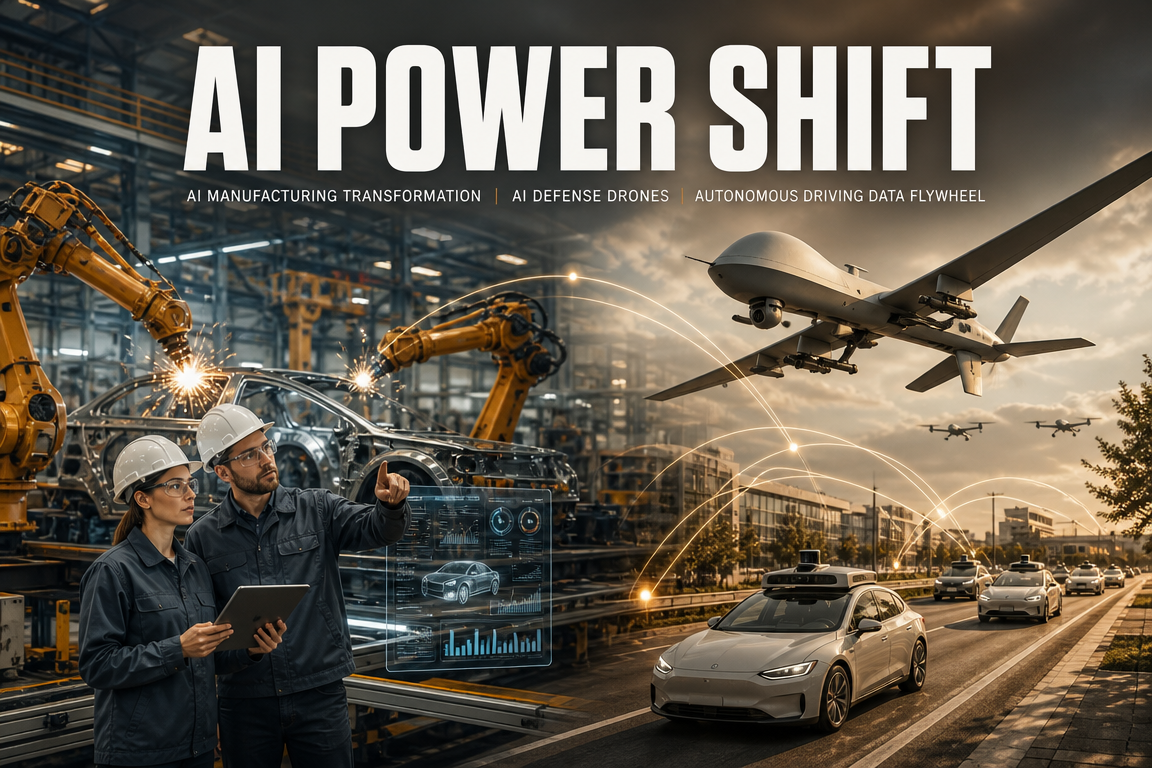
● AI-Driven Manufacturing Shock
AI is reshaping the future of Korean manufacturing: semiconductors, humanoids, autonomous driving, and regional talent development over the next 10 years
The core issue is not simply “put AI into factories.”
Over the next decade, Korea’s manufacturing sector will likely determine the trajectory of the Korean economy depending on whether it can simultaneously achieve AI transformation, semiconductor leadership, physical AI, autonomous driving, and regional industrial restructuring.
Manufacturing AX, or M·AX, is the next stage beyond smart factories. It goes beyond automation and aims to build an industrial operating system in which AI agents independently make decisions across design, production, quality control, maintenance, HR, finance, and logistics.
Korea already holds several structural advantages in this field.
Few countries possess HBM, manufacturing data, telecommunications and power infrastructure, and established value chains in automobiles, shipbuilding, robotics, consumer electronics, and semiconductors.
At the same time, China’s AI talent pool and robotics and drone ecosystem are advancing rapidly, making the next 10 years a critical window for Korea’s manufacturing competitiveness.
1. Why Manufacturing AI Transformation M·AX Is Needed Now
Key point: Korean manufacturing has advanced automation, but it has not yet reached true autonomy.
Traditional factory automation was built on equipment operating under rules defined by humans.
M·AX, by contrast, refers to AI interpreting data, predicting equipment conditions, adjusting production plans, and identifying process issues autonomously.
From the perspective of Professor Byung-Dong Yoon of Seoul National University, industrial AI is still at an early stage.
Consumer-facing generative AI has already gone mainstream, but industrial AI for manufacturing is still in its formative phase.
The reasons Korea must accelerate M·AX are clear.
First, experienced workers are aging, and tacit knowledge is disappearing.
Second, quality, maintenance, energy, and production data remain fragmented across departments, limiting productivity gains.
Third, small and mid-sized manufacturers face both labor shortages and cost pressure.
Fourth, intensifying global supply chain competition makes manufacturing competitiveness a core national competitiveness issue.
In the end, M·AX is not about replacing people with automation. It is about building an autonomous manufacturing system that can run without human intervention and deliver significantly higher productivity when humans are present.
2. Three Structural Advantages Korea Has in Manufacturing AX
The first advantage is data.
Over the past decade, Korean factories have accumulated substantial data through ERP, MES, PLC, and smart factory initiatives.
The challenge is that this data has not yet become a true asset.
Manufacturing data, unlike language data, lacks context.
For example, numerical data from equipment is difficult to use for AI training unless it is linked to the product being manufactured, whether the output was defective or non-defective, and the conditions under which the work was performed.
Accordingly, the core task of M·AX is not merely collecting data, but adding context and converting manufacturing data into usable assets.
The second advantage is Korea’s industrial base.
Korea has broad value chains across semiconductors, automobiles, shipbuilding, batteries, displays, consumer electronics, steel, machinery, and defense.
This means there are many real industrial environments where AI can be applied.
The third advantage is infrastructure.
Physical AI requires telecommunications, power, data centers, sensors, semiconductors, robots, automobiles, and mobile devices.
Korea is short on GPUs, but it has strong capabilities in HBM, communications networks, power infrastructure, manufacturing sites, and device ecosystems.
This combination gives Korea a basis for differentiated competitiveness in AI-driven manufacturing transformation.
3. The Next Competitive Frontier in Semiconductors Is AI Agents
Key point: In semiconductors, AI agents are likely to become critical infrastructure that affects corporate survival, not just productivity tools.
Professor Jung-Ho Kim of KAIST describes manufacturing AX as fundamentally about AI agents.
An AI agent is not a chatbot that answers questions. It is an autonomous system that sets plans, uses tools, executes tasks, and verifies outcomes based on objectives.
In the future, a company that manages 100 AI agents effectively may be more productive than one that hires 100 people.
This applies to semiconductor design firms, fabless companies, design houses, foundries, and memory manufacturers.
HBM design, in particular, involves complex interactions among electrical signaling, power delivery, thermal management, packaging, cooling, and AI optimization.
Finding the best design by manual coordination alone takes too much time.
If AI agents can run simulations, compare designs, and suggest optimization paths, development time and cost can be reduced materially.
From HBM4 onward, customized HBM is expected to emerge, with different base die requirements depending on the GPU vendor.
By HBM5, some computational functions may shift into HBM itself.
In that case, memory becomes a core component of AI computing architecture rather than a simple storage device.
As AI data centers and physical AI expand, memory demand is likely to increase further.
Large AI models require massive memory capacity not only for parameters, but also for KV cache, context processing, sensor data, and image data.
This creates a major opportunity for Korea’s semiconductor industry, while also implying that failure to adopt design automation and manufacturing AX quickly could erode its competitive position.
4. The Real Issue for Samsung Electronics and SK hynix
Korea’s exports remain highly dependent on semiconductors.
From a macroeconomic perspective, Korea’s growth rate and corporate earnings will likely continue to depend heavily on the semiconductor cycle.
The problem is that while semiconductors are performing well, other industries are still experiencing weak demand conditions.
To narrow this gap, Korea must extend the AI manufacturing technologies validated in semiconductors to other industries, not just improve productivity within the semiconductor sector itself.
For example, a 10% improvement in semiconductor yield can generate economic effects worth tens of trillions of won, potentially reaching hundreds of trillions of won.
At that scale, the impact extends beyond corporate profits to tax revenue, investment, employment, and fiscal capacity.
For Samsung Electronics, the challenge is to connect memory, foundry, mobile, consumer electronics, AI, devices, data, and semiconductor design into a single vertically integrated ecosystem.
As Google has built a strong ecosystem by linking AI, TPU, YouTube, advertising, and cloud services, Samsung has the potential to link foundry, memory, mobile, consumer electronics, and on-device AI.
However, this requires moving beyond internal competition and toward a collaborative AX strategy.
5. AI Robots and Humanoids as a Practical Response to Labor Shortages
Key point: Humanoid robots are less a job-displacement technology than a solution to labor gaps in manufacturing environments where people no longer want to work.
CEO Yoon-Seol Um of Arobot argues that Korea faces especially strong pressure to adopt robots.
The reasons are threefold.
The working-age population is declining.
Labor costs are rising.
Manufacturing still accounts for a large share of the economy.
The labor shortage is especially severe for small and mid-sized manufacturers.
Young workers are reluctant to move to regional manufacturing sites, skilled workers are aging, and foreign workers are difficult to train as long-term specialists because of visa constraints.
Humanoids matter because they resemble humans.
If they can use the same tools and work environments as people, the need to deploy separate service robots, kitchen robots, transport robots, and cleaning robots declines.
A single humanoid can become an “all-in-one labor platform” capable of performing multiple tasks.
Of course, robots will not eliminate all jobs.
Instead, new jobs are likely to emerge, such as data collectors, robot trainers, motion model designers, AI operations managers, and robot maintenance engineers.
The more important issue is not total job count, but changes in job structure.
6. Why Physical AI Matters in Shipbuilding, Construction, and Defense
Physical AI refers to AI with a body.
While many focus on software, hardware accounts for half the challenge.
Actuators, sensors, reducers, motors, batteries, controllers, materials, durability, and manufacturing quality all matter.
Korea’s strength lies in precisely this hardware ecosystem.
It already has a network of parts and materials suppliers, machinery companies, automobile parts makers, and shipbuilding equipment firms.
If these companies transition into the physical AI value chain, Korea can aim for a top-three global position in humanoids and industrial AI robots.
In shipbuilding, for example, the average age of welding specialists is rising.
Welding is not simply drawing a line. It is a highly skilled task requiring judgment on force, angle, speed, temperature, and material characteristics.
Capturing that tacit knowledge in data and transferring it to robots is the essence of physical AI.
One key concern among demand-side firms is data leakage.
Shipbuilders, defense companies, and automakers are highly sensitive about exposing proprietary process know-how.
Accordingly, a practical approach may be to keep data on a company’s internal servers, allow AI firms access only through permissions, and retain the resulting models internally.
7. Autonomous Driving Is Now an AI Data Competition, Not an Automotive One
Key point: Autonomous driving competition is no longer about engines or chassis. It is about AI models, data, semiconductors, simulation, and software platforms.
According to Byung-Wook Jun of the Korea Automobile Research Institute, autonomous driving can be divided into three stages.
First-generation autonomous driving is rule-based autonomy.
Humans encode every driving condition and scenario as rules.
This approach was limited because it could not capture the complexity of real roads.
Second-generation autonomous driving is end-to-end AI driving.
AI learns driving patterns from large-scale driving data.
Tesla and several Chinese companies are advancing rapidly in this area.
Third-generation autonomous driving is physical AI-based autonomy.
The vehicle does not simply memorize data. It uses a world model to imagine future situations and select optimal actions.
True autonomy requires the ability to understand and respond to situations that the system has never directly observed.
Korea’s strategy should be a dual track: rapidly closing the gap in second-generation systems while preparing for third-generation autonomy.
Simple imitation will not be enough to catch Tesla and China.
Korea must combine physical AI, automotive AI semiconductors, simulation data, and manufacturing AX to create an opportunity to lead in the next phase.
8. How to Assess Tesla, Waymo, and Chinese Competitors
In Level 2 autonomous driving, Tesla is widely viewed as the leader.
Tesla has accumulated extensive driving data from vehicles with human drivers and used that data to improve FSD performance.
Chinese companies are rapidly catching up.
China’s advantages include a large domestic market, fast regulatory response, massive data volume, and an aggressive AI talent base.
In Level 4 robo-taxi operations, however, Waymo remains strong.
Waymo’s model is based on fixed geographic areas, high-definition maps, supervision, and multiple sensors.
Tesla and Waymo operate in different segments, even though both fall under autonomous driving.
Korea must address both markets.
Mass-market Level 2 and Level 2+ autonomous driving are important, but so are Level 4 robo-taxis and autonomous logistics in defined areas.
9. The Core of Autonomous Driving Competitiveness Is the Data Flywheel
Building autonomous vehicles requires data.
But data can only be collected if autonomous vehicles are already on the market.
Solving this circular problem is one of Korea’s key challenges.
One practical approach is to equip regular vehicles, taxis, and rental cars with data-collection devices.
Given Hyundai Motor and Kia’s annual production scale in the millions, they could build a data-collection base relatively quickly if they choose to do so.
Another is a state-led data-sharing platform.
Data generated in autonomous driving pilot cities such as Gwangju should be managed as a public asset.
Firms should have incentives to contribute data if doing so grants access to a larger shared pool.
For example, if a company that contributes 10 units of data can access 100 units of data, participation becomes commercially attractive.
Finally, simulation data is essential.
It is impossible to collect every accident scenario on real roads.
Therefore, edge cases such as rare incidents, near-accidents, severe weather, and sudden pedestrian movements must be generated and trained in simulation environments.
10. Automotive AI Semiconductors Are the Hidden Battleground of Future Mobility
Autonomous vehicles require far more semiconductors than internal combustion vehicles.
The issue is not simply quantity. The core requirement is AI semiconductors capable of high-performance on-board computation.
Even the best AI model is meaningless if it cannot be deployed inside the vehicle.
Cloud-dependent autonomy faces latency, communication failure, and security issues.
That is why on-device AI is critical.
The challenge is that a general-purpose AI chip is not necessarily optimal for every automaker.
Tesla designs its own FSD chip, and Chinese automakers are also vertically integrating chips tailored to their own models.
Future mobility competition is therefore shifting from “who has the better AI model” to who has the semiconductor optimized for its own AI model.
Korea is one of the few countries that has both semiconductors and automobiles.
If these two industries are not connected, the opportunity will be missed. If they are connected effectively, Korea can develop both future mobility and AI semiconductors simultaneously.
11. Regional Manufacturing and Talent Development: Another Pillar of M·AX
Key point: Manufacturing AX is not only a project for large firms in the capital region. It is a regional survival strategy.
According to Professor Seong-Hyun Sim of Changwon National University, the essence of manufacturing AX is tied to regional economic survival.
Cities such as Changwon, Ulsan, Geoje, and Gwangju are supported not only by large corporations but also by countless small and mid-sized suppliers.
The problem is that young people do not want to work in manufacturing.
In particular, regional manufacturers struggle to recruit workers, the average age is rising, and skilled knowledge is being lost.
In this context, M·AX is not simply a technology deployment effort. It is a strategy to make manufacturing a more attractive sector again.
Through DX and smart green industrial park programs, some firms have already achieved automation rates above 90%.
These companies no longer resemble traditional factories; their work environments increasingly resemble software companies.
If one reason young people avoid manufacturing is image and working conditions, AX can help change that perception.
12. The Threat From China’s AI Talent and Hardware Ecosystem
China is far ahead of Korea in AI talent scale.
Chinese researchers make up a significant share of major AI conferences.
China’s graduate student pipeline, PhD-level workforce, government investment, and speed of industrial adoption are all difficult for Korea to match.
The drone market is a notable example.
Korea once developed drone technologies as well, but Chinese products became dominant because they were far cheaper and improved quickly in performance.
The fact that many drones used by both sides in the Russia-Ukraine war are Chinese-made is symbolically important.
The same pattern could repeat in humanoids, physical AI, and manufacturing robots.
Korea should be concerned about a future in which research labs use Chinese robot platforms, students become familiar with those platforms, and industry naturally standardizes around the Chinese ecosystem.
Accordingly, Korea must develop not only AI software, but also robot hardware, sensors, controllers, manufacturing equipment, and data platforms.
That is the path to preserving industrial competitiveness and industrial sovereignty.
13. How to Build Practical AI Talent
The biggest shortage in manufacturing AX is not generic AI developers.
The shortage is of practical talent that understands manufacturing operations and can use AI effectively.
It is unrealistic to expect AI specialists alone to solve manufacturing challenges.
Instead, engineers who understand factories must learn AI.
When domain expertise is combined with AI tools, real productivity gains emerge.
That is why upskilling and reskilling are essential.
Existing manufacturing engineers need upskilling in AI applications.
Workers from other roles also need pathways to transition into AI manufacturing positions.
From a regional perspective, upskilling is especially urgent.
Outside the capital region, where AI specialists are scarce, converting existing manufacturing workers into AI-enabled talent is often the most realistic strategy.
When building semiconductor or AI manufacturing clusters, the focus should not be limited to factories.
Schools and research institutions should be integrated into the cluster.
Large-scale talent development models, including support for tuition and living expenses from entry through doctoral study, followed by direct placement into companies, should also be considered.
14. The Most Important Points Not Often Emphasized in Other Coverage
First, manufacturing data does not become valuable simply because it is abundant.
It must be contextualized to become an AI asset.
Only data linked to product type, process, conditions, and quality outcomes can support real manufacturing AI.
Second, the operating system may matter more than the AI model itself.
Many companies focus on which AI model to adopt, but M·AX requires sensors, compute, data, memory, models, application domains, operating teams, and business KPIs to be connected.
Third, manufacturing AX is not only a factory issue.
Finance, HR, procurement, inventory, supply chain, design, quality, and customer response must also undergo AI transformation.
AI applied only to a single production line is unlikely to create global competitiveness.
Fourth, long-term dependence on Chinese hardware can create standard-setting dependency.
The pattern seen in drones could repeat in robotics and physical AI.
Low-cost, high-performance equipment is important in the short term, but from a national ecosystem perspective, Korea needs its own platforms.
Fifth, Korea’s real opportunity lies in linking semiconductors, manufacturing, and physical AI.
Korea is one of the few countries that simultaneously has HBM, automobiles, shipbuilding, consumer electronics, telecommunications, power infrastructure, and manufacturing sites.
While the lack of GPUs is a clear weakness, Korea’s potential role across the physical AI value chain is larger than often assumed.
Sixth, government initiatives are insufficient if evaluated only on a 4- to 5-year cycle.
Semiconductor and manufacturing competitiveness are the result of accumulation over 10, 20, and 40 years.
M·AX should therefore be designed as a long-term industrial policy, not a short-term project.
15. Key Watchpoints for Korea’s Manufacturing Sector Over the Next 10 Years
The first watchpoint is semiconductor yield and AI design automation.
As demand for HBM and AI semiconductors rises, the speed at which AI agents are introduced into design, process, and packaging will be decisive.
The second watchpoint is the M·AX gap among small and mid-sized manufacturers.
Large corporations can build their own AI infrastructure, but smaller firms need education, computing resources, data platforms, and testbeds.
Without public AI infrastructure, the productivity gap between large and small firms could widen further.
The third watchpoint is the commercialization timeline for humanoids.
Industrial humanoid commercialization efforts may accelerate around 2028.
Labor-shortage industries such as shipbuilding, construction, logistics, food service, agriculture, and highway rest areas may face the earliest adoption pressure.
The fourth watchpoint is the autonomous driving data platform.
To catch Tesla and China, Korea needs a national data flywheel that connects vehicle data, pilot data, and simulation data.
The fifth watchpoint is regional talent development.
If Korea aims to be among the top three AI nations, it needs a top-three level system for education, research, and industry linkage.
In particular, practical AI talent capable of working in regional manufacturing sites will be essential.
< Summary >
AI will be one of the most important variables shaping Korea’s manufacturing sector over the next decade.
M·AX is not just smart factory development; it is a broader transformation of manufacturing around AI agents.
Korea has favorable conditions for the physical AI era, including HBM, manufacturing data, telecommunications and power infrastructure, and value chains in automobiles, shipbuilding, consumer electronics, and robotics.
However, China’s AI talent, drone and robotics hardware ecosystem, and scale advantages in data represent significant risks.
Over the next several years, Korea’s key priorities are likely to include improving semiconductor yield, adopting humanoids, building an autonomous driving data platform, advancing regional manufacturing AX, and developing practical AI talent.
Ultimately, the outcome will depend not on a single AI model, but on data assetization, factory-level implementation capability, hardware ecosystems, and long-term industrial policy.
[Related Articles…]
AI Semiconductor Supercycle and the Outlook for the Korean Economy
Autonomous Driving and Physical AI Reshaping the Future Industrial Map
*Source: [ 경제 읽어주는 남자(김광석TV) ]
– [풀버전] “AI가 한국 제조업의 미래를 바꿉니다” 반도체··휴머노이드·자율주행·인재양성, 앞으로 10년의 승부 | 경읽남과 토론합시다 | 윤병동X김정호X엄윤설X전병욱X심성현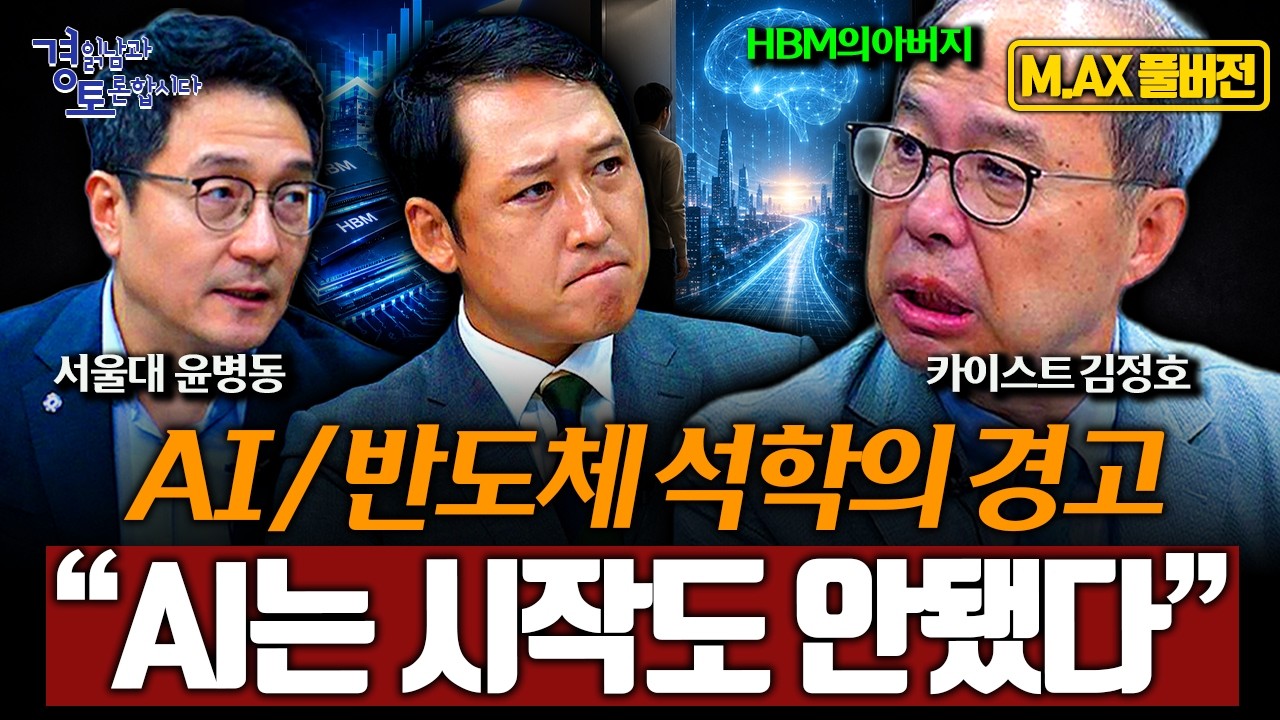
● Ukraine-Drone, Russia-Pressure, Japan-Tomahawk, Korea-Volatility
The Real Economic Impact of the Russia-Ukraine War on South Korea: Drone Warfare, Tactical Nuclear Weapons, Japan’s Tomahawk Missiles, and China-Taiwan Risk
The core issue is not simply that “Russia is under pressure” or that “Ukraine is fighting well.”
Ukraine’s drone warfare capabilities are putting pressure on Russia’s mainland and energy infrastructure, while Russia is recalibrating its ties with Asian countries, including South Korea, amid a prolonged war.
At the same time, Japan’s deployment of Tomahawk missiles, discussions over the redeployment of U.S. tactical nuclear weapons in South Korea, military responses from North Korea and China, and escalating U.S.-China tensions over Taiwan are combining to increase geopolitical risk across the Korean Peninsula, financial markets, and global supply chains.
From an economic perspective, this connects directly to defense stocks, energy prices, the KRW/USD exchange rate, the global growth outlook, AI semiconductors, and the drone industry.
In other words, this is not merely a foreign affairs or security issue. It is a major variable that could reshape South Korean equities and industrial structure.
1. The significance of Ukraine’s drone warfare: Why some now say even the U.S. cannot fully stop it
The most striking point in the original text is that Ukraine’s drone force has already reached a world-class level.
Through the war with Russia, Ukraine has rapidly advanced from simple reconnaissance drones to suicide drones, long-range strike drones, naval drones, and AI-based target tracking in real combat.
Traditional military power has centered on aircraft carriers, fighter jets, missiles, and tanks. After the war in Ukraine, however, the battlefield has increasingly shifted toward low-cost, high-efficiency drones.
This matters because it changes the cost structure of war.
When a target that once required a missile worth hundreds of millions of won can now be attacked with a drone costing only a fraction of that amount, the defending side bears a much heavier cost burden.
Even with a dense air defense network, Russia cannot fully intercept all drones if Ukraine launches them in large numbers.
As a result, Russian refineries, ammunition depots, military logistics bases, ports, and bridges remain under sustained threat.
The statement that Ukraine could, if it chose to, devastate Russian strategic facilities on a broad scale reflects this dynamic.
2. Drone warfare has become a real-world testbed for the AI industry
This war is also highly relevant from the perspective of AI trends.
Whereas early-stage drone use involved simple commercial drones fitted with explosives, current systems integrate reconnaissance, analysis, targeting, and evasive maneuvering into a single operational framework.
In particular, AI-driven image recognition, autonomous navigation, electronic warfare avoidance, swarm flight, and real-time target analysis are advancing rapidly.
In the past, operators manually controlled drones while watching the video feed. Going forward, AI is likely to identify targets, calculate optimal routes, and carry out missions even in electronic warfare environments.
This trend has direct implications for Korean companies.
Drone platforms, batteries, communication modules, AI semiconductors, sensors, cameras, satellite communications, and cybersecurity firms may all become part of a new defense value chain.
Whereas the defense industry was once centered on large weapons systems, the next phase is likely to be defined by AI defense, combining software, artificial intelligence, and semiconductors.
3. Why Russia is becoming more urgent: Putin’s options are narrowing
The original text suggests that President Putin is being pushed into a position where he may have to take greater risks.
This does not mean Russia has been militarily defeated.
Rather, it means Russia’s options are narrowing as the war drags on.
First, there is the manpower issue.
A mobilization order carries significant political costs.
If a government that has told the public the war is going well issues another large-scale mobilization, it may be interpreted domestically as a sign that the war is more difficult than portrayed.
Second, there is the energy infrastructure issue.
Russia is a major energy exporter, but if refineries are attacked or logistics systems are disrupted, domestic supplies of gasoline and diesel can also be affected.
The remark that Russia is dependent on imported fuel for domestic use highlights concerns that its energy structure may be less robust than it appears.
Third, sanctions evasion and industrial input procurement remain difficult.
As Western sanctions continue, Russia faces constraints in obtaining semiconductors, precision machinery, auto parts, industrial equipment, and electronic components.
This is where South Korea becomes important from Russia’s perspective.
Korea is highly competitive in semiconductors, automobiles, shipbuilding, refining, petrochemicals, batteries, consumer electronics, and industrial equipment.
4. Why the claim that “Russia is looking to Korea” should be viewed economically
The original title uses the strong phrase that Russia secretly visited Korea.
However, because official confirmation matters, investors should avoid treating such claims as fact and instead focus on why Russia might seek contact with South Korea.
Russia may need Korea for four main reasons.
First, industrial goods and parts supply chains.
Russia is struggling to secure high-performance semiconductors, auto parts, factory equipment, precision machinery, and electronic components under war and sanctions.
Korea has global competitiveness in these sectors, so Russia may seek access through indirect or diplomatic channels.
Second, energy and refined products.
Russia is a major oil and gas producer, but attacks on refineries can disrupt supplies of higher-value petroleum products.
Korea has strong refining and petrochemical industries.
Third, shipbuilding and shipping.
Sanctions can create problems for Russian vessel operations, LNG transport, and offshore plant-related logistics.
Korean shipbuilders are among the world leaders in LNG carriers, ice-class vessels, and special-purpose ships.
Fourth, diplomatic balance.
Russia is strengthening ties with North Korea, but severing relations with South Korea entirely would also be costly.
Korea is a U.S. ally, but it is also economically connected to China, Russia, Japan, and Europe.
5. Japan’s Tomahawk deployment: Why North Korea and China are concerned
The original text refers to Japan’s Tomahawk-related developments.
The Tomahawk is a long-range cruise missile capable of precision strikes on command centers, missile bases, radar sites, and military infrastructure.
Japan’s adoption of Tomahawk missiles signals a shift from a purely defensive posture toward a capability for retaliatory strike.
For North Korea, this means Japan will have the capacity to strike missile facilities on the Korean Peninsula. For China, it means Japan’s military role in the East China Sea and Taiwan Strait is expanding.
This shift has direct implications for the Korean Peninsula.
As security cooperation among South Korea, the United States, and Japan deepens, North Korea and China may perceive greater pressure.
At the same time, South Korea may gain additional deterrence against North Korea’s nuclear and missile threats.
However, this also increases the risk of a faster military buildup in Northeast Asia.
6. Redeployment of U.S. tactical nuclear weapons in South Korea: the most sensitive variable for peninsula risk
Another major point in the original text is the possibility of deploying U.S. tactical nuclear weapons in South Korea.
This remains one of the most sensitive topics in South Korea’s security debate.
As North Korea advances its nuclear capabilities and emphasizes tactical nuclear operations, discussion continues in South Korea over indigenous nuclear armament or the redeployment of U.S. tactical nuclear weapons.
However, this carries both benefits and risks.
The benefit is stronger deterrence against North Korea.
It could make U.S. extended deterrence more credible if North Korea threatens South Korea with nuclear weapons.
The risk is also significant.
China and Russia could respond strongly, and North Korea could use the issue as a justification for further nuclear tests or missile launches.
From a financial-market perspective, higher tensions on the Korean Peninsula could push up the KRW/USD exchange rate, trigger short-term foreign capital outflows, and drive volatility in defense and energy-related stocks.
In short, the tactical nuclear issue is not only a security debate. It is a variable that could alter the risk premium across Korean assets.
7. Japan’s strategic shift and China’s response: Northeast Asia is changing
The original text also refers to Japan’s disruptive policy shift and China’s resulting uncertainty.
Structurally, this suggests that Japan is moving away from its traditional cautious security posture toward a more active military and diplomatic role.
Japan is increasing defense spending, expanding retaliatory strike capabilities, deepening missile cooperation with the United States, and discussing responses to a Taiwan contingency.
China is likely to view this negatively.
Beijing sees Taiwan as a core national interest, and Japan’s willingness to consider involvement in a Taiwan contingency complicates China’s military planning.
As Japan becomes a more important pillar of the U.S. Indo-Pacific strategy, China must manage pressure across the Korean Peninsula, the Taiwan Strait, the South China Sea, and the East China Sea simultaneously.
This also affects global supply chains.
If tensions in the Taiwan Strait rise, semiconductor supply chains could be disrupted, and Korean and Japanese materials and equipment industries may also be affected.
Ultimately, geopolitical risk is transmitted into corporate earnings, equity prices, exchange rates, and commodity prices.
8. Taiwan’s shifting position after favoring Japan
The latter part of the original text refers to changes in Taiwan’s strategic position.
This can be interpreted as a discussion of which countries Taiwan may align more closely with amid U.S.-China competition.
Taiwan is central to the global semiconductor industry.
TSMC in particular plays a critical role in the global AI semiconductor supply chain.
The reason the United States, Japan, and Europe seek to attract TSMC plants is straightforward.
However, from Taiwan’s perspective, expanding overseas production can provide insurance through diversification while also raising concerns that strategic technology and talent may move abroad.
Building semiconductor capacity in Japan is advantageous for supply-chain diversification, but it may also raise concerns in Taiwan about the outflow of core assets.
South Korea should monitor this trend closely.
If semiconductor cooperation between Taiwan and Japan strengthens, competitive pressure on Korea’s semiconductor industry may increase.
At the same time, a rise in Taiwan Strait risk could make Korean semiconductor firms more attractive as alternative suppliers.
Samsung Electronics, SK hynix, and Korean materials and equipment companies must therefore manage both geopolitical risk and AI-driven demand.
9. Five immediate economic implications for South Korea
First, structural growth potential in defense.
As the wars in Ukraine, North Korean nuclear threats, Japan’s rearmament, and Taiwan Strait tensions continue simultaneously, export opportunities for Korean defense firms are likely to expand.
K-defense has already demonstrated competitiveness in Poland, the Middle East, and Southeast Asia.
Going forward, drones, counter-drone systems, AI command and control, and surveillance and reconnaissance equipment may become major growth areas in addition to tanks, self-propelled artillery, and missiles.
Second, higher energy price volatility.
If Russian refineries are attacked or Black Sea and Baltic logistics are disrupted, global oil and petroleum product prices could become more volatile.
Because Korea is heavily dependent on energy imports, higher oil prices directly weigh on the trade balance, inflation, and corporate costs.
Third, upward pressure on the KRW/USD exchange rate.
When tensions rise on the Korean Peninsula, Taiwan Strait risk increases, and global growth concerns deepen, safe-haven demand strengthens and the dollar may rise.
This increases import prices and complicates monetary policy for the Bank of Korea.
Fourth, semiconductor supply chain reorganization.
As AI semiconductor demand surges, the roles of Taiwan, Japan, the United States, and South Korea are being redefined.
The greater the Taiwan Strait risk, the more global firms may value the stability and capacity of Korean semiconductor production.
Fifth, greater uncertainty in the global economic outlook.
When war, sanctions, military competition, energy insecurity, and supply-chain reorganization occur simultaneously, firms delay investment and consumer sentiment weakens.
By contrast, defense, energy security, cybersecurity, and AI infrastructure industries may benefit structurally.
10. The key point often missed in other coverage
Many reports discuss these events separately: “Russia is under pressure,” “Ukraine attacked with drones,” or “Japan acquired Tomahawks.”
The more important point is that these developments are part of one interconnected trend.
The first key point is that warfare is shifting from hardware to software.
Real-time intelligence, AI analysis, drone control, electronic warfare response, and satellite communications are becoming more important than tanks and fighter jets.
This means the boundary between AI and defense is disappearing.
The second key point is that Russia’s weakening does not necessarily lead to stability on the Korean Peninsula.
As Russia weakens, it may deepen ties with North Korea, while China may become more cautious about closer alignment among the United States, Japan, and South Korea.
In other words, Russia’s difficulties are both an opportunity and a risk for Korea.
The third key point is that Japan’s expanding military role could narrow South Korea’s strategic space.
As Japan becomes a more central security partner for the United States, South Korea will need to determine how to secure its own leverage within the trilateral framework.
Economically, Japan is also seeking to regain influence in semiconductors, batteries, defense, and aerospace.
The fourth key point is that Taiwan risk could alter the long-term valuation premium of Korean equities.
Rising Taiwan Strait tensions may improve the perception of Korea as an alternative supply base for semiconductors, but broader regional risk could also make foreign investors view Korean assets as more exposed.
The fifth key point is that the next investment theme is likely to be not peace, but security costs.
Countries are likely to allocate more capital to defense, energy security, cybersecurity, AI infrastructure, and semiconductor self-sufficiency.
This is not a short-term theme. It is a structural shift that may last for more than five years.
11. Key indicators for investors and companies
1) The intensity of Ukrainian drone attacks on Russian territory
Increased strikes on Russian energy facilities and military logistics could affect both global oil prices and the course of the war.
2) The possibility of additional Russian mobilization
A mobilization order would signal prolonged war and internal pressure.
3) North Korean missile launches and the possibility of a nuclear test
As discussions around U.S. tactical nuclear weapons or Japan’s missile deployments become more concrete, North Korea may respond militarily.
4) Japan’s defense spending and missile deployment schedule
Changes in Japan’s security policy directly affect the military balance in Northeast Asia.
5) TSMC’s overseas production strategy
As production sites are diversified across Japan, the United States, and Europe, the global semiconductor supply chain will continue to be restructured.
6) The South Korean government’s diplomatic balancing strategy
How Korea strengthens its alliance with the United States while managing China and Russia risk will remain critical.
7) The pace of Korean companies entering AI defense
The speed at which drone, robotics, autonomous systems, satellite communications, and AI semiconductor firms enter the defense ecosystem will shape future growth potential.
12. Potential scenarios for South Korea
Scenario 1: Stronger trilateral security cooperation among South Korea, the United States, and Japan
As North Korea, China, and Russia become more closely aligned, security cooperation among South Korea, the United States, and Japan is likely to deepen.
In that case, Korean defense, cybersecurity, aerospace, and AI surveillance industries could benefit.
Scenario 2: Expanded Russian outreach to Korea
Russia may continue seeking Korean industrial technology and products despite sanctions.
However, South Korea remains constrained by the U.S. sanctions framework, limiting the scope for formal cooperation.
Scenario 3: Increased North Korean military provocation
Discussion of tactical nuclear weapons, Japanese missile deployments, and expanded trilateral exercises could trigger stronger North Korean responses.
In the short term, this would likely increase financial market volatility.
Scenario 4: Reassessment of Korea’s role in the semiconductor supply chain
If Taiwan risk increases, global technology firms and governments may place greater value on Korea’s semiconductor production capacity.
Competition in AI semiconductors, HBM, advanced packaging, and foundry services is likely to intensify.
Scenario 5: Renewed energy and inflation pressure
If attacks on Russian energy infrastructure coincide with risks in other major regions, oil prices could rise again.
This would weigh on inflation, interest rates, and consumer sentiment in Korea.
< Summary >
The war in Ukraine is demonstrating a new model of warfare combining drones and AI.
Russia’s prolonged war and sanctions are increasing the likelihood that it will need Korea’s industrial technology and supply chains.
Japan’s Tomahawk deployment and military buildup are raising tensions in North Korea and China and reshaping the security environment on the Korean Peninsula.
Discussion of U.S. tactical nuclear weapons in South Korea is a sensitive variable that could affect the KRW/USD exchange rate, foreign capital flows, and defense stocks.
Rising Taiwan Strait risk and closer semiconductor cooperation between Taiwan and Japan may create both risks and opportunities for Korea’s semiconductor industry.
Key investment themes ahead are defense, energy security, AI semiconductors, drones, and cybersecurity.
[Related Articles…]
Defense stocks and the global equity impact of geopolitical risk
AI semiconductor supply chain reorganization and opportunities for Korean firms
*Source: [ 달란트투자 ]
– 극비리에 한국 찾은 러시아. 곧 한국에 상상못할 일 터진다|조의준 대표 풀버전