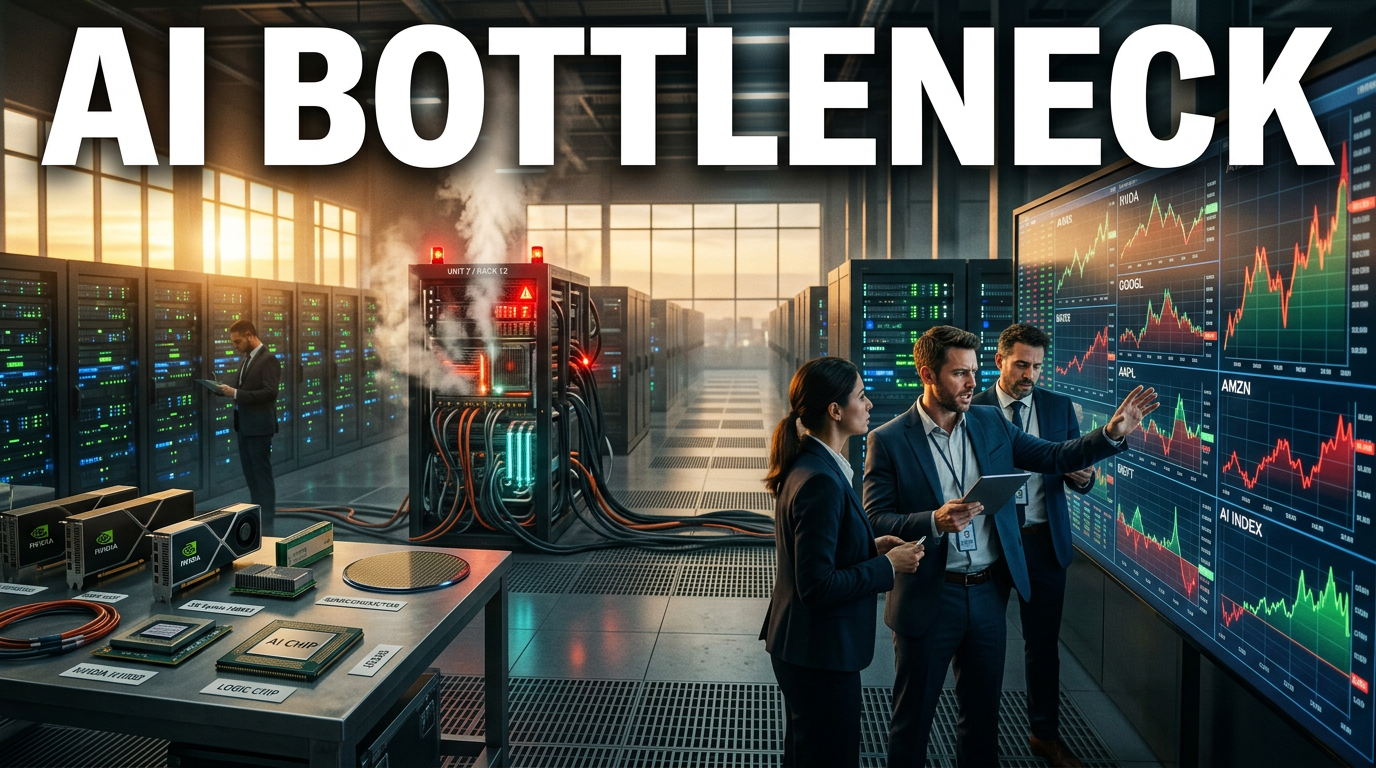
● AI Bottleneck Earnings Season
“AI bottleneck” earnings season is coming… This time, a section where it’s verified by numbers, not “bubble”
5 things you should know starting now (core point of this article)
- Tech stocks (Tech) are likely to “lead” earnings growth in Q1 2026
- Despite the controversy that “there’s too much AI investment,” AI CAPEX (capital expenditure) is growing to around 1,000 trillion won
- The bottleneck structure where demand outweighs supply continues (from servers/power to networking)
- In the earnings season, what matters isn’t only “this quarter’s earnings,” but forward guidance + evidence of making money with AI
- While short-term stock price fluctuations can be bigger, in the long run, the AI infrastructure value-chain remains the strongest narrative
News-style summary: Q1 2026 tech stock earnings—an outlook that could neutralize the “AI bubble” debate with numbers
- As the earnings season for U.S. big tech/tech stocks gets fully underway, the market’s focus is once again centered on “does AI actually become money?”
- At the time of the last earnings announcement, there was controversy about an AI bubble, and this time there’s an interpretation that the debate will be revisited and confirmed with “earnings numbers”
- After Q1 2026 EPS (earnings per share) growth is expected at around 12%, the outlook is that it will rise to nearly 20% in subsequent quarters
- By sector, the picture is highlighted that the center of growth rates is skewing toward tech stocks (about 45%)
- In other words, because it’s “growth backed by profits,” the logic is that the AI beneficiary trend can continue
1) The “rules of the game” in earnings season: The market already prices in expectations, but what matters more is “guidance”
- Points that individual investors can easily miss during earnings announcements:
- More than this quarter’s earnings
- next quarter (forward) revenue/earnings outlook has a higher chance of driving the stock price more
- Even if results come in “a little better” than analysts’ consensus, the stock may have limited upside
- On the other hand, if it beats expectations by more, it can react strongly, but
- in a period where it’s already priced in, fluctuations like “even if it’s good, it falls” can occur
- In conclusion, earnings season is a fight of “number confirmation + interpretation of the message”
2) AI bottlenecks create beneficiary stocks: Why it looks less like a “bubble” and more like “volume and CAPEX”
2-1) AI investment explodes: The more CAPEX rises, the more severe the “demand-supply imbalance” can become
- The companies spending the most on AI are essentially focused on big tech/hyperscalers (cloud)
- AI investment items are made up of GPU purchases, data center construction, R&D, and more
- The assumptions cited in this article:
- There are claims that companies’ AI-related capital expenditures could grow to around 1,000 trillion won per year
- The increase versus the prior year’s target is large, and it also mentions the possibility of growing even more next year
- From an investor’s perspective, people ask “Isn’t it a bubble because it’s too expensive?” but
- CEOs repeat the message that “We’re already making money with AI → we’ll invest more”
2-2) The logic of speed of returns: Profitability may be higher not by “buying and running GPUs,” but by “lending them”
- AI revenue models aren’t just simple production/sales;
- they expand into a system of providing server resources by the hour unit (cloud/infrastructure rentals)
- From the supplier’s standpoint, “resource lending (servers/compute)” becomes revenue
- From the user’s standpoint, the stronger the AI demand, the more they pay rental costs and keep using it
- So the argument is that “AI investment = bubble” is wrong—this is a structure where the market is actually the one paying money
2-3) The most important fact: A bottleneck where demand stays ahead of supply (servers/power/network)
- The core conclusion emphasized in the article was this:
- AI demand overwhelms supply
- Therefore, bottlenecks keep forming, and hardware/infrastructure companies that solve the bottlenecks are likely to benefit
- Bottleneck areas where issues occur (value chain):
- GPU itself shortages
- memory inside GPUs (HBM/DRAM) shortages
- networking/optical components connecting GPUs shortages
- power shortages to run data centers
- Shortages also exist in cloud operations/serving capability (server processing throughput)
- It also cites evidence supporting the intensity of demand, such as anecdotal experiences like “cases where servers stop due to overload”
3) The reality of “AI bottleneck” beneficiaries: Which companies/sectors could stay strong for a while
3-1) Frontline AI infrastructure: The gap between GPU value and big tech earnings growth rates
- The article explains from an M7 perspective that
- Nvidia (or GPU-centered players) are driving a large gap in big tech earnings growth rates
- It also includes the claim that forward-based valuation may appear relatively low
- Since investment decisions ultimately come down to “growth rate vs valuation vs momentum,”
- here the tone was interpreted as “relative attractiveness”
3-2) Solve the data center bottleneck: Going after “power/data centers/network”
- The direction mentioned in the article is this:
- It’s not just the game of buying GPUs;
- it becomes important to supply the “space” where GPUs go
- As examples,
- power (like fuel cells)
- data center operations/infrastructure
- networking/optical components
stocks that directly touch these bottleneck areas are discussed
3-3) Semiconductor (process bottleneck) keeps continuing: The meaning of the TSMC story
- Semiconductor capacity expansion takes time, and
- especially in AI core processes (advanced processes), when demand concentrates, utilization/lines could be “fully packed”
- What matters here is that “expansion of supply” doesn’t necessarily follow immediately
- So if AI-driven orders combine with process bottlenecks,
- even with short-term volatility, the frame is that mid-term earnings visibility could improve
3-4) “Share buybacks” also support the stock price: EPS can rise even if growth rates weaken
- A message to not look only at earnings during the earnings season, but to also consider capital return (share buybacks)
- The article explains that big tech/big-tech-level companies are trending toward higher share buybacks than dividends
- Share buybacks mean:
- reducing the number of shares to create an effect of raising EPS (earnings per share)
- affecting market supply/demand, enabling short-term stock-price downside protection/support
- Conclusion: If AI is the growth engine, share buybacks work together as a “device for defending shareholder value”
4) Three questions individual investors should check “for sure” in earnings announcements
4-1) Does “making money with AI” show up as numbers?
- The key in what CEOs usually say can be compressed into two things:
- Whether AI reduced costs (restructuring/efficiency)
- Whether AI increased revenue (transformation/subscriptions/usage)
- More than a simple declaration of “we’ll do AI,”
- real-world figures matter
4-2) Is there evidence that “we can keep investing in AI”?
- What the market is most sensitive to is this:
- the investment size is big, but whether the returns actually materialize
- A key observation point is whether management convincingly shows in the earnings announcement the “link between next quarter/next year’s investment and profits”
4-3) Does the “strength” remain in the guidance for the next quarter?
- If, during earnings season, the theme becomes “it went well this time, but what about next time?” volatility could increase
- It also includes mention that macro events (e.g., geopolitical/war risk) could create uncertainty for the next quarter
5) Next point: Volatility could be “normal”—how to respond in earnings season
5-1) Why the stock price swings on the day of the earnings announcement
- In periods where market expectations are already high,
- even good earnings may fall if it falls short of “expectations”
- When options/profit-taking/psychological selling combine,
- it’s common for the price to move up and down sharply at once
5-2) Don’t make mistakes (message emphasized in the original text)
- If you concentrate decisions on the day of the earnings announcement, the probability of losses can increase
- From the standpoint of “fundamentals I’m confident in,”
- it can be advantageous to observe volatility and respond after confirming
6) “Agentic AI” could re-highlight the CPU bottleneck (trend expansion)
- The expanded theme claimed in the article is this:
- the era of only using chatbots → the era where AI directly controls computers/work
- if agents perform tasks like generating/editing/executing files,
- there’s a discourse that the CPU share could become larger
- So instead of only looking at GPU-centered beneficiary stocks,
- there’s a viewpoint presented that it opens room to expand interest into the CPU/memory/network value chain
Main message to convey (the real conclusion of this article)
- The key point of this earnings season isn’t whether it’s an “AI bubble,” but whether
- AI investment (CAPEX)
- bottleneck (supply constraints)
- and evidence that companies are making money with AI through guidance/proof
align at the same time. - And because the market tends to price in developments well,
- more than short-term stock price movements,
- the probability for the next quarter/next year matters more.
- Ultimately, there’s a strong possibility that a “value chain that resolves AI bottlenecks” could create the link between earnings and stock prices, and
- this article’s strongest view is that the trend can continue for a while
Additional (a “hidden most important point” in this article that’s less covered elsewhere)
- Even if the “AI bubble” debate can be temporarily drowned out,
- in the earnings season, ultimately the CEO’s AI numbers/guidance language and
- whether CAPEX is actually maintained become the essential checklist items
- In other words, the criteria for picking stocks shouldn’t be “AI attention,” but rather
- the core message is that you should switch to “the mechanism by which AI turns into profits”
< Summary >
- Q1 2026 tech stocks’ earnings growth is likely to be led, and EPS growth rates are expected to strengthen gradually
- AI investment size is rapidly increasing (the figure of 1,000 trillion won per year is mentioned), creating a window where the market’s “bubble” debate could be neutralized with earnings numbers
- The core is a bottleneck structure where AI demand stays ahead of supply (servers/GPUs, HBM·DRAM, networking, power, data center operations)
- In earnings announcements, forward guidance and evidence of making money with AI (costs down/revenue up) matter more than this performance
- Short-term volatility can be normal (priced in + profit-taking), so it’s better to judge based on fundamentals than be swayed by day-of sentiment
- With the spread of agentic AI, CPU bottleneck issues could be re-highlighted, leaving room to expand the focus on AI infrastructure
[Related articles…]
- Latest points to watch on the flow of AI investment and CAPEX
- The impact of TSMC process bottlenecks on the AI value chain
*Source: [ 월텍남 – 월스트리트 테크남 ]
– AI병목 수혜주, 또 놓치시면 진짜 후회합니다.