● Musk Power Surge, Tesla Shock, OpenAI Bombshell
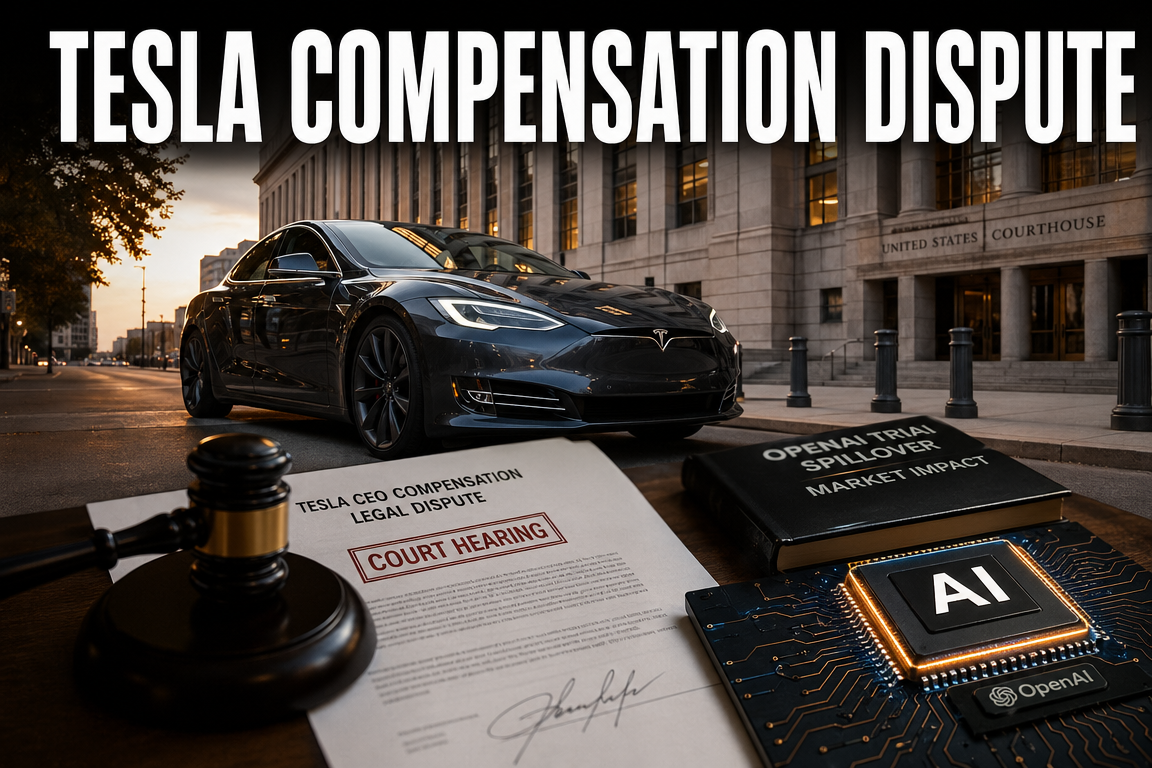
Musk’s Stake Confirmed at 20.3%, Effectively Closing Tesla’s Eight-Year Compensation Dispute The Real Drivers Behind the Rebound to $378 and the Concurrent Market Shock from the OpenAI Trial
This development is not simply “Musk received more shares.” Key points include: intraday volatility of nearly 4%; the governance implications of Musk’s final 20.3% stake; the practical impact of Tesla’s Texas charter provisions that raise barriers to shareholder litigation; and how the OpenAI court proceedings on the same day may affect Tesla, broader US equities, and large-cap tech sentiment. The “3% litigation threshold” and the resulting structural shift in governance risk are central to the market’s assessment.
1. What Happened in the Market Today
Tesla closed at $378.67, modestly higher versus the prior session.
The close does not capture the full trading dynamic. Shares fell to roughly $364 intraday (nearly -4%) before recovering through the afternoon and finishing positive.
This pattern suggests the market simultaneously priced positive and negative implications within the same news flow.
On the positive side, an eight-year compensation overhang moved toward an institutional resolution, reducing uncertainty.
On the negative side, investors continued to weigh accounting costs associated with large equity awards, potential EPS pressure, and broader EV demand and macro uncertainty.
2. Why a Single SEC Filing Mattered
The focal point was a share registration filing with the SEC, generally understood as the formal registration process for equity issued for employee/management compensation.
Some commentary framed the filing as abrupt, but the more relevant point is sequencing: after the board and Musk signed an implementation agreement, Tesla proceeded quickly to SEC registration within days.
This indicates progression from intent to execution.
For markets, that is a signal that the matter is approaching closure. In US equities, reduced legal/structural uncertainty often compresses risk discounts.
3. Award Size: Key Numbers
The filing covers approximately 303.96 million shares. At current prices, implied value is roughly $114.6 billion.
The award reflects the outcome of the 2018 compensation package. Tesla replaced cash salary/bonus with a structure tied to market-cap and operational milestones, delivering large option grants upon achievement.
The strike price is reported at approximately $23.34 per share on a split-adjusted basis. With the stock near $378, the economic leverage is substantial.
This is a material transfer of value rather than a routine compensation event.
4. Musk’s Final Stake at 20.3%: Governance Significance
While reported figures varied, the key point is Musk’s Tesla ownership rising to approximately 20.3%.
At this level, Musk’s influence extends beyond that of a typical largest shareholder and materially strengthens his control over strategic direction.
Voting power is central. For a founder-led company with long-duration programs (autonomy, robotics, energy, AI infrastructure), leadership continuity is frequently embedded in valuation.
Stake expansion can be viewed in two ways: near-term dilution and “excess compensation” criticism versus a lower probability of leadership exit and greater strategic continuity.
Investor interpretation will depend on whether enhanced founder control is treated as governance risk or as stability for long-horizon execution.
5. Market Relief: The Prior 96 Million-Share Interim Award Was Removed
A significant concern was whether the previously discussed interim award of roughly 96 million shares would remain in effect in addition to the 2018 package.
Based on disclosed documentation, that component appears effectively forfeited rather than preserved in parallel.
In practical terms, the outcome does not appear to include stacking an “emergency” package on top of the 2018 package.
Markets generally responded favorably to clearer boundary-setting versus an open-ended pattern of incremental demands.
6. The Next Issue: A New 10-Year Compensation Package
This event does not necessarily end the broader compensation debate. A separate long-term structure approved at the shareholder meeting last November remains relevant.
That plan is linked to targets up to a $1 trillion scale and is described as up to roughly 420 million shares, vesting over approximately 10 years as milestones are achieved.
Combined with the 2018 package, the potential future share accumulation is materially larger.
Accordingly, the news functions both as a resolution of past compensation and a starting point for further long-term control consolidation.
7. Under-Discussed Core Point: Texas Charter “3% Litigation Threshold”
A pivotal, less-emphasized development is Tesla’s charter amendment following the relocation of its headquarters to Texas.
One key provision requires a shareholder to hold at least 3% of shares to bring certain legal challenges, including those related to compensation.
This threshold is effectively unattainable for retail investors and difficult for many institutions to meet independently.
Historically, the litigation that overturned the 2018 package originated from a small-shareholder action rather than a large institutional filing.
The revised structure materially reduces that avenue of external judicial constraint.
This is not a technical legal footnote; it implies a shift from a model with meaningful external litigation checks to a more internally consolidated governance framework.
- Supportive view: lower litigation risk, improved managerial stability, stronger long-term execution capability
- Critical view: weaker board independence, reduced minority shareholder protections, excessive founder power concentration
Investors increasingly need to evaluate governance premium/discount alongside operating performance.
8. Why Near-Term Volatility Was Likely
The event is not unambiguously positive.
First, recognition of compensation expense can create EPS headwinds over upcoming quarters.
Second, Tesla faces a less favorable demand backdrop: intensified China competition, softer European demand, competitive pressure versus BYD, and pricing strategy constraints.
Third, US equity valuation remains sensitive to large-cap tech earnings and the rate path. Fed policy and Treasury yields directly affect growth-stock multiples.
Tesla’s share price therefore reflects both company-specific factors and broader macro/tech risk appetite.
9. Why Long-Horizon Investors May Interpret the Event Differently
For investors with a 5+ year horizon, the dominant factor may be reduced uncertainty.
- Compensation structure has been re-clarified
- CEO retention incentives strengthened
- Awarded shares are subject to sale restrictions
- Additional packages remain performance-linked and long-duration
- External litigation risk appears materially reduced
These factors tend to support long-term strategic execution rather than near-term earnings optics.
If Tesla is revalued as a platform spanning autonomy, robotaxi, Optimus, energy storage, and AI infrastructure rather than as a pure auto OEM, market framing may shift accordingly.
The primary investment debate is increasingly centered on Tesla’s positioning in AI/robotics-led industrial transformation rather than near-term EV unit growth.
10. The OpenAI Trial on the Same Day: Why Tesla Investors Should Monitor It
On the same day, proceedings involving Elon Musk, Sam Altman, and OpenAI began in US federal court in Oakland, California.
The case addresses AI industry ownership structures, the legitimacy of transitions from nonprofit to for-profit models, the Microsoft-OpenAI relationship, and governance power in generative AI.
The trial may extend for weeks, and Musk testimony has been discussed.
This can drive incremental Tesla volatility because markets increasingly price Musk across a bundled set of exposures: Tesla, xAI, SpaceX, X, and high-profile litigation.
11. What Musk’s Claimed Amount Signals
Reported claims range from roughly $79 billion to $134 billion.
The magnitude is notable relative to initial funding.
The key market implication is less the cash outcome than the legal validation of principles: whether OpenAI’s original nonprofit public-interest purpose conflicts with its current commercial structure.
The case therefore functions as a governance and legitimacy challenge for the AI sector, not solely a damages claim.
12. Why Microsoft Internal Emails Are Being Highlighted
A frequently cited element is historical Microsoft internal email material.
If interpreted as evidence that potential conflicts with prior commitments were recognized internally at the time, such documents could influence fact-finder perceptions.
However, litigation outcomes are rarely determined by a single document; proceedings are typically more complex than media summaries.
Markets nevertheless trade narrative direction, so these references may continue to be used as supportive context for Musk’s claims.
13. Scenario: Musk Receiving 10% of OpenAI Equity
Speculation suggests a potential outcome where Musk could receive a significant equity position.
This cannot be categorically ruled out, but it is premature to treat as a base case.
Courts can impose remedies including damages, structural remedies, or injunctive relief. OpenAI’s multi-layered structure further complicates any direct “equity transfer” framing.
A broader takeaway is that if the case catalyzes rule-setting for AI governance, competitive dynamics across generative AI could be affected.
14. Key Items for Tesla Investors to Track
Four-Point Checklist
1) Near-term earnings and EPS sensitivity Compensation expense recognition, slower auto sales, and pricing policy changes remain near-term pressures.
2) Governance structure changes Musk’s ~20.3% stake and the 3% litigation threshold are central to future governance debates.
3) Long-term growth narrative validation Monitor whether FSD, robotaxi, Optimus, and energy translate into measurable financial outcomes.
4) Expansion of Musk-specific headline risk OpenAI litigation, xAI competition, political commentary, and issues across other entities may influence Tesla’s valuation indirectly.
15. News-Style Key Takeaways
– Tesla rebounded from an intraday selloff to close near $378. – The catalyst was SEC disclosure and increased confidence in implementation of Musk’s compensation package. – Musk is positioned to receive ~304 million shares, lifting ownership to approximately 20.3%. – The previously discussed 96 million-share interim award does not appear to be additive. – The primary structural change is Tesla’s Texas charter, introducing a 3% shareholder threshold for certain lawsuits. – This reduces minority-shareholder legal leverage while potentially improving managerial stability. – The OpenAI trial commenced the same day, testing AI ownership/governance and nonprofit principle issues. – Trial developments and potential Musk testimony may add volatility to Tesla and broader tech sentiment.
16. Highest-Impact Points Often Underemphasized in Media
First, the core issue is not “Musk got paid,” but the institutional entrenchment of a founder-centered governance model.
Second, the 3% litigation threshold is likely to be a decisive variable in future governance premium/discount and may influence institutional positioning.
Third, the event should be framed within a longer-duration contest spanning AI, robotics, autonomy, and energy, not solely as an auto-sector headline.
Fourth, the OpenAI trial is a test case for generative AI governance and large-cap tech power, potentially re-accelerating regulatory and policy debate depending on outcomes.
17. Bottom Line: Bullish or Bearish
Near term, the net impact appears broadly neutral with elevated volatility risk, given earnings sensitivity, cost recognition, and ongoing EV demand concerns.
Long term, the event reduces legal uncertainty, strengthens leadership retention incentives, and may increase strategic execution capacity in AI- and robotics-adjacent initiatives.
The market’s central question is whether a Tesla with greater Musk control can credibly translate long-duration innovation into sustained leadership and value creation.
< Summary >
Musk’s stake rising to approximately 20.3% represents a governance reconfiguration rather than a routine compensation headline. SEC registration indicates the 2018 package is moving toward completion, and concerns about additive interim awards have eased. The critical structural change is Tesla’s Texas charter provision requiring at least a 3% shareholding to pursue certain lawsuits, materially reducing minority-shareholder legal leverage and reshaping governance risk. Near-term EPS and demand pressures remain, while longer-term interpretations may emphasize leadership continuity and improved strategic execution conditions. In parallel, the OpenAI trial challenges AI-sector ownership and nonprofit-to-commercial governance, with potential spillovers to Tesla volatility and broader AI risk sentiment.
[Related Posts…]
Tesla earnings and share-price dynamics: core points to reassess now
OpenAI restructuring and the generative AI competitive landscape: summary of big-tech power shifts
*Source: [ 오늘의 테슬라 뉴스 ]
– 머스크 지분 20.3% 확정 — 8년 끌어온 보상 패키지가 끝났다, $378 주주는 어떻게?
● Samsung-SK hynix-earnings-shock-AI-boom
KRW 57T Operating Profit at Samsung Electronics; 72% Operating Margin at SK hynix — The Key Factor at Current Prices Is Elsewhere
This development should not be framed as a simple “strong earnings” story. The critical issues are: (i) what drove the outsized results, (ii) how the HBM-driven memory structure differs from prior super-cycles, and (iii) why equity performance is often more sensitive to decelerating growth rates than to record absolute profits. The relevant framework distinguishes “industry time” from “equity market time,” particularly in the current AI semiconductor cycle.
1. Why the Market Reacted So Strongly to This Earnings Print
Samsung Electronics and SK hynix both delivered results above consensus, renewing investor focus on Korean semiconductors domestically and globally.
- Scale matters: Samsung Electronics’ 1Q operating profit was cited at approximately KRW 57 trillion, comparable to its 2018 full-year operating profit (~KRW 58 trillion) at the prior peak cycle. This indicates a materially higher earnings capacity versus past cycles.
- SK hynix profitability was exceptional: An operating margin of 72% is unusual for manufacturing businesses, and commentary suggested its gross margin exceeded NVIDIA’s. This reflects strong pricing power by suppliers addressing key AI infrastructure bottlenecks—most notably HBM.
2. Why SK hynix Outperformed Samsung Electronics on Profitability
The primary driver is business mix.
2-1. SK hynix is More Concentrated in the Highest-Margin Segment
SK hynix has higher exposure to HBM, currently the most profitable segment within the AI semiconductor ecosystem. Samsung Electronics has a broader portfolio spanning memory, non-memory, displays, and device businesses. As a result, Samsung’s consolidated margins are less concentrated in the highest-margin product line.
2-2. HBM Is a Bottleneck-Relief Component in the AI Era
HBM is not merely a higher-end DRAM variant. In AI systems—especially GPU-centric architectures—high-bandwidth memory materially affects throughput and power efficiency. As AI training and inference workloads scale, HBM becomes a gating component, elevating suppliers from component vendors to ecosystem enablers.
2-3. Commodity Memory vs. HBM: Fundamentally Different Earnings Quality
- Commodity DRAM: Highly cyclical; pricing is volatile and sensitive to marginal changes in supply-demand balance.
- HBM: More contract-driven and often customer-specific, with a higher share of pre-negotiated volume/price terms. This can reduce spot-price sensitivity and improve earnings stability relative to commodity memory.
3. How This Semiconductor Super-Cycle Differs From Prior Cycles
This cycle should not be interpreted as a repeat of PC, smartphone, or conventional cloud capex cycles.
3-1. Prior Cycles Were Quantity-Driven (Q); This Cycle Is More Price/Mix-Driven (P)
Historically, super-cycles were driven by demand surges, followed by capacity expansion and subsequent oversupply. In contrast, the current cycle is characterized by rising ASPs and mix shift toward high-value products such as HBM, driving margin expansion even without proportional unit growth.
3-2. FX Has Amplified Reported Results
A high KRW/USD level increases KRW-reported revenue and profit for exporters. The impact is more pronounced when combined with favorable product mix and pricing, helping explain the magnitude of SK hynix’s profitability.
4. Core Question: Do Record Earnings Imply Continued Share Price Upside?
Equity markets do not price absolute earnings alone; they often price the rate of change.
4-1. Industry Perspective vs. Equity Market Perspective
From an industry standpoint, momentum may persist into 2Q and 3Q. Commentary referenced potential Samsung Electronics 2Q results exceeding KRW 80 trillion and annual revenue figures being discussed at KRW 300 trillion+ for Samsung Electronics and KRW 200 trillion-low range for SK hynix.
However, equity markets tend to react more to inflections in growth than to record levels.
4-2. Share Prices Often React First to Growth Deceleration
If DRAM contract prices rose +96% QoQ in 1Q and then rose again in 2Q but at +60% QoQ, earnings may still improve, yet the market can interpret the change as growth deceleration, limiting price momentum.
4-3. Why Shares Can Decline Despite Strong Earnings
When expectations and valuation already discount stronger outcomes, results that are “good but less surprising than priced in” can trigger profit-taking and volatility. This dynamic is particularly relevant in sectors with high expectations and rapidly shifting multiples, such as semiconductors.
5. How to Frame 2Q–3Q Equity Outlook
Earnings are likely to remain strong near term, but price action will depend on how the market interprets deceleration risk and forward guidance.
5-1. Near-Term: Earnings Momentum Likely Intact
AI demand, data center build-outs, and large-cap tech capex trends may continue to support expectations through at least 2Q.
5-2. Late June to July and Beyond: Interpretation Risk Increases
Markets will shift focus from trailing prints to:
- Forward guidance and implied growth rates
- HBM capacity expansion and supply response
- Sustainability of hyperscaler capex
- Valuation constraints
At that stage, capital-market narratives can dominate industrial newsflow.
6. Why This Cycle May Be Less Prone to a Rapid Downturn Than Past Cycles
6-1. Demand Has Shifted From B2C to B2B
Prior cycles relied heavily on consumer electronics, which are more sensitive to macro slowdowns. The current driver is AI infrastructure—data centers, cloud, hyperscalers—where spending is more strategic and less tied to short-term consumer replacement demand.
6-2. Big Tech AI Competition Provides a Structural Floor
Major platforms (Microsoft, Amazon, Google, Meta) face strategic risk if they underinvest in AI. This competitive dynamic can make AI infrastructure capex more resilient, even amid broader economic moderation.
7. Samsung Electronics vs. SK hynix: Differentiated Investment Frameworks
7-1. Samsung Electronics: Scale and Optionality
Samsung’s broad portfolio reduces pure-play HBM exposure but offers potential re-rating if it demonstrates progress in:
- HBM competitiveness and delivery execution
- Higher-value memory mix shift
- Foundry performance improvement
For Samsung, market confidence in the pace of AI-memory repositioning may matter more than a single-quarter earnings headline.
7-2. SK hynix: Current High-Profitability Benchmark
SK hynix most directly reflects the market’s preferred AI-memory narrative: HBM leadership and exceptional profitability. However, higher embedded expectations raise sensitivity to incremental upside versus consensus and to any evidence of margin normalization.
8. Key Points (News-Style Summary)
8-1. Earnings Snapshot
Both companies have entered a peak earnings phase; SK hynix stands out due to HBM-driven mix and unusually high operating margins.
8-2. Industry Interpretation
This cycle is structurally more mix/price-led (HBM) than volume-led, distinguishing it from prior super-cycles.
8-3. Equity Interpretation
While earnings may remain strong, share prices can become more volatile as the market prioritizes growth-rate deceleration risk over absolute profit levels.
8-4. Macro Variables
A favorable FX backdrop, rising big tech capex, and intensified AI infrastructure competition are currently supportive and may influence broader Korean equity and macro conditions given semiconductor index weights.
9. Underemphasized but Material Considerations
9-1. Earnings Peak vs. Share Price Peak Can Diverge
Equities frequently peak before reported earnings peak. When earnings narratives are most widely circulated, markets may already be shifting focus to deceleration and valuation.
9-2. This Is Less a “Good Cycle” Than a “Long Competition”
AI semiconductors increasingly function as both cyclical assets and strategic infrastructure, tied to long-duration platform competition and supply-chain positioning.
9-3. Relative Leadership Can Rotate by Phase
In the current high-margin HBM phase, SK hynix is advantaged. If Samsung demonstrates visible improvement in HBM competitiveness and execution, relative performance could change as the market discounts the next phase.
10. Investor Checklist (Key Questions)
1) How much additional upside remains in HBM pricing and shipments?
2) Will big tech AI data-center capex remain durable beyond 2025?
3) What is the pace of Samsung’s HBM competitiveness recovery?
4) How sustainable are SK hynix’s current margins given contract structures?
5) What level of expectations is already embedded in valuations?
< Summary >
Samsung Electronics and SK hynix are benefiting from AI semiconductor demand and HBM-driven mix shift, resulting in historically strong earnings. SK hynix’s HBM concentration has produced exceptionally high operating margins. However, equity performance typically responds more to changes in growth rates than to record absolute earnings, implying higher sensitivity to deceleration and expectations. Unlike prior cycles, this phase is supported by B2B AI infrastructure demand and sustained platform competition, potentially extending the cycle. Investors should prioritize growth rates, expectations, HBM competitiveness, and big tech capex durability over headline earnings figures.
[Related Articles…]
- https://NextGenInsight.net?s=semiconductors
- https://NextGenInsight.net?s=AI
*Source: [ 경제 읽어주는 남자(김광석TV) ]
– 삼성전자 57조, SK하이닉스 72% 영업이익률…향후 주가는 어떻게 움직일까? | 경읽남과 토론합시다 | 이형수 대표 [1편]