
● Samsung Shifts White Goods Strategy
The news prepared for today is a massive breaking story related to the ‘home appliances’ you use every day.It is not simply a story about a certain product being discontinued.If you read this single article to the end, you will understand the real reason why Samsung Electronics is closing its core point factories and attempting to give up white goods after 50 years.In particular, while news and YouTube conventionally just say ‘pushed out by China’, I will deliver the hidden key takeaway insights regarding the transition to an Apple-style business model and evolution into a platform company taking place behind the scenes.Today’s key takeaway news briefing that will broaden our investment and business horizons starts right now.
[News Briefing] Samsung Electronics Carries Out Home Appliance Business Restructuring After 50 Years
1. What and How Will It Change? (Massive Surgery on Production Lines)
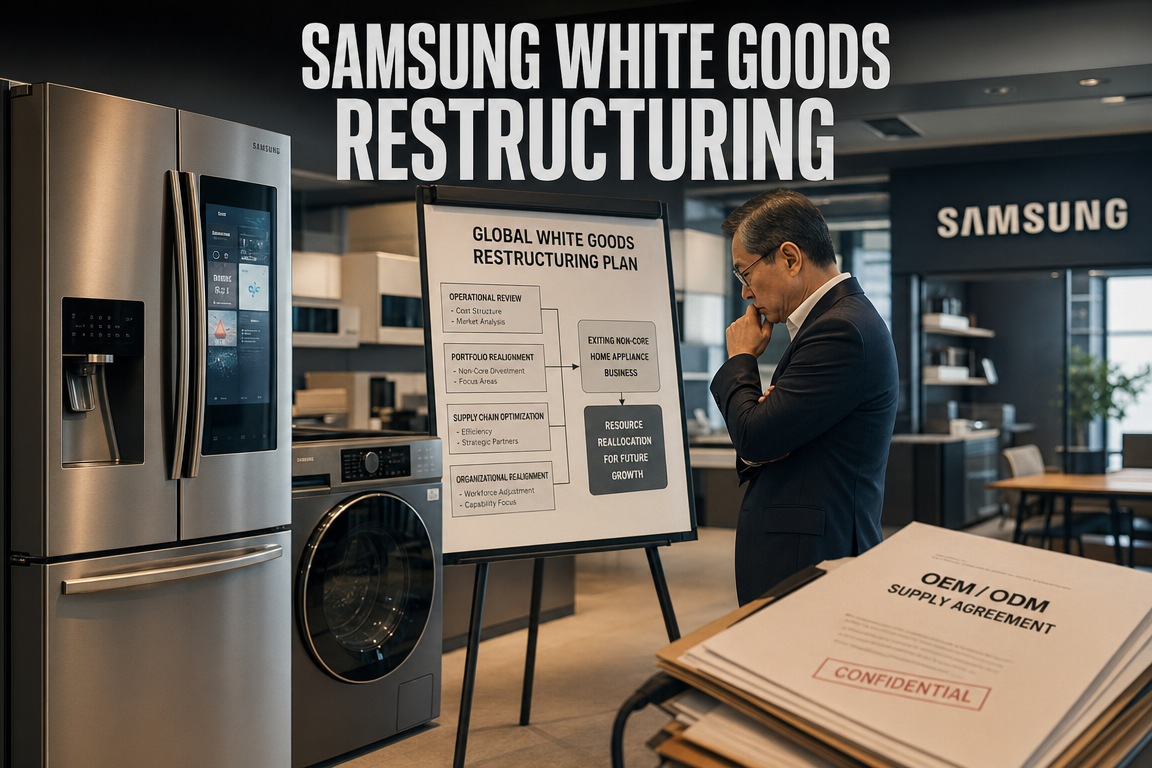
Samsung Electronics has decided to completely halt the direct production of small and medium-sized home appliances such as dishwashers and microwaves.Now, these products will not be directly made by Samsung, but will be 100% transitioned to outsourced manufacturing (OEM/ODM) methods.It is not simply about clearing out domestic lines; the manufacturing plant in Malaysia, which was a core point hub in Asia, has also entered the process of being liquidated.This is a massive decision that fundamentally changes Samsung’s direct manufacturing constitution, which has been maintained for a staggering 50 years.Moving forward, the company’s capabilities will be concentrated solely on the ‘large premium white goods’ lineup with high profit margins, such as refrigerators, washing machines, and air conditioners.
2. Why Was This Decision Made? (Cost Burden and Intensifying Global Competition)
The most direct cause is precisely the ‘low-price offensive’ of Chinese home appliance companies that are fiercely rising.Due to the upward standardization of technological prowess, it has become difficult to justify expensive prices based solely on a premium brand in the small and medium-sized home appliance market.On top of this, profitability has significantly deteriorated as cost burdens from rising labor costs and skyrocketing raw material prices have overlapped.To survive amidst uncertain global economic outlooks, they have chosen a ‘selection and concentration’ strategy, boldly cutting off unprofitable businesses and focusing on lucrative areas.
3. What Are the Hidden Internal Risks? (Labor-Management Conflict and Management Uncertainty)
Amidst such rapid changes, internal growing pains are also quite severe.In the process of closing and downsizing production lines, restructuring issues are inevitably bound to occur.Currently, internal dissatisfaction is escalating as controversies over reduced performance bonuses coincide with the possibility of labor union strikes.Behind the positive goal of improving the company’s constitution, such labor-management conflicts are emerging as a major variable that could increase future management uncertainty.
[Core Point Analysis] The Real Intentions Other Media Never Tell You (Next Level Insight)
1. Evolution from a Hardware Manufacturer to a ‘Platform Design Company’
YouTube and news simply package this situation as ‘cost reduction’ or ‘the humiliation of being pushed out by China’.However, reading the flow of business from our perspective as working professionals, this is a highly sophisticated strategy that directly benchmarks the path Apple has taken.Apple does not directly assemble iPhones but outsources to Foxconn, while the headquarters focuses only on design, software, and brand value.Samsung Electronics is also stepping into a phase of manufacturing innovation, handing over the ‘simple assembly production’ of low-margin products to outsourcing, and focusing on key takeaway technology development and brand marketing.Now, Samsung intends to evolve not as a home appliance ‘manufacturer’, but as a ‘platform designer’ that connects home appliances.
2. The Future Home Appliance Ecosystem Dominated by Smart Homes and Artificial Intelligence
The common point of the refrigerators, washing machines, and air conditioners they decided to keep this time is that they are large devices serving as ‘main hubs’ inside the house.The real ulterior motive is to dominate the smart home ecosystem that controls all devices in the house by actively combining the latest AI trends with these large devices.They will cheaply make small and medium-sized appliances through outsourcing, but ensure that all these devices connect to Samsung’s large AI appliances and the ‘SmartThings’ app.Ultimately, the home appliance market in the era of the Fourth Industrial Revolution is not a battle of who makes devices well, but a battle of who dominates software and data.
3. A Meticulous Survival Strategy Prepared for Geopolitical Risks
Withdrawing the Malaysian factory is also not simply an issue of labor costs alone.Amidst the massive trend of global supply chain reorganization currently underway worldwide, they are preemptively clearing out hubs with declining efficiency.There is a meticulous calculation underlying this to flexibly cope with geopolitical crises by relocating global factories, and to save capital to reinvest in core point businesses that will truly become future sources of income, such as AI semiconductors.
< Summary >
- Samsung Electronics halts direct production of small and medium home appliances like dishwashers and microwaves, transitioning to outsourcing (OEM/ODM).
- Carries out massive home appliance business restructuring after 50 years, including the withdrawal of the Malaysian production hub.
- Reorganizes business centering on ‘large premium home appliances’ to respond to China’s low-price offensive and reduce costs.
- Evolves into an Apple-style strategy where hardware assembly is outsourced, and the headquarters focuses on AI, design, and platforms.
- Possibility exists that labor-management conflicts and strike risks will act as short-term management uncertainties.
[View Related Articles]
- Samsung Electronics AI Ecosystem Expansion and the Future of Smart Homes
- Restructuring Survival Strategies of Tech Companies Amidst Global Crises
*Source: 서울경제TV