● AI-Driven-Selloff,Geo-Risk,Inflation-Fears
Comprehensive Summary of the SK Hynix, Samsung Electronics, and KOSPI Sell-Off: The Underlying Drivers Behind the May 12 Market Dislocation
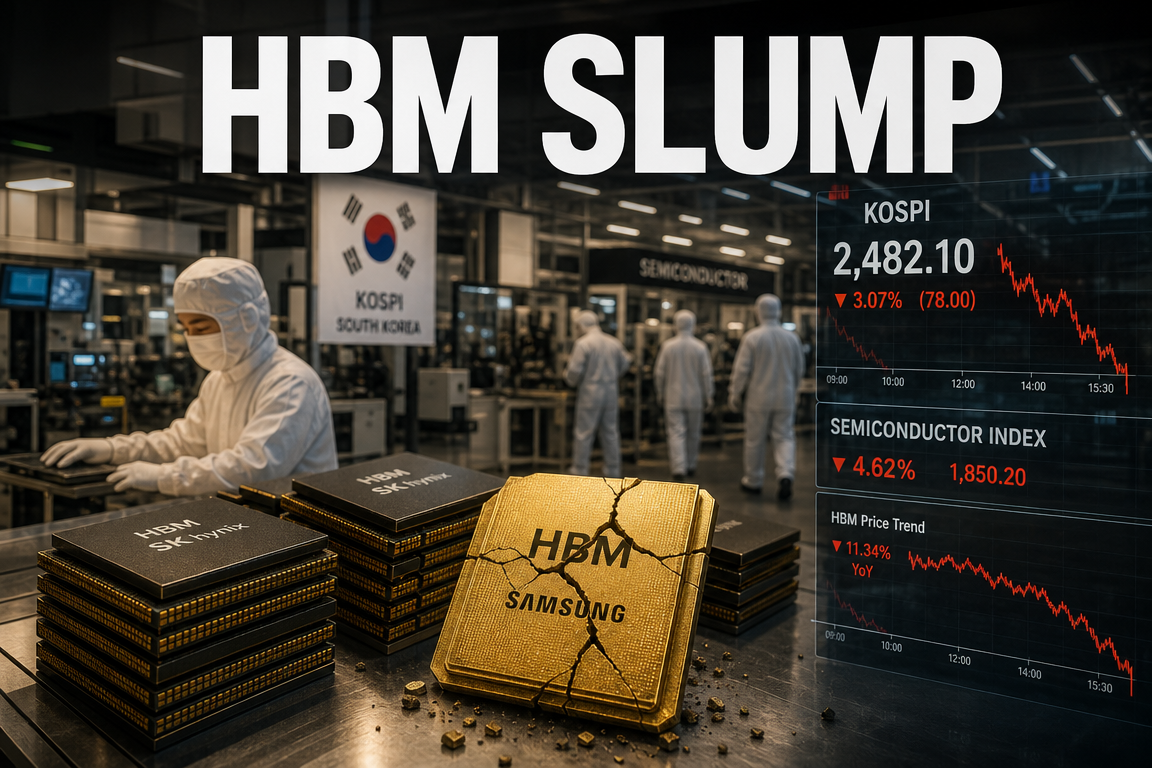
The market decline should not be interpreted as a brief pullback limited to large-cap semiconductors. The move reflected a simultaneous convergence of (i) misinterpretation of AI-related policy remarks, (ii) profit-taking flows, (iii) Middle East geopolitical risk, (iv) positioning ahead of US CPI, and (v) instability in foreign investor flows.
While much of the coverage focused on “Samsung Electronics and SK Hynix fell,” the primary trigger was the market’s sensitivity to a perceived risk of incremental taxation on AI-related companies. Volatility expanded on the misunderstanding, and intraday losses partially retraced after clarifications were issued.
This report consolidates: why the “AI tax” misunderstanding generated outsized impact; why Samsung Electronics and SK Hynix were hit first; why US inflation risk and geopolitics amplified the move on the same day; and the key interpretation that is often omitted in mainstream coverage.
1. What happened in the domestic equity market on May 12
On May 12, Korean equities faced strong intraday downside pressure. Selling was concentrated in semiconductor bellwethers such as Samsung Electronics and SK Hynix, rapidly weakening risk sentiment.
The decline was not attributable to a single factor. Multiple headwinds overlapped, with the most sentiment-sensitive catalyst being policy remarks that escalated into an AI-related taxation controversy.
- Remarks emerged suggesting that excess tax revenues generated by the AI boom could be returned to the public
- Some investors interpreted this as potential “special taxation” on AI companies
- Selling intensified across semiconductors and AI beneficiaries
- The KOSPI fell sharply intraday and volatility increased
- Losses partially narrowed after a policy office clarification reduced perceived policy risk
In effect, the drawdown aligned more with policy-interpretation risk than with deterioration in earnings or industry structure.
2. The most direct catalyst: misunderstanding around a potential “AI special tax”
The core catalyst was a comment attributed to the presidential policy office. The statement, framed around returning incremental tax receipts associated with the AI boom to the public, was rapidly and negatively interpreted by the market.
From an investor perspective, the implication could be read as: “If AI-related industries are generating outsized profits, the government may seek additional taxation on the sector.”
In the Korean market, the principal AI proxy is effectively large-cap semiconductors. Samsung Electronics and SK Hynix are widely viewed as central beneficiaries of AI server demand via memory and HBM. As a result, they became the primary selling targets once policy uncertainty increased.
A subsequent clarification indicated the remarks did not imply a new AI tax, but rather referenced using naturally higher tax receipts arising from economic expansion. Following this clarification, the market stabilized to an extent and losses partially retraced.
However, the initial dislocation had already occurred. Equity markets typically react faster to perceived policy direction and interpretation than to the policy substance itself.
3. Why Samsung Electronics and SK Hynix were hit harder
The magnitude of the declines in Samsung Electronics and SK Hynix was not solely a function of market capitalization. The two names are regarded as the most direct Korea-listed exposure to AI-related demand.
- HBM-led AI semiconductor expectations were already meaningfully priced in
- Higher foreign and short-term trading participation increased sensitivity to headline risk
- Large index weights mechanically amplified KOSPI downside when these names sold off
- Recent outsized gains increased incentives for profit-taking
Given that semiconductors have been a leading global theme, even modest negative catalysts can prompt rapid de-risking and realization of gains.
Overall, the declines reflected a combination of: policy misinterpretation, elevated valuation sensitivity, short-term flow dynamics, and a moderation of previously extended AI optimism.
4. Secondary driver: profit-taking after an extended rally
This factor is structurally important. Large drawdowns often require a catalyst, but the magnitude is typically larger when positioning is crowded and prices have risen materially.
Samsung Electronics and SK Hynix had sustained strong performance on expectations of: an earnings inflection, improving memory cycle dynamics, HBM supply competitiveness, and perceived spillover benefits tied to Nvidia-related demand.
In such conditions, incremental uncertainty tends to trigger accelerated profit-taking, increasing sell volume and expanding intraday downside.
Accordingly, the move is better characterized as a near-term risk reset and pace adjustment, rather than a fundamental impairment.
5. Third driver: geopolitical risk rose following Trump’s Iran-related remarks
Based on Bloomberg reporting, geopolitical risk was another key axis. Remarks indicating consideration of potential conflict involving Iran contributed to a risk-off tone in global markets.
Heightened Middle East risk typically raises simultaneous concerns regarding:
- Potential spike in crude oil prices
- Inflation re-acceleration risk
- Reduced confidence in the timing of US rate cuts
- Increased demand for safe-haven assets
- Broader de-risking across equities
Korean equities are highly sensitive to external risk factors. Cyclical and globally exposed sectors, including semiconductors, are often sold first during risk-off episodes.
Therefore, the semiconductor sell-off reflected not only domestic policy uncertainty but also global macro risk repricing.
6. Fourth driver: positioning and caution ahead of US CPI
The market’s sensitivity was also elevated by the impending US CPI release. Investors were positioned defensively due to concerns that inflation could re-emerge above expectations.
US CPI matters because upside inflation surprises can delay Federal Reserve rate cuts and compress equity valuations globally.
- Higher CPI -> risk of prolonged restrictive policy stance
- Weaker rate-cut expectations -> increased pressure on growth and semiconductor valuations
- Stronger USD potential -> higher risk of foreign outflows
- Weaker KOSPI sentiment -> deeper adjustment in large-cap technology
AI- and semiconductor-linked equities, which embed longer-duration growth expectations, are typically more rate-sensitive. As a result, headline risk can be magnified into larger price moves near major macro releases.
7. One-page, news-style consolidation of the drivers
(1) Policy factor
Remarks from the presidential policy office were interpreted as tightening AI-related taxation. Subsequent clarification reduced concern, but intraday volatility had already expanded materially.
(2) Flow and positioning factor
After a significant rally, profit-taking accelerated. Foreign and short-term trading flows responded quickly to headline risk.
(3) Global risk factor
Trump’s Iran-related remarks elevated geopolitical risk, strengthening global risk-off sentiment and adding pressure to the KOSPI and semiconductor complex.
(4) Macro factor
Ahead of US CPI, inflation concerns intensified. The possibility of delayed rate cuts increased downside pressure.
8. The most important point often omitted in other coverage
The critical issue is not whether a new tax is immediately implemented. From the market’s perspective, the more consequential signal is how policymakers view AI-sector excess profits.
This matters because AI and semiconductors are the primary premium sectors in Korea. If official messaging is interpreted as “large gains should be socially redistributed,” markets may infer:
- Potential for future regulatory tightening
- Shift in the balance from incentives to burdens
- Risk of a valuation discount applied to AI proxy earnings estimates
- Emergence of a Korea-specific policy discount
The central mechanism was policy communication risk. This is not directly observable in near-term fundamentals, and is therefore frequently underweighted in commentary, despite its importance to risk premia.
Markets price not only policy, but also perceived policy trajectory and messaging tone. The episode is best interpreted as a temporary repricing of uncertainty around how market-friendly the AI industrial growth framework will be.
9. Key monitoring items going forward
(1) Follow-on policy communication
Assess whether the incident remains isolated or evolves into broader debate on taxation, redistribution, or industrial policy. Additional remarks could reintroduce volatility in semiconductor sentiment.
(2) US CPI outcome
A downside CPI surprise could reframe the sell-off as an overreaction. An upside surprise could increase the probability of further adjustment in semiconductors and growth equities.
(3) Middle East developments and crude oil
If Iran-related risk escalates, oil and inflation expectations may rise again, increasing global equity volatility.
(4) Semiconductor fundamentals
The key variable is demand and earnings trajectory rather than the single-session drawdown. If HBM demand, AI server capex, memory pricing, and major customer order visibility remain intact, the move is more consistent with sentiment-driven volatility.
10. How to interpret the sell-off
In summary, the May 12 decline was a multi-factor adjustment rather than a single-catalyst event.
- Policy remarks misinterpreted as AI-targeted taxation
- Profit-taking after an extended rally
- Geopolitical risk following Iran-related remarks
- Inflation caution ahead of US CPI
These factors overlapped, pressuring Samsung Electronics, SK Hynix, and the broader KOSPI. The partial retracement after clarification indicates that policy interpretation risk was the most sensitive immediate trigger. For Korea’s AI and semiconductor complex, policy messaging and the gap between intent and market interpretation should be monitored alongside earnings fundamentals.
11. One-line conclusion
The decline was driven less by semiconductor earnings deterioration and more by policy-communication-driven uncertainty amplified by profit-taking, geopolitical risk, and pre-CPI macro caution.
< Summary >
The primary driver behind the May 12 declines in Samsung Electronics, SK Hynix, and the KOSPI was the misinterpretation of remarks about incremental AI-related tax receipts as a potential “AI special tax.” Clarifications reduced the perceived risk and narrowed losses, but volatility had already increased. The move was amplified by profit-taking after a sharp rally, heightened Middle East geopolitical risk linked to Iran-related remarks, and inflation caution ahead of the US CPI release. The core issue was not immediate fundamental impairment, but policy communication risk and a rapid deterioration in investor risk appetite.
[Related Articles…]
- Semiconductor cycle rebound and key drivers for KOSPI direction (https://NextGenInsight.net?s=semiconductors)
- Repositioning in AI beneficiaries: investment considerations for Samsung Electronics and SK Hynix (https://NextGenInsight.net?s=AI)
*Source: [ 내일은 투자왕 – 김단테 ]
– 하이닉스, 삼성전자 코스피 떡락 이유 (5월 12일)
● HBM Shock, Nvidia Margins, AI Supercycle
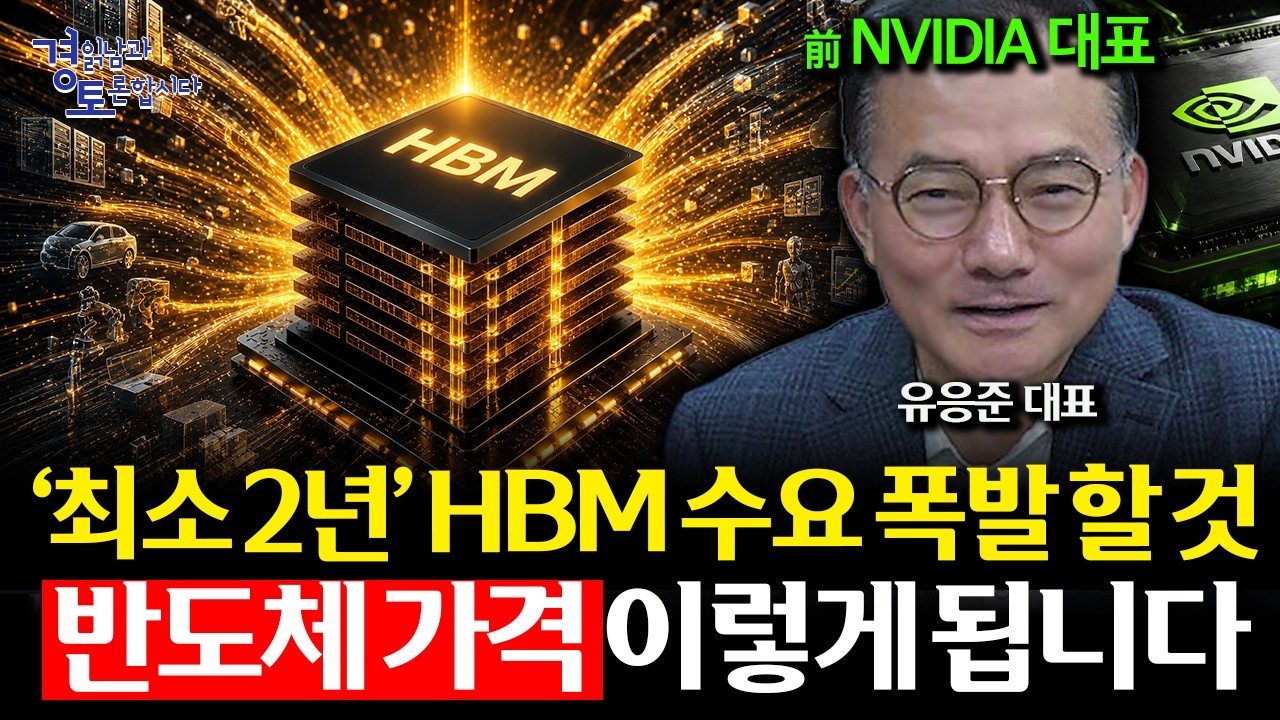
The Real Reason SK Hynix Posted Higher Margins Than NVIDIA, and the Key Variables of the HBM Supercycle
This report focuses on the underlying drivers of recent semiconductor earnings rather than the headline narrative of “strong results.”
It explains:
- Why SK Hynix was able to deliver margins higher than NVIDIA’s in a specific period
- Why price (P), not volume (Q), was the primary earnings driver this quarter
- What to monitor over the next two years across AI, data centers, and semiconductors
Key points often underemphasized in mainstream coverage are included:
- Pricing power created by an HBM supply bottleneck
- A structure in which NVIDIA’s accelerator roadmap effectively pre-signals memory-cycle demand
- Why the real economy and capital markets should be analyzed separately
1. Key Takeaways at a Glance
The central conclusion is that Q1 semiconductor earnings were driven more by price (P) than shipment volume (Q).
Revenue follows a P × Q structure. In this quarter, results improved primarily because P rose sharply, not because Q expanded significantly.
Price increases tend to lift operating margins disproportionately:
- With fixed costs largely unchanged, incremental pricing flows through to profit at a high rate.
- As a result, operating profit can grow faster than revenue.
This explains why, during a period of clear HBM supply advantage, SK Hynix could temporarily exhibit a higher margin profile than a leading downstream AI platform company.
2. Why SK Hynix Margins Exceeded NVIDIA’s
2-1. The Core Driver: An HBM Supply Bottleneck
HBM was the binding constraint in the AI infrastructure supply chain.
Even with strong GPU supply, AI servers cannot be completed without adequate HBM availability. The firm controlling the bottleneck gains superior pricing leverage.
At the time, HBM supply was effectively pre-allocated and rapidly absorbed, enabling SK Hynix to set more favorable pricing terms rather than merely selling into strong demand.
2-2. Price Growth Has Greater Profit Impact Than Volume Growth
Investors often conflate revenue growth driven by higher units with revenue growth driven by higher pricing. The operating profit impact differs materially.
If pricing rises while cost structure remains broadly stable, a substantial portion of the price uplift becomes incremental margin. This is why operating profit growth can outpace revenue growth.
In this quarter, “selling at higher prices” was more relevant than “selling more units.”
2-3. Even a Dominant Platform Can Lose Leverage at the Bottleneck Layer
NVIDIA typically maintains strong ecosystem and pricing influence. However, when a critical component is scarce, supplier leverage can shift upstream.
This cycle illustrates that value capture within AI hardware is sensitive to where the constraint resides, not only to downstream platform dominance.
3. Sustainability: Structural or Temporary?
3-1. Base Case: Not Permanent, but Likely to Persist Near Term
Excess margin conditions are unlikely to persist indefinitely:
- NVIDIA has incentives to diversify suppliers.
- Samsung Electronics and Micron are expected to expand competitiveness in HBM.
Overreliance on a single vendor increases procurement risk for the end customer. However, pricing leverage typically erodes gradually, not instantly.
A reasonable view is that elevated HBM demand may persist for roughly the next two years.
3-2. Why HBM Demand Could Remain Strong for at Least Two Years
The main support is NVIDIA’s product roadmap.
With next-generation accelerator families and subsequent product iterations communicated to the market, associated memory demand can be planned in advance.
Semiconductor supply chains operate on long lead times:
- Long-term agreements, pre-orders, capacity reservations, and qualification cycles
- Multi-quarter planning embedded in customer validation processes
Accordingly, roadmap visibility functions as an implicit demand signal for the memory and advanced packaging ecosystem.
4. Forward Earnings Driver: Price (P) or Volume (Q)?
4-1. Near Term: Price Remains the Primary Variable
To date, pricing has been the principal driver of earnings momentum. Whether volume can take over as the dominant driver is uncertain.
The key constraint is the pace of capacity expansion.
4-2. Why Q Is Unlikely to Scale Rapidly
HBM scaling is constrained by:
- Advanced packaging complexity
- Thermal management requirements
- Yield ramp limitations
- Customer qualification timelines
In addition, data center and fab expansion depend on practical infrastructure constraints:
- Power availability
- Water supply
- Land, permitting, and environmental regulation
Strong demand does not translate into immediate supply increases. This supports a scenario where pricing is more likely to remain elevated than to collapse rapidly.
4-3. Three Price Scenarios
Three broad paths are plausible:1) Continued price increases2) Stabilization at elevated price levels3) Partial normalization while remaining structurally high
The most probable outcome lies between (2) and (3): upside in price acceleration may be limited versus this year, but the absolute price level may remain resilient if supply remains constrained.
5. The Largest Variable: Micron and Supplier Diversification
5-1. Micron’s Entry Can Change Industry Economics
A key swing factor is Micron’s ability to scale competitive HBM and secure meaningful placement in NVIDIA’s supply chain.
If an additional qualified supplier ramps quickly:
- The bottleneck eases
- Customer bargaining power improves
- SK Hynix’s pricing leverage likely moderates
The current margin structure depends on near-monopolistic bottleneck conditions.
5-2. NVIDIA’s Incentive to Avoid Single-Vendor Dependence
From NVIDIA’s perspective, supplier concentration increases risk across:
- Pricing
- Delivery schedules
- Political and geopolitical exposure
- Supply-chain resilience
Over time, Samsung Electronics’ and Micron’s progress will be critical in determining how quickly excess industry margins normalize.
6. NVIDIA Fundamentals vs. Equity Performance
6-1. Real-Economy Strength and Capital-Market Pricing Diverge
NVIDIA’s business indicators remain strong:
- Visible roadmap
- Sustained demand
- Potential for continued earnings improvement
However, equity prices reflect more than fundamentals:
- Expectations already priced in
- Valuation constraints
- Interest rates
- Geopolitics and trade policy
- Market sentiment and risk premia
6-2. Recent Market Moves Were More Macro-Driven Than Earnings-Driven
Recent equity-market troughs were driven largely by macro and geopolitical risk, not by company-specific earnings deterioration.
Key factors included:
- Reciprocal tariff concerns
- US-China tensions
- FX volatility
- Treasury yield and oil price swings
In such regimes, strong earnings can coexist with muted stock performance. AI industrial momentum and equity returns should be evaluated separately.
7. Why NVIDIA’s Roadmap Acts as a Leading Indicator for the Memory Cycle
7-1. Accelerator Announcements Function as Demand Pre-Signals
NVIDIA’s next-generation product announcements are effectively forward indicators for:
- GPU demand
- HBM demand
- Packaging capacity
- Power and infrastructure requirements
HBM requires long design-in, qualification, and contracting cycles. As a result, NVIDIA’s roadmap is often interpreted as an earnings-cycle guide for memory suppliers and data-center capex.
7-2. Implications of “Trillion-Dollar Demand” References
Statements implying very large future demand suggest the AI infrastructure transition remains early-stage.
This points to continued capex needs across the stack:
- Memory
- Networking
- Power equipment
- Cooling
- Server racks and facility build-outs
8. Undercovered but Material Points
8-1. The Core Profit Mechanism Is the Bottleneck, Not the Theme
Broad AI growth does not guarantee uniform profit capture across the value chain.
Excess profits typically concentrate at the constraint point. In this cycle, HBM represented that constraint.
8-2. HBM Should Be Treated as a Strategic Asset, Not a Commodity DRAM Product
Conventional memory has been priced as a cyclical commodity. HBM differs due to:
- Customer qualification and ecosystem integration
- Yield and packaging dependence
- Tight coupling with platform roadmaps
This can alter how memory suppliers are valued versus traditional DRAM-cycle frameworks.
8-3. Supply Expansion Is Constrained by National Infrastructure, Not Only Technology
Many analyses focus on yield and process hurdles. Practical constraints are also decisive:
- Power-grid capacity
- Permitting and environmental constraints
- Data-center hosting capacity
AI-era competitiveness is increasingly linked to national-scale industrial infrastructure readiness.
9. What to Monitor: Investors vs. Industry Participants
9-1. Investor Framework
1) Separate earnings from equity performance; macro variables can dominate.2) Track both HBM demand persistence and the speed of supply diversification.3) Focus less on “AI bubble” debates and more on where pricing power resides.
9-2. Industry Framework
1) HBM likely retains strategic importance over the next ~2 years.2) Samsung Electronics’ and Micron’s catch-up pace can reshape industry profitability.3) Data-center and power infrastructure investment may become the primary limiting factor for AI expansion.4) Longer term, defense, robotics, and physical AI may emerge as incremental demand vectors.
10. One-Sentence Reframing
In the AI era, value capture can shift from the most visible platform to the supplier controlling the most binding bottleneck.
11. Final Checklist
- Q1 earnings were driven primarily by price, not volume.
- HBM supply constraints amplified SK Hynix’s margins.
- The excess-profit structure may not be permanent.
- HBM demand strength is likely supported for roughly the next two years by accelerator roadmaps.
- Supply expansion is constrained; price levels may be more likely to remain high than to collapse.
- The key variables are Micron/Samsung Electronics’ progress and the pace of power and data-center infrastructure build-out.
- For equities, incorporate macro and geopolitical factors alongside company fundamentals.
< Summary >
- SK Hynix’s elevated margins were enabled by HBM supply bottlenecks.
- This quarter’s semiconductor earnings were driven by pricing; operating profit grew faster than revenue.
- HBM demand may remain strong for at least ~2 years based on visible accelerator roadmaps.
- As supplier diversification progresses, current pricing power should gradually normalize.
- Investors should separate AI industrial momentum from equity-market dynamics and analyze semiconductors alongside data-center and power infrastructure constraints.
[Related Links…]
-
HBM demand surge: Conditions for sustaining the semiconductor supercycle
https://NextGenInsight.net?s=HBM -
Post-NVIDIA AI infrastructure strategy: Why data centers and power infrastructure matter
https://NextGenInsight.net?s=엔비디아
*Source: [ 경제 읽어주는 남자(김광석TV) ]
– 하이닉스가 엔비디아보다 마진이 높은 이유 | 경읽남과 토론합시다 | 유응준 대표 [2편]