● Tech Shock, AI Rout, Korea Slump
Why Samsung Electronics and SK Hynix Sold Off: A Shift in AI Semiconductor Risk Appetite Triggered by a Seagate Comment
Market focus centered on two questions: why Samsung Electronics and SK Hynix declined in tandem, and why the broader KOSPI weakened simultaneously.
The move was not primarily driven by new company-specific negatives in Korea. It reflected a convergence of (1) deteriorating sentiment toward US semiconductor and storage names, (2) changing interpretation of AI-related demand, (3) recalibration of memory-cycle expectations, and (4) valuation pressure from elevated US Treasury yields.
This report summarizes the immediate catalyst, the transmission mechanism into Korean memory equities, and the key variables investors should monitor.
1. What happened today: the starting point of the sell-off
The declines in Samsung Electronics and SK Hynix were primarily triggered by weakening risk appetite in US semiconductor and storage-related equities rather than new idiosyncratic developments in Korea.
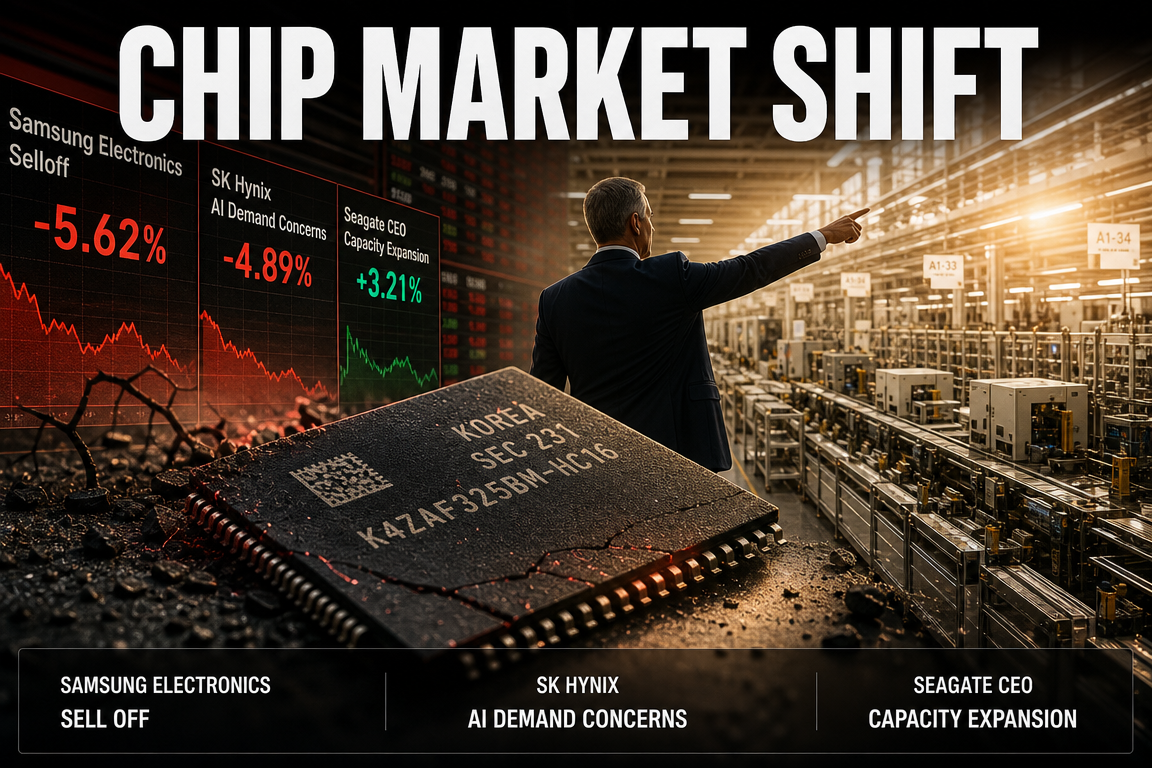
The initial catalyst was commentary from Seagate’s CEO indicating that capacity expansion takes time and that responding quickly to AI-related demand is challenging.
While such remarks can be interpreted as evidence of strong demand, the market instead focused on execution risk: the possibility that companies may not convert demand into revenue and earnings quickly enough during a favorable cycle.
Key takeaway: markets are prioritizing capacity readiness and speed of earnings conversion over headline demand strength.
2. Why Seagate’s comments affected Samsung Electronics and SK Hynix
Seagate is primarily a hard-disk-drive vendor, yet the market increasingly prices the broader “AI infrastructure value chain” as a single complex: storage, servers, data centers, HBM, DRAM, NAND, power, and networking.
AI capex translates into data center build-outs, which require not only compute silicon but also memory, storage, and supporting infrastructure.
Therefore, messaging such as “demand is strong, but scaling supply is slow” tends to be interpreted as a potential bottleneck risk across the AI supply chain, tightening sentiment toward memory suppliers as well.
3. Why Micron weakness matters more for Korean memory equities
Micron is widely viewed as a bellwether for the global memory cycle. When Micron sells off, investors often infer that memory upcycle expectations may have moved ahead of fundamentals.
Recent semiconductor equity performance has been driven largely by AI memory, particularly HBM, underpinning expectations of earnings recovery and valuation re-rating for both Samsung Electronics and SK Hynix.
When related US names weaken, the Korean market typically reacts with higher sensitivity because semiconductors represent a core index driver rather than a standalone sector.
As a result, Micron’s decline functioned less as a single-stock event and more as a catalyst for profit-taking across Korean memory equities.
4. The structural backdrop: elevated US Treasury yields as a valuation constraint
A principal macro driver is the persistence of elevated US Treasury yields.
Higher yields mechanically increase discount rates and compress valuations, particularly for growth and technology equities whose investment cases rely on future earnings expansion.
While Samsung Electronics and SK Hynix have manufacturing characteristics, their recent equity narratives have increasingly traded as AI-linked growth exposures tied to a high-growth memory cycle.
Consequently, even with strong AI demand, volatility and episodic drawdowns can intensify when rates remain elevated.
Key takeaway: macro conditions, especially the rate path, can dominate sector fundamentals in the short run.
5. Today’s market sequence (news-style summary)
- First: Seagate’s CEO highlighted strong AI demand but noted that capacity expansion and supply response require time.
- Second: The market interpreted the message less as a supply-tightness benefit and more as a risk of delayed earnings conversion.
- Third: Weakness in storage-related equities was followed by declines in Micron.
- Fourth: Micron’s move weighed on sentiment toward Samsung Electronics and SK Hynix, prompting broader de-risking in Korean memory.
- Fifth: Elevated US Treasury yields increased valuation pressure on technology and growth equities, extending the impact to the KOSPI.
- Sixth: The sell-off reflected a combination of changing AI supply-chain interpretation, memory-expectation recalibration, and rate-driven valuation pressure, rather than a single company-specific negative.
6. The key point often missed: from AI narrative to earnings verification
The market is not primarily questioning whether AI demand exists. The focus has shifted to the timing, magnitude, and durability of monetization: who captures the demand, how quickly it translates into revenue and margins, and whether supply-chain constraints or capex burdens limit near-term earnings.
As a result, broad “AI optimism” may be less effective as a standalone driver. Investors are increasingly differentiating by:
- revenue capture by product category,
- supply bottlenecks and delivery timelines,
- margin sustainability,
- capex intensity and returns,
- customer ordering behavior and repeatability.
This suggests a transition from a first-stage expectation phase to a second-stage verification phase, implying greater dispersion among semiconductor equities.
7. Why Samsung Electronics and SK Hynix should be analyzed separately
Despite moving together, the two equities have different sensitivity profiles.
SK Hynix is more directly positioned as an HBM-centric AI memory proxy, typically benefiting more during AI-driven rallies but also showing greater downside sensitivity when expectations are reset.
Samsung Electronics has broader diversification across memory, foundry, mobile, consumer electronics, and display. While this can provide relative defensiveness, its index weight and foreign flow sensitivity can amplify drawdowns when global semiconductor sentiment weakens.
8. Key variables to monitor (Korea and global context)
This move may extend beyond a single session as markets simultaneously reprice the semiconductor cycle, monetary policy, and global growth risk.
Priority indicators:
- Direction of US Treasury yields
Sustained or rising yields can prolong valuation compression in technology and growth equities. - Durability of AI infrastructure capex
Monitor whether large-cap technology companies maintain data center investment pace or signal moderation. - Persistence of memory price recovery
A reversal in DRAM and NAND pricing would pressure earnings expectations. - HBM supply capacity and customer demand quality
Focus on shipment volumes and profitability, not only technical capability. - Foreign flows and KOSPI positioning
Given Korea’s semiconductor concentration, cross-border flows can drive index-level volatility.
9. What investors should assess most rigorously
In the current environment, equity declines on favorable news and outsized reactions to marginal commentary indicate a high-sensitivity regime.
The key distinction is whether the move reflects:
- fundamental deterioration in the cycle, or
- a reset of expectations after rapid appreciation.
Current signals align more with expectation recalibration than abrupt demand collapse. However, elevated prior expectations can extend the duration and depth of volatility.
Investors should monitor: revisions to earnings estimates, order stability from key customers, rate and FX trends, and whether supply-chain constraints are easing or tightening.
10. One-line conclusion
The decline in Samsung Electronics and SK Hynix was driven less by a single Seagate comment and more by a combined shock: shifting interpretation of AI demand monetization, weakness in Micron and related US names, valuation pressure from elevated US yields, and a broad expectation reset after a strong run.
< Summary >
Seagate CEO remarks regarding supply responsiveness were interpreted negatively, pressuring Seagate and Micron and transmitting risk-off sentiment to Samsung Electronics and SK Hynix.
The core drivers were: potential AI supply-chain bottlenecks, recalibration of memory-cycle expectations, and technology valuation pressure under elevated US Treasury yields.
The critical point is not a decline in AI demand, but a market shift toward stricter verification of monetization speed and supply readiness.
Investors should evaluate Samsung Electronics, SK Hynix, the KOSPI, the semiconductor cycle, and US yield dynamics together to contextualize ongoing volatility.
[Related Articles…]
- Semiconductor cycle inflection signals: key variables to monitor now (NextGenInsight.net?s=semiconductor)
- AI capex expansion and KOSPI beneficiary reshuffling: identifying potential winners this year (NextGenInsight.net?s=AI)
*Source: [ 내일은 투자왕 – 김단테 ]
– #삼성전자 #하이닉스 떡락 이유 (5월 19일)
● Trump Insiders Load Up on Microsoft and Neglected Stocks
Covert Accumulation by Trump-Linked Portfolios: Why Microsoft, and Why Out-of-Favor Equities Now
This shift is not a routine rotation.
This report consolidates: portfolio changes among individuals widely viewed as Trump-adjacent; the rationale behind concentrated purchases of Microsoft; the practical meaning of profit-taking in Google; capital reallocation toward out-of-favor software, crypto-related equities, and healthcare; and how the U.S. 10-year Treasury yield may influence equities.
The key question is why these investors are allocating to the most criticized segments of the market at this time.
Overall, the activity appears less like a political trade and more like a contrarian attempt to position ahead of the next equity rotation.
1. Core takeaway: Trump-linked actors converged on “out-of-favor” exposure
Two primary threads stand out:
First, a Bill Ackman-aligned concentrated value portfolio significantly reduced its Alphabet position and added Microsoft as a top holding.
Second, a portfolio associated with U.S. Commerce Secretary Howard Lutnick’s family reduced some extended winners and reallocated toward relatively lagging software, crypto-related equities, and healthcare.
Commonality: the positioning favors segments facing elevated skepticism rather than consensus trades.
2. Ackman’s decision: Why sell Google and buy Microsoft?
2-1. Google was accumulated in pessimism; the position is now treated as a monetization opportunity
Ackman’s approach is highly concentrated (approximately 10 holdings), so replacing a major position implies a clear relative-value view.
In early 2023, Alphabet was impacted by extreme bearish narratives following the emergence of ChatGPT, including concerns that search would structurally weaken, that Alphabet was behind in AI, and that advertising could face disruption.
Ackman accumulated Alphabet during that period, framing the valuation discount as excessive relative to fundamentals. Alphabet later became a key contributor to performance.
The reduction is more consistent with capital reallocation after material gains than with a negative reassessment of Alphabet’s core outlook.
2-2. Microsoft accumulation thesis: market concerns are viewed as over-discounted
The stated rationale centers on: a valuation reset to more attractive levels; insufficient market recognition of the embedded value of the OpenAI-related stake/exposure; and an assessment that fears of AI overinvestment are overly reflected in the share price.
A critical element is Microsoft 365 (Word, Excel, PowerPoint, and collaboration tooling) as deeply embedded enterprise infrastructure with high switching costs.
While the market has questioned whether generative AI could compress software moats, this view implies the opposite: the most advantaged players are those controlling enterprise data, productivity workflows, cloud infrastructure, security, and distribution.
Under this framework, Microsoft is positioned not as an AI casualty but as a central platform for AI monetization.
2-3. Not a generic “tech bet,” but a bet against sentiment distortions
Superficially, this resembles a mega-cap swap. More fundamentally, it expresses a view that market sentiment has over-penalized a high-quality asset.
As with Alphabet previously, the trade targets a period when a strong franchise is temporarily repriced under heightened skepticism.
3. Commerce Secretary family-linked portfolio: evidence of broader rotation into laggards
3-1. Cantor Fitzgerald-linked positioning characteristics
Howard Lutnick is widely recognized as U.S. Commerce Secretary, with long-standing market attention on his network and family-linked financial interests.
The reported changes suggest not a narrow swap, but an expansion of risk exposure while trimming some appreciated positions and adding to under-owned sectors.
This resembles a conventional institutional rotation approach: maintaining a constructive market stance while seeking incremental returns from segments that have underperformed.
3-2. Additions: software, crypto-related equities, healthcare
The portfolio increased exposure to large software leaders such as Microsoft, added crypto-related equities, and expanded positions in healthcare names that had experienced drawdowns (e.g., UnitedHealth).
These sectors differ operationally but share a market characteristic: recent heavy discounting driven by negative narratives.
- Software: fears of AI-driven disruption to legacy business models
- Crypto-related: volatility and policy uncertainty
- Healthcare: regulatory and earnings concerns
Institutional capital often targets such areas when adverse news is judged to be substantially priced in.
3-3. Reductions: partial profit-taking in crowded winners
The portfolio reduced exposure to names such as Intel, Nvidia, and Broadcom.
This does not necessarily imply a negative view on these businesses; it aligns with a distinction between “good companies” and “good stocks,” where expectations and valuation can limit forward returns after re-rating.
4. News-style summary: what is occurring in the market
4-1. Portfolio changes (summary)
- A Bill Ackman-aligned portfolio materially reduced Alphabet and initiated Microsoft as a top holding.
- Rationale cited: improved valuation, under-reflected OpenAI-related value, and excessive discounting of AI capex concerns.
- A portfolio linked to the U.S. Commerce Secretary’s family maintained a constructive stance while increasing software, crypto-related, and healthcare exposure.
- Some large semiconductor and highly re-rated winners were partially trimmed.
- The pattern is consistent with potential rotation from leadership-chasing toward recovery in oversold sectors.
4-2. Market interpretation (key points)
- The market debate appears less about “AI is over” and more about where AI monetization accrues next.
- Attention may be shifting from first-order AI beneficiaries (semiconductors, datacenters) toward software, platforms, productivity, and cloud distribution.
- The U.S. 10-year Treasury yield may serve as a near-term catalyst for volatility, though many still do not view it as sufficient on its own to reverse broader risk appetite.
5. Primary interpretation: positioning for the next cycle, not a “Trump-linked trade”
Coverage often emphasizes political proximity or implied informational advantages.
From an investment perspective, the more relevant feature is the focus on what the market is discounting most aggressively, rather than what it currently rewards.
In an environment combining recession concerns, AI valuation debate, rate pressure, and policy uncertainty, oversold high-quality assets often recover first if the macro scenario does not deteriorate materially.
The positioning may be an attempt to front-run that sequencing.
6. Under-discussed core points
6-1. Microsoft: signaling a shift from AI infrastructure to AI embedded in workflows
AI exposure has been largely framed through chips and datacenter buildouts.
A larger monetization phase may emerge as AI becomes embedded into everyday enterprise workflows. At that stage, the critical bottleneck shifts from compute to distribution and interface.
Control of documents, meetings, email, collaboration, and enterprise data becomes strategically central, positioning Microsoft as a primary conduit for adoption and monetization.
6-2. Google reduction: a model case of capital reallocation
Retail investors often interpret selling a high-quality company as a negative fundamental signal.
Institutional portfolios frequently sell strong performers to redeploy into assets with more favorable forward return profiles, driven by relative valuation and sentiment distortions.
On this view, the Alphabet trim reflects relative opportunity rather than renewed pessimism.
6-3. Policy-alignment optionality may also matter
Rotation into crypto-related exposure, technology, and policy-sensitive assets may reflect not only valuation but also optionality tied to potential changes in the policy environment.
Themes such as deregulation, U.S.-centric industrial reconfiguration, technology competitiveness, and capital market activity could gain relevance through the election cycle and related negotiations. This is an interpretive angle rather than a confirmed driver.
7. Key variable to monitor: the U.S. 10-year Treasury yield and equity drawdown risk
The U.S. 10-year yield may provide a near-term justification for equity pullbacks, particularly for growth stocks with elevated valuation sensitivity.
However, absent a material deterioration in earnings and cash-flow durability, a medium-term recovery framework for high-quality growth and oversold quality assets remains plausible.
Near-term volatility risk is elevated; a definitive trend reversal signal is not yet evident based on rates alone.
8. Practical investor takeaways
8-1. Emphasize relative comparison over momentum chasing
The current environment rewards differentiation between headline-favored names and high-quality assets with excessive fear priced in.
8-2. Focus on second-order AI beneficiaries
If first-order beneficiaries were semiconductors and infrastructure, second-order beneficiaries may include enterprise workflows, cloud services, productivity software, and automation platforms.
Microsoft’s accumulation aligns with this framing.
8-3. Integrate rates and valuation discipline
Even strong businesses can deliver limited returns when purchased at stretched valuations. Conversely, temporarily depressed quality assets can re-rate as macro uncertainty stabilizes.
Key inputs: earnings trajectory, valuation, potential policy sensitivity, and the degree of sentiment-driven mispricing.
9. Consolidated conclusion
The portfolio changes are more informative as signals of internal market rotation than as a narrow “Trump-linked buying” narrative.
They suggest capital is rotating from heavily re-rated leadership into lagging segments, while the AI thesis broadens from semiconductor-led infrastructure toward software-led monetization and distribution.
Ackman appears to be applying a prior contrarian framework (used in Alphabet) to Microsoft, while the Commerce Secretary family-linked portfolio reflects a broader laggard rotation.
The central implication is that prospective opportunity may concentrate in high-quality assets temporarily under skepticism, though timing remains uncertain.
10. At-a-glance key points
- Ackman realized gains in Alphabet and accumulated Microsoft.
- Core thesis: more attractive valuation, over-discounted AI concerns, and under-recognized OpenAI-related value.
- A Commerce Secretary family-linked portfolio increased software, crypto-related, and healthcare exposure.
- Market focus may be moving from semiconductor-led AI beta to software/platform-led AI monetization.
- The main near-term risk variable is the U.S. 10-year yield; it is not yet widely viewed as sufficient to invalidate the medium-term rotation thesis.
Across multiple Trump-adjacent, high-profile portfolios, the common shift has been away from extended winners and toward out-of-favor software, crypto-related equities, and healthcare.
Ackman realized gains in Alphabet and reallocated toward Microsoft, indicating a relative-value assessment consistent with a broadening AI monetization narrative from semiconductors to enterprise software and productivity platforms.
Near-term equity volatility may be influenced by the U.S. 10-year yield, but the broader signal points to potential rotation and re-rating in oversold quality assets.
[Related articles…]
- https://NextGenInsight.net?s=AI
- https://NextGenInsight.net?s=rates
*Source: [ 소수몽키 ]
– 트럼프 최측근의 은밀한 매수, 역발상 베팅 적중할까