● Samsung, Strike, Shock, KOSPI, Slips, SK hynix, Surges
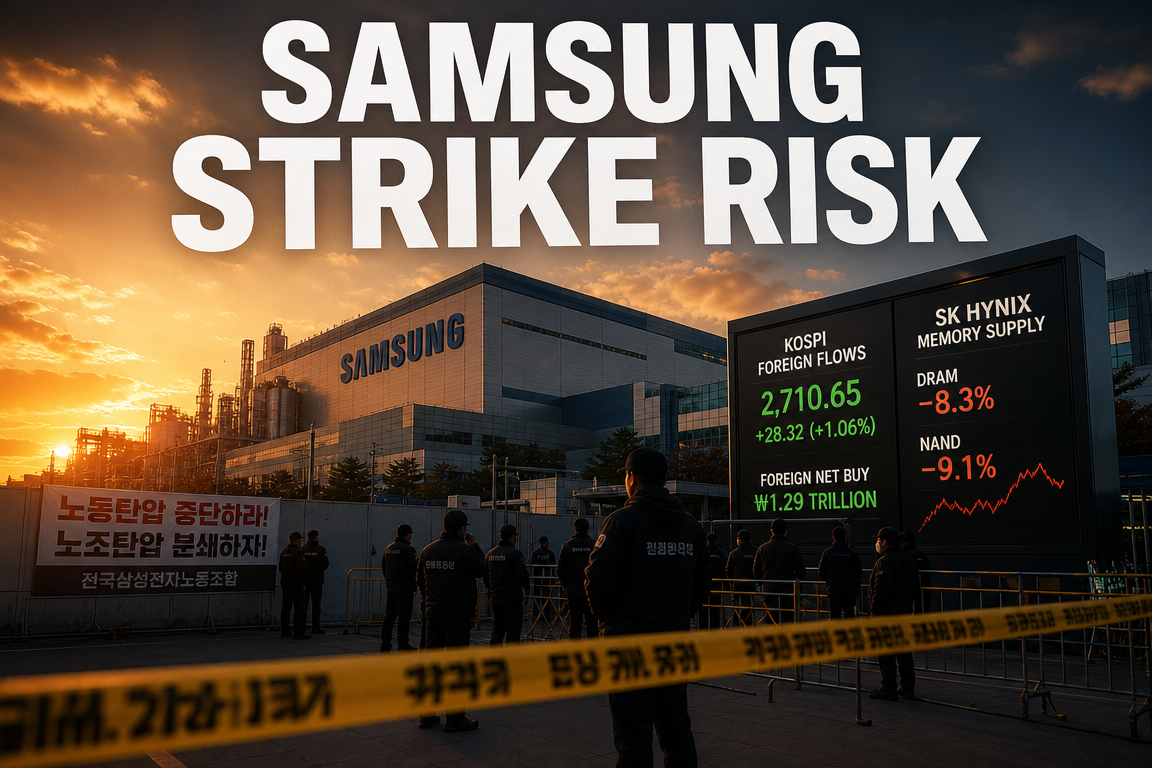
Samsung Electronics Strike Risk Pressures KOSPI; Why SK Hynix Held Up: Key Market Takeaways (May 20)
Today’s market narrative extends beyond labor-management tensions at Samsung Electronics. Key linkages included Samsung Electronics’ share price, the KOSPI, foreign investor flows, US Treasury yields, and semiconductor cycle expectations.
Market sensitivity centered less on the probability of a strike itself and more on potential supply disruption, incremental justification for foreign selling, and changes in expectations for memory pricing. The session also highlighted why Samsung-specific negative headlines were interpreted as a near-term relative positive for SK Hynix, and whether that move reflected sentiment or earnings-linked expectations.
One-line market summary
Samsung Electronics’ post-mediation talks with labor ended without agreement, increasing perceived strike risk. This coincided with a surge in the US 30-year Treasury yield, pressuring the KOSPI.
In contrast, markets linked potential Samsung production disruption to tighter memory supply, supporting buying interest in SK Hynix on a perceived beneficiary thesis.
1. What happened at Samsung Electronics
Post-mediation talks ended without agreement
The key development was the failure of post-mediation negotiations between labor and management.
From a market perspective, this signals a higher probability of escalation into operational action. For a firm positioned at the center of global electronics and memory supply chains, strike-related uncertainty is a material risk factor.
Why the market reacted
Equities typically discount uncertainty before outcomes. Elevated strike risk raises concerns around production disruption, shipment delays, customer responses, and downward revisions to earnings estimates. Such uncertainty tends to widen the risk discount applied to large-cap names.
Given Samsung Electronics’ index weight, company-specific risk can translate into broad index pressure.
2. Why the KOSPI declined in tandem
Index weight effect
Samsung Electronics’ outsized weight in the KOSPI means weakness in the stock can materially drag the index.
When large-cap risk rises, investor risk appetite can deteriorate across adjacent sectors, leading institutions and foreign investors to reduce exposure to semiconductors, IT hardware, and other mega-caps.
Easier conditions for foreign selling
The session’s pressure was not solely domestic. The US 30-year Treasury yield reached a multi-decade high, reinforcing the relative appeal of high-yielding safe assets and reducing risk-asset demand.
In this setup, Samsung’s labor risk can function as an additional catalyst for foreign investors to reduce Korean equity exposure, particularly in semiconductors.
3. Why the US 30-year Treasury yield matters
Higher long-end yields raise the discount rate
Rising long-term yields typically weigh on equities by lifting discount rates, a dynamic that can be particularly relevant for large-cap technology and semiconductors.
Implications for FX and foreign flows
Higher US yields often coincide with USD strength, which can reduce the relative attractiveness of KRW assets and amplify foreign outflows. The day’s decline therefore reflected a combination of company-specific risk and adverse global macro conditions.
4. Why SK Hynix was relatively strong
Markets priced in a tighter supply scenario
The market interpreted a potential Samsung production or shipment disruption as a reduction in overall memory supply.
A tighter supply outlook can support memory pricing expectations, creating a perceived tailwind for competitors such as SK Hynix.
Linkage to semiconductor cycle expectations
Recent sentiment has leaned toward a recovery narrative following inventory normalization. In that context, supply-tightening headlines can accelerate pricing expectations, particularly in concentrated DRAM and NAND markets where shifts at major suppliers can move pricing assumptions.
5. Why the beneficiary thesis may be incomplete
Magnitude and duration determine impact
Any supply disruption depends on strike intensity, participation, and duration. A limited or short-lived event may have minimal impact on memory pricing and industry fundamentals.
Accordingly, SK Hynix’s strength may reflect near-term positioning rather than confirmed earnings improvement.
Samsung’s operational mitigation capacity
As a large-scale manufacturer, Samsung has contingency planning, production rebalancing capability, and inventory management tools that can reduce realized supply shock versus market expectations.
If disruption proves modest, beneficiary trades may reverse.
Risk of broader sector de-rating
If the situation becomes prolonged, uncertainty could extend from Samsung to broader perceptions of Korean semiconductor stability. In that case, foreign investors could reduce exposure to the sector overall, including names initially viewed as beneficiaries.
6. News-style key points
Samsung Electronics
- Post-mediation negotiations ended without agreement, increasing perceived strike risk.
- Markets reflected concerns over production and earnings uncertainty.
KOSPI
- Index declined due to Samsung’s weight and weaker large-cap risk appetite.
- Broader sentiment softened across mega-caps.
Foreign investor flows
- Higher US long-end yields reduced risk appetite.
- Samsung-specific uncertainty reinforced the rationale for foreign selling.
SK Hynix
- Potential Samsung supply disruption supported expectations of tighter memory supply and firmer pricing.
- The stock reflected short-term beneficiary positioning.
Semiconductor cycle
- The event links to memory pricing, supply-chain stability, and the pace of recovery expectations.
- The primary variable is not the headline risk but the realized degree of disruption.
7. Underemphasized but critical point
The key issue is not the strike headline, but the justification for foreign flow reduction
Market focus often centers on strike risk, but the more material implication is the simultaneous emergence of two drivers that can justify foreign deleveraging:1) A sharp rise in US long-term yields
2) Labor-related uncertainty at Korea’s flagship semiconductor manufacturer
Together, these factors can reinforce a “reduce exposure” framework for global allocators, increasing the discount applied to Korean equities.
SK Hynix strength also reflects pre-existing recovery positioning
Interpreting SK Hynix solely as a “competitor benefit” trade is incomplete. The move likely also reflects underlying positioning for a memory upcycle; Samsung-related supply headlines acted as an incremental catalyst. The market reaction highlights sensitivity to memory pricing signals.
8. Key items to monitor
First, whether a strike occurs
- Probability of renewed negotiations
- Expected strike scope and participation
Second, whether production disruption materializes
- Utilization rates
- Shipment schedules
- Responses from major customers
Third, whether foreign selling is transient or persistent
- Foreign net flows
- Interaction with US yields and USD/KRW dynamics
Fourth, whether memory pricing expectations are revised upward
- DRAM and NAND pricing indicators
- Changes in analyst earnings revisions
9. Investor framing
The current environment is driven by the interaction of labor risk, global rates, foreign flows, and memory pricing expectations. Single-name interpretation may miss the broader transmission mechanism. The key question is whether headlines translate into measurable impacts on supply, earnings, and cross-border allocations.
Conclusion
The May 20 market move was not attributable to strike concerns alone. Higher US long-term yields increased the likelihood of foreign risk reduction, while Samsung’s labor uncertainty intensified pressure on Korea’s flagship index constituent. SK Hynix outperformed on expectations of tighter memory supply and firmer pricing, though durability depends on the realized level of disruption and subsequent revisions to pricing and earnings expectations.
< Summary >
- Samsung’s failed post-mediation talks increased strike risk; the KOSPI weakened due to index concentration and risk sentiment.
- A surge in the US 30-year yield strengthened the rationale for foreign selling and added pressure to Korean equities.
- SK Hynix outperformed on perceived benefit from potential Samsung supply disruption and improved memory pricing expectations.
- The central driver is the interaction between foreign flows, US yields, and semiconductor cycle expectations, rather than the headline alone.
- Monitor strike developments, realized production impact, foreign flow persistence, and memory pricing changes.
[Related Articles…]
- Samsung Electronics labor risk and KOSPI volatility: Key drivers
- Semiconductor cycle recovery and potential SK Hynix beneficiary dynamics
*Source: [ 내일은 투자왕 – 김단테 ]
– 삼성전자 내일 큰일 났다 (5월 20일)
● War Shock Rally, KOSPI Climbs, Dollar Fades
Why the KOSPI Can Rise While the Middle East War Continues: The Market’s Forward-Looking Reaction
The war persists, yet the KOSPI is rising, USD strength is moderating, and risk appetite is improving. This can be explained by three factors:
1) The real economy and capital markets move differently.
2) Markets react more to the peak of fear than to the ongoing conflict.
3) Equity prices are ultimately driven less by headlines and more by liquidity, rate-cut expectations, FX stabilization, and the recovery of risk-on positioning.
This report explains why the KOSPI can rise despite an unresolved war, why peaks in the DXY and USD/KRW can align with equity lows, and which indicators investors should monitor for Korea and global markets.
1. Single Most Important Takeaway
Even if the Middle East war continues, the KOSPI can rise because:
The real economy weakens under prolonged conflict, but capital markets typically rebound once fear has passed its peak.
Equity markets discount conditions ahead of the realized outcome; market bottoms frequently form near maximum uncertainty rather than after resolution.
2. Key Drivers (News-Style): Why Equities Rise During War
2-1. Markets Price the “Peak Fear” More Than the War Itself
A common pattern is observed when fear is most aggressively priced:
- The DXY peaks
- USD/KRW forms a local high
- Crude oil futures spike
- Major equity indices form a bottom
This does not imply the conflict has ended; it indicates that forced de-risking and panic positioning have likely crested. Markets respond more to the remaining downside tail risk than to the current severity.
2-2. At Peak Fear, Capital Rotates Into Safe Havens
Typical risk-off flows include:
- Equity selling
- USD buying
- Preference for US Treasuries
- KRW depreciation
- Commodity spikes
When fear stops intensifying, incremental shock diminishes and capital begins rotating back toward risk assets. The core mechanism behind a KOSPI rebound is a reversal in flows, not conflict resolution.
2-3. The Real Economy Can Remain Weak While Equities Recover
Prolonged war can pressure the real economy:
- Higher energy costs
- Logistics disruption
- Rising corporate input costs
- Weaker consumption sentiment
However, equity markets often pre-price these effects. In periods of global slowdown, expectations for policy response (monetary and fiscal) can increase, supporting risk assets even while macro data remains soft.
3. Why Investors Must Separate the Real Economy From Capital Markets
3-1. The Real Economy Reacts to the Conflict’s Path
As duration extends, damage accumulates:
- Slower household income growth
- Lower corporate revenue momentum
- Higher costs
- Weaker small-business conditions
- Reduced consumption
A prolonged Middle East risk backdrop can therefore weigh on Korea’s growth outlook.
3-2. Capital Markets React to the Trajectory of Fear
Financial markets are typically more sensitive to changes in perceived risk than to the realized path of events:
- Immediate surge in fear after outbreak
- USD rally and FX depreciation
- Equity drawdown
- Gradual adaptation over time
- Recovery as fear subsides
Headlines can remain negative while positioning and flows have already shifted.
4. What Major Shocks Have Shared: 2020 Pandemic, 2022 Russia-Ukraine War, 2025 Tariff Shock, 2026 Middle East War
4-1. Different Triggers, Similar Market Structure
Across distinct shocks, markets often follow a similar sequence:
1) Uncertainty emerges
2) Fear spreads
3) Equities fall and USD rises
4) Peak fear passes
5) Equities rebound
Recognizing this structure reduces headline-driven decision-making.
4-2. Why the Tariff Shock Analogy Matters
Tariffs impact the real economy after implementation, but markets can bottom near the announcement-driven fear peak. Real-economy deterioration and equity-market lows often do not coincide.
5. The Second Pillar Behind Equity Strength: Liquidity
5-1. Markets Tend to Follow Liquidity Conditions
As real activity weakens, policymakers often respond:
- Fiscal expansion
- Supplementary budgets
- Transfers and consumption support
- Rate cuts
- Expanded money supply
Although intended to stabilize the real economy, liquidity can also flow into capital markets, enabling equities to strengthen ahead of macro recovery.
5-2. Why Rate-Cut Expectations Support Equities
Lower rates can:
- Reduce corporate funding burdens
- Raise the present value of future earnings
- Reduce the relative attractiveness of deposits and bonds, improving risk appetite
Common transmission:
Real-economy slowdown → policy response expectations → stronger rate-cut outlook → improved liquidity conditions → more supportive equity backdrop
5-3. In a Pivot Regime, Rates and FX Can Matter More Than War Headlines
Key variables likely to drive the next leg include:
- Timing of Federal Reserve rate cuts
- Shifts in the Bank of Korea stance
- Direction of the DXY
- Stability of USD/KRW
- Risk of renewed oil price upside
War dominates headlines, but KOSPI trend persistence often depends more on rates, liquidity, and FX stability.
6. Why FX Matters: A Condition for a Durable KOSPI Rebound
6-1. A USD/KRW Peak Often Marks a Sentiment Inflection
Korea is highly sensitive to foreign flows; without FX stabilization, sustained equity upside is harder to maintain. Foreign investors evaluate both equity returns and FX translation risk. KRW stabilization can improve the probability of stronger foreign inflows.
6-2. A Softer USD Can Reinforce Risk-On Reallocation
A turning point in the DXY can signal a reduction in extreme safe-haven demand, increasing the likelihood of reallocation toward emerging markets, particularly those with valuation support. Korea can benefit when export leverage, policy expectations, and attractive valuation coincide.
7. What Investors Should Monitor Now
7-1. Track the Speed of Fear Propagation, Not War Resolution
More actionable indicators include:
- Declining frequency/intensity of shock headlines
- Stabilization of oil’s upside momentum
- DXY losing upward trend
- USD/KRW stabilization
- Falling volatility metrics
The key is whether fear is decelerating.
7-2. Macro Weakness and Equity Strength Can Coexist
A weaker growth outlook does not mechanically imply lower equity prices. Sharper slowdown signals can raise expectations for policy support, which may lift equities earlier than the real economy improves.
7-3. Incorporate Sector Rotation
Market advances are rarely uniform. In liquidity-driven phases, leadership often rotates. Areas to monitor:
- Semiconductors and AI infrastructure beneficiaries
- Growth sectors sensitive to rate cuts
- Import-oriented sectors benefiting from FX stability
- Domestic-demand beneficiaries of fiscal support
- Consumer recovery leverage if oil stabilizes
8. Commonly Missed but Material Points
8-1. Markets Trade Positioning Created by Events
The key is not the event itself, but where positioning becomes crowded due to the event. During war-driven fear, crowding can build in USD, commodities, and other safe havens. When positioning reaches extremes, mean reversion becomes more likely.
8-2. Policy Expectations Can Create a “Bad Macro, Better Equities” Setup
Deteriorating real-economy data is negative in isolation, but it can strengthen expectations for rate cuts or fiscal support, which can be supportive for equities. This mechanism explains why negative news can coincide with rising prices.
8-3. Distinguish Economic Narratives by Category
The same headline can have different implications depending on whether it is:
- Real-economy information
- Capital-market information
- Policy information
- Sentiment/positioning information
A “prolonged war” headline can be negative for growth, supportive for policy expectations, and neutral or even constructive for markets if risk premium has already been repriced.
9. Scenario Framework and What to Watch
9-1. Scenario A: Rapid De-escalation
Most likely first-order effects:
- Oil stabilization
- FX stabilization
A softer USD and improved foreign flows can add upside support to the KOSPI, with potential relative strength in growth and export-linked sectors.
9-2. Scenario B: Conflict Persists, Containment Holds
Historically, this is the most resilient market condition: headlines remain negative, but fear does not expand further. Equities may trend gradually higher with stronger rotation across sectors. This is broadly consistent with the current rebound thesis.
9-3. Scenario C: Escalation Into Broader Regional Conflict
Risk-off dynamics can reappear:
- USD spike
- USD/KRW rebound higher
- Oil spike
- Equity pullback
Even in this case, markets will likely focus on identifying the next “peak fear” point, making the intensity and breadth of fear re-acceleration the key variable.
10. Consolidated Key Messages
A rising KOSPI during an ongoing Middle East war is not anomalous. It reflects a standard market mechanism:
- Markets price the end of fear before the end of the war
- Macro weakness can increase expectations for liquidity and rate cuts
- Trend durability often depends on FX stability and policy expectations
Key indicators to monitor:
- Whether fear is intensifying or fading
- DXY direction
- USD/KRW stability
- Liquidity conditions
- Strength of policy-response expectations
The KOSPI can rise even while the Middle East war continues because markets typically respond more to the passing of peak fear than to formal conflict resolution. The real economy is pressured by prolonged conflict, but capital markets are more sensitive to fear compression, liquidity expectations, rate-cut outlooks, and FX stabilization. Investors should prioritize monitoring the DXY, USD/KRW, crude oil, liquidity conditions, and policy expectations over war headlines alone.
[Related Articles…]
-
KOSPI trends and foreign flow dynamics: key indicators to monitor now
https://NextGenInsight.net?s=KOSPI -
Rate-cut expectations and global capital rotation: implications for Korean equities
https://NextGenInsight.net?s=interest%20rates
*Source: [ 경제 읽어주는 남자(김광석TV) ]
– 중동전쟁 안 끝났는데 코스피가 오르는 이유. 돈은 이미 움직이고 있습니다 | 경읽남 x Bler. 콜라보 | 칠판강의 [1편]