● SpaceX Bombshell, Tesla Surge, Musk Shock
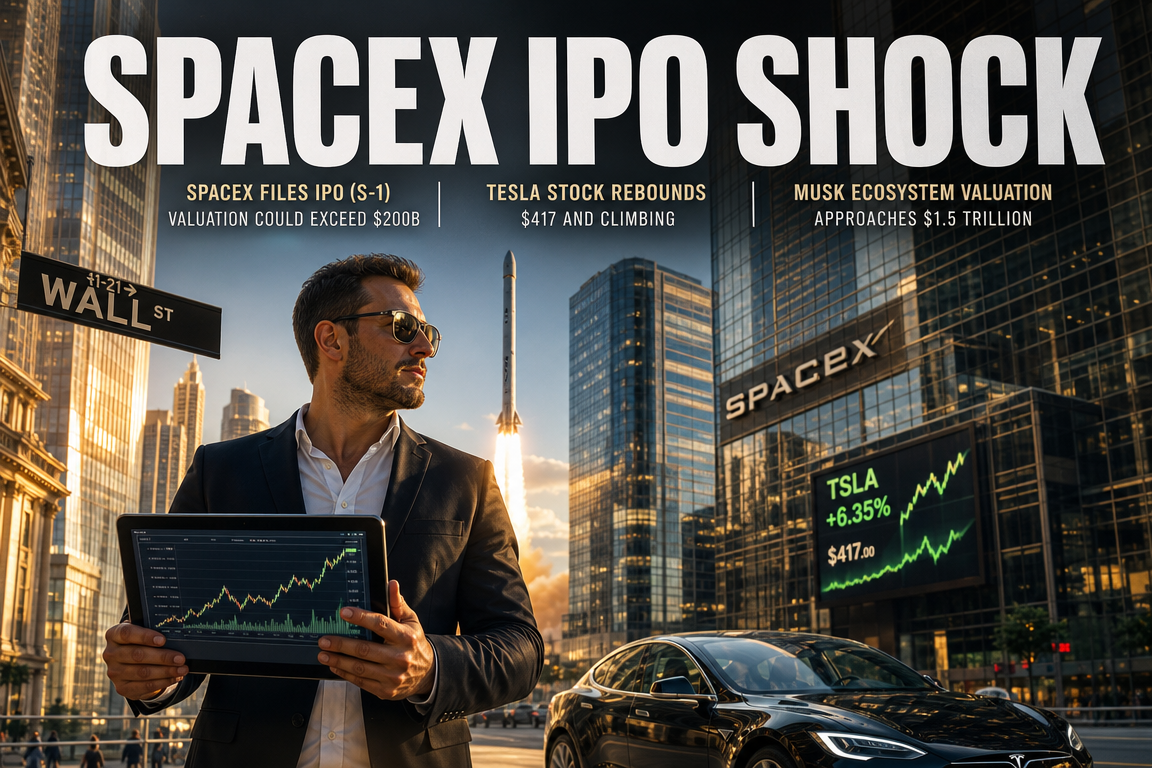
SpaceX S-1 First Full Disclosure; Tesla Rebound to $417: Why a Company With $18.5B Revenue Shows a $5.0B Loss
This is not merely a SpaceX IPO headline. The S-1 provides the first audited disclosure of SpaceX’s revenue mix, Starlink’s recurring-revenue profile, and the extent to which the xAI combination drove reported losses. The key issue for public markets is the potential re-rating and capital reallocation across the broader Musk corporate ecosystem.
The central takeaway: operational indicators appear strong; the reported loss is largely attributable to xAI; markets are focused less on near-term earnings and more on how capital is reorganized across the ecosystem.
1. Market context: why Tesla rose to $417
Tesla closed at $417.26, up approximately 3.25%. While the S-1 disclosure was a primary catalyst, the move is more accurately explained by two concurrent drivers.
1-1. Nvidia earnings lifted the broader AI complex
Nvidia reported strong quarterly results, including revenue of roughly $81.6B, ~85% year-over-year growth, and guidance of $91.0B for the next quarter, above consensus (~$86.84B). The print reinforced the view that AI infrastructure spending remains robust.
This supported Tesla sentiment because investors are increasingly positioning Tesla as an AI-adjacent platform rather than solely an EV manufacturer.
1-2. Why the SpaceX S-1 affected Tesla
The S-1 represents the first formally audited, legally accountable disclosure of SpaceX financials, shifting the market from estimates to verified figures. It also provides a clearer reference point for the scale of Musk’s private-asset base and AI-related investment intensity, prompting reassessment of Tesla’s role within the ecosystem.
2. Why the SpaceX S-1 matters
In the US listing process, an S-1 filed with the SEC typically contains financial statements, business model details, risk factors, executive compensation, and ownership structure. From this point forward, financial opacity materially declines, and misstatements carry legal exposure; investors treat S-1 disclosures as high-reliability primary-source information.
2-1. Why this disclosure is unusually consequential
Prior SpaceX financial data largely reflected media and industry estimates. While revenue was commonly cited in the $15B–$16B range, these were not audited disclosures. The S-1 introduces verified numbers that exceed prior expectations.
3. SpaceX disclosed financials: larger than expected
Key disclosed figures:
- FY2025 total revenue: > $18.5B
- Starlink revenue: $11.4B
- FY2025 net loss: $5.0B
- Cash and cash equivalents (FY2025): $22.8B
- Total assets: $92.0B
- Total debt: $50.8B
Revenue is the initial focal point. Against prior expectations of ~$15B–$16B, >$18.5B implies stronger-than-assumed scaling in core operations.
3-1. Starlink is the primary revenue engine
Starlink revenue was disclosed at $11.4B. Reported subscriber count exceeded 9.0 million by end-2025 and reportedly crossed 10.0 million in February 2026.
The strategic value is not only scale but also recurring subscription cash flows, typically viewed favorably by public-market investors due to higher visibility and durability.
4. Why $18.5B revenue can still translate into a $5.0B net loss
The primary driver is the xAI combination, not deterioration in SpaceX’s core businesses.
4-1. xAI as the central loss driver
SpaceX combined with Elon Musk’s AI company xAI in February 2026. The S-1 reflects this effect on a recast basis for 2025. xAI’s FY2025 operating loss was approximately $6.4B.
As a result, consolidated reporting can present SpaceX as loss-making even if SpaceX and Starlink operations are comparatively strong, because xAI’s expansion-stage cost structure is absorbed into the combined results.
4-2. Interpreting the loss profile
A fact-based interpretation of the disclosed structure:
- Core SpaceX operations appear to generate substantial revenue.
- Starlink exhibits a scalable recurring-revenue model.
- xAI is in an aggressive investment phase with elevated operating losses.
- The consolidated loss is more consistent with front-loaded investment than with weak demand.
5. Why a $1.75T–$2.0T valuation is being discussed despite losses
5-1. Markets often price strategic control and platform potential over near-term earnings
Starlink is positioned as a space-based communications layer with global scalability once the network is deployed. In combination with launch services, space transport, defense-related contracting, connectivity, and AI infrastructure, the overall profile resembles a multi-vertical platform that is not easily comparable to single-industry peers.
5-2. Liquidity strength is a notable disclosure
Cash and cash equivalents were disclosed at $22.8B at end-2025, up from $11.4B in 2024. Despite the scale of AI investment implied by xAI losses, liquidity increased, supporting the view that the company can finance expansion without immediate balance-sheet stress.
6. IPO timeline and structure
Indicative market references point to:
- Roadshow: potentially early June
- Pricing: June 11
- Nasdaq trading debut: June 12
- Ticker: SPCX (reported)
- Stock split: 5-for-1 (reported as completed)
6-1. Underwriter lineup
Goldman Sachs is referenced as lead underwriter, with Morgan Stanley, Bank of America, Citi, and JPMorgan among co-managers. The syndicate composition signals expectations for a large-scale transaction.
6-2. Retail allocation of 30% is atypical for mega-IPOs
Large IPOs often allocate ~10% to retail investors. A reported 30% priority allocation could support demand breadth but may also increase post-listing volatility.
6-3. $75B raised as primary issuance
If the full $75B is primary issuance, proceeds go to the company rather than representing insider monetization. This frames the IPO primarily as growth-capital financing for space, satellite, and AI infrastructure initiatives.
7. Why this matters for Tesla shareholders
SpaceX listing dynamics can affect Tesla through index flows, governance transparency, and cross-ecosystem capital allocation.
7-1. Potential Nasdaq-100 inclusion and passive flow effects
At a $1.75T–$2.0T market cap, Nasdaq-100 inclusion could be considered rapidly. Index inclusion would create mechanical passive inflows (e.g., QQQ and related mandates). However, inclusion also forces weight rebalancing across incumbents, potentially pressuring relative weights of existing mega-cap constituents, including Tesla.
7-2. Potential reduction of the “Musk discount” via transparency
A recurring institutional concern has been uncertainty around Musk’s time allocation, governance, and capital deployment across private and public entities. Public-company disclosure can improve transparency around roles, capital uses, and risk management, potentially reducing governance-related valuation discounts.
7-3. Capital rotation risk as a short-term negative
Investor attention and incremental capital can rotate into a new, high-profile listing, potentially creating near-term outflows from adjacent “ecosystem” equities, including Tesla, particularly if markets frame the pair as competing exposures.
8. Bull and bear cases for Tesla: both can be valid
8-1. Positive framing
- A successful SpaceX listing could strengthen market confidence in Musk-led execution.
- Public-market pricing may re-rate the broader ecosystem.
- Tesla could be reframed as an AI/robotics platform rather than an auto OEM.
- Greater transparency could reduce governance-related discounting.
8-2. Negative framing
- Institutional and retail flows could rotate from Tesla into SpaceX post-listing.
- xAI losses (~$6.4B) could intensify valuation debate around the combined entity.
- If SpaceX underperforms post-IPO expectations, sentiment could weaken across related names.
- Tesla’s relative appeal could diminish temporarily versus a new “category-defining” listing.
Net implication: short-term flow dynamics may be adverse while the medium-term narrative could be supportive, depending on execution and market positioning.
9. What Tesla investors should monitor
A key question is the appropriate classification of Tesla within the ecosystem. Public markets still partially treat Tesla as an EV manufacturer; the ecosystem framing is:
- SpaceX: space transport, satellite network, infrastructure
- xAI: large-scale models and AI software
- Tesla: physical-world AI execution (autonomy, robotics, energy systems)
Within this framing, Tesla’s differentiated asset is the combination of manufacturing scale and real-world AI deployment. Optimus, robotaxis, and FSD are positioned as pathways to monetize AI in physical environments through data feedback loops.
9-1. Separate re-rating drivers for Tesla
As markets compare each ecosystem entity post-listing, Tesla may be redefined from “vehicle sales” toward “real-world AI commercialization,” a potential structural shift in valuation framing.
10. Additional Tesla items to watch alongside this event
10-1. Lithuania’s FSD approval
Lithuania reportedly became the second European country to approve FSD. Smaller-market regulatory openings can precede broader regional adoption, with policy diffusion potentially becoming as important as technical capability in near-term perception.
10-2. FSD 14.3.3 update and the path toward unsupervised FSD
If driver-monitoring requirements are relaxed, markets may interpret this as incremental progress toward unsupervised operation. The core equity question shifts from unit sales to conversion of the fleet into an AI services platform.
10-3. India factory cancellation: negative or capital discipline
While superficially negative, a decision to forgo incremental capacity can be interpreted as capital-allocation discipline, particularly under demand uncertainty and potential overcapacity risk. Operational efficiency and utilization can be prioritized over expansion.
11. Key points summary
- Tesla closed up at $417.
- The move reflected both SpaceX S-1 disclosure and an AI-sector boost following Nvidia results.
- SpaceX FY2025 revenue was disclosed at >$18.5B, above prior market expectations.
- Starlink FY2025 revenue was disclosed at $11.4B and is the primary growth driver.
- The $5.0B net loss is driven primarily by xAI losses (~$6.4B), not core business weakness.
- IPO proceeds are positioned to fund space, satellite, and AI infrastructure expansion.
- Post-listing index inclusion could drive passive inflows.
- Short-term, Tesla may face capital rotation risk into SpaceX.
- Medium-term, Tesla could be re-rated as a physical-world AI platform within the ecosystem.
12. Under-emphasized market implication
12-1. Markets focus less on “loss vs profit” and more on who controls AI infrastructure capital
The key issue is whether the IPO formalizes capital allocation across the ecosystem. The strategic question is how Starlink cash flows and IPO proceeds will be deployed across AI infrastructure priorities.
12-2. Tesla’s true comparables may shift away from auto OEMs
If SpaceX and xAI scale publicly, Tesla may increasingly be benchmarked against AI infrastructure and robotics platforms rather than traditional auto peers, potentially changing the valuation framework.
12-3. “Execution AI” within the ecosystem is concentrated in Tesla
In a three-part structure—xAI as “cognition,” SpaceX as “network/infrastructure,” Tesla as “physical deployment”—the highest operating leverage from real-world commercialization could accrue to Tesla, subject to product and regulatory execution.
13. Forward watchlist
- SpaceX IPO demand and aftermarket performance around June 12
- Sustainability of post-IPO valuation
- Nasdaq-100 inclusion probability and ETF rebalancing impacts
- Tesla relative strength versus ecosystem-linked peers
- Pace of FSD expansion across Europe
- Incremental disclosures on Optimus and robotaxi commercialization
- Evidence of where AI infrastructure capital concentrates within the ecosystem
14. Conclusion
The S-1 disclosure is a structural market event: audited financials formalize SpaceX’s scale, reveal Starlink’s recurring-revenue base, and clarify that the consolidated loss is largely driven by xAI’s expansion costs. For Tesla, near-term volatility risk remains due to potential capital rotation, while the medium-term effect could be a reframing of Tesla as a physical-world AI execution platform.
< Summary >
The SpaceX S-1 disclosed FY2025 revenue of >$18.5B and Starlink revenue of $11.4B. The FY2025 net loss of $5.0B is primarily explained by the inclusion of xAI, which posted an operating loss of ~$6.4B. Post-IPO, SpaceX may see passive inflows via potential Nasdaq-100 inclusion, while Tesla could face short-term outflow risk. The broader implication is a shift in AI infrastructure capital allocation and potential re-rating across the Musk ecosystem.
[Related Links…]
-
Tesla stock and robotaxi outlook: key points to reassess now
https://NextGenInsight.net?s=Tesla -
How expanding AI infrastructure investment affects US equities and the global economy
https://NextGenInsight.net?s=AI
*Source: [ 오늘의 테슬라 뉴스 ]
– 역대 최초 공개! SpaceX 진짜 숫자 — 매출 $185억인데 손실인 이유, $417 테슬라 주주는 지금 어떻게?
● SpaceX IPO Shock, AI Empire, Space, Infrastructure Titan
In-Depth Analysis of a Potential SpaceX IPO: Why It Should Be Valued as a “Space and AI Infrastructure Platform,” Not a Rocket Company
This report goes beyond a headline summary of an IPO. It consolidates the strategic rationale for a potential SpaceX listing, how capital markets may increasingly categorize the company as critical infrastructure for future industries, and how global macro trends in AI, data centers, semiconductors, connectivity, and the space economy can converge into a single investment narrative.
Key areas covered include revenue composition, Starlink cash-generation dynamics, Starship unit economics, AI data center strategy, the long-horizon “space computing” concept, and potential post-IPO volatility and valuation disputes. A final section highlights underemphasized points relative to mainstream coverage.
1. What Has Been Disclosed About the Potential Listing
Following the release of IPO-related filings, market attention has intensified. The expected ticker has been discussed as SPCX, with timing referenced as June, although key IPO terms (offer price, share count, and detailed ownership structure) remain partially undisclosed.
Key Disclosure Points
First, governance control remains highly concentrated.
Elon Musk is reported to hold approximately 85% of voting power. Under a dual-class structure, public investors could hold Class A shares with lower voting rights, while Musk’s Class B shares retain control even if economic ownership declines.
Second, valuation expectations are aggressive.
Implied valuation ranges cited are approximately $1.5 trillion to $2.0 trillion, placing SpaceX among the largest global public companies and within the scale range of leading mega-cap technology firms such as TSMC or Broadcom.
News-Style Summary
- Expected ticker: SPCX
- Potential timing: June (discussed)
- Offer price and deal size: not yet disclosed
- Musk voting control: ~85%
- Implied valuation: $1.5T–$2.0T
Core Interpretation
The IPO’s strategic significance may be less about near-term fundraising and more about repositioning SpaceX from a “rocket company” to a platform seeking to control both AI infrastructure and a space-based network stack.
2. Corporate Identity: A Future Systems and Infrastructure Company
SpaceX frames its mission in expansive terms, but for investors the practical interpretation is a long-duration strategy integrating:
- Space transportation
- Communications and connectivity
- Compute and AI training/inference infrastructure
- Data center buildout
- Potential semiconductor expansion
This challenges conventional sector-based valuation frameworks. SpaceX’s model implies a tightly coupled flywheel: launch capability enables satellites; satellites generate connectivity revenue; cash flow funds AI and compute infrastructure; AI optimizes engineering and operations; improved efficiency further reduces launch and deployment costs.
3. Financial Profile and Business Structure: Where Cash Is Generated and Deployed
SpaceX revenue for 2025 is referenced at approximately $18.7 billion.
Three Operating Pillars
3-1. Space Segment: Launch and Space Transport
Launch services for satellites, cargo, and specialized payloads; effectively “space logistics.”
3-2. Connectivity Segment: Starlink
Satellite broadband targeting regions and use cases where terrestrial networks are constrained, including remote geographies, maritime, aviation, and military environments.
3-3. AI Segment: xAI, X, Data Centers, Chips
Includes generative AI models (e.g., Grok), utilization of the X data asset, large-scale data center infrastructure, potential compute-as-a-service offerings, and longer-term vertical integration into semiconductors and agent platforms.
Profit Center Assessment
Starlink appears to be the primary source of revenue and profitability. The launch business functions as strategic infrastructure, while the AI segment is capital-intensive and likely the largest incremental funding requirement.
- Starlink: cash engine
- AI: growth engine requiring substantial capital
- Rockets: core infrastructure enabling both
Core Interpretation
A key IPO driver may be raising capital to scale AI-related infrastructure: data centers, compute resources, and power solutions—potentially including long-horizon space-based data center concepts.
4. Launch Business: Dominant Competitive Position
SpaceX’s Falcon 9 and Falcon Heavy are positioned as market-defining assets in commercial launch. Market share figures are frequently described as exceeding 80% by cumulative orbital launch mass, suggesting a structural dominance rather than standard category leadership.
Why Launch Dominance Matters
Launch cost is the primary logistics cost driver for the space economy. Lower launch costs expand the feasible economics of satellite constellations, space manufacturing, and data center deployment concepts. Launch is both a revenue stream and a lever that reduces internal costs across SpaceX’s adjacent businesses.
5. Starship: The Primary Long-Term Value Driver
Starship is central to the next phase of SpaceX’s strategy. It is designed for full reusability; success is associated with expectations of reducing launch costs by over 99% versus historical averages.
- Height: ~120m
- Fully reusable payload target: ~100 tons to LEO
Markets Potentially Reshaped by Starship
- Faster, lower-cost deployment of large satellite networks
- Reduced cost to expand Starlink
- Expanded space-based communications infrastructure
- Feasibility of transporting equipment for space-based compute concepts
- Improved economics for lunar and Mars programs
Investor Focus
From Starship V3 onward, the focus shifts from technical demonstration to commercial validation: payload, cadence, and repeatability. Valuation sensitivity is likely to remain tightly linked to perceived Starship execution probability.
6. Starlink: The Near-Term Cash Generator
Starlink is referenced as exceeding 10 million subscribers, with annual subscriber growth described as approaching ~100%, indicating continued early-stage scaling.
Structural Advantages
1) Strong demand in underserved regions and high-mobility use cases (maritime, aviation, remote operations)
2) Increased strategic value during conflict and disaster scenarios due to resilience versus terrestrial infrastructure disruption
3) Structural cost advantage from vertical integration: SpaceX internalizes launch costs
Economic Characteristics
Starlink is a subscription-based recurring revenue model, providing relative predictability in an industry typically characterized by project-based cash flows. In regimes where investors emphasize recurring revenue and high barriers to entry, Starlink can function as a stabilizing component of SpaceX’s consolidated valuation.
7. xAI and Data Center Strategy: Closer to the IPO’s Capital Rationale
The key bottleneck in AI competition is increasingly physical infrastructure: power, GPUs, data centers, semiconductors, and compute access, rather than model architecture alone.
Inferred AI Platform Components
- Operation of generative AI models (e.g., Grok)
- Use of X platform data
- Buildout of large-scale data centers
- Potential cloud-like compute capacity offerings
- Potential semiconductor vertical integration
- Potential expansion into AI agent platforms
Vertical integration is a consistent pattern across Musk-affiliated companies; the strategy appears to target reduced dependency on external supply chains across rockets, satellites, connectivity, data, AI, and potentially chips.
8. Space-Based Data Centers: Relevance as a Narrative Shift
Space-based data centers appear speculative; however, the underlying premise is an attempt to bypass terrestrial constraints:
- Power grid limitations
- Site constraints
- Cooling bottlenecks
- Transmission infrastructure constraints
Core Logic
Space enables persistent solar energy capture. If launch becomes sufficiently low-cost and high-volume, large-scale compute infrastructure could theoretically be deployed in orbit, reducing dependence on terrestrial power and cooling constraints.
Market-Relevant Point
The near-term investment relevance is less about near-term feasibility and more about valuation framing: positioning SpaceX as an AI infrastructure supplier, expanding perceived total addressable market beyond the space sector. A referenced TAM figure of $28.5 trillion indicates a deliberate shift toward AI-centric market definition.
9. The SpaceX Flywheel: Why the Integrated Model Matters
Flywheel Step 1: Rockets
Reduce space logistics costs via low-cost launch.
Flywheel Step 2: Starlink
Deploy a large-scale constellation and build recurring subscription revenue.
Flywheel Step 3: AI Infrastructure Investment
Reinvest cash flow into data centers and compute capacity.
Flywheel Step 4: AI-Driven Efficiency
Use AI for design optimization, operations, autonomy, and hardware productivity.
Flywheel Step 5: Further Cost Declines
Lower costs accelerate constellation expansion and broader space infrastructure buildout.
If executed, SpaceX evolves into a large-scale infrastructure platform with structural cost advantage rather than a single-product manufacturer or service provider.
10. Performance Expectations and Valuation Debate
If 2025 revenue is approximately $18.7B, a high-growth scenario could imply expectations near $40B revenue in 2026. At $1.5T–$2.0T valuation, the implied revenue multiple is elevated.
Bear Case Arguments
- AI segment profitability remains uncertain
- Starship commercialization remains unproven
- Persistent, large-scale capex requirements
- Debt burden
Bull Case Arguments
- Near-monopoly-like position in launch
- Starlink recurring revenue and network effects
- AI infrastructure optionality
- Long-horizon expansion across chips, data centers, and space-based compute concepts
Traditional valuation methods may be insufficient due to overlapping growth, technology, and infrastructure-control premiums.
11. Risk Factors: Key Items Likely to Matter in Filings
11-1. Starship Execution Risk
Delays or failures would impair the cost-reduction thesis and slow adjacent initiatives including space-based compute concepts.
11-2. Regulatory Risk
Launch approvals, spectrum allocations, defense and communications rules, and country-level policy changes are material variables.
11-3. AI Legal Risk
Generative AI faces litigation exposure related to copyright, harmful content, and liability attribution.
11-4. Capex Intensity
Capex referenced near $20B in 2025 highlights the importance of cash flow discipline and financing conditions.
11-5. Leverage and Funding Conditions
Debt referenced near $29.1B as of March 2026 increases sensitivity to interest rates and capital market access.
11-6. Key-Person Concentration
Concentration of CEO/CTO/chair influence elevates leadership and governance risk.
11-7. Technology Uncertainty and Competitive Pressure
Competition spans space (Blue Origin, state programs), connectivity, and AI ecosystems (NVIDIA-centered stacks, leading frontier model developers).
12. Why SpaceX Matters in a Global Macro Context
The global economy is shifting from manufacturing-centric dominance toward control of energy, data, semiconductors, communications networks, and AI compute capacity. SpaceX intersects multiple megatrends:
- AI demand driving accelerated data center investment
- Semiconductor and compute supply chain competition
- Rising geopolitical risk increasing strategic value of satellite connectivity
- Intensifying technology competition centered in the United States
- Valuation uplift for firms controlling critical future infrastructure
SpaceX may therefore function as a concentrated expression of strategic infrastructure competition rather than a standalone thematic equity.
13. Five Underemphasized Points
1) The core moat is not rockets alone, but control over the cost structure.
SpaceX internalizes launch capacity, enabling structurally lower costs for satellite connectivity and broader space infrastructure.
2) Starlink is not only a connectivity product; it is a funding mechanism for AI infrastructure expansion.
Recurring cash flow can be redeployed into compute and data center capex.
3) The IPO rationale is likely closer to AI infrastructure funding than launch expansion.
The largest capital requirements are expected in compute, power, and data center buildout.
4) The value of space-based data centers is primarily narrative and valuation framing, not near-term feasibility.
If investors shift classification from space launch to AI infrastructure platform, valuation frameworks may shift materially.
5) The company is converging toward a cross-sector infrastructure holding-company model.
As space, connectivity, AI, semiconductors, cloud, and energy converge, peer comparison becomes less clear—supporting premium valuation or amplifying expectations risk.
14. Investment Interpretation Framework
The key issue post-listing is likely category assignment by public markets. If treated primarily as a launch company, valuation may appear stretched. If treated as physical infrastructure for the AI era, higher premiums may be sustained.
This profile is not a defensive or stable equity. It reflects high ambition, sustained capex, and execution dependency. The relevant investor question is not whether the company is “good,” but the probability-weighted likelihood of the integrated narrative being realized.
15. Final Summary
SpaceX is increasingly difficult to explain solely as a rocket company. Current cash generation appears driven by Starlink; entry barriers are anchored in launch capability; long-horizon growth optionality centers on AI infrastructure and space-based compute concepts.
The investment thesis depends primarily on:
- Starship commercialization pace and repeatability
- Expansion of Starlink profitability
- Realism and execution of AI data center and compute strategy
If these elements reinforce each other, SpaceX could become one of the most structurally unique large-cap listings. If execution breaks in any critical component, valuation compression risk may rise rapidly.
< Summary >
The central issue in a SpaceX IPO is not the listing of a space company, but potential market re-rating as a future-industry infrastructure platform integrating rockets, Starlink, AI, data centers, and space computing. Starlink is the near-term cash generator; rockets create entry barriers; AI and space-based compute define the long-horizon narrative. The main variables are Starship success, capex discipline, and the credibility of the AI infrastructure roadmap. Long-term valuation depends on whether markets recognize SpaceX as a physical infrastructure controller for the AI era.
[Related Articles…]
-
AI data center investment expansion: power, semiconductors, and cloud beneficiaries
https://NextGenInsight.net?s=AI -
Space industry listing wave: why satellite connectivity and launch markets are structurally shifting
https://NextGenInsight.net?s=space
*Source: [ 내일은 투자왕 – 김단테 ]
– 드디어 밝혀진 SpaceX의 모든것! 심층분석