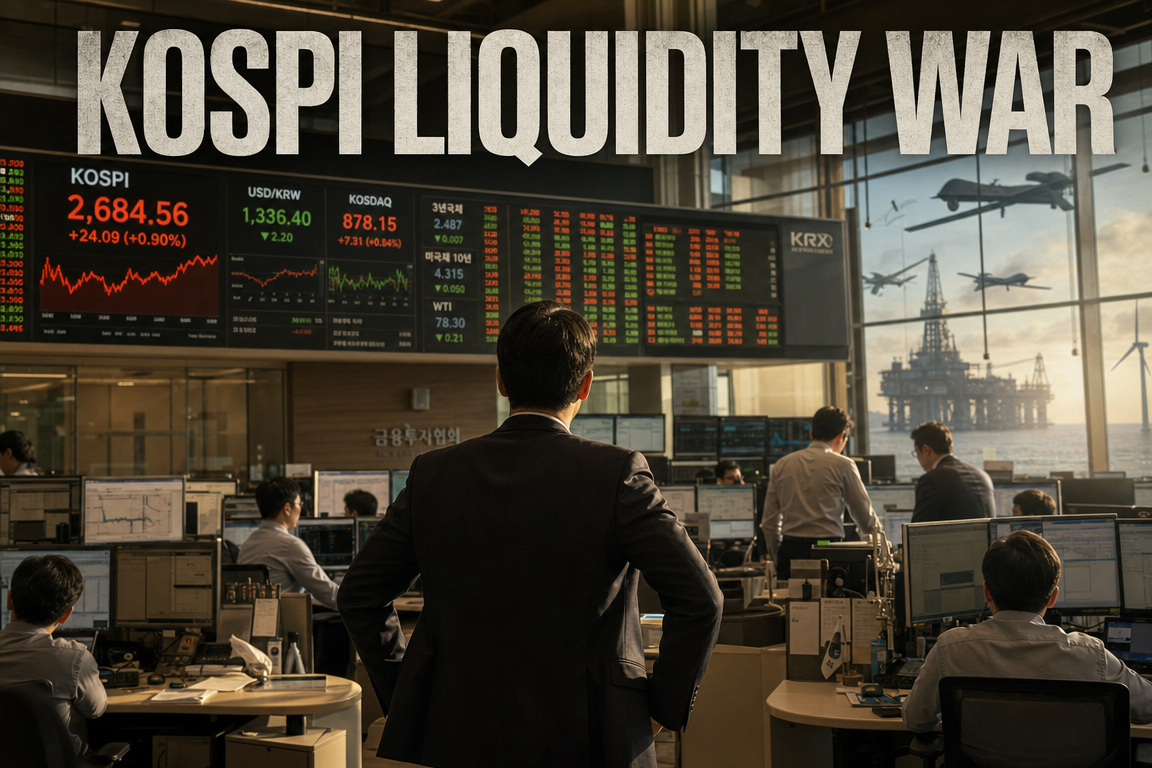
● War, Liquidity, Defense, Energy Shift
Why the KOSPI Can Rise While War Continues: Government Debt, Liquidity-Driven Markets, and Capital Rotation to Defense and Energy Transition
This report consolidates the key drivers behind equity strength despite ongoing conflict: (i) markets pricing peak fear earlier than the real economy, (ii) liquidity creation via expanded fiscal deficits and debt issuance, and (iii) post-conflict budget allocation and structural capital reallocation toward defense modernization, energy security, and supply-chain restructuring.
1. Key Takeaways (Executive View)
Equity resilience during prolonged conflict reflects three interacting forces:
1) The real economy absorbs the ongoing operational impact of war, while capital markets often price the peak of fear earlier.
2) Expanding sovereign deficits and debt-funded fiscal spending can create a liquidity-driven market regime.
3) War-related shocks accelerate structural shifts (energy transition, supply-chain reconfiguration, defense technology upgrades), and capital rotates toward the beneficiaries of these shifts.
The core issue is not “war has ended,” but “fear is largely priced, and marginal liquidity is being allocated to structural winners.”
2. Why the KOSPI Can Rise Even If the War Has Not Ended
2-1. Real economy and capital markets operate on different time horizons
- The real economy can face persistent pressures as conflict continues: input-cost inflation, logistics disruption, weaker consumption, and slower growth.
- Capital markets often respond more to the inflection in sentiment than to the continued presence of the event itself.
- When headlines are most severe, prices are frequently already discounted; subsequent normalization of risk perception can support rebounds even without resolution.
2-2. Markets price the “next scene,” not the current headline
- Early-stage conflict typically drives synchronized stress: oil, yields, FX volatility, and risk-off positioning.
- Over time, markets reassess whether incremental negative news has diminishing marginal impact and whether policy will respond with additional support.
- This sequence can produce staggered performance across indices, growth, defense, and energy-linked equities.
2-3. Liquidity can dominate conflict duration as a market driver
- Liquidity is a primary factor in equity support, particularly during growth-slowdown concerns.
- Beyond monetary policy, fiscal policy becomes more influential when rate-cut expectations weaken.
- Debt issuance and fiscal deployment inject cash flows into the economy via infrastructure, defense, subsidies, industrial policy, corporate revenues, and household income—ultimately reaching asset markets.
3. How Government Debt Can Create a Liquidity-Driven Market Regime
3-1. Liquidity is not only a function of interest rates
Liquidity is shaped by two channels:
- Central bank monetary policy
- Government fiscal policy
When monetary easing is constrained, debt-funded fiscal expansion can still increase aggregate liquidity.
3-2. Debt expansion can be equity-supportive in the short term
- Fiscal expansion can cushion growth and stabilize demand.
- Corporate revenues and household disposable income may improve at the margin.
- Sector leadership strengthens when spending is concentrated:
- Higher defense budgets support defense supply chains
- Energy security spending supports nuclear, renewables, grid infrastructure, and storage
- Supply-chain spending supports materials, components, equipment, and logistics infrastructure
3-3. Long-term risks: debt overhang dynamics
Debt-supported liquidity can raise longer-term vulnerabilities:
- Higher interest burden and reduced fiscal flexibility
- Lower capacity to respond to future shocks
- Currency depreciation risk and structurally weaker growth
The regime can resemble an extension of the cycle via debt rather than a fundamentally self-sustaining expansion.
4. Post-War Relevance: Structural Shifts vs. Temporary Disruptions
4-1. Distinguish what reverts from what does not
- Temporary changes revert after shocks fade.
- Structural changes persist even after the shock ends.
Geopolitical risk reshapes energy systems, supply chains, production models, defense doctrines, and investment allocation—not only oil prices.
4-2. War redirects capital flows
- Capex and industrial reconfiguration continue once initiated.
- Disrupted supply chains do not revert solely on price optimization.
- Energy security risk reprioritizes national policy agendas.
The key variable is the persistence of post-conflict capital allocation by sector.
5. Structural Shift #1: Accelerated Energy Transition Driven by Energy Security
5-1. Energy mix adjustment
As Middle East risk rises, countries reduce dependence on concentrated fossil-fuel supply. Likely beneficiaries include:
- Renewables
- Nuclear
- Grid and transmission infrastructure
- Energy storage systems
- Power network reinforcement
Energy transition increasingly reflects security priorities, not only decarbonization.
5-2. Supply diversification as the central theme
For South Korea, high sensitivity stems from:
- Low energy self-sufficiency
- High oil dependence
- High dependence on Middle Eastern crude
Focus shifts from “how high oil prices rise” to “how effectively crude and gas procurement diversify,” including increased US crude share, diversified LNG sourcing, expanded nuclear utilization, and complementary renewable investment.
5-3. Implications for Korean industry
Energy transition affects connected value chains:
- Refining, petrochemicals
- Power equipment
- ESS, transmission and distribution
- Nuclear components
- Data-center power infrastructure
AI-driven data-center load growth links energy security and AI infrastructure as a single strategic theme.
6. Structural Shift #2: Supply-Chain Restructuring and Production Model Changes
6-1. From just-in-time to resilient, flexible supply chains
- Prior globalization optimized for minimal inventory and lowest-cost sourcing.
- Current conditions prioritize stability amid war, sanctions, shipping disruption, export controls, and technology barriers.
- Firms diversify suppliers and redesign inventory strategies despite higher costs.
6-2. Security logic increasingly overrides pure cost logic
Resilience becomes a top management agenda across strategic categories:
- Critical chemicals and inputs
- Semiconductor materials
- Energy commodities
- Battery minerals
- Advanced components
- Defense components
7. Structural Shift #3: Rise of Bio-Based Packaging and Substitution Materials
7-1. Naphtha and chemical feedstock disruption as a second-order signal
Operational volatility in refining and chemical utilization can propagate into:
- Plastic containers
- Packaging materials
- Consumer and industrial ancillary materials
Firms with pre-secured substitutes gain relative advantage.
7-2. Strategic relevance of bio-based packaging
Bio-based packaging is positioned as:
- A supply-chain risk mitigant
- A substitute-material industry supported by ESG and cost-structure shifts
Recurring war- and oil-linked disruptions can raise the strategic value of plastic substitutes, bio-based packaging, and alternative chemical materials.
8. Structural Shift #4: A Higher-Cost Economy and a Mid-Rate Regime
8-1. Reversion to a low-cost economy is less likely
Geopolitical risk increases:
- Freight and insurance
- Energy and commodities
- Logistics disruptions
- Security costs
Cost structures, once elevated, tend to remain sticky. This increases pricing pass-through attempts and household inflation pressure.
8-2. Not a rapid easing cycle: mid-rate persistence risk
If energy-driven inflation pressures re-accelerate, central banks face constraints on aggressive easing. Oil and transport costs can diffuse into services and producer prices.
Key implication: policy rates may remain higher for longer. However, fiscal deployment can partially substitute for monetary easing, weakening the historical simplicity of the rates-equities relationship.
9. Structural Shift #5: Asymmetric Warfare and Defense Industry Repricing
9-1. Definition and cost asymmetry
A defining feature is low-cost drones forcing high-cost intercept responses, creating structurally unfavorable cost exchange ratios. This pressures militaries to redesign force structures.
9-2. Defense shifts from volume to technology integration
Defense increasingly encompasses:
- Drones and counter-drone systems
- ISR, electronic warfare
- Satellite communications
- AI-enabled targeting and autonomy
- Sensors and networked communications
- Cybersecurity
Korean firms can extend traditional manufacturing strengths by integrating software, AI, communications, and autonomy to enhance export competitiveness.
9-3. Why Korean defense is gaining attention
Perceived strengths include delivery lead times, cost competitiveness, quality, sustainment, and production speed. Market attention often includes:
- Hanwha Aerospace
- LIG Nex1
- Hyundai Rotem
- Korea Aerospace Industries (KAI)
Primary evaluation should focus on technology positioning (drone/counter-drone, radar, guided weapons, satellites, unmanned naval systems, cyber and integrated networks), rather than name-based momentum.
10. AI Trend: Investor-Relevant Implications
10-1. AI as a national strategic asset
AI is expanding beyond consumer applications into:
- Defense and intelligence analysis
- ISR and satellite imagery interpretation
- Cyber defense
- Drone swarm control
- Supply-chain forecasting
AI should be assessed across defense, energy infrastructure, and data-center buildout.
10-2. Defense-AI integration is accelerating
Future competitive defense primes may be defined by:
- Partnerships with AI startups and satellite communications providers
- M&A or rapid integration of software, sensors, and autonomy
Battlefield data analytics and real-time decision support may become central to defense valuation frameworks.
10-3. Data centers and energy infrastructure are jointly constrained
AI growth materially increases power demand. AI exposure analysis should extend beyond semiconductors to:
- Grid capacity and upgrades
- Generation mix
- ESS
- Cooling systems
- Nuclear and renewables integration
AI and energy transition function as a coupled investment theme.
11. Implications for the Korean Economy and the KOSPI
11-1. Index strength should not be interpreted as pure growth optimism
KOSPI upside may reflect a mix of:
- Growth-slowdown concerns
- Debt-funded fiscal liquidity
- Sectoral restructuring expectations
This suggests a hybrid regime combining fundamentals with policy/liquidity effects.
11-2. Capital may concentrate in specific beneficiary sectors
Market breadth may remain uneven, with recurring leadership in:
- Defense and unmanned systems
- Energy transition and power infrastructure
- Supply-chain stabilization (materials, parts, equipment)
- AI infrastructure and data centers
- Substitute materials and sustainable packaging
11-3. Fiscal sustainability requires higher weight in Korea
While fiscal spending can support near-term conditions, longer-term constraints include aging demographics and social insurance burdens. Slower trend growth increases the sensitivity to debt-funded liquidity side effects.
12. News-Style Summary (Investor Format)
Market reaction
Equity rebounds during ongoing conflict reflect a combination of reduced marginal fear and expanding fiscal liquidity.
Macro
Rising sovereign debt can be supportive for risk assets in the short term but increases long-term debt-overhang and reduced fiscal capacity risks.
Inflation and rates
Geopolitical energy risk reinforces a higher-cost environment, raising the likelihood of a mid-rate regime rather than rapid easing.
Industry structure
Energy transition, supply-chain restructuring, bio-based substitution, and defense modernization are emerging as persistent structural themes.
AI trend
AI is increasingly treated as a strategic capability linked to defense, data centers, and energy infrastructure.
13. Under-Emphasized but Material Points
1) The key variable is post-conflict budget allocation, not war headlines.
2) Fiscal policy may dominate monetary policy in driving liquidity in the current regime.
3) AI winners may skew toward B2B and infrastructure (power, data centers, defense AI, satellite communications, cybersecurity, sensors), not only consumer applications.
4) A higher-cost regime can catalyze substitution, localization, automation, and AI adoption—not only compress margins.
5) KOSPI gains can signal both liquidity support and heightened dependence on debt-financed policy.
14. Analytical Framework Going Forward
Interpret current markets as: peak fear largely priced, debt-funded fiscal liquidity supporting assets, and capital rotating toward structural beneficiaries.
Key variables to monitor:
- Duration and scale of debt-funded fiscal expansion
- Persistence of higher costs and a mid-rate regime
- Relative capital intensity and policy prioritization across energy transition, defense modernization, supply chains, and AI infrastructure
< Summary >
The KOSPI can rise during ongoing war because markets often price peak fear early, while debt-funded fiscal spending supports a liquidity-driven regime. Real-economy pressures remain, but markets discount policy response and future allocation effects. Post-conflict structural themes include energy security-driven transition, supply-chain restructuring, higher-cost and mid-rate persistence, defense modernization, and AI-enabled infrastructure expansion. The core question is the destination of incremental capital flows after the initial shock.
[Related Links…]
KOSPI liquidity regime overview:
https://NextGenInsight.net?s=KOSPI
AI infrastructure and energy transition linkage:
https://NextGenInsight.net?s=AI
*Source: [ 경제 읽어주는 남자(김광석TV) ]
– [모아보기] 전쟁 안 끝났는데 코스피 오르는 이유|정부 부채가 만든 유동성 장세와 ‘돈의 이동’
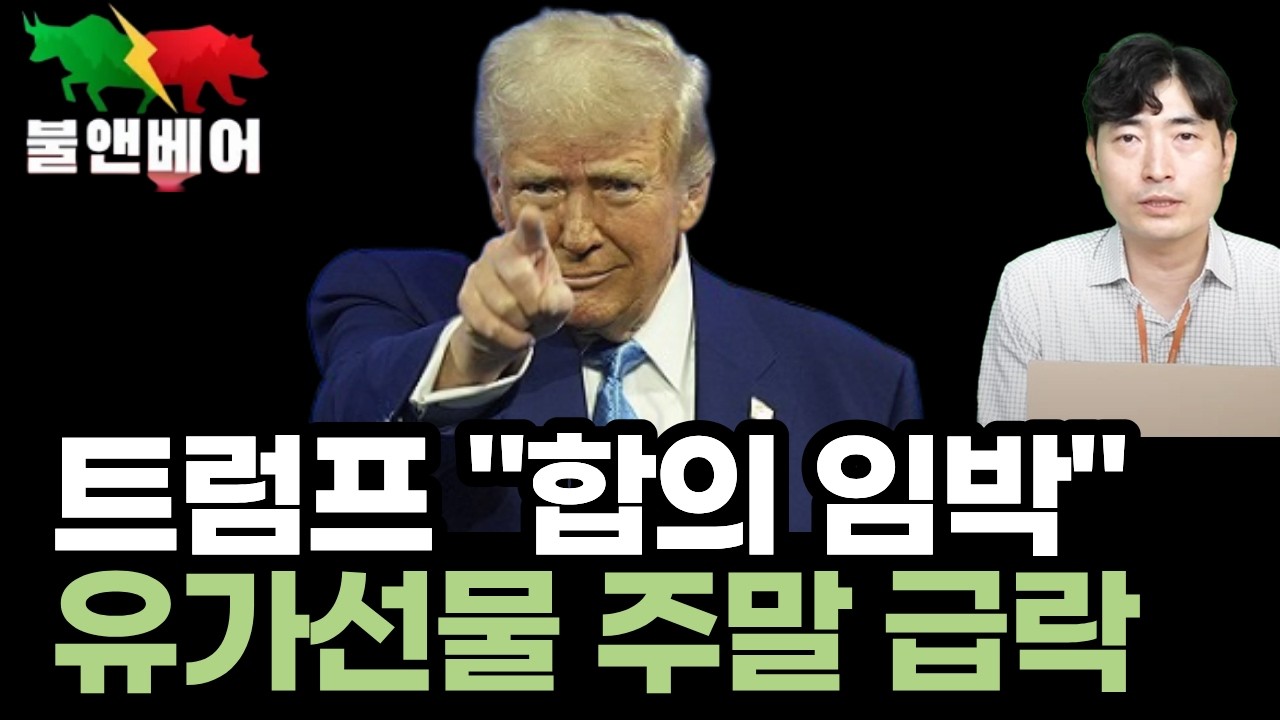
● Trump Iran Deal Shock, Oil Plunges, Markets Rip
Trump: “Iran Deal in the Final Countdown” — Is Middle East Risk Really Over? Key Points Behind Early Moves in Crude, Bitcoin, and Equities
This is not a routine diplomatic headline. It links potential de-escalation in the Middle East, the operational status of the Strait of Hormuz, signals of downside pressure in global crude prices, reactions in U.S. equities and Bitcoin, and near-term volatility in global markets. The key is not the “deal is near” narrative, but execution risk driven by Iran’s internal power structure, the role of the IRGC, the credibility of Trump’s claim, and why crude reacted immediately while Bitcoin remained more restrained. Less-covered but critical points are highlighted separately below.
1. One-line takeaway
Trump stated that negotiations with Iran are in the “final closing stage,” and markets quickly priced in a higher probability of Middle East de-escalation.
He cited discussions on peace-related matters with senior counterparts across Saudi Arabia, the UAE, Qatar, Pakistan, Turkey, Egypt, Jordan, and Bahrain, and noted that a call with Israeli Prime Minister Netanyahu “went well.”
The market’s focal phrase was: “The Strait of Hormuz will be opened.” That single line contributed to immediate downside pressure in crude and a partial stabilization in global risk sentiment.
Iran’s Fars News Agency countered that Trump’s remarks were “incomplete” and inconsistent with reality. Markets reflected expectations, but the situation remains unresolved.
2. Core situation (news format)
Trump-side statement
- Trump said the U.S., Iran, and major regional countries have largely completed a deal, with only final technical details remaining.
- Agenda items included peace-related understandings and regional stabilization, including potential reopening of the Strait of Hormuz.
Iran-side response
- Fars News Agency rejected the characterization as inconsistent with reality.
- Fars is widely viewed as aligned with IRGC messaging, suggesting political signaling rather than a simple factual dispute.
Market reaction
- With regular futures markets closed over the weekend, crude still moved lower in response to the headline.
- Bitcoin rose, but without an aggressive breakout, indicating risk-on impulse tempered by unresolved uncertainty.
3. Why the Strait of Hormuz matters
The Strait of Hormuz is a key chokepoint for global crude shipments. Any shift in perceived disruption risk transmits rapidly into oil prices and inflation expectations.
Lower perceived tension can reduce supply-disruption premia, pressure crude lower, and ease inflation concerns, with potential second-order effects on:
- Fed policy expectations (rate-cut pricing)
- U.S. long-end yields
- Equity valuation multiples, particularly growth and Nasdaq-sensitive segments
This is a cross-asset macro catalyst: oil → inflation → rates → equities → crypto.
4. Three plausible scenarios
Scenario 1: Trump reached Iran’s negotiating camp; the IRGC resists
- Frequently discussed baseline scenario.
- Iran’s diplomatic channel may align with a partial deal, but operational control—especially over Hormuz—may remain with the IRGC.
- Risk: a “headline relief rally” followed by renewed volatility as markets demand evidence of implementation.
Scenario 2: IRGC broadly aligned, but extracting leverage at the end
- Most market-supportive outcome.
- Late-stage rhetorical hardening can reflect bargaining over wording, control, and domestic optics.
- Implications: greater probability of sustained downside in crude, improved risk appetite, and better equity sentiment.
Scenario 3: Trump overstated progress
- Not fully dismissible, but presented here as less likely given:
- specific naming of multiple leaders
- public timing guidance implying near-term deliverables
- Market bias: progress exists, but execution risk remains.
5. Why crude reacted more than Bitcoin
Why crude moved first and more aggressively
Crude is the most direct transmission channel for Middle East geopolitical risk. Even incremental signals about Hormuz can rapidly compress risk premia.
Why Bitcoin was more cautious
Bitcoin does not mechanically rise during geopolitical stress. In risk-off regimes, USD and U.S. Treasuries can dominate as safe havens; in easing-risk regimes, liquidity expectations can support crypto. This episode reflects:
- partial risk-premium compression
- persistent uncertainty about implementation
U.S. equities and long-end yields
A common market pathway:
- lower oil → lower inflation pressure → improved rate-cut expectationsThis can support long-end yields and growth equities (notably Nasdaq and AI-linked megacaps), conditional on follow-through in implementation and sustained oil moves rather than a one-off headline reaction.
6. Why Iran’s internal power structure is central
“Iran” may not act as a single coherent actor. Interests can diverge between:
- government/diplomatic negotiators
- security and military stakeholders with operational control
For strategic assets like Hormuz, operational enforcement can outweigh written commitments. Historical episodes of conflicting messaging between diplomatic officials and the IRGC reinforce why markets avoid full conviction at this stage.
7. Next-week checklist for markets
(1) What the text of any agreement actually says
Wording determines interpretation: aspirational language vs enforceable commitments vs conditional clauses.
(2) Whether nuclear-related provisions are included
If nuclear components are involved, market impact shifts from short-cycle headline risk to potentially longer-duration regional reconfiguration.
(3) Official Iranian messaging and IRGC-linked reactions
Markets may weigh Iranian hardline follow-up signals more heavily than Trump’s statement due to implementation capacity.
(4) Oil follow-through vs mean reversion
- continued downside supports higher confidence in de-escalation
- a sharp rebound signals the market does not trust implementation
(5) Repricing of Fed cuts
Whether this becomes a durable macro impulse depends on rates markets. Track long-end yields and USD alongside crude.
8. Core macro point: inflation pathway
Beyond geopolitics, the principal market sensitivity is the inflation trajectory. Middle East tension can quickly reprice energy inputs and headline inflation, shaping monetary policy expectations.
If de-escalation stabilizes crude:
- U.S. inflation pressure may ease at the margin
- policy constraints may soften
- risk assets, especially higher-duration equities, can benefit
9. Why this matters for AI and “Fourth Industrial Revolution” exposure
AI is capital- and energy-intensive, linked to:
- electricity demand and data-center buildout
- semiconductor supply chains
- corporate capex cycles
These segments are sensitive to both rates and energy costs. A sustained reduction in oil-driven inflation risk can support:
- long-end yield stability
- improved financial conditions
- better sentiment for AI infrastructure and adjacent sectors (semiconductors, cloud, power infrastructure, robotics)
Conceptual linkage:Middle East de-escalation → oil stability → inflation easing → rate pressure easing → improved growth/AI risk appetite
10. Under-discussed but critical points
Key point 1: Execution matters more than the headline
Market pricing reacts to announcement risk, but outcomes depend on who can implement. If the IRGC retains effective control, outcomes may diverge from diplomatic narratives.
Key point 2: Hormuz is a military control problem, not a document problem
The investable signal is not the statement itself, but:
- actual shipping safety
- maritime insurance costs
- observable risk premia in freight and energy markets
Key point 3: Do not infer “risk over” from an initial oil drop
Oil can front-run expectations; geopolitics can reverse quickly. Assess persistence over multiple sessions.
Key point 4: The core market impact runs through monetary policy
The largest cross-asset effect is via Fed policy expectations. Energy disinflation supports risk assets; the link is incomplete without rates-market confirmation.
11. Investor framing
Short-term
Early-week markets may price “deal optimism,” with relative attention potentially shifting toward:
- energy (downside sensitivity)
- airlines and consumer segments (benefit from lower fuel/input costs)
- rate-sensitive growth equities
Medium-term
Focus on verifiable inputs:
- agreement language
- Iranian follow-up messaging
- crude trend
- U.S. Treasury yields
A confirmation-based approach using crude and rates is more robust than headline-driven positioning.
Conservative interpretation
This remains a “countdown” phase rather than completion. Positioning should reflect the gap between announcement and implementation.
12. Conclusion
Trump’s “final-stage” claim introduced a market-supportive de-escalation signal, with crude reacting quickly and broader risk sentiment stabilizing. However, Fars’ pushback, IRGC execution risk, and historical precedent argue against concluding that Middle East risk has ended.
The central question is whether the Strait of Hormuz can operate with sustained, credible security. The downstream implications span crude, inflation, rate-cut expectations, U.S. equities, Bitcoin, and AI-linked growth exposure.
Near-term market direction is likely to be shaped by:
- agreement wording
- Iranian hardline follow-up messaging
- oil’s follow-through behavior
< Summary >
- Trump said the Iran deal is in the final stage and referenced the potential reopening of the Strait of Hormuz.
- Crude moved lower on the headline; Iran’s Fars News Agency disputed the characterization, keeping uncertainty elevated.
- The key variable is execution capacity across Iran’s negotiating camp versus IRGC-linked control dynamics.
- This is a cross-asset macro catalyst affecting crude, inflation, rate-cut expectations, U.S. equities, Bitcoin, and AI-linked growth exposure.
- Next week, prioritize agreement text, Iranian follow-up statements, and oil trend confirmation.
[Related Articles…]
- AI investment and U.S. equity market trends: https://NextGenInsight.net?s=AI
- Rate-cut expectations and global macro outlook: https://NextGenInsight.net?s=rate
*Source: [ Maeil Business Newspaper ]
– [속보] 트럼프 “이란 합의 초읽기” vs 이란 파르스 “호르무즈 우리 관할” I 홍장원의 불앤베어