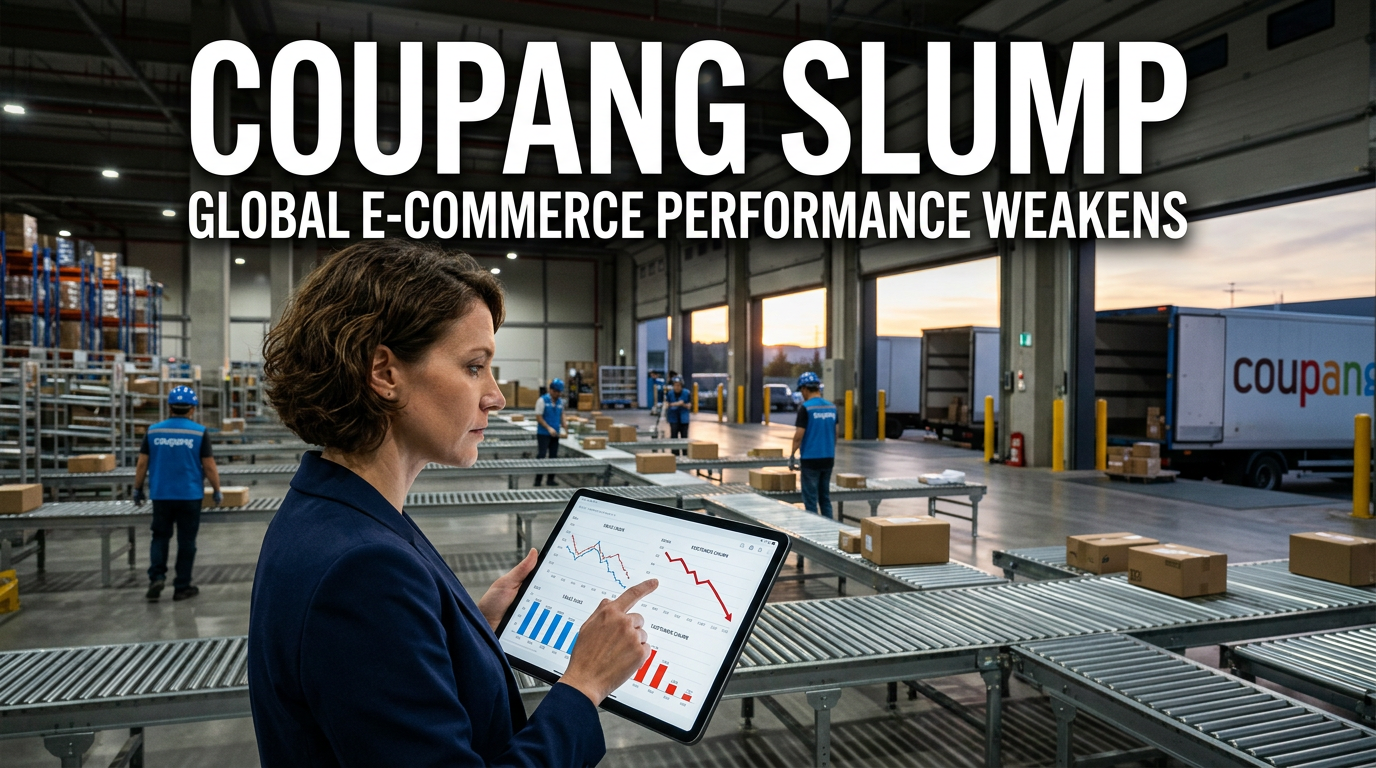
● Coupang Shutdown Rumors Ignite Ecommerce Shakeup
“The ‘Drop-off from Coupang’ Effect—Did It Really Happen? … Signal of a Reshuffle in the ‘E-commerce Arena’ Shown by Coupang’s Q1 2026 Results”
Key takeaway in one line: The drop-off from Coupang is certainly a “short-term exodus,” but it did not lead to Coupang’s total collapse
This point comes down to exactly three things. First, in Coupang’s Q1 2026, revenue grew but operating profit was thrown into major volatility. Second, there was news about membership churn (e.g., WoW cancellations), but the signal is closer to “the pace slowed” rather than “the customer base collapsed.” Third, competitors are strongly moving to change the board all at once—not just through the Naver/Kurly alliance, but also in the delivery space (Coupang Eats vs. Baemin).
And here, let’s naturally connect the core SEO keywords too. This issue is close to an “industrial realignment,” where the e-commerce market, subscription-based memberships, platform competition, delivery apps, and AI automation are all being shaken in the same flow.
1) Coupang in Q1 2026: “The Drop-off from Coupang Effect?” Conclusion Confirmed by Numbers
① Revenue up 8%, but “the growth rate isn’t what it used to be”
Coupang’s Q1 revenue was reported as up 8% year over year. On the surface it’s growth, but compared with the industry average (commerce typically grows by around 10–20%), the experience is different.
In particular, Coupang was a company that used high growth in the 20% range (even after it got bigger) almost like a default setting, but this figure (8%) can be read as Coupang’s first noticeable “growth slowdown shock” in its history.
② Operating loss: The biggest warning is the appearance of a “quarterly loss”
More important is operating profit. Coupang recently created a flow of profitability, but in this quarter it flipped back to a quarterly operating loss, and the scale is large.
An operating loss in the “around 350 billion won range” (mentioned in won currency equivalents) was observed, and there were interpretations that this is not just about marketing costs—it reflects a broader shake-up in the cost structure.
③ Active customers: Slight increase YoY, but decrease vs. the previous quarter… “The drop-off didn’t mean a total collapse”
Active customers rose by +2% compared to the same period last year, but fell by -3% compared to the previous quarter. You have to account for seasonality effects, but at minimum, the weight is on the idea that “there was churn in that quarter.”
So the conclusion is being framed like this. It’s hard to say the effect “didn’t exist,” but it’s also hard to say Coupang “collapsed.”
2) Coupons (handling after the hacking incident) as an “interpretation trap” mixed into accounting/performance
① The 50,000-won coupon debate: The cost-recognition method can create a growth-rate illusion
After the hacking incident, there was controversy over whether the coupons Coupang issued were “marketing” or “an apology,” and the accounting treatment also affects the outcome.
The key is that Coupang accounted for the coupons not as “cost,” but as a “sales deduction” method. This approach may not reveal an actual drop in customer spending directly as a loss/cost, so in the end, it can create a structure where “revenue growth (8%)” and “worsening in perception (operating loss)” appear together.
② If the “actual usage amount” is different, the growth-rate adjustment changes
There’s also an interpretation that it’s unlikely that the full 50,000-won total coupons were actually used in full by people. Especially if they’re used mainly in places that are easier to use—like Coupang Eats/Coupang’s general mall— the extent to which “coupons make revenue look better” could shrink, and the interpretation of the growth rate changes as well.
3) Why operating losses grew: Not just a coupon issue, but “compensation + operating costs + resource reallocation”
① Compensation and administrative expenses related to information leakage/personal data incidents
The most direct reason operating losses spiked is compensation costs related to the incident and administrative expenses. This is interpreted as a kind of cost that a business operator “cannot avoid.”
② Logistics/IT operating structure: An incident can break “delivery efficiency” and even the “forecasting system”
Coupang’s logistics isn’t just “put items in a warehouse and be done with it.” It’s run by attaching IT resources based on demand forecasting, so there was an assessment that if demand doesn’t move as predicted, it creates a structure where costs can blow up.
③ Mention of possible increase in venue/consulting/lobbying/outsourcing costs
Another point is that during the incident and response process, organizational resources might have shifted to outsourcing/consulting/venue arrangements, which could have worsened the cost structure.
In other words, the view is that the drop-off from Coupang (demand churn) itself + incident costs + the collapse of operating efficiency hit together, causing operating losses to widen.
4) “Financial risk” may be limited… a range where cash and operating flows hold up
① The size of cash-like assets is large, so short-term shocks may be absorbable
In interview/analysis streams, there are observations that “even if a disastrous operating loss continues into the next quarter, it’s unlikely to immediately become a cash liquidity crisis.”
② But even with good growth, opportunity cost can arise
Even if finances don’t collapse right away, if the timing of reinvestment for growth is delayed, interpretations included that “opportunity cost (the speed of getting to the next round)” will emerge.
5) Coupang vs. Naver–Kurly alliance: Areas where the “drop-off from Coupang benefit” shows up in actual numbers
① Kurly: As operating profit comes in, credibility is secured in the “numbers game”
For Kurly, it was confirmed that Q1 revenue was in the range of several hundred billion won, and operating profit was also recorded as positive (+). Given the valuation controversy that had been common due to losses/uncertainty, this time, there’s an evaluation that a “section proven by operating profit” has opened.
② “Maybe it’s because of the drop-off from Coupang,” but Kurly already built an organic base
The key point is this. It’s possible that the drop-off from Coupang moved customers to Kurly, but the perspective included is that Kurly didn’t suddenly benefit without preparation—it already had the strength (capacity) in place.
So, the most balanced interpretation is that timing + pre-existing preparation (organic strength) lined up together.
③ Naver: Beyond shopping, it absorbs the “Coupang rebound benefit” with fresh/ subscription/ delivery infrastructure
There are interpretations that a significant portion of customers leaving Coupang moved over to Naver. In particular, Naver’s investments/collaborations (e.g., additional investment in Kurly) and movements related to fresh delivery appeared at the same time.
Also, with metrics mentioned—like Naver Plus Store (increases in active users/transaction volume)— there are viewpoints reading it as an “infrastructure-expansion strategy,” not a temporary promotion.
6) Coupang Eats is relatively defended… the delivery market is a “different game”
① Analysis says Coupang Eats didn’t see big fluctuations
There was an assessment that Coupang’s commerce (general shopping) was shaken, but the summary is that the delivery side (Coupang Eats) continued its growth trajectory.
There were also observations that “free delivery based on a membership (Wow)” may have contributed greatly to defending Coupang Eats.
② The key is Baemin: The parent company Delivery Hero (DH) moves to sell
The news grows even bigger here. As DH, Baemin’s parent, was discussed as trying to sell Baemin, there was a flow suggesting that a possible Uber–Naver alliance (consortium) could emerge as the “top acquisition candidate.”
7) Why would DH want to sell: Pressure on cash flow + stress from the investor/ maturity structure
Reasons mentioned for why DH can’t “sit on” Baemin for long include lack of cash/liquidity pressure and stress from the maturity structure. So it’s not just “strategic intent from management”—“financial realities that must be met” are pulling the sale timing forward.
Also, with the fact that Uber holds DH shares overlapping, there are observations that the future acquisition landscape (reshuffling of Korea’s delivery market) could accelerate even more.
8) Naver’s interest in Baemin: Even considering fair review/regulatory and funding issues, “business fit” is high
Two main reasons were mentioned for why Naver is interested in Baemin.
First, advertising/local ads in delivery apps match the nature of Naver’s advertising ecosystem. Second, Baemin’s experience in commerce/logistics infrastructure aligns well with Naver’s shopping/subscription strategy.
However, with structures like “Naver holding 20%,” there’s also a view that the burden of fair review/regulatory issues from a foreign company acquiring a domestic platform and the realities of funding would operate together.
9) SSG (Shinsegae) · Gmarket · Oasis: The “Coupang drive” was tackled by multiple competitors at the same time
① Shinsegae (SSG): A jagged strategy + a membership-centered response, but results are limited
There are opinions that Emart/Shinsegae feels like their strategy keeps going back and forth. There were moves to aim at the post-Coupang-exit phase by investing in logistics centers → then selling them, and by changing memberships, but from a mid- to long-term roadmap perspective, criticism about a lack of consistency was included.
② Gmarket: Looks like it is increasing ad/marketing budgets to draw in younger users
Gmarket is said to have grown in presence, and there were mentions that large-scale ad placements may have increased user inflow.
③ Oasis: Some benefit + improved profits by strengthening omnichannel
Oasis received benefits, though not to the same extent as Kurly, and there was mention of a flow where operating profit improved slightly.
10) Did Chinese e-commerce also get shaken? Spread of “trust costs” from personal data issues
What’s interesting is that the impact isn’t limited to Korea—there are observations that Chinese e-commerce is also affected. Mentioned are indicator flows like a decline in payment amounts for AliExpress/Temu, and there’s an interpretation that incidents related to personal information may have affected people’s psychology and trust.
And if purchases through Naver increase domestically, you can also think about an effect where “the reason to buy from AliExpress in the first place” decreases.
11) Can “external variables” like Starbucks (SSG) shake up the Coupang landscape too?
Looking only at this quarter, “the Coupang drop-off” already created a turning point, but there is a strong tone that the long-term landscape is still fluid.
However, if social issues (Shinsegae/Starbucks-related matters, etc.) grow larger, there could be room for a second-order impact on consumer emotions and brand preference.
12) Conclusion: It’s still up in the air whether the drop-off from Coupang becomes a “long-term structural change” or just “short-term noise”
① Short-term churn is real, but it hasn’t been proven as a long-term collapse
In the data, active customers increased year over year, and Coupang commerce revenue also grew, so it’s difficult to conclude it’s a “service that disappears immediately.”
② The key is whether the “noise persists” and whether competitors can win in the “infrastructure/satisfaction” battle
Here too, there are two core things.
First, if Coupang keeps reducing friction around government/case-related issues, the long-term deterioration could be slowed. Second, it’s important whether competitors like Naver–Kurly–Baemin (Uber–Naver) go beyond merely “taking customers with discounts” and whether they can retain customers by maintaining experience (delivery quality/price/satisfaction).
In other words, it’s likely that not a short-term promotion war, but the redefinition of platform experience will decide the real winner.
“The 5 most important points” compiled separately in this article
1) The drop-off from Coupang isn’t “none,” but it’s also not a “complete collapse.” Active customers show “slowed pace” with last year being + and the previous quarter being -.
2) The essence of the operating loss is not just the coupon logic, but the possibility of incident-response compensation + administrative costs and a breakdown of logistics/IT operating efficiency and forecasting systems.
3) Even if a financial crisis (cash depletion) is unlikely, opportunity cost can arise in the timing of reinvestment for growth.
4) The strength of the Naver–Kurly alliance isn’t just simple benefit—it’s a structure where “infrastructure/fresh logistics/subscriptions/IPO timing” overlap.
5) The delivery market has a different “shape” than commerce. Coupang Eats is relatively defended, and the DH sale issue makes it more likely that Baemin’s landscape will change.
< h3 > Next quarter (Q2) is the real turning point
Next is exactly “Q2 results.” This is the period where we can gauge whether Coupang regains its growth rate or gets structurally pushed down further in terms of membership/price competition/operating efficiency.
In the same context, Kurly also needs to confirm whether its operating profit improvement is a one-off, and Naver is the time to see whether performance continues in real transaction volume through delivery/fresh logistics/ads/subscriptions.
Summary
– Coupang Q1 2026: Revenue grew by 8%, but growth slowdown is clear, and the scale of operating losses suggests that the short-term impact of “Coupang churn” is being confirmed. – Active customers increased (+2%) year over year but fell (-3%) quarter over quarter, signaling slower pace rather than total collapse. – The core of the operating loss expansion is not only coupon logic, but also incident-response compensation/admin costs + the possibility of breakdown in logistics and IT operating efficiency. – Although a cash liquidity crisis seems unlikely, opportunity cost can arise in reinvestment timing for growth. – Naver–Kurly: Kurly’s operating profit improvement and Naver’s fresh/subscription/delivery infrastructure investment show the Coupang-churn benefit becoming more concrete. – Delivery market: Coupang Eats’ defense is relatively strong, and Baemin’s DH sale issue raises the possibility of an Uber–Naver alliance, which could speed up how fast the board changes. – Conclusion: The long-term landscape will be decided by whether the “noise continues” and how strongly competitors can maintain their experience/satisfaction (a structure, not just discounts).
[View two related posts]
- The e-commerce landscape after Coupang: The next phase of subscription-based memberships and platform competition
- Reshaping the delivery app market: What Uber–Naver and Baemin acquisition scenarios mean
*Source: [ 티타임즈TV ]
– ‘탈쿠팡’ 효과, 어디까지 영향을 미쳤을까?