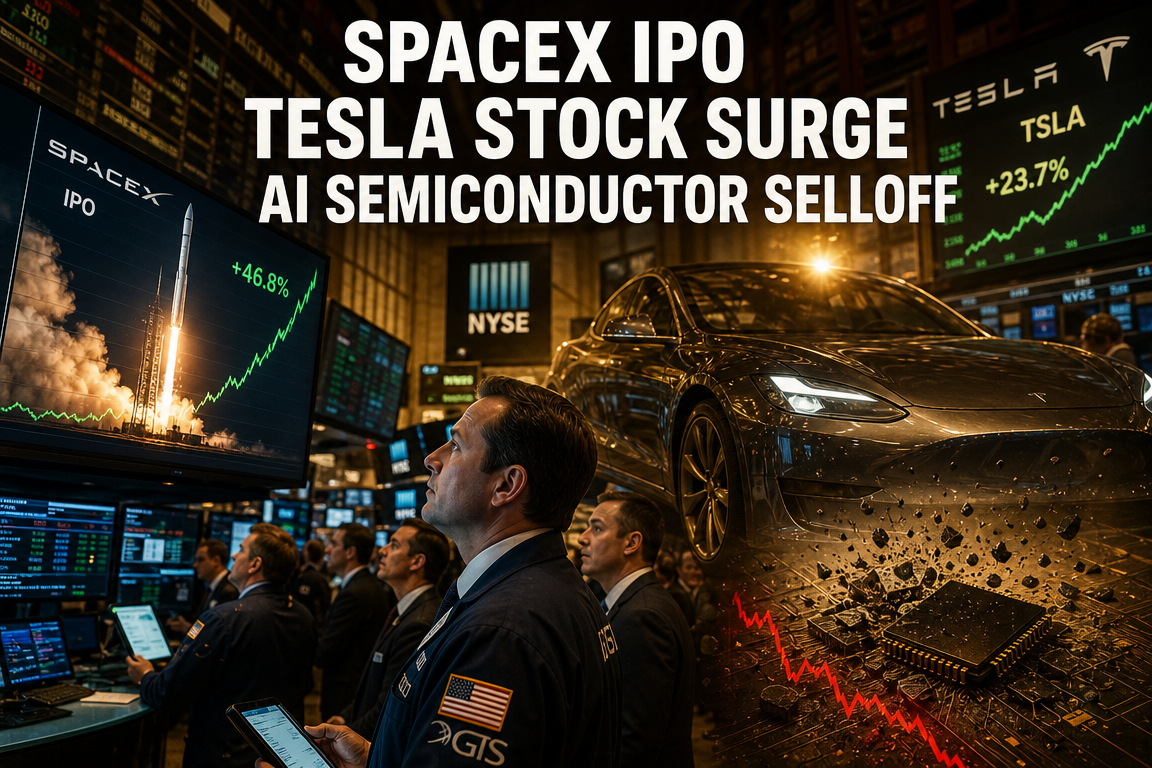
● Tesla Soars, SpaceX IPO Shock, AI Power Play
Tesla Surges Ahead of Potential Record-Scale SpaceX IPO: The Key Driver Lies Elsewhere
This report goes beyond a simple explanation of “why Tesla rose.”
It consolidates: the structure of the SpaceX IPO, the implications of Wall Street’s initial $190 price target, why Tesla–SpaceX merger speculation has resurfaced, how Tesla’s Q2 delivery outlook may affect valuation, and what Musk appears to be positioning for amid the AI semiconductor and manufacturing infrastructure race.
While the headline is the SpaceX IPO, the underlying chain connects US equities, inflation dynamics, EV demand, AI semiconductors, and Tesla valuation.
Key Headlines at a Glance
- Tesla closed at $399.15, up 4.60% on the day.
- The S&P 500, Nasdaq, and Dow also rose sharply, but Tesla outperformed the broader indices.
- The surface catalyst was easing Middle East risk and lower oil prices; however, trading behavior suggests SpaceX IPO expectations and Tesla Q2 performance expectations were also priced in.
- SpaceX set an IPO price of $135 and indicated a total raise of $75 billion, positioning it as a record-scale IPO event.
- Wall Street’s first external coverage set a $190 price target for SpaceX.
- Some institutional investors reportedly view a Tesla–SpaceX merger scenario as moving from fringe to more mainstream discussion.
- Barclays forecast 418,000 Tesla Q2 deliveries, above market consensus.
- Musk reportedly conducted an AI6 chip design review and met with the ASML CEO, signaling escalation in the AI infrastructure buildout.
1. Why Tesla Rose 4.60%: The Broad Market Rally Is Insufficient as a Standalone Explanation
1-1. Surface catalyst: expectations of reduced Middle East tension
Risk appetite strengthened across markets.
- The S&P 500 rose 1.75%.
- The Nasdaq rose 2.54%.
- The Dow rose 1.86%.
Comments attributed to former President Trump regarding a potential peace arrangement involving Iran contributed to oil price declines, which markets interpreted as a signal of easing inflation pressure.
Lower oil prices can reduce consumer cost burdens and relieve logistics and production cost pressure, generally supportive for growth equities, including technology and EV-related names.
1-2. Macro data was not clearly supportive
Macro indicators were mixed:
- May PPI came in above expectations.
- Initial jobless claims exceeded forecasts.
Inflation pressure was not conclusively resolved, and labor market cooling was not unambiguously orderly. The strength of the risk-on move implies expectations beyond near-term data. For Tesla, those expectations plausibly linked to the SpaceX IPO event and front-running of Q2 results.
2. SpaceX IPO: Why It Matters for Broader Markets
2-1. IPO price at $135; indicated raise of $75 billion
SpaceX set an IPO price of $135 per share. The indicated raise of $75 billion is viewed as outsized versus historical IPO benchmarks, with potential to influence overall US IPO market sentiment.
2-2. The critical factor is the issuance structure, not the listing itself
Key elements of the offering structure:
- Approximately 4.2% of total shares are offered to the public.
- The remaining 95.8% remains with existing holders.
- Musk is reported to retain 82% voting control post-IPO.
This implies limited free float with high symbolic demand, increasing the likelihood of early supply-demand imbalance and elevated volatility.
2-3. 30% retail allocation is unusually large
Allocating 30% of the offering to retail investors is atypical for a large IPO.
This may support initial demand, but also increases the probability of short-term speculative flows and higher price dispersion after listing.
3. Wall Street’s Initial $190 Target: The Number Alone Is Not the Full Signal
3-1. Oppenheimer framing: SpaceX as more than a launch company
The first external coverage initiated with a Buy and a $190 price target, about 41% above the $135 IPO price.
The key point is the valuation framework: SpaceX is being positioned as a vertically integrated AI infrastructure platform combining capital intensity, data, AI capability, hardware, and manufacturing execution.
This aligns with an environment where value capture increasingly depends on control of AI-era bottlenecks rather than the legacy product category.
3-2. Material skepticism remains
Some analysts remain materially more conservative on fair value. The debate concentrates on:
- whether space-based AI infrastructure is monetizable at scale; and
- whether the valuation embeds expectations beyond near-term fundamentals.
Early trading may therefore be more narrative-driven than earnings-driven.
4. Why the SpaceX IPO Matters to Tesla Shareholders
4-1. Repricing of Tesla’s stake is possible
The text references Tesla holding approximately 18.89 million shares of SpaceX.
At the $135 IPO price, this implies an asset value of roughly $2.5 billion. While not dominant relative to Tesla’s market capitalization, the shift from private-mark-to-market expectations toward a public reference price can affect investor sentiment.
4-2. Near-term capital rotation risk
Capital may rotate into SpaceX IPO participation, potentially funded by sales of liquid large-cap holdings, including Tesla. The text notes Tesla appearing among top short-term net-sold names, consistent with this risk.
Accordingly, the SpaceX IPO can be sentiment-positive while also creating near-term flow-related headwinds.
5. Merger Speculation: Why It Has Re-emerged as a More Mainstream Scenario
5-1. The tone has shifted
Historically, Tesla–SpaceX merger discussion was often treated as retail speculation. Recent commentary suggests some institutions are now treating it as a scenario worth evaluating as part of the investment thesis, implying the market is increasingly sensitive to structural reconfiguration narratives.
5-2. Strategic logic cited
Common arguments supporting merger logic:
- Both firms sit within a Musk-led technology ecosystem.
- AI, robotics, communications, space, semiconductors, and manufacturing capabilities are interlinked.
- Consolidation of data, compute, and manufacturing capabilities could improve long-term efficiency.
A combined narrative spanning robotaxis, humanoid robotics, satellite communications, and AI compute could influence how investors categorize the platform and assign multiples.
5-3. Execution barriers remain significant
Key obstacles identified:
- Difficulty of determining merger premium and exchange ratios.
- Potential opposition from Tesla shareholders.
- Regulatory conflict between Tesla’s China exposure and SpaceX’s US government and defense contracting.
National security review and geopolitical constraints could outweigh financial rationale, making collaboration structurally easier than legal consolidation.
6. Tesla Q2 Outlook: The More Immediate Driver for Near-Term Pricing
6-1. Barclays is above consensus
Barclays forecast Tesla Q2 deliveries at 418,000, above consensus around 397,000. If realized, this would represent a meaningful sequential improvement and could support near-term sentiment.
6-2. Regional trends are mixed
- China: comparatively clearer recovery signals.
- Europe: signs of stabilization and rebound.
- US: potential softness due to EV tax credit changes and pull-forward effects.
The key question is whether China and Europe strength can offset US deceleration.
6-3. Not only a volume issue
Tesla is not valued solely as an auto manufacturer; however, quarterly deliveries remain central because current cash generation and credibility for longer-duration narratives are still anchored by the core automotive business.
A delivery beat can reinforce “core business resilience,” facilitating renewed willingness to underwrite AI-driven optionality.
7. Underappreciated Signal: AI6 Chip and the ASML Meeting
7-1. AI6 chip review as a capacity signal
Musk reportedly conducted an engineering review of the Tesla AI6 chip and made constructive remarks relating to wafer yield availability.
This is relevant because FSD, robotaxis, Optimus, and large-scale AI training depend on chip performance and supply scalability, not only software progress.
7-2. Implications of meeting the ASML CEO
Musk’s meeting with the ASML CEO ahead of the SpaceX IPO is notable. ASML effectively controls supply of leading-edge EUV lithography tools, a critical bottleneck in advanced semiconductor manufacturing.
This suggests focus on the constraint set shifting from software to manufacturing equipment and semiconductor production capacity.
7-3. The shared denominator between Tesla and SpaceX is AI infrastructure
Despite different end markets, common infrastructure requirements include:
- high-performance chips
- large-scale compute
- manufacturing automation
- data acquisition and real-time processing
- vertically integrated supply chains
From an investor perspective, the more material question may be ecosystem integration and capacity control, rather than formal merger probability.
8. The Most Actionable Takeaways Often Missed Elsewhere
8-1. The move is better explained by AI supply-chain control than by IPO sentiment alone
The IPO narrative is directionally relevant, but the deeper driver is perceived progress in securing AI compute and semiconductor production bottlenecks. Long-duration valuation support depends more on execution capacity than on listing events.
8-2. A loose federation scenario may be more realistic than a full merger
Maintaining separate entities while sharing technology, data, and infrastructure may reduce regulatory risk, preserve financing flexibility, and retain narrative benefits.
8-3. The principal valuation inflection remains robotaxis and Optimus
Merger speculation may provide incremental support, but the core upside drivers remain robotaxi commercialization pace, the depth of Optimus progress, and the feasibility of AI chip production scaling.
Auto deliveries indicate operating endurance; AI initiatives influence the multiple.
9. Upcoming Items to Monitor
- SpaceX initial price action after Nasdaq trading begins
- Post-listing volatility related to limited free float
- Tesla Q2 delivery release versus consensus
- Additional robotaxi timeline disclosures
- Optimus progress updates and AI6 development milestones
- Further actions related to semiconductor supply-chain procurement
10. Conclusion
Attributing Tesla’s rise solely to a broad market rally obscures the underlying drivers.
Markets are increasingly repricing the Musk ecosystem through the lens of a record-scale SpaceX IPO, but the more durable question is control of AI infrastructure bottlenecks.
Near term, Tesla’s Q2 deliveries are the primary sensitivity. Medium term, post-IPO flow dynamics matter. Long term, AI6 and semiconductor manufacturing capacity are likely to be central determinants for both Tesla and SpaceX.
< Summary >
Tesla rose 4.60% as a combination of market risk-on, oil price declines, SpaceX IPO expectations, and improving Q2 delivery forecasts.
SpaceX priced at $135 with an indicated $75 billion raise, with an initial Wall Street target of $190.
Tesla–SpaceX merger speculation has intensified, but execution faces significant regulatory and stakeholder barriers.
More important is the effective convergence of both companies around AI semiconductors and manufacturing infrastructure.
Tesla’s directional drivers remain Q2 results, robotaxis, Optimus, and the scalability of AI6 production.
[Related Articles…]
- SpaceX IPO and the Repricing of AI Infrastructure Platforms
- Tesla Outlook: Robotaxis, AI Chips, and the Next Valuation Regime
*Source: [ 오늘의 테슬라 뉴스 ]
– SpaceX 역대 최대 IPO 전날 테슬라가 +4.60% 뛴 진짜 이유 — 월가 첫 커버리지 $190이 말하지 않은 것, $399 주주는?
● SpaceX IPO Shock, AI and Chip Selloff Fear
Will a SpaceX IPO Pull Liquidity from Semiconductor and AI Stocks? From “Capital Black Hole” Concerns to Space-Industry Beneficiaries and the Market’s Overlooked Core Issue
A SpaceX IPO is not merely a large IPO event.
It may simultaneously involve large-scale capital reallocation, near-term volatility in semiconductor and AI equities, potential Nasdaq-100 inclusion, a re-rating of the space-industry value chain, and longer-term shifts in the global economy and industrial structure.
Key investor questions typically fall into three areas:
- Will capital rotate out of AI and semiconductors after a SpaceX IPO?
- Will Korean space-related stocks rise, or face a pullback?
- Which businesses could drive SpaceX’s growth after listing?
This report separates near-term price dynamics from longer-term industry growth drivers and highlights a core point that is often underemphasized in mainstream coverage.
1. Key Takeaways: What a SpaceX IPO Signals to Markets
A SpaceX IPO is viewed as an event that can alter broader liquidity conditions.
Beyond a single listing, it may influence where global capital concentrates and which sectors receive valuation premiums.
Core mechanics:
- Pre-IPO: capital flowed into “proxy exposures” because direct ownership was unavailable.
- Post-IPO: capital may rotate into SpaceX directly once accessible in public markets.
- This transition can increase short-term volatility across semiconductors, AI, megacaps, and space-related equities.
However, part of this rotation may already be reflected in prices, as positioning can begin well ahead of the listing.
2. Will a SpaceX IPO Pressure Semiconductor and AI Stocks?
2-1. Conclusion: Near-term pullbacks are plausible, but this is not, by itself, evidence of structural impairment
Markets have repeatedly raised concerns that SpaceX could function as a “capital black hole,” triggering profit-taking in semiconductors and AI.
The concern is not baseless. In an environment with elevated valuation debates, rate sensitivity, and earnings expectations already priced in, a mega-IPO can create visible supply-demand imbalances.
Institutional investors may need to rebalance portfolio weights, reducing other exposures to fund new allocations. In that process, semiconductor, AI, and large-cap growth stocks may experience temporary dislocation.
2-2. A key counterpoint: IPO allocations are often funded by pre-positioned liquidity
Mega-IPOs rarely rely on last-minute funding flows.
As timing becomes more visible, institutions often raise cash or rebalance gradually over weeks to months. Accordingly, the scenario in which capital exits other sectors abruptly on the listing date may be overstated.
2-3. The more material variable may be index inclusion rather than the IPO itself
A larger structural driver could be subsequent passive inflows linked to index inclusion.
If SpaceX is added to the Nasdaq-100 relatively quickly, index-tracking ETFs and passive funds would need to buy mechanically. This is not discretionary demand; it is rule-driven.
Market participants therefore often distinguish:
- First volatility window: IPO launch and initial price discovery
- Second volatility window: index-inclusion-driven rebalancing
This could reshape growth-sector positioning across U.S. equities and influence overall market sentiment.
3. Why Space-Related Equities Rose First, Then Pulled Back
3-1. Pre-IPO: “proxy exposure” premiums expanded
Given SpaceX’s long private status, investors sought indirect exposure.
Typical beneficiaries included:
- firms with indirect equity or partnership links,
- companies expected to benefit from SpaceX revenue expansion,
- space-theme names treated as functional substitutes.
These moves were often driven more by scarcity of direct access than by near-term fundamentals.
3-2. As listing nears, proxy premiums can compress
Once SpaceX is publicly tradable, the incentive to hold imperfect proxies can diminish.
As a result, some space-related equities that appreciated on pre-IPO expectations may face profit-taking around the listing window. This dynamic reflects a liquidity and positioning adjustment rather than a definitive negative view on underlying businesses.
4. How to Frame Korean Space-Related Equities
4-1. Separate “SpaceX proxies” from “space-industry beneficiaries”
A SpaceX IPO does not mechanically imply upside for Korean space-themed stocks.
A more precise framework divides them into:
- names that rose primarily as substitutes for SpaceX exposure,
- names positioned to benefit from secular growth in the space ecosystem.
The first category may face outflows post-IPO. The second may be re-rated over time as the industry expands.
4-2. Long-term upside depends on concrete positioning in the value chain
Assessment should be based on functional role in the space value chain, not the presence of a “space” label.
Relevant segments include:
- satellite manufacturing,
- observation, surveillance, and reconnaissance,
- satellite communication antennas and equipment,
- launch-vehicle components and precision materials,
- ground stations, data processing, and services.
Value creation may increasingly concentrate in services, data, networks, defense integration, and AI-enabled business models rather than purely in manufacturing.
4-3. Short-term equity performance and long-term industry growth can diverge
The space industry may expand in the real economy while capital markets experience near-term concentration in SpaceX, pressuring related equities.
Both outcomes can occur simultaneously. Timing risk is therefore material: a favorable secular theme does not guarantee immediate equity upside.
5. Plausible Post-IPO Trading and Positioning Path
5-1. Immediately after listing: expectations versus supply dynamics
Early trading may feature direct conflict between:
- pent-up demand from investors seeking exposure, and
- profit-taking from participants positioned ahead of the IPO.
Differences between institutional and retail behavior, and between passive and active strategies, can amplify volatility. Positive headline catalysts do not preclude near-term drawdowns.
5-2. Around index inclusion: a second volatility phase
Index inclusion can trigger incremental, non-discretionary buying.
This phase can generate more pronounced flows than the IPO itself, depending on timing, market conditions, and index weight.
5-3. Approximately 6 months later: lock-up expirations and secondary supply
As lock-ups expire, potential share supply from early holders can become a focal risk.
The impact is not uniformly negative; market reaction depends on operating performance, expectations, and valuation at that time. The critical variable is investor confidence in execution, not the lock-up event in isolation.
6. Where SpaceX Could Expand After Listing
6-1. Launch services: still core, but increasingly a foundation layer
SpaceX’s competitive advantage is cost-efficiency and execution capacity in launches.
As government and commercial satellite deployments increase, the company’s baseline economics may strengthen.
6-2. Starlink: from satellite internet to global communications infrastructure
Starlink is positioned beyond consumer broadband, with potential expansion across:
- coverage in underserved regions,
- disaster response connectivity,
- military communications,
- remote industrial connectivity,
- maritime and aviation networks.
If direct-to-device capabilities scale, boundaries with traditional telecom may further blur. This positions Starlink as a strategic component of global digital infrastructure.
6-3. Defense: a structural growth axis
With rising defense budgets, space-based communications, ISR, missile warning, and battlefield networking have gained strategic priority.
SpaceX has expanded its presence in U.S. government and defense-related programs, supporting a thesis of evolution from a launch provider into a defense infrastructure enabler.
6-4. AI and data infrastructure: an underweighted growth vector
SpaceX can also be framed as an AI and data-infrastructure platform.
As satellite networks scale, data volumes increase materially, requiring:
- compute capacity,
- data centers,
- AI analytics capabilities.
Potential linkages with adjacent AI initiatives, utilization of space-based communications data, and real-time optimization applications (surveillance, logistics, situational awareness) imply a convergence of space, telecom, defense, and AI.
7. The Most Underemphasized Points in Typical Coverage
7-1. Space-industry economics are harder to quantify than semiconductors
Semiconductors often have clearer earnings linkage: downstream strength can translate into more measurable forecasts for suppliers and equipment makers.
In contrast, it remains difficult to quantify how a SpaceX equity move translates into revenue and profit changes for specific Korean firms. Momentum-driven participation without measurable linkage increases timing and valuation risk.
Industry attractiveness and valuation attractiveness are separate questions.
7-2. Market understanding of the space sector remains comparatively limited
Investor literacy is high in semiconductors and batteries, but lower in space, where many view the theme as attractive yet lack a clear model of monetization.
This can create opportunity for informed investors, but it also raises the burden of due diligence.
7-3. Treat the IPO as an ecosystem transition signal, not only a trading event
The larger implication may be sector formation.
As SpaceX becomes publicly listed, the space economy could shift from a “theme” framework toward recognition as a standalone investable sector, spanning manufacturing, communications, defense, data, and AI-enabled services.
8. Practical Investor Checklist
8-1. Short-term trading
- Monitor volatility in proxy names that rallied on pre-IPO expectations.
- Track flow dynamics around index inclusion more closely than the IPO date alone.
- Distinguish structural thesis breaks from temporary rebalancing-driven dislocations in semiconductors and AI.
8-2. Medium-term positioning
- Prioritize companies with identifiable revenue linkage to the space value chain.
- Segment exposure across defense, satcom, ground infrastructure, antennas, and data-processing firms.
- Focus on the pace of industry capex and contract expansion rather than SpaceX’s share price alone.
8-3. Long-term allocation
- Approach space as a multi-year growth industry rather than a single-cycle theme.
- Track increases in national space R&D and procurement budgets.
- Monitor expansion in AI, data centers, and satellite-data monetization models.
9. Bottom Line: Evaluate Both “Capital Rotation” and “Industry Expansion”
A SpaceX IPO can absorb liquidity and raise near-term volatility across semiconductors, AI, megacaps, and space-related equities.
However, framing it as “SpaceX up, everything else down” is overly reductive. Some rotation may already be priced, and post-IPO developments could elevate the broader space industry into institutional portfolios as a formal sector allocation.
For Korean equities, the central question is not whether a name is labeled “SpaceX-related,” but whether it has a defensible role in the space economy with measurable exposure.
The event should be analyzed as:
- Near term: a flow-driven supply-demand shock
- Medium to long term: a signal of a changing industrial order
< Summary >
A SpaceX IPO may increase short-term volatility in semiconductor and AI equities, but it does not, by itself, imply an immediate, one-way capital exodus.
Institutional funding may be partially pre-positioned, and a larger variable could be passive flows tied to potential Nasdaq-100 inclusion.
Korean space-related equities should be assessed by separating proxy-driven names from companies with tangible exposure to space-industry growth.
Over the longer term, SpaceX may be better understood as a next-generation infrastructure platform spanning launch services, Starlink, defense integration, and AI/data infrastructure.
The critical discipline is separating near-term price dynamics from long-term industry expansion.
[Related Articles…]
- SpaceX IPO: Liquidity Rotation, Index Inclusion, and Space-Sector Re-Rating
- AI Infrastructure: Data Centers, Networks, and the Next Investment Cycle
*Source: [ 경제 읽어주는 남자(김광석TV) ]
– 스페이스X 상장하면 반도체·AI 주식 빠질까? | 경읽남과 토론합시다 | 정의훈 선임연구원 [3편]