● SpaceX-IPO Shockwave
Will a Mega-Scale SpaceX IPO Surge or Sell Off? The More Material Variable Is Elon Musk’s AI-and-Space Value Chain
This issue is not limited to whether a SpaceX IPO performs well. Three factors are central:
1) Whether SpaceX can evolve from a single-sector space company into a new growth pillar for the global economy and U.S. equities.
2) Whether Musk’s integrated ecosystem across Starlink, xAI, Tesla, and energy can function as an operational “end-to-end AI value chain.”
3) For investors, whether structural variables—rates, inflation, semiconductors, data centers, and space infrastructure—matter more than the offer price or first-day trading.
This report summarizes the implications of a SpaceX IPO, business structure, post-listing price drivers, key risks, potential Korea-related beneficiaries, and under-discussed considerations.
1. Why markets are highly sensitive to a SpaceX IPO
This is not a conventional large IPO. The market is effectively treating it as a combined listing event for:
- Space industrial capacity
- AI infrastructure
- Next-generation communications
- Defense technology
At offer-price levels, SpaceX is already valued at a mega-cap scale; post-listing market-cap positioning would be compared with large U.S. technology leaders, creating signaling effects. The equity would likely be categorized as a growth asset priced on forward expectations rather than near-term earnings.
Potential dual-path price action:
- Initial surge driven by scarcity and expectations
- Subsequent elevated volatility driven by valuation constraints and funding considerations
Company quality and entry valuation are distinct considerations.
2. What SpaceX is as a business
SpaceX should not be analyzed solely as a launch provider; it is a multi-segment platform with infrastructure characteristics.
2-1. Launch services
SpaceX’s foundational business is launch services. Its share of global launch cadence has become dominant, implying effective standard-setter status in space transport.
2-2. Starlink-based satellite communications
The primary cash-flow engine is Starlink. Beyond consumer satellite internet, Starlink functions as a candidate global communications layer for the post-6G era. In low-density geographies where terrestrial rollout is expensive, low-earth-orbit satellite networks can be economically advantaged (e.g., large-area markets and regions with high last-mile infrastructure costs).
2-3. Space-based data center experimentation
A longer-horizon initiative is the concept of space-based computing: satellites equipped with on-orbit compute and interlinked as distributed infrastructure. Economic viability is not yet proven. Key constraints include cooling, launch cost, maintenance, and orbital operations efficiency. The practical question is not technical feasibility alone, but when (or whether) cost competitiveness emerges.
2-4. Integration with the AI ecosystem
SpaceX may be better assessed within the Musk ecosystem:
- Starlink: communications layer
- xAI: model development and AI services
- Tesla: physical-AI endpoints (vehicles, robotics)
- Energy: power supply and storage
- SpaceX: space transport and potential orbital infrastructure
If integration matures, SpaceX can be positioned as an AI-era infrastructure operator rather than only a space company.
3. Core thesis: Musk is targeting an end-to-end AI value chain
The AI stack can be segmented as follows:
- Power infrastructure
- Communications infrastructure
- AI infrastructure (GPU, memory, data centers)
- AI models
- AI services
- Physical-AI products (vehicles, robots, devices)
Most companies occupy one or two layers. The Musk strategy seeks cross-layer linkage:
- Communications: Starlink
- Models/services: xAI, Grok
- Physical AI: Tesla vehicles, Optimus
- Power: Megapack, solar
- Space transport and data infrastructure: SpaceX
If executed, SpaceX’s strategic relevance expands from launch capacity to enabling infrastructure for AI deployment at scale.
4. Upside case: why the thesis is not purely speculative
4-1. Existing dominance in launch markets
SpaceX is not purely pre-revenue. It has secured strong market position in launch cadence, satellite deployment scale, reusability, and cost efficiency relative to peers.
4-2. Satellite deployment speed is structurally difficult to match
Starlink’s deployment volume, payload efficiency per launch, high launch frequency, and reusability-based operations create a pace advantage versus state-led programs and traditional commercial competitors.
4-3. Reusability changed the cost curve
The economic core of space is unit delivery cost. Historically, high cost constrained market size. Reusability lowers the effective “space shipping” cost curve, with second-order impacts across communications, defense, earth observation, and data-driven services.
5. Key risks to monitor post-listing
5-1. Valuation risk
The market may assign high multiples by treating SpaceX as AI-adjacent infrastructure rather than manufacturing. High-multiple assets can re-rate sharply if performance under-delivers. Growth-premium compression is more likely when real rates rise or rate-cut expectations weaken.
5-2. Funding and capital intensity
Large ambition implies large capital requirements: launch system development, satellite manufacturing, network maintenance, orbital experimentation, and AI infrastructure. Even after an IPO, incremental capital raises could remain a persistent market variable.
5-3. Uncertain profitability trajectory for xAI
Starlink is increasingly viewed as cash-generative, while xAI remains investment-heavy. Monetization depends on model competitiveness, customer acquisition, enterprise conversion, and infrastructure efficiency.
5-4. Macro sensitivity
Mega-cap growth assets are typically sensitive to macro conditions:
- Renewed inflation pressure
- Delayed policy easing
- Higher long-end yields
- Higher discount rates for long-duration cash flows
Company execution may be insufficient to offset adverse macro repricing.
6. Implications for space and AI investment themes
6-1. Space is shifting from “theme” to infrastructure
Space is increasingly linked to communications, defense, logistics, observation, and data services—characteristics consistent with infrastructure industries rather than episodic projects.
6-2. AI is ultimately a power, network, and data center competition
Application-layer advantage is insufficient without electricity, connectivity, and compute. SpaceX valuation could be reframed through the lens of AI infrastructure optionality.
6-3. Faster convergence of defense and AI
Asymmetric warfare, drones, real-time satellite communications, and AI-enabled analytics can accelerate defense tech adoption, potentially supporting sustained public-sector demand.
7. Investment framing: priorities beyond IPO-day momentum
7-1. Post-IPO momentum trading requires volatility budgeting
Large IPOs can spike on demand and scarcity. Subsequent price action can reverse on profit-taking, flow rotation, media-driven overextension, and valuation constraints. Staged entry is generally more consistent with risk management.
7-2. Space exposure as a limited-weight theme
Even with strong long-term narratives, portfolio concentration risk is elevated due to volatility and long-duration payoffs.
7-3. Consider indirect beneficiaries
Supply-chain and adjacent industries may offer more stable exposure than the listed equity alone:
- Aerospace components
- Specialty alloys and advanced materials
- Satellite communications equipment
- Data center components
- Power infrastructure
- Semiconductors and AI memory supply chains
8. Potential implications for Korean equities: sectors to monitor
Direct benefit from a SpaceX listing is limited; indirect value-chain exposure is more practical.
8-1. Aerospace and satellite-related names
Potential attention may concentrate on companies linked to space components, aviation materials, and launch-related collaboration opportunities.
8-2. AI semiconductors and memory
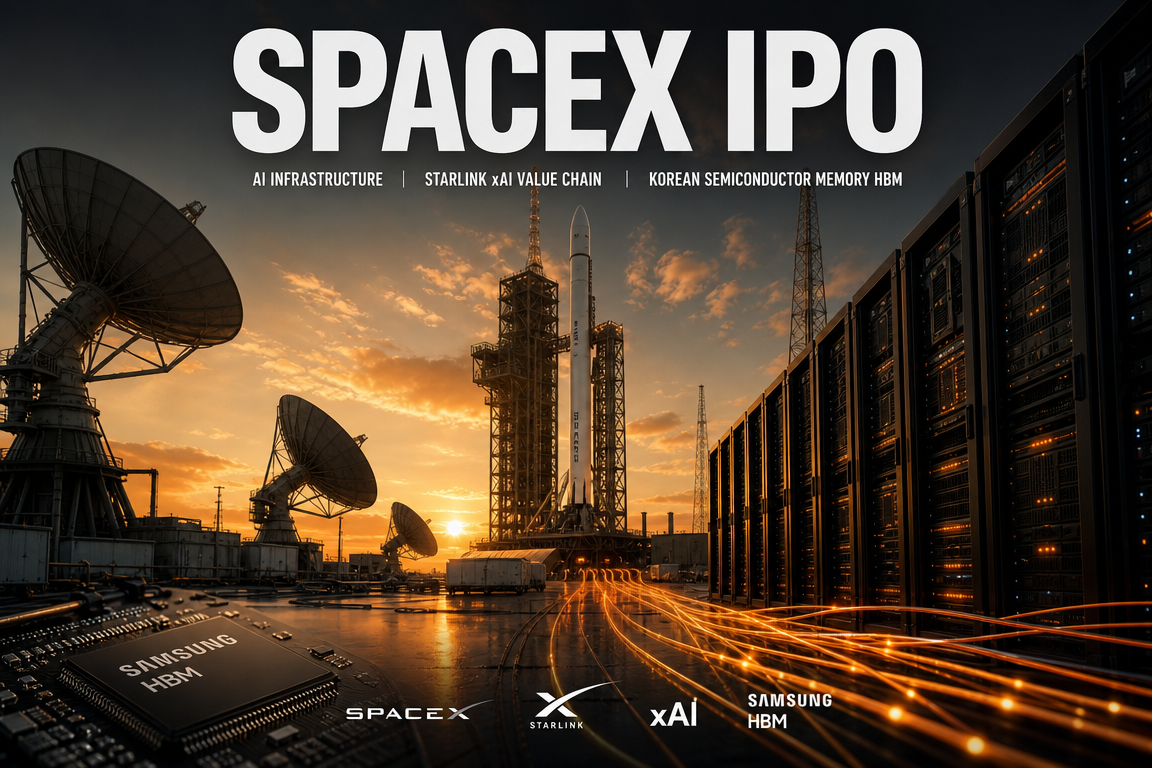
If SpaceX and xAI expand AI infrastructure, demand for HBM, server memory, and related semiconductors could increase, supporting indirect tailwinds for major Korean semiconductor suppliers.
8-3. Power infrastructure and data center beneficiaries
AI-driven data center buildouts increase demand for power, cooling, and facilities investment, extending the impact beyond pure technology into industrials and infrastructure.
9. Under-covered points with high analytical value
9-1. The core is cost-structure redesign, not “space as spectacle”
The differentiator is reduced unit cost to place mass and capability in orbit. Lower delivery cost expands addressable markets across data, communications, and defense.
9-2. The real competitor to space data centers is terrestrial data centers
The key is not novelty but relative economics. Terrestrial sites face power constraints, permitting friction, community opposition, and rising cooling costs. Space becomes relevant if terrestrial economics deteriorate and orbital options improve on a cost-adjusted basis.
9-3. The strategic endpoint may be ecosystem self-sufficiency
Rather than optimizing standalone growth for each company, the ecosystem may be designed to integrate power, communications, AI, mobility, robotics, and space logistics. In that case, valuation depends increasingly on cross-business coupling and execution.
9-4. Government demand may be the primary game-changer
Beyond consumer connectivity, large opportunities may reside in government, defense, and public-sector programs: communications, ISR, battlefield networking, drone countermeasures, and real-time analytics. These markets can feature longer-duration contracts than retail services.
10. Conclusion: treat a SpaceX IPO as an industrial-structure shift, not a single-day trade
A SpaceX listing is less about first-day percentage moves and more about validating whether space is becoming a core layer of communications and AI infrastructure, and whether Musk’s integrated ecosystem is recognized by public markets.
- Short term: IPO flows and valuation discovery
- Medium term: profitability validation for Starlink and xAI
- Long term: execution of an AI–space–power–mobility value chain
< Summary >
The central issue is not IPO-day performance but the integrated value chain linking space, communications, AI, power, and robotics. Starlink is increasingly viewed as a cash-flow engine, and reusability has materially altered the cost structure of space transport. Key risks include premium valuation, ongoing capital needs, and uncertain monetization for xAI. Long-term positioning may be compelling, but near-term price behavior is likely to remain highly volatile. For Korean investors, indirect exposure via aerospace, power infrastructure, AI memory, satellite communications, and data center supply chains may be more actionable than direct exposure alone.
[Related Articles…]
- AI Data Centers: Power, Cooling, and Capex Trends
- Space Infrastructure and Satellite Connectivity: Market Structure Shifts
*Source: [ 경제 읽어주는 남자(김광석TV) ]
– [LIVE] 스페이스X 초대형 IPO, 급등할까? 급락할까? [즉시분석]