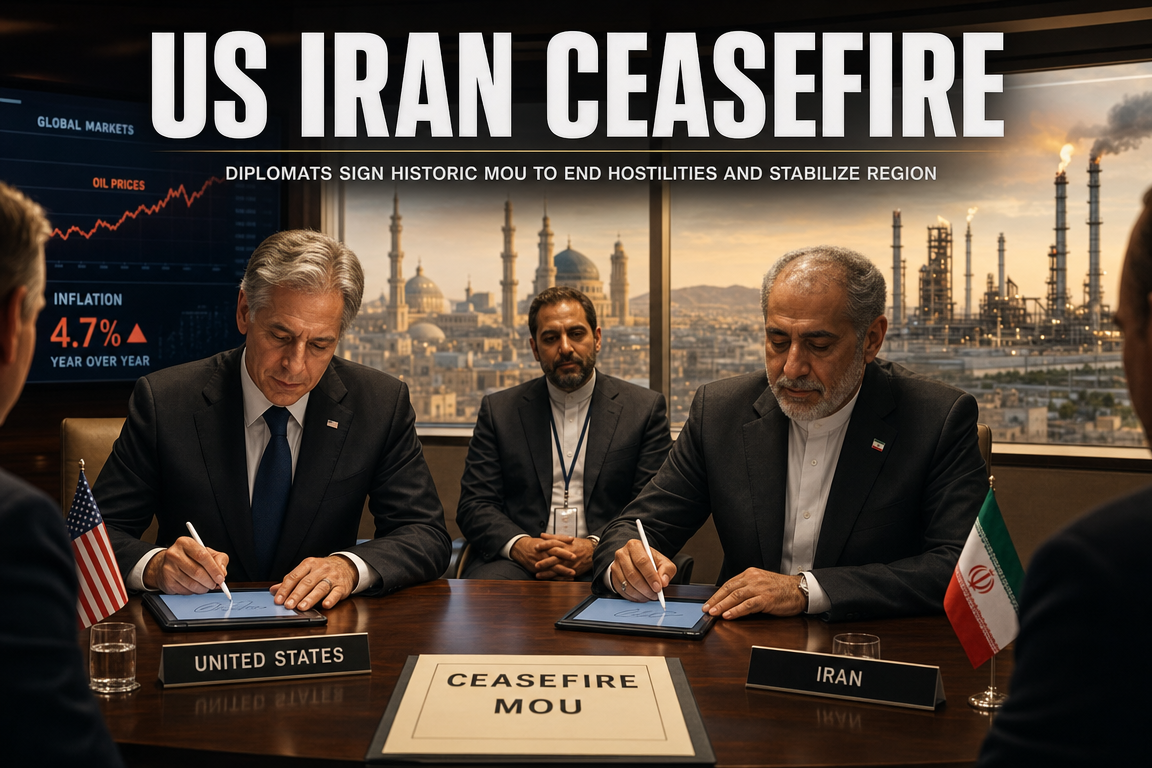
● Middle East Deal Shock, Oil, Inflation, Rates, AI Stocks
Middle East Ceasefire MOU Nearing Signature: Why a Digital Signature, and What It Signals for Oil, Inflation, Rates, and Risk Assets
This development should not be read as a straightforward “ceasefire agreement” headline.
While the market focus is on “possible conclusion within 24 hours,” the more material issues are interconnected: the political meaning of a digital signature, the incentives driving Trump’s push for rapid closure, implications for crude oil and inflation pressure, spillovers into US rate policy and financial markets, and Iran’s internal power balance.
This report prioritizes structure over headlines: why the process is shifting away from an in-person summit, why the US may be accepting an apparently more flexible framework, and how this could transmit into the global economy, US equities, energy markets, and AI-related investment sentiment.
1. Situation Snapshot: Why a Ceasefire MOU Has Re-emerged Suddenly
Pakistan’s Prime Minister Shehbaz Sharif stated that a US–Iran ceasefire agreement could be reached within the next 24 hours, raising near-term risk sensitivity across markets.
The key point is not optimism alone, but the additional remark that the parties are “preparing a digital signature for a peace agreement.”
This suggests negotiations have progressed beyond exploratory dialogue into procedural execution (format, sequencing, and implementation mechanics).
Mention of a working-level meeting next week further implies a “declaration first, technical sequencing later” pathway.
- Pakistan is positioning itself as an active mediator
- Public rhetoric remains firm, but working-level engagement indicates a search for overlap
- Preparation for a digital signature implies maximum time compression
- Market stabilization and risk containment appear to be taking priority over political optics
2. Headline-to-Framework Summary: Key Points to Date
The following structure captures the essential elements.
2-1. Mediator Signaling from Pakistan
Pakistan’s prime minister assessed that the parties are closer to an agreement than at any recent point.
He indicated preparations for digital execution immediately after finalization and referenced a working-level meeting next week.
This points to movement in negotiation protocol rather than a purely speculative statement.
2-2. Symbolic Signals from Within Iran
Iran announced funeral scheduling for the late Supreme Leader Ayatollah Khamenei in early next month.
This matters because formalizing a large-scale state event implies an assessment that escalation risk will be contained at least through late June.
A prolonged high-intensity conflict environment would complicate such scheduling.
2-3. Baseline Elements Under Discussion
A broad framework reportedly includes:
- Suspension of military operations
- Easing or cessation of measures related to the Strait of Hormuz
- Nuclear constraints and a pathway to further nuclear-related arrangements
- Sanctions relief and treatment of frozen assets
Material gaps remain within each item, and final language will likely be conditional and staged.
3. Core Issue 1: Frozen Assets and the Sequencing of Concessions
A practical negotiation bottleneck is Iran’s frozen assets.
Iran reportedly seeks immediate release of a portion of assets at or upon signature.
The US appears more inclined toward phased release tied to compliance.
This creates a “show first” versus “implement first” sequencing problem.
3-1. Why This Is Not Only a Financial Issue
Frozen assets are also domestic political capital.
Iran’s pragmatic faction needs tangible economic deliverables to defend an agreement against hardline criticism.
Without visible gains, the agreement risks being framed internally as unilateral concession.
Partial asset recovery enables a “economic benefit secured” narrative.
3-2. Most Plausible Compromise Structure
A likely structure:
- Execution of an initial MOU
- Limited, early-stage asset release as a confidence measure
- Stepwise nuclear verification milestones
- Additional asset release tied to verified compliance
This implies a staged exchange mechanism rather than a single, comprehensive settlement.
4. Core Issue 2: Nuclear Decommissioning and Verification Mechanics
The central difficulty is less the concept of constraints and more the verification design: where, how, and by whom.
The US seeks demonstrable, externally verifiable dismantlement; Iran emphasizes sovereignty and domestic control over execution.
A framework centered on IAEA-led verification is a credible anchor.
4-1. Likely Procedural Components
- Halt to further enrichment of highly enriched uranium
- Facility suspension or staged operational reduction
- On-site inspections by external verification teams
- Economic compensation calibrated to verified milestones
Accordingly, the MOU is more likely to serve as the starting point of a verifiable roadmap than a final-status agreement.
5. Why a Digital Signature Matters More Than It Appears
Digital execution is a structurally meaningful signal.
Historically, agreements of this scale are signed in-person in neutral venues (e.g., Geneva, Muscat, Doha) to maximize symbolism and commitment.
Choosing a digital signature suggests deliberate minimization of political exposure.
5-1. Most Practical Rationale: Iran’s Internal Political Risk
Iran’s internal power alignment appears fragmented.
Pragmatists may favor de-escalation and economic normalization, while hardliners may resist visible accommodation.
Public optics—handshakes, joint statements, and summit imagery—could amplify domestic backlash.
A digital signature can preserve substance while limiting politically costly visuals.
5-2. Time Compression and Security Benefits
- Supports a 24-hour closure target by reducing travel and protection logistics
- Avoids controversy around venue selection
- Lowers exposure to disruptions (terror risk, protests, internal opposition)
- Enables agreement execution with limited symbolic consumption
In practice, this is consistent with “maximize operational outcome, minimize political theater.”
6. Why Trump Is Accelerating the Ceasefire: Energy and Inflation Constraints
While political optics matter, the dominant constraints are likely crude oil, US inflation, the rate path, and electoral risk.
6-1. Why Higher Oil Prices Are Politically Costly
A prolonged Middle East risk premium impacts energy markets first.
The Strait of Hormuz risk can raise prices even without actual supply disruption.
In tight inventory environments, precautionary stock-building can drive secondary price acceleration.
6-2. Why Oil Often Re-accelerates Inflation
Oil transmits into logistics, industrial inputs, electricity, and petrochemical feedstocks.
It often pressures producer prices first, then consumer prices with a lag.
If oil-driven inflation rises while US inflation is not fully stabilized, the Federal Reserve’s easing justification weakens.
6-3. The Scenario Trump Likely Wants to Avoid: A More Hawkish Fed
A high-risk chain:
- Prolonged conflict
- Rebound in crude oil
- Re-acceleration of US inflation
- Delayed rate cuts
- Higher Treasury yields
- Higher equity volatility
This increases macro and market stress. The ceasefire push can be read as pre-emptive containment of inflation and rate risks rather than purely diplomatic positioning.
7. Market Implications: What Changes If the MOU Is Executed
7-1. Crude Oil
The most immediate channel is reduced risk premium.
Lower perceived Strait of Hormuz disruption risk can compress short-term oil price pressure.
7-2. Inflation Expectations
If oil stabilizes, incremental upside risks to producer and consumer prices decline.
This affects not only the US but also Europe and Asia via policy expectations.
7-3. Rates and the US Dollar
Even without immediate Fed easing, reduced tightening risk can limit Treasury yield spikes and moderate USD strength.
7-4. US Equities and Growth Stocks
A more stable rate outlook typically supports large-cap technology and duration-sensitive growth assets.
Given the current linkage between AI infrastructure investment, semiconductors, power demand, and rate expectations, reduced geopolitical risk can improve risk appetite.
8. Why This Also Matters for AI Trends
While geopolitics and AI appear unrelated, markets connect them through energy and discount rates.
8-1. AI Is More Energy-Sensitive Than Often Assumed
Generative AI scaling, data centers, GPU clusters, and cooling infrastructure are sensitive to electricity cost and energy supply stability.
Energy price spikes raise data-center operating costs, semiconductor production costs, and logistics expenses.
Therefore, geopolitical de-escalation is relevant to AI infrastructure economics.
8-2. Rate Stability Directly Influences AI Valuations
Many AI-linked equities embed long-duration cash-flow expectations.
Higher rates raise discount-rate pressure; rate stabilization tends to support valuation expansion.
The transmission chain can be summarized as: energy stabilization → lower inflation risk → less rate pressure → improved growth-asset sentiment.
9. Under-Discussed Core Point
Many reports focus on “ceasefire probability,” but a more realistic interpretation is that this may be a risk-management framework rather than full trust restoration.
9-1. More Risk-Containment Mechanism Than “Peace Declaration”
Neither side appears positioned for full normalization.
Rising costs of escalation likely pushed both toward a controlled framework to stop expansion and cap downside.
This is closer to an interim system designed to contain energy, inflation, and political risks.
9-2. Digital Signature Reflects Power Structure, Not Technology Preference
Digital execution likely helps Iran reduce domestic hardliner backlash while allowing the US to claim deliverables.
Form is therefore strategically relevant.
9-3. Trump’s Incentive Set Likely Centers on Inflation and Rates
Public messaging may emphasize diplomatic achievement, but the binding constraint is macro-financial.
If oil cannot be contained, inflation risks rise; if inflation risks rise, the Fed’s easing flexibility falls; if the Fed remains restrictive, markets reprice.
10. Key Items to Monitor
- Whether the MOU is executed within the stated 24-hour window
- Whether the digital signature is confirmed as an official diplomatic instrument
- Follow-through measures affecting Strait of Hormuz transit normalization
- IAEA participation and inspection scope
- Whether frozen asset relief is lump-sum or milestone-based
- Fed communication regarding energy-driven inflation risks
- Whether crude oil and US Treasury yields stabilize concurrently
11. Integrated View
This MOU is not a simple “war ending” story.
It reflects Iran’s internal power balance, Pakistan’s mediation role, US sensitivity to rates and inflation, and oil-market risk premium management.
Digital execution is a signal that parties seek to lock in operational outcomes while minimizing political exposure.
For markets, the critical question is not the ceasefire headline but whether it reduces oil volatility, limits inflation re-acceleration risk, and narrows the probability of a prolonged restrictive rate regime—factors that can influence US equities and AI-related risk appetite.
< Summary >
The US–Iran ceasefire MOU should be treated as a multi-variable macro and market event linking oil, inflation, rates, and US political constraints.
A digital signature likely functions as a political-risk mitigation tool, particularly to reduce domestic hardliner backlash within Iran.
Trump’s acceleration appears more consistent with oil and inflation containment—and avoiding a more restrictive Fed path—than with diplomacy alone.
If Middle East risk premia compress and stabilize oil and Treasury yields, the setup becomes more constructive for US equities and AI-linked growth assets.
The structure is likely a staged, verification-and-compensation mechanism rather than a full normalization agreement.
[Related Articles…]
*Source: [ 경제 읽어주는 남자(김광석TV) ]
– [속보] 종전 MOU 디지털 서명의 이유. 종전 서두르는 트럼프의 속내 [즉시분석]
● Trump Iran Deal, Kim Photo, North Korea Shock
Why Trump Suddenly Posted a Photo of Kim Jong Un: Signals of an Imminent Iran Nuclear Deal and the Potential for a Third U.S.-North Korea Summit
What markets should focus on is not merely the U.S.-Iran agreement itself.
This development connects to a broader macro and risk framework spanning global crude oil, Middle East geopolitical risk, U.S. equities, semiconductor stocks, and global supply chains.
In particular, Trump’s decision to repost a photo with Kim Jong Un from the 2018 Singapore summit shortly after discussing an Iran deal is widely viewed as a deliberate signal rather than nostalgia.
This report summarizes, in a news-style structure: why Trump may be reactivating the North Korea channel, the likely structure of the Iran deal, why markets may be rallying while core risks remain, and why a third U.S.-North Korea summit—if it occurs—could be structurally different from prior rounds.
1. Key news catalyst: Why the U.S.-Iran deal is accelerating suddenly
Trump stated directly that the U.S.-Iran deal would be explained on June 14.
From a market perspective, this is a higher-conviction signal than prior speculation, as it ties the narrative to a specific timeline.
Trump’s messaging can be summarized as follows:
- The Obama-era nuclear deal effectively made it easier for Iran to progress toward nuclear capability.
- The new arrangement is designed to block Iran’s path to a nuclear weapon.
- After the deal, the Strait of Hormuz could reopen more reliably, supporting regional stabilization.
Markets reacted quickly: crude prices declined and the geopolitical risk premium began to compress.
2. The critical issue: This is not “full removal,” but effectively a two-step process
A central point that is often underweighted in media coverage is that the deal may not immediately remove or export Iran’s nuclear materials.
Based on Trump’s framing, the approach appears to be: once conditions are “appropriate” and the situation “calms,” nuclear-related materials buried by strikes would be recovered, diluted, and destroyed.
This implies delayed implementation rather than immediate disposal.
Summary structure:
- Step 1: Political agreement and de-escalation announcement
- Step 2: Later attempt to recover and process nuclear materials
This is closer to a phased deferral of the most sensitive issue than a fully resolved settlement. It may be supportive for risk assets in the near term, while leaving medium-term geopolitical risk partially intact.
3. Why Iran can also claim “victory”
The deal is noteworthy because it may allow both sides to frame the outcome as a domestic win.
Trump can argue:
- Military pressure brought Iran to negotiations.
- The agreement reflects a hardline approach rather than conciliation.
- It advances non-proliferation and stabilizes key shipping routes.
Iran can argue:
- Enriched uranium or key materials were not immediately exported.
- Immediate dismantlement of the program was avoided.
- The regime preserved bargaining power even after U.S. military action.
This type of agreement is a common diplomatic pattern: an outcome that is politically survivable for both parties rather than a definitive resolution.
4. Why June 14 matters: Potentially a political set piece
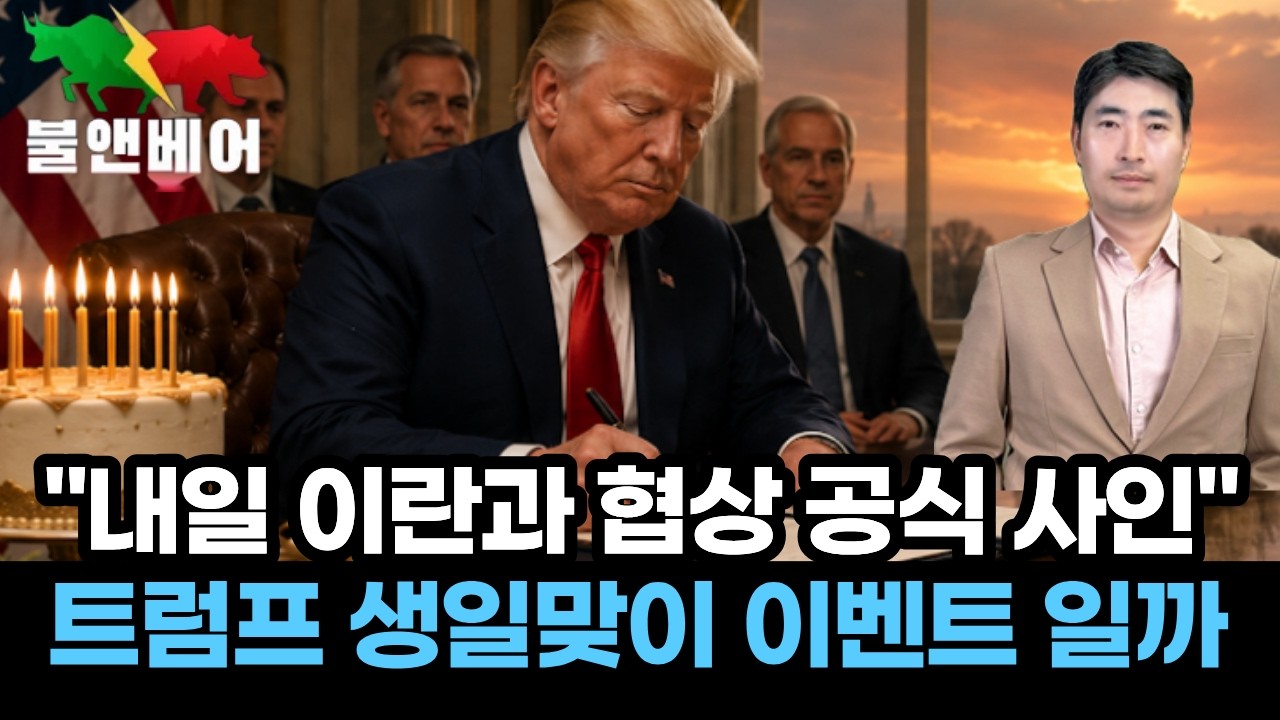
June 14 is also Trump’s birthday.
Given Trump’s reliance on symbolic political staging, aligning a major foreign-policy “deliverable” with a personal milestone may be intentional.
For Iran, this may be politically uncomfortable because it could appear to validate Trump’s domestic narrative. This helps explain why Iranian messaging may attempt to manage expectations in advance.
5. Iran’s internal dynamics: High probability of a deal, with persistent hardline resistance
Despite signs of progress, Iran’s internal political landscape remains fragmented.
Media aligned with the Islamic Revolutionary Guard Corps has highlighted anti-deal sentiment and criticism of negotiators.
Key items to monitor:
- Whether an announcement translates into a signed and actionable agreement
- Whether hardliners constrain implementation
- Whether disputes re-emerge around inspections, verification, and nuclear-material handling
6. Why markets moved quickly: Transmission to oil and U.S. equities
The market relevance is direct: de-escalation in the Middle East typically impacts global crude oil first.
Because the Strait of Hormuz is a critical energy chokepoint, improved confidence in passage can pressure oil prices lower.
The typical macro transmission channel:
- Reduced Middle East risk
- Stabilization or decline in crude prices
- Reduced inflation pressure
- Lower rate volatility / improved bond-market expectations
- Improved risk appetite in U.S. equities, particularly growth and technology
This environment can be indirectly supportive for large-cap technology and, in Korea, semiconductor bellwethers such as Samsung Electronics and SK Hynix, given linkages through energy costs, logistics, consumer confidence, and earnings expectations.
However, headline agreement and operational execution diverge. Renewed conflict or stalled implementation can reintroduce oil upside risk.
7. Why Trump reposted the Kim Jong Un photo: A signal for the next diplomatic card
Trump’s repost of the 2018 Singapore summit photo shortly after discussing Iran is unlikely to be incidental.
Three plausible interpretations:
7-1. Interpretation 1: Political sequencing to emphasize a continuous “deal-making” narrative
Trump has consistently branded himself as a leader who ends conflicts through negotiation.
Pairing an Iran deal narrative with imagery from North Korea reinforces:
- A contrast with Obama-era diplomacy
- A claim of combining coercion with leader-level engagement
- An implicit assertion that North Korea can be re-engaged if required
7-2. Interpretation 2: An open-channel probe toward North Korea
Trump has often used public communications to test counterparts’ reactions rather than relying solely on formal diplomatic channels.
The photo may function as a non-official signal: a suggestion that, after Iran, the U.S. could re-open dialogue with North Korea.
7-3. Interpretation 3: Domestic political asset management
North Korea remains a high-recognition political asset for Trump: he was the U.S. president who met Kim Jong Un directly.
Reactivating that imagery can reinforce a “Trump-only diplomacy” message to his base.
8. Could a third U.S.-North Korea summit occur?
A third summit remains possible, but the execution threshold appears high.
Even if political intent exists, structural constraints are more binding than in prior cycles.
8-1. North Korea may harden after observing the Iran case
From Pyongyang’s perspective, the Iran episode may reinforce:
- Without a credible nuclear deterrent, a state can become a target of military pressure
- Regime security incentives argue against meaningful denuclearization
- Talks may be acceptable, but relinquishing core deterrence is risky
This reduces the probability of substantive denuclearization outcomes even if summitry resumes.
8-2. The lingering impact of the Hanoi “no-deal”
The second summit ended without agreement after North Korea offered a Yongbyon-centered proposal and the U.S. judged it insufficient.
This matters because North Korean negotiators likely internalized the risks of top-down summit diplomacy, where prepared packages can be rejected at the last moment, creating internal accountability costs in a high-control political system.
This reduces bureaucratic willingness to pursue another high-stakes summit without stronger pre-negotiated certainty.
8-3. The gap between U.S. denuclearization demands and North Korea’s compensation expectations remains wide
Even if engagement resumes, the core issue is conditionality.
The U.S. is likely to require measurable denuclearization steps, while North Korea may prioritize regime security guarantees, sanctions relief, phased reciprocity, and treatment closer to de facto nuclear-state status.
Without convergence, a summit could occur as a political event with limited deliverables.
9. The investor linkage: Middle East diplomacy, a North Korea option, and AI/semiconductor risk appetite
This should not be treated as isolated foreign-policy news. Global markets are currently sensitive to the interaction between geopolitical risk premia and technology-led equity momentum.
If Middle East risk compresses:
- Energy prices stabilize
- Inflation pressure eases
- Rate expectations become less restrictive
- Equity valuation conditions for growth improve
- Optimism around AI infrastructure capex and semiconductor demand can strengthen
Given current investor focus on AI servers, HBM, data-center power demand, and cloud investment, oil and rate stability can reinforce flows into high-duration technology themes even amid valuation debate.
At its core, the issue is whether global risk premia compress further or re-expand—directly influencing equity directionality.
10. News-style key takeaways
- U.S.-Iran deal: Trump explicitly referenced June 14 as an explanation window, raising market conviction.
- Deal structure: Likely a two-step arrangement, deferring nuclear-material handling rather than immediate removal.
- Iran domestic politics: Hardline resistance persists despite a broader tilt toward agreement.
- Market impact: Potential for lower crude, softer inflation impulse, improved risk sentiment in U.S. equities and semiconductors.
- Meaning of the Kim photo: Potential political signal testing a renewed North Korea engagement option after Iran.
- Third U.S.-North Korea summit: Possible, but high difficulty due to post-Hanoi dynamics and stronger North Korean deterrence incentives.
11. Under-discussed but material points
- First, the Iran arrangement may be less “final” than markets assume; deferred nuclear-material handling is a key residual risk.
- Second, reposting the Kim photo likely functions as a diplomatic or political “next-card” test rather than retrospection.
- Third, North Korea could interpret Iran as evidence to reduce denuclearization incentives, increasing negotiating friction.
- Fourth, the core relevance is risk-premium repricing across oil, rates, and AI/semiconductor equities.
- Fifth, headline announcement and implementation diverge; investors should focus on inspection, verification, and enforcement mechanics.
12. Forward monitoring checklist
- Whether an agreement is announced and/or signed around June 14
- How specific the terms are on timing and verification of nuclear-material processing
- Domestic reactions from Iranian hardliners and IRGC-aligned channels
- Whether Hormuz-related stabilization translates into sustained oil downside
- Whether Trump issues additional North Korea-related signals (messages, photos, statements)
- Whether U.S. election dynamics accelerate foreign-policy event-driven diplomacy
< Summary >
Trump’s indicated U.S.-Iran agreement appears supportive for near-term risk sentiment, but may represent an incomplete two-step framework that defers the most sensitive nuclear-material resolution.
Trump’s subsequent repost of a Kim Jong Un photo can be interpreted as a political and diplomatic signal testing a potential North Korea engagement option.
However, North Korea may infer from the Iran case that deterrence should not be traded away, raising the difficulty of any third summit producing substantive outcomes.
From an investor perspective, the relevant frame is the impact on global risk premia—linking crude oil, inflation expectations, rates, and AI/semiconductor equity positioning.
[Related Articles…]
- Trump Re-Election Scenarios: Implications for Global Markets and Equity Risk Premia
- AI Semiconductor Cycle: Key Drivers in HBM, Data Centers, and Capex
*Source: [ Maeil Business Newspaper ]
– [홍장원의 불앤베어] 갑자기 김정은 사진 올린 트럼프 왜? 3차 미북정상회담은 열릴 수 있나