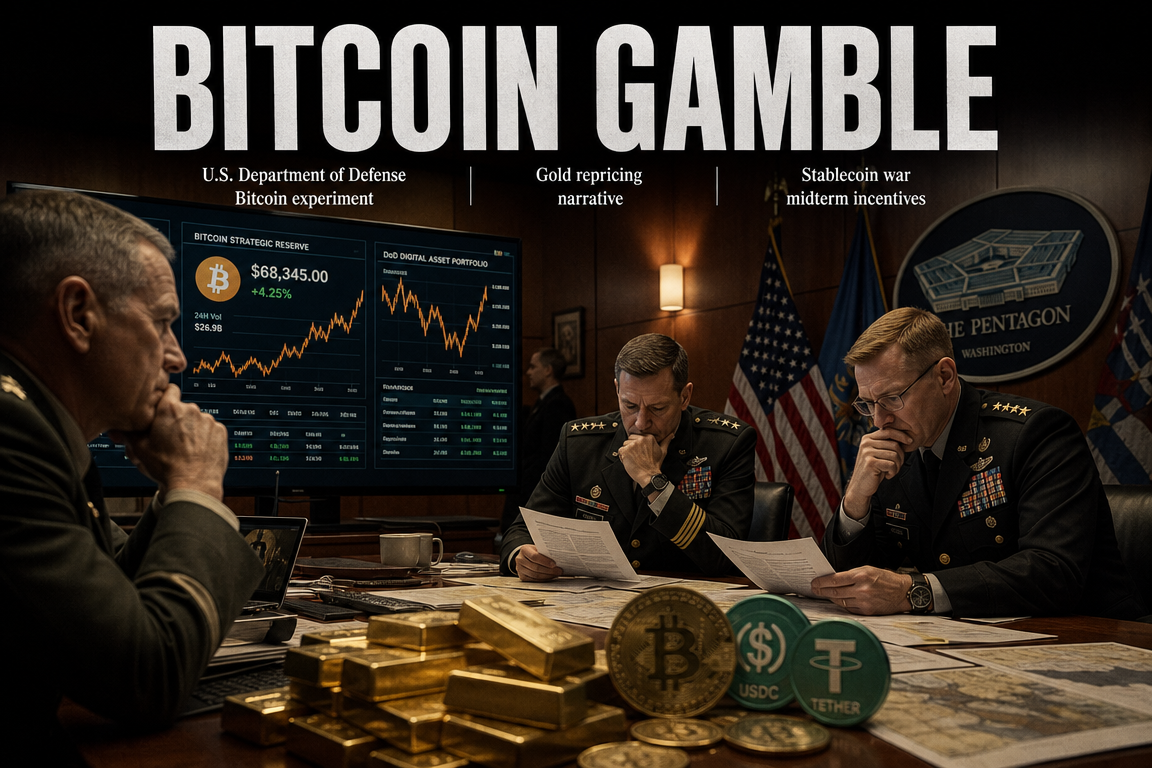
● Bitcoin-Defense, Gold-Reset, Stablecoin-War
The U.S. Department of Defense’s Bitcoin Experiment, Gold Repricing, and the Stablecoin War: The Crypto Market Is Now About “Order Reshaping,” Not “Price”
This is not a short-term discussion of Bitcoin price targets or near-term market moves.
The core issues are threefold:
First, the United States is beginning to treat Bitcoin not as a speculative instrument, but as a potential national security asset.
Second, gold prices, the U.S. dollar, U.S. Treasuries, oil, and Middle East conflict dynamics are not independent variables; they are increasingly linked within a single macro framework.
Third, stablecoins are no longer an internal crypto-industry topic. They are a variable that can influence the global economy, trade settlement, monetary hegemony, and the KRW exchange rate.
This report consolidates the following:
- Why the U.S. Department of Defense has started evaluating the Bitcoin network
- Why the gold bullish thesis has re-emerged despite recent consolidation
- Why stablecoins are structurally linked to U.S. Treasury demand and U.S. midterm election incentives
- Why the Strait of Hormuz, oil, the dollar, and Bitcoin are increasingly moving as a connected complex
- Why Korea should not delay policy responses to KRW stablecoins
The format is news-driven, but prioritizes the market-structure inflection points over headline summaries.
1. Key Developments at a Glance: Structural Shifts Underway
Recent discussion around crypto markets can be organized into four pillars:
- Potential U.S. treatment of Bitcoin as a strategic asset
- Gold repricing narratives and potential adjustments to the dollar system
- Stablecoin legalization and its linkage to U.S. Treasury demand
- Middle East geopolitics, energy power dynamics, and settlement-order realignment
These themes appear separate, but are increasingly converging.
In practical terms, the U.S. is attempting to re-architect manufacturing, energy, monetary infrastructure, and digital assets within a single strategic framework.
2. Why It Matters That the U.S. Department of Defense Is Evaluating Bitcoin
A central point is that Bitcoin is increasingly interpreted not merely as an investable product, but as an asset under consideration within national security frameworks.
2-1. Why the Department of Defense Would Evaluate the Bitcoin Network
The focal point is not price. It is the physical security properties of Proof-of-Work (PoW).
Most networks are primarily exposed to logical attacks. Bitcoin, by contrast, requires an attacker to incur substantial real-world energy and hardware costs.
This shifts the security model from credential compromise to high-cost, physical-resource warfare. That framing is relevant for future cyber defense, satellite communications, and resilient military-grade protocols.
2-2. What Changes If Bitcoin Moves from “Strategic Reserve” to “Security Asset”
“Strategic reserve” can imply limited holdings. “Security asset” introduces different institutional mechanics:
- Dedicated budgeting pathways
- Defense-policy justification
- Higher probability of bundling into broader legislative packages
In the U.S., defense-linked legislation typically has stronger passage momentum than standalone financial-market bills.
The market therefore may need to price not only ETFs, corporate accumulation, or halving dynamics, but also the probability of integration into state-level systems.
2-3. China Containment and Mining Hardware Turnover Are Part of the Same Issue
Network control is influenced by hashrate distribution, mining infrastructure, and hardware supply chains.
A plausible interpretation is that U.S. interest extends beyond Bitcoin as software to the broader mining stack, including reducing dependence on China-linked hardware and infrastructure.
Bitcoin functions both as a digital asset and as a hardware/supply-chain domain.
3. Why Gold Consolidated After Conflict Headlines, and Why the Bull Thesis Returned
A common misconception is that conflict must mechanically lift gold. The observed consolidation does not, by itself, invalidate gold’s role.
3-1. Oil and Dollar Liquidity Demand Were the Immediate Variables
In Middle East escalation scenarios, especially those involving the Strait of Hormuz, oil pricing becomes the central transmission channel.
Higher oil prices increase dollar demand for energy purchases. That environment can force liquidity preference and prompt profit-taking in assets that have already appreciated, including gold.
This can be interpreted as a liquidity event rather than a structural loss of safe-haven function.
3-2. Slower Central-Bank Gold Purchases Can Be Read Through the Same Lens
A moderation in central-bank gold buying is not necessarily a reversal in preference; it may reflect near-term dollar and cash prioritization.
In periods of rising energy import costs and settlement pressure, some countries face constraints in holding non-cash reserves.
3-3. Why Medium-to-Long-Term Gold Support Arguments Remain Intact
The longer-term case is structural:
- Politicization of the dollar
- U.S. sanctions risk
- Reserve diversification incentives
- Ongoing de-dollarization pressures
Additionally, after Basel III (2019), gold’s reserve-asset treatment changed, strengthening its institutional rationale.
Short-term consolidation and medium-term structural support can coexist.
4. The Larger Framework: Why Gold Repricing Narratives Persist
A key debate is gold repricing as a policy mechanism, not a market story alone.
4-1. U.S. Debt Constraints Have Reached a Scale That Limits Traditional Options
U.S. deficits and debt dynamics have intensified. Some market participants increasingly consider scenarios in which the U.S. adjusts elements of the dollar framework through non-traditional mechanisms.
Gold repricing is discussed as a tool to expand fiscal capacity and improve monetary-policy maneuverability.
4-2. Why This Connects to “Gold Price Surge” Scenarios
The mechanism is accounting-driven:
Revaluing gold well above its current book value can generate substantial balance-sheet capacity.
That capacity could be deployed toward debt management, fiscal flexibility, or market-stabilization facilities, subject to political and institutional feasibility.
If the framework gains traction, gold may be treated less as a hedge and more as a policy asset.
4-3. What the France Gold Movement Narrative Signals
The core issue is not only “who holds gold,” but:
- Quality and classification
- Storage jurisdiction
- Practical control and mobilization speed
- Repricing optionality under stress
The market focus shifts from nominal holdings to operational control.
5. Why Stablecoins Link to U.S. Midterm Incentives
This is primarily a financial-policy issue, not a crypto-industry storyline.
5-1. Stablecoins as a Demand Channel for U.S. Treasuries
As USD stablecoin supply expands, issuers typically increase reserve holdings of U.S. Treasuries, especially short-dated bills.
Stablecoins can therefore function as an incremental buyer base for U.S. government debt, a relevant factor under high rates and elevated issuance.
5-2. Why the U.S. Has Strategic Incentives to Scale Stablecoins
Wider stablecoin adoption in global payments extends dollar dominance into a digital settlement layer.
A private-issuer structure can also reduce political costs relative to direct state expansion of base money.
Stablecoins thus operate as:
- A digital dollar distribution layer
- A Treasury-demand expansion mechanism
- A tool in global settlement reordering
5-3. Why the CLARITY Act and GENIUS Act Matter
Their significance is not limited to “regulatory clarity.”
They define:
- Regulatory jurisdiction
- Legal treatment of stablecoins
- Eligibility criteria for market participants
Once rules are formalized, institutional adoption can accelerate, shifting the market from retail-driven speculation toward infrastructure-led industrial scaling.
6. Why Strait of Hormuz Transit Fees Connect to Stablecoins and Bitcoin
This is effectively a settlement-order issue, not only geopolitics.
6-1. The Payment Instrument for Transit Fees Is a Monetary-Influence Question
If transit fees become operational, the settlement medium becomes strategically important.
Whether settlement is denominated in RMB, USD stablecoins, or Bitcoin changes both symbolism and enforceability.
The U.S. would have clear incentives to prefer dollar-based settlement rails. Sanctioned actors may prefer instruments with lower freeze and seizure risk.
6-2. Bitcoin Re-Emerges as a “Politically Neutral” Settlement Candidate
Scale of actual usage is uncertain, but signaling is material.
When Bitcoin enters discussion around sanctions evasion, maritime logistics, energy settlement, or third-country trade, it becomes harder to treat it as only an investment asset.
7. Stablecoins and Bitcoin: Correlated, Not Identical
A common oversimplification is that stablecoin growth mechanically implies Bitcoin appreciation. The relationship is more functional than linear.
7-1. Different Functions
- Stablecoins: payments and settlement
- Bitcoin: collateral, store-of-value characteristics, and potential strategic-asset framing
Stablecoins behave as money substitutes; Bitcoin can behave as digital gold or digital strategic collateral.
7-2. Why They Remain Linked
Within crypto markets, stablecoins are the core liquidity base.
Greater stablecoin portability and availability can support higher trading activity and collateral usage for Bitcoin.
As tokenization scales, demand rises for high-trust digital collateral, where Bitcoin remains a leading candidate.
8. Why Korea Should Not Delay: The Strategic Meaning of KRW Stablecoin Policy
This section focuses on implications for Korean investors and corporates.
8-1. USD Stablecoin Penetration in Korea Could Accelerate Rapidly
Korea’s payment infrastructure is highly advanced: mobile finance UX, QR payments, and fast settlement.
That also implies that USD stablecoins could achieve rapid adoption if regulatory and commercial pathways open.
8-2. Corporates May Move Before Retail
The incentive is operational:
- Trade settlement
- Cross-border remittance
- Faster reconciliation
- Lower fees
Use cases such as inter-affiliate settlement, import/export payments, and global platform revenue settlement are structurally compatible with USD stablecoins.
8-3. KRW Stablecoins Should Be Framed as “Defense,” Not “Internationalization”
Positioning KRW stablecoins as a direct challenge to dollar dominance is likely unrealistic.
However, establishing a KRW-denominated digital settlement layer for domestic payments and domestic asset markets can function as a defensive measure.
The priority is limiting erosion of domestic payment sovereignty by external USD stablecoin platforms.
9. Why RWA and Tokenization May Arrive Faster Than Expected
RWA is the tokenization of real-world assets for digital trading and settlement.
9-1. Equity Is Already Fractional Ownership in Practice
Buying one share represents owning a fraction of an enterprise.
Tokenization extends this logic with broader asset coverage and different trading infrastructure.
9-2. What Can Be Tokenized
- Commercial real estate
- Art
- Royalties
- Private company equity
- Bonds
- Commodities
- Cashflow-rights instruments
In principle, most transferable economic claims can be tokenized.
9-3. Convergence with the AI Economy
As AI agents become more economically active, micro-transaction and high-frequency settlement rails become more important.
Human-optimized money and machine-optimized money may diverge in usability requirements.
Stablecoins may become a baseline settlement rail for AI-native commerce.
10. What Investors Should Monitor
10-1. Prioritize Regulation and Infrastructure Over Short-Term Price Action
Near-term charts may be less informative than:
- U.S. legislative timelines
- Defense/monetary/payment infrastructure shifts
- U.S. Treasury issuance and yields
- Middle East geopolitical risk and energy transmission
10-2. Use a Value-Chain Lens
The stablecoin ecosystem includes multiple bottlenecks:
- Issuers
- Custody and safeguarding
- Payment rails
- Exchanges
- Wallets
- Tokenization platforms
- Regulated financial institutions positioned to benefit
Capital often concentrates in constrained infrastructure segments rather than the most visible endpoints.
10-3. Korean Investors Should Integrate FX and KRW Risk
Crypto should be analyzed inside a macro framework, not as a standalone theme.
For Korea, KRW valuation, USD liquidity, energy pricing, and export conditions are interconnected inputs.
11. Under-Discussed Point with High Strategic Relevance
11-1. This Is a “State-System Redesign” Phase, Not a “Coin Market” Phase
Market narratives often center on Bitcoin price, ETF flows, and altcoin rotation.
A more consequential shift is the U.S. treating manufacturing, energy, gold, Bitcoin, and stablecoins as linked components of system design.
This is a governance and infrastructure question, not only an asset-market question.
11-2. Gold and Bitcoin May Function as Bridges Rather Than Competitors
If gold repricing gains policy relevance, gold can re-emerge as a policy asset.
That process can also strengthen the narrative for Bitcoin as digital strategic collateral, implying a sequential “bridge” dynamic rather than a zero-sum tradeoff.
11-3. Korea’s Core Risk Is Delay Itself
The primary risk is not only USD stablecoin adoption, but unprepared adoption.
Corporates have clear incentives to move early; consumers may follow without explicit friction.
If policy lags while usage expands, domestic platforms and settlement infrastructure may be structurally subordinated to external systems.
12. Final Summary: What Is Reshaping the Market
- Bitcoin in the U.S. is increasingly framed as a potential national-security asset
- Gold may re-enter focus as a policy-repricing asset despite near-term consolidation
- Stablecoins link to U.S. Treasury demand, electoral incentives, and digital dollar hegemony
- Strait of Hormuz risk and energy settlement are increasingly part of a settlement-order conflict
- Korea faces rising urgency on KRW stablecoin frameworks and tokenization rules
The relevant question is not only “Where does Bitcoin go next?” but:
- Which states are designing which settlement orders
- Which assets are being integrated into institutional frameworks
- Where Korea may lose strategic leverage through delayed policy response
< Summary >
The U.S. is increasingly evaluating Bitcoin as a candidate national-security asset, while gold is re-emerging as a potential policy-repricing instrument.
Stablecoins are not merely crypto instruments; they function as infrastructure tied to U.S. Treasury demand, dollar dominance, trade settlement, and AI-native payment systems.
The Strait of Hormuz, oil, the dollar, and Bitcoin are moving within a connected macro-security complex.
Korea risks erosion of domestic payment sovereignty if it delays KRW stablecoin policy and tokenization frameworks.
The current cycle is defined more by settlement-order restructuring than by short-term price action.
[Related Articles…]
- Bitcoin: Strategic Asset Integration and Market Structure Implications
- Stablecoins: Regulation, Treasury Demand, and Global Settlement Rails
*Source: [ 경제 읽어주는 남자(김광석TV) ]
– [코인 모아보기] 미국 국방부가 비트코인을 모으기 시작했다. “크립토 시장 판이 바뀝니다” | 경읽남과 토론합시다 | 김창익x김동환x정구태x이지민
● SpaceX IPO Snub, ETF Shock, AI Listing Warning
Why Mirae Asset Received Zero Shares in the SpaceX Offering: IPO Allocation Mechanics, the ETF Butterfly Effect, and Key Investment Considerations Ahead of OpenAI and Anthropic Listings
This event extends beyond “Mirae Asset did not receive SpaceX IPO shares.” It highlights (i) the practical realities of US mega-IPO allocation, (ii) structural disadvantages for Korean distribution channels, (iii) how foreign capital can be screened in strategic sectors such as space and AI, and (iv) how these dynamics can propagate into space ETFs and related equity flows.
1. One-line takeaway: the issue was not “subscription failure,” but unequal access
Mirae Asset Securities offered participation in the SpaceX deal, yet ultimately received zero shares. The core implication is that US mega-IPOs—particularly in strategic industries—are not driven solely by pro-rata allocation. Relationships, existing partnerships, regional quotas, and lead underwriter discretion typically dominate outcomes. In practice, Korean investors may be permitted to participate but remain structurally lower priority in final allocations.
2. Why strong SpaceX IPO performance was largely expected
2-1. The offer price was set below prevailing expectations
As of April secondary transactions, implied valuation was approximately USD 1.22 trillion (roughly USD 93 per share on an equivalent basis). Market discussion suggested a potential listing valuation near USD 1.75 trillion, while the final offer price was set at USD 135. This structure supported first-day demand conditions.
2-2. Free float was limited
Post-listing tradable supply was reportedly below 8%. High demand against constrained supply typically increases the probability of near-term price pressure.
2-3. On day one, flows often dominate valuation
For mega-IPOs, first-day trading tends to be driven by order imbalance rather than intrinsic valuation. SpaceX reportedly traded up to USD 167 shortly after listing, representing a gain of more than 20%.
3. Why Korean investors captured limited primary-market upside
3-1. Access was restricted to professional-investor profiles
Participation in Korea was limited to investors meeting qualification criteria (e.g., certain historical balances/tenure in financial investment products), effectively narrowing access.
3-2. Participation in the syndicate did not guarantee allocation
Despite Mirae Asset’s role as a co-manager and expectations of some allocation, the final result was zero shares.
3-3. Lead underwriter discretion and relationship-based allocation were decisive
Goldman Sachs, as lead underwriter, had significant influence over final distribution. In strategic-sector offerings, prioritization may reflect existing relationships, strategic considerations, and home-market preference rather than mechanical pro-rata allocation.
4. Structural reasons Korean channels were disadvantaged in the US IPO framework
4-1. Regional quota allocation was US-centric
Reported quota split: 85% US, 10% Europe, 5% Asia. The Asia quota was limited and contested among multiple financial hubs (e.g., Japan, Singapore, Hong Kong), reducing the probability of meaningful Korea-linked allocations.
4-2. Space is a strategic sector with tighter foreign-capital sensitivity
Space-related assets intersect with communications and national security. Screening of non-US participation can be more conservative, particularly amid broader geopolitical and technology-protection considerations.
4-3. Institutional demand crowded out the marginal channel
The planned retail portion reportedly shifted from ~30% toward ~20% as institutional demand exceeded expectations. Under such conditions, allocation generally skews toward large US institutions, with smaller foreign channels more likely to be cut.
5. The key loss for Korean investors was the price differential
At an offer price of USD 135 and a reported first-day high near USD 167, successful primary allocations captured immediate upside exceeding 20%. Without allocation, investors seeking exposure faced secondary-market entry at higher prices, materially worsening expected return and risk/reward at entry.
6. Refunds did not eliminate losses: FX slippage risk
Although subscription deposits were refunded, FX movement between funding and refund dates could create KRW-based losses. A potential FX loss of approximately KRW 19 per USD was referenced, which can be meaningful in investor experience even when principal is returned.
7. The broader market impact came through ETFs: why this was an “ETF butterfly effect”
7-1. Some space ETFs intended to hold SpaceX at meaningful weights
Certain space-focused ETFs reportedly planned to allocate up to ~25% to SpaceX, relying on IPO allocations to establish initial positioning.
7-2. ETFs often must buy, not choose to buy
ETFs tracking an index or applying rule-based inclusion criteria may be required to purchase constituents regardless of price. Missing IPO allocation forces secondary-market buying at potentially higher levels.
7-3. Buying SpaceX at elevated prices requires selling other holdings
To fund SpaceX purchases, ETFs may need to reduce positions in existing portfolio holdings, generating selling pressure in other space-related equities while reinforcing incremental demand for SpaceX.
7-4. Internal rotation within the space theme is likely
Capital may rotate from prior beneficiaries (e.g., listed space-exposure names) into SpaceX post-listing, potentially producing near-term relative weakness in peers even if the broader theme remains constructive.
8. Could space ETFs become a relative opportunity?
SpaceX’s post-IPO appreciation may raise near-term single-name entry risk, while ETF-related rotations could temporarily depress other space-exposed holdings. A space ETF can provide blended exposure: a higher-priced SpaceX allocation alongside potentially discounted peers, mitigating single-name timing risk. Over longer horizons, SpaceX’s valuation may serve as a sector-level reference point that can influence repricing across the private and public space ecosystem.
9. Could similar allocation outcomes recur in OpenAI and Anthropic IPOs?
The probability is non-trivial. AI is increasingly linked to national competitiveness, data governance, cloud infrastructure, and security considerations. As a result, Korean domestic distribution alone may not secure meaningful allocations in the largest strategic AI listings.
10. Practical positioning for individual investors
10-1. Attractive entry points often occur pre-IPO in secondary markets
For high-demand names, a portion of the return may be realized before listing as expectations are incorporated into price.
10-2. Direct individual access is structurally limited
US private-market access is typically intermediated by private funds, local entities, and restricted distribution networks, favoring scale and relationships.
10-3. Broker “VIP” channels can be operationally relevant
Large brokers may periodically source limited allocations in late-stage private companies, with access dependent on relationship and asset size.
10-4. Counterparty and structure risk require stricter controls
Private-market exposure entails information asymmetry, liquidity constraints, and contractual complexity. Investors should prioritize regulated, reputable intermediaries and verify contract terms, hedging approach, tax implications, and resale restrictions.
11. Why US entities and US-institution channels tend to be advantaged
A cited case referenced group-level subscriptions of approximately KRW 70 billion achieving partial success via a US-entity/institutional channel. Given the reported 85% US quota, being categorized within the US allocation pool materially improves probability of receipt. Channel selection can be as determinative as the investment thesis.
12. SpaceX price durability: separate near-term flows from long-term fundamentals
12-1. Near term: limited float and attention can support prices
In early trading, supply constraints and high visibility can sustain premiums, particularly if growth-equity sentiment remains constructive.
12-2. Lock-up terms were described as complex and staged
While 180-day lock-ups are commonly assumed, the structure was presented as more granular:
- Elon Musk and major holders: ~60% subject to a 1-year lock-up
- Early investors and employees: staged, condition-based selling allowed earlier, including:
- 20% sellable two days after first quarterly earnings release post-IPO
- an additional 10% if the stock trades 30%+ above offer price for 5 days
- 7% each after 70/90/105/135 days (total 35%)
- an additional 28% after Q3 earnings release
- 100% after day 181
12-3. First major checkpoint: roughly 1.5 months post-IPO
Early private-market entrants may have significant unrealized gains, increasing the likelihood of profit-taking as staged liquidity windows open. Monitoring the timing and size of potential supply is necessary alongside earnings and guidance.
13. Long-term risk 1: valuation appears to extend beyond Starlink
Starlink is described as the primary current earnings driver, with strong subscriber growth (e.g., +1.6 million in a single quarter; cumulative subscribers exceeding 10 million). However, an example framing suggested overall valuation near USD 2.2 trillion while Starlink might be valued around USD 780 billion, implying a substantial portion of value depends on less-proven segments and future optionality.
14. Long-term risk 2: AI infrastructure value may be priced aggressively
The text referenced large AI compute arrangements involving Anthropic and Google, described at:
- Anthropic: USD 1.25 billion per month
- Google: USD 920 million per month
Both contracts were described as extending to 2029 but terminable with 90 days’ notice, indicating customer-favorable optionality. AI-premium sensitivity to growth-stock sentiment, rates, and cloud capex cycles remains a key variable.
15. Long-term risk 3: governance discount risk
The structure was described as offering limited control to public shareholders:
- Class B: 10 votes per share and concentrated voting control
- Class A: economic exposure with limited governance influence
Such structures can embed an enduring governance discount for minority investors.
16. Core points for investors
Allocation
Mirae Asset, despite syndicate participation, received zero shares. Lead underwriter discretion, US-centric quota design, and strategic-sector characteristics were the primary explanatory factors.
Flows
Offer price: USD 135. Reported initial trading high: USD 167 (+20%+). Limited float and high demand dominated early valuation sensitivity.
ETF implications
Space ETFs that planned to use IPO allocations to establish SpaceX weights may be forced into higher-priced secondary-market purchases, potentially driving simultaneous selling in existing holdings and incremental buying pressure in SpaceX.
Strategy
Similar allocation constraints may apply to major AI IPOs (e.g., OpenAI, Anthropic). Pre-positioning via private markets, relationship-based channels, and US-entity pathways may be more practical than relying solely on domestic retail distribution.
17. Under-discussed but decision-relevant considerations
17-1. The central issue is Korea-based platform bargaining power
The event reflects limited practical negotiating leverage for Korean distribution in the largest US strategic-sector IPOs.
17-2. ETF rule-based buying can amplify early price dislocations
Post-IPO ETF catch-up buying is not discretionary flow; it can structurally extend early premiums.
17-3. Staged lock-up release timing may matter more than day-one trading
Key selling windows at 30/70/90/135 days and around earnings events can coincide with fading momentum, accelerating repricing risk.
17-4. OpenAI and Anthropic may be even harder to access than SpaceX
AI’s policy sensitivity may tighten allocation conservatism further, increasing the likelihood of constrained foreign-channel distribution.
18. Tactical framework for individual investors
Strategy 1. Treat day-one momentum as a trading regime
If participating post-IPO, risk management should reflect flow-driven dynamics rather than fundamental anchoring.
Strategy 2. Use space ETFs for diversified exposure
ETFs can reduce single-name entry risk by blending SpaceX exposure with peers potentially pressured by rotations.
Strategy 3. Consider waiting for earnings and early lock-up windows
Fundamental investors may find more rational entry conditions after guidance and staged liquidity events are absorbed.
Strategy 4. Prepare early for the next mega-IPO
Once listing headlines appear, the primary-market allocation window is often effectively closed. Reviewing access channels, eligibility, and cross-border structures in advance is operationally material.
19. Implication
The SpaceX allocation outcome functions as a case study in access asymmetry in strategic-sector US capital markets. For Korean investors, identifying high-quality companies is insufficient; the access pathway and allocation probability can be the primary determinant of realized entry price and expected return. A structured approach that differentiates (i) pre-IPO exposure, (ii) immediate post-IPO flow regimes, and (iii) post-lock-up fundamental entry points is increasingly relevant.
SpaceX’s IPO strength was supported by a relatively attractive offer price versus expectations, limited free float, and demand-driven flows. Mirae Asset received zero final allocation due to US-centric quota design, lead underwriter discretion, and strategic-sector sensitivities. Korean investors lost primary-market pricing and faced higher secondary-market entry, while space ETFs may be forced to buy SpaceX at elevated prices, potentially inducing rotations and flow-driven distortions across the theme. Similar constraints may apply in future AI IPOs such as OpenAI and Anthropic, increasing the importance of advance channel preparation and lock-up/earnings-based timing discipline.
[Related Articles…]
*Source: [ Jun’s economy lab ]
– 미래에셋은 왜 스페이스x 청약물량을 못 받은 걸까? (ft.ETF나비효과)