● Samsung, SK Hynix, D-ram Price, FOMO, Risk, Re-rating
Should You Buy Samsung Electronics or SK Hynix Now? The Real Question Is Not “Good Companies,” but “Good Stocks”
The key issue is not whether Samsung Electronics and SK Hynix are strong businesses.
The core questions are how much of that strength the market has already priced in, and how the semiconductor outlook, DRAM pricing, AI semiconductors, the KOSPI outlook, and the broader equity investing environment interact from here.
This report focuses on four points:
- Why a good business is not necessarily a good stock
- The specific triggers that could make semiconductor stocks vulnerable now
- Why share prices can decline even when earnings improve
- Why equities can remain firm despite elevated government bond yields
A key principle often missed in mainstream coverage is also emphasized: the collapse of expectations can be more damaging than changes in earnings.
1. Key Takeaways at a Glance
The market’s central question has converged on one topic:
“Is it still appropriate to enter Samsung Electronics and SK Hynix now?”
At a surface level, the argument appears straightforward:
- AI demand remains strong
- HBM and the memory cycle are improving
- Earnings are recovering
However, the key conclusions are different:
- Samsung Electronics and SK Hynix may be high-quality businesses.
- Whether they are attractive stocks at today’s price is a separate issue.
- Share prices reflect not only fundamentals, but also expectations, positioning/flows, and valuation.
- A turn in DRAM pricing can undermine the investment thesis.
- The market may have already priced in expectations beyond near-term earnings improvement.
Conclusion: relying on “good company therefore buy” can materially increase risk in the current phase.
2. Why “Good Business” and “Good Stock” Are Not the Same
This is the foundational investment concept.
Many investors assume a strong company should translate into a strong stock. In practice, that is not consistently true.
2-1. Business Fundamentals and Stock Price Level Are Different Questions
A business is assessed based on intrinsic fundamentals:
- sustainable earnings power
- competitive positioning
- long-term market structure and share potential
A stock, however, must be evaluated as price versus value:
- high-quality companies can generate limited returns if purchased at excessive valuations
- high-quality companies can generate outsized returns if purchased when expectations are depressed
In simplified terms:
- Good business: likely applicable to Samsung Electronics and SK Hynix
- Good stock: depends on attractiveness at the current price
Without this distinction, investors remain confused by “why the stock fell even though earnings were good.”
2-2. Not Necessarily “Bad Stocks,” but Difficult to Classify as “Clearly Attractive” Now
The stocks can still rise, including large upside scenarios.
However, the issue is that modest weakening in the cycle could reopen severe downside risk. Investment decisions should weigh expected return against downside exposure.
Other assets may offer similar upside with lower downside, reducing the rationale for concentrated exposure to highly cyclical semiconductor equities.
3. The Primary Driver Now: DRAM Pricing
The most direct variable for forward direction in Samsung Electronics and SK Hynix is DRAM (and NAND) pricing, more than headline-driven narratives.
3-1. Semiconductor Earnings Can Be More Sensitive to Price Than Volume (Near Term)
Companies grow profits by:
- selling more units
- selling at higher prices
In memory, near-term operating leverage often comes more from price because:
- volume expansion requires time (capex, capacity ramp, supply planning)
- if output is stable and ASPs rise, costs may not increase proportionally, driving rapid profit expansion
This mechanism is central to the current market view: pricing improvement has driven earnings expectations and lifted share prices.
3-2. Strong 2Q Results May Be Likely, but Markets Discount What Comes After
The key question is not whether 2Q earnings will be good; the market largely anticipates that.
What matters more is whether pricing strength persists through 3Q, 4Q, and into next year.
Equities discount forward expectations. The market focus is the durability of the pricing cycle rather than confirmed near-term results.
3-3. Reframing the Question: Not “Will These Stocks Go Higher?” but “Will DRAM Prices Keep Rising?”
A practical framework:
- Replace “Will Samsung Electronics rise?” with “Will memory pricing momentum persist?”
- Focus on whether DRAM and NAND pricing cycles could turn
This reframing is closer to the primary driver of earnings revisions and valuation.
4. The Highest-Risk Scenario: Not “Earnings Slow,” but “Cycle Narrative Breaks”
This is a central risk factor.
4-1. The Market Is Treating Memory Less Like a Traditional Cyclical and More Like a Structural AI Beneficiary
Historically, Samsung Electronics and SK Hynix were valued as cyclical names:
- strong profits at the peak
- recurring oversupply and price declines
- persistent valuation discounts based on the assumption of mean reversion
Recently, sentiment has shifted due to:
- sustained AI-related demand
- higher value mix led by HBM
- potential expansion of longer-term contracting versus pure spot dynamics
- broader AI infrastructure buildout
This supports a narrative that memory may be less purely cyclical than before.
4-2. If DRAM Pricing Wobbles, Expectations May Reset Faster Than Earnings
If DRAM prices decline for any reason, earnings may weaken moderately.
The larger risk is a regime shift in how the market categorizes the stocks:
- “This is structural AI growth” may revert to “this is still a cycle.”
In that case:
- earnings estimates can fall
- valuations can compress simultaneously
This combination can drive a larger drawdown than the earnings change alone would imply.
5. How Strong Is FOMO in the Current Tape?
Price action is not fully explained by fundamentals; positioning and psychology matter.
5-1. “Others Profited, I Didn’t” Is Increasingly Influential
FOMO (Fear of Missing Out) appears to be contributing to incremental demand.
This behavior often strengthens later in a rally, when flows increasingly reflect crowding and comparative performance pressure rather than risk-adjusted analysis.
5-2. High Attention Can Also Mean Many Buyers Are Already In
Equity prices ultimately depend on marginal buyers.
When a stock becomes widely favored, a significant portion of investors may already hold positions, reducing incremental buying capacity. Further upside then requires upside surprises beyond already-elevated expectations.
6. Earnings-Driven vs Liquidity-Driven: Where the Market Stands
A second axis is the market regime.
6-1. Macro Tailwinds: Rate-Cut Expectations and Liquidity Are Supportive
Global equities, including the KOSPI, have benefited from gradual rate-cut expectations, supporting risk appetite.
This liquidity backdrop has likely enabled valuation expansion in semiconductor names beyond what fundamentals alone might justify.
The current regime reflects both earnings recovery and a liquidity component.
6-2. Liquidity Rallies Can Decelerate Abruptly
In liquidity-supported markets, “good story” assets can become expensive quickly.
Risk increases when price appreciation outpaces the pace of earnings improvement, forcing fundamentals to “catch up” to valuation. In that setup, small disappointments can trigger outsized volatility.
7. Why Equities Can Be Strong Despite High Government Bond Yields
Conventional logic suggests high yields pressure equities via higher discount rates and improved risk-free alternatives.
Yet equities have remained resilient. Key reasons:
7-1. Markets React More to the Direction of Rates Than the Absolute Level
Even if current yields are elevated, if investors believe the next phase is lower rates, asset prices can adjust in advance.
7-2. If Growth Expectations Dominate, Equities Can Rise Despite High Nominal Yields
Recent markets have emphasized AI investment, potential productivity gains, and earnings recovery more than recession risk.
In such periods, earnings growth expectations can offset discount-rate pressure, particularly for large-cap technology and AI-linked sectors. In Korea, memory is positioned as a key linkage to that theme.
7-3. The Driver of Higher Yields Matters
Not all yield increases are equivalent:
- yields rising on inflation re-acceleration tend to be equity-negative
- yields rising on stronger growth expectations can be supportive for select sectors
Recent market behavior reflects a mixed interpretation, with capital still flowing into earnings-upside themes.
8. Five Checks Investors Should Prioritize Now
8-1. Focus on “Better Than Expected,” Not Simply “Good”
With expectations elevated, meeting consensus may be insufficient.
8-2. Monitor DRAM and NAND Price Direction First
These are the most relevant leading indicators for the equity thesis.
8-3. Continuously Test Whether AI Demand Is Structural or Transitory
Valuation sensitivity is high to whether AI infrastructure spending proves durable or becomes a temporary overbuild.
8-4. Separate Thesis-Driven Exposure From FOMO-Driven Exposure
Entry decisions driven by crowd behavior increase the probability of buying into peak expectations.
8-5. Evaluate Relative Value Versus Alternatives
Equities are inherently relative. Compare expected return and drawdown risk not only across stocks, but also versus global equities, ETFs, bonds, and cash-like instruments.
9. The Most Important Point Often Missing in Mainstream Coverage
9-1. The Core Risk Is Not “Earnings Down,” but “Valuation Framework Changes”
Many discussions stop at earnings up/down.
The more important risk is the market’s framing:
- a growth-oriented premium is partially embedded
- a small pricing/cycle setback could restore a cyclical discount
That shift can drive larger price declines than earnings changes alone.
9-2. When Everyone Agrees, Expectation Density Becomes the Risk
The critical variable is not the news itself, but how it compares with consensus expectations.
9-3. Price-Cycle Interpretation Matters More Than Technology Narratives
HBM, AI servers, and data center buildouts are important.
However, for equity outcomes, the key is how these factors translate into memory pricing, earnings revisions, and valuation.
10. Conclusion: High-Quality Businesses, but the Question Must Be More Precise at This Price
There is no requirement to adopt a uniformly bearish view:
- AI-era demand
- memory upcycle
- earnings recovery potential
remain relevant.
However, the appropriate approach is not “buy because the company is good,” but “is the risk-adjusted return attractive at today’s price?”
A modest turn in DRAM pricing can impair expectations faster than reported earnings, and can trigger valuation compression that may be sharper than many investors assume.
In this environment, the market is effectively buying expectations; in expectation-driven markets, sentiment and positioning can move faster than fundamentals.
< Summary >
Samsung Electronics and SK Hynix may be high-quality businesses, but it is difficult to conclude they are automatically attractive stocks at current price levels.
The key variables are DRAM and NAND pricing; what matters more than 2Q earnings is the trajectory of the pricing cycle thereafter.
The market has increasingly framed memory as an AI structural beneficiary rather than a pure cyclical. If memory prices weaken, that framing can reverse quickly, potentially causing larger equity declines than earnings changes alone.
FOMO appears to be contributing to demand, raising the risk associated with crowded expectations.
Equities have remained firm despite high government bond yields because markets price the direction of rates and growth expectations, not only the absolute yield level.
The decision should be based on whether expected compensation is sufficient for the embedded cycle and valuation risks.
[Related Articles…]
- Semiconductor Cycle Reset: The Real Inflection Point Between AI Demand and Memory Pricing
- KOSPI Outlook Update: Why Rates, Liquidity, and Earnings Are Moving Together
*Source: [ 경제 읽어주는 남자(김광석TV) ]
– “좋은 기업이 좋은 주식은 아니다” 삼성전자·SK하이닉스 지금 사야 할까? | 경읽남과 토론합시다 | 김현준 대표님 [1편]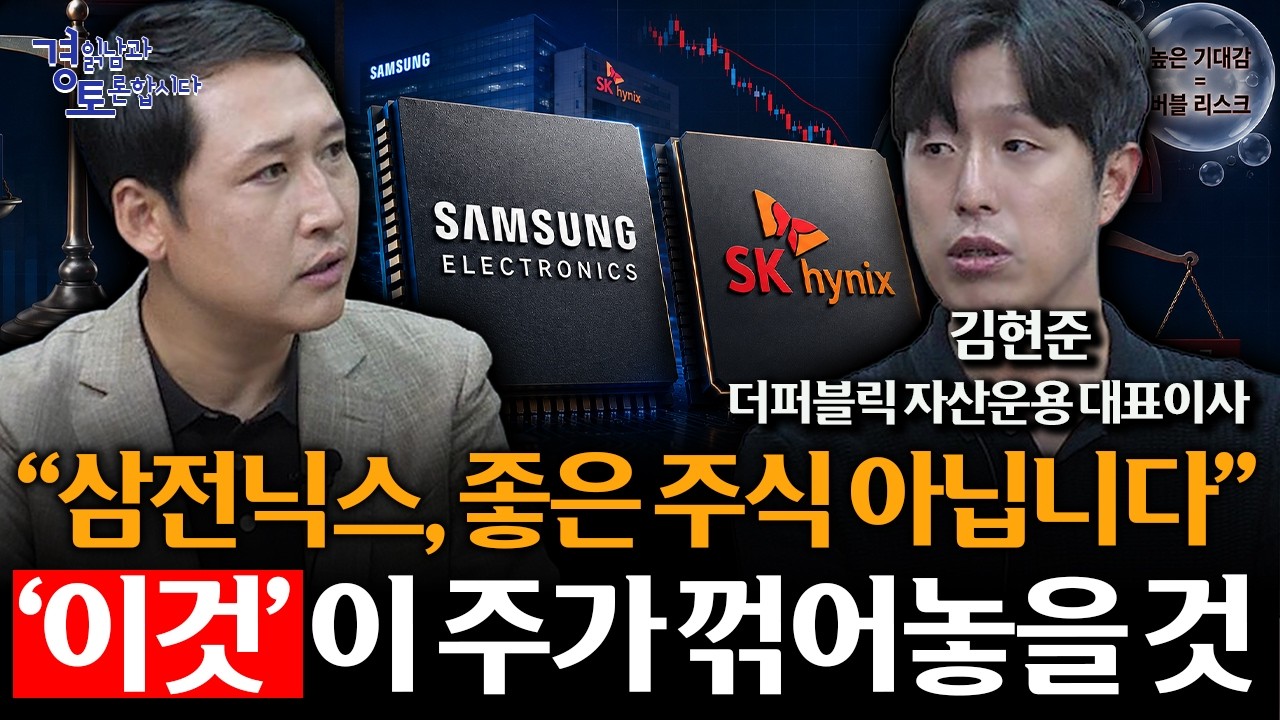
● Mideast Shock, Oil Plunges, Markets Rally
U.S.–Iran Breakthrough, Full Reopening of the Strait of Hormuz: Why the Market Regime Is Shifting from Crude Selloff to Semiconductors, Small Caps, and Bitcoin
This development should not be treated as a standalone Middle East headline.
The agreement connects multiple market drivers at once: lower global oil prices, reduced inflation pressure, U.S. equity sector rotation, the durability of the semiconductor rally, and a rebound in Bitcoin and other risk assets.
This report focuses on transmission mechanisms rather than simple conclusions. It explains why small and mid-cap and cyclical equities may react more than mega-cap tech, why logistics normalization can lag a political reopening of the waterway, and how second-order effects could influence global macro conditions and the AI investment cycle.
1. Key headline: U.S.–Iran negotiating breakthrough and an immediate ceasefire signal
Signals indicating a rapid U.S.–Iran understanding emerged concurrently.
From the U.S. side, messaging referenced completion of an agreement, a fully open Strait of Hormuz with unrestricted passage, and authorization for an immediate withdrawal of U.S. naval blockade assets.
From the Iranian side, comments from a deputy foreign minister indicated the start of war termination beginning tonight and the immediate cessation of military operations across multiple fronts, including Lebanon.
In addition, a final-stage negotiation process is expected to proceed for 60 days, with a memorandum of understanding to be disclosed.
This suggests the current phase is closer to a practical ceasefire and implementation pathway than a fully executed final signature.
2. Why markets reacted immediately: crude selloff and improving risk appetite
Oil markets moved first.
Following the announcement of full reopening of the Strait of Hormuz, global crude prices declined rapidly, with price action observed near the low-$80s range.
This move indicates the market is removing a previously embedded geopolitical risk premium.
As supply-disruption risk declines, oil prices tend to stabilize, and the next-order impact flows into inflation and interest-rate expectations.
Equity index futures also responded positively.
Technology and small-cap equities strengthened, and the relatively larger move in small-cap benchmarks such as the Russell 2000 is notable.
Bitcoin recovered meaningfully without an explosive spike, consistent with improved risk sentiment following reduced geopolitical uncertainty.
3. Why the Strait of Hormuz matters: reopening a core artery of global energy trade
The Strait of Hormuz is a critical corridor for global energy logistics.
When passage is constrained or the threat of blockade rises, uncertainty for crude and LNG shipments increases sharply, transmitting into freight rates, insurance costs, manufacturing input costs, and consumer inflation.
In practical terms, Hormuz is not a localized flashpoint; it is a variable that can reset global cost structures.
Accordingly, a statement of full reopening is a strong risk-relief signal for markets.
Energy-importing regions in Europe and Asia benefit from restored supply reliability, and economies with high energy import dependence, including South Korea, are structurally sensitive to this channel.
4. Execution matters more than announcements
Even if an agreement appears complete, markets ultimately price implementation.
Four monitoring points are central.
4-1. Durability of the U.S.–Iran arrangement
Current messaging allows both sides to frame the outcome as a win, which can support political durability.
However, over the 60-day process, friction may emerge around language, the scope of sanctions relief, and military follow-through.
4-2. Whether the Israel–Lebanon front truly de-escalates
This is the largest residual variable.
A U.S.–Iran understanding does not automatically translate into full control over Israel–Hezbollah dynamics.
If domestic political constraints and hardline postures persist, sporadic escalation risk remains.
Under that scenario, markets may interpret the outcome as partial risk containment rather than full geopolitical resolution.
4-3. Logistics normalization may lag political reopening
A reopened route does not immediately restore normal shipping behavior.
Processes typically include mine clearance, route security validation, enhanced maritime protection, vessel redeployment, and insurance repricing.
The speed at which insurers reduce war-risk premia can be decisive for real-economy normalization.
A time lag between “political reopening” and “economic normalization” should be assumed.
4-4. How far oil can fall
Near-term downside is consistent with risk-premium compression, but magnitude and persistence are separate questions.
Without a corresponding increase in effective supply, declines may be limited.
If global growth expectations improve concurrently, demand expectations could rise and moderate the extent of any oil drawdown.
5. Equity market focus: semiconductor leadership vs. broadening participation
The central equity-market question is whether gains remain concentrated or broaden.
Recent performance has been heavily skewed toward AI and memory semiconductors, with names such as NVIDIA, Micron, SK hynix, and Samsung Electronics leading on AI infrastructure capex.
With reduced Middle East risk and more stable oil, the market’s framing can shift from “AI-only” to “capital rotation into laggards.”
5-1. Why semiconductor strength can persist
Semiconductor fundamentals remain constructive.
HBM, AI servers, and data center memory demand are not typically reversed by a single geopolitical event.
The AI trend remains structural, and hyperscaler capex plans continue.
Moreover, energy stability can reduce operating and logistics cost volatility, supporting IT investment planning; lower rate pressure can also be valuation-supportive for growth assets.
5-2. Why other sectors may strengthen more
Cyclicals, industrials, consumer sectors, financials, and small/mid-caps may benefit more directly from lower oil and improving rate stability.
These segments have been more constrained by oil-driven inflation risk, rate sensitivity, and geopolitical uncertainty.
Small caps, in particular, often display higher sensitivity to yields; easing inflation concerns and declining bond yields can amplify equity response.
5-3. Base case framing: not leadership replacement, but rally broadening
The more relevant question is whether participation broadens rather than whether semiconductors “end.”
A plausible regime is continued leadership resilience in AI-linked winners with incremental upside emerging in previously lagging sectors.
Broadening participation typically improves the internal quality of an equity advance.
6. Macro interpretation: inflation and rates can reprice
This is a macro event as well as a geopolitical event.
Energy price stability directly lowers inflation expectations at the margin.
For the Federal Reserve, oil-driven inflation shocks are a key complication; reduced risk can lessen policy uncertainty.
This does not imply immediate policy action, but markets often reprice ahead of central banks.
If energy-driven inflation fears fade, bond yields, equities, FX, and broader risk conditions can stabilize.
This backdrop is typically supportive for emerging-market assets and export-oriented markets, including South Korea.
7. Implications for South Korean equities: KOSPI, semiconductors, refining/chemicals, and transport
7-1. Large-cap semiconductors
Samsung Electronics and SK hynix are likely to remain primary beneficiaries of AI memory demand.
Near-term profit-taking risk may rise due to positioning and prior gains; the key variable is pace rather than direction.
7-2. Refining and chemicals
Lower oil can pressure refiners near term via inventory valuation, while benefiting chemicals and certain manufacturers through reduced input costs.
Oil downside should be interpreted differently by sub-industry.
7-3. Airlines, shipping, and logistics
Fuel-cost stabilization and normalization of maritime risk are constructive for airlines and transport.
Lower insurance costs and reduced operational disruption risk can improve earnings visibility.
7-4. Small- and mid-cap growth
If rate pressure eases, KOSDAQ and smaller growth equities can regain support.
A key monitoring point is whether flows broaden beyond large-cap semiconductors.
8. AI trend lens: energy stability as an indirect tailwind for AI infrastructure
AI is more energy-linked than commonly acknowledged.
Data centers, GPU servers, cooling systems, and grid investment are all exposed to energy cost and volatility.
Reduced energy uncertainty can improve planning confidence for large-scale AI infrastructure programs.
Lower volatility in power costs, supply chains, and logistics can support server deployment and component procurement.
Near term, the event may catalyze broadening beyond semiconductors; medium term, it can still be supportive for the AI ecosystem through improved operating stability.
9. News-style checklist: what markets should monitor
First. The U.S. and Iran appear to be transitioning into a ceasefire and implementation phase, rapidly reducing geopolitical risk.
Second. Full reopening of the Strait of Hormuz pressured oil lower, reinforcing disinflation expectations.
Third. Beyond tech, small caps and cyclicals showed stronger relative response.
Fourth. The key inflection is not an end to semiconductors, but whether the rally broadens across sectors.
Fifth. Real logistics normalization may lag due to insurance, security, and route-restoration frictions.
Sixth. For AI, energy stability can be a medium-term positive for data centers and semiconductor supply chains.
10. The most under-discussed point
The primary beneficiary may be valuation normalization across the broader market segments that were compressed by oil, rates, and geopolitical uncertainty, rather than already-extended AI semiconductor winners.
If this event lowers inflation risk and improves rate stability, both U.S. and South Korean equities could transition from a narrow mega-cap-led regime to a broader, multi-sector advance.
If confirmed, portfolio construction and factor exposures may need to adjust accordingly.
Additionally, reopening Hormuz is not only an oil issue; it can improve the stability of the AI infrastructure investment cycle.
In the current industrial cycle, semiconductors and data centers are core assets, and both rely on energy and logistics reliability.
11. Forward watchlist and scenarios
Markets are likely to track the following:
1) Over the 60-day window, the specificity of the memorandum and implementation roadmap.
2) Whether additional clashes are contained on the Israel–Lebanon front.
3) Whether oil stabilizes after further downside.
4) Whether U.S. Treasury yields and the U.S. dollar stabilize concurrently.
5) Whether equity flows broaden beyond semiconductors.
In a constructive scenario, oil stability, rate stability, cyclical outperformance, and continued AI/semiconductor strength can coexist.
In a risk scenario, renewed sporadic conflict, delayed insurance normalization, and oil reacceleration could reintroduce volatility.
12. Conclusion: prioritize evidence of broadening market leadership
The U.S.–Iran development is market-positive through lower oil, improved risk appetite, and reduced inflation pressure.
For investors, the core issue is not the one-day move in specific tickers; it is whether this event alters market structure.
The key test is whether equities transition from a narrow semiconductor-driven advance to broader sector participation.
If that shift is validated, this may become a meaningful inflection point for second-half global macro conditions and equity-market dynamics.
< Summary >
A U.S.–Iran breakthrough, including a full reopening of the Strait of Hormuz and ceasefire signaling, drove oil lower and improved risk sentiment.
The core implication is not only oil stability, but potential easing of inflation risk, reduced rate pressure, and a higher probability of rally broadening into small/mid-caps and cyclicals.
AI and semiconductors remain structurally supported, but the primary near-term question is whether market participation broadens.
Implementation risk remains due to potential time lags in logistics normalization and the possibility of renewed regional clashes.
[Related Articles…]
Semiconductor Supercycle Re-Acceleration: Why AI Memory Demand Is Reshaping Market Leadership
Rate-Cut Expectations and U.S. Equity Positioning: Key Asset-Allocation Signals for the Second Half
*Source: [ Maeil Business Newspaper ]
– [속보] 미국-이란 전격 협상 합의. 즉시 종전, 호르무즈 전면 개방 I 홍장원의 불앤베어