● Bitcoin-Winter,Trump-Crypto-Shift,Quantum-Risk
Bitcoin Outlook: Key Variables in Full Focus — Crypto Winter, Delayed Rate Cuts, Trump Policy, Stablecoins, and Quantum Computing Risks
The central point of this discussion was not simply whether Bitcoin will rise or fall.
The key issue is that Bitcoin price action can no longer be explained by the halving cycle alone.
The market must now account for sharply lower crypto trading volumes, capital rotation into AI investments, weaker expectations for rate cuts, delays in U.S. crypto policy, competition for stablecoin leadership, and quantum computing-related security risks.
One point many investors may overlook is that a pro-crypto Trump administration does not necessarily imply an immediate increase in Bitcoin prices.
Rather, the U.S. may be more focused on reshaping the stablecoin and crypto industry order around U.S. interests than on lifting Bitcoin in the short term.
Below is a news-style summary of the discussion, followed by the variables investors should monitor most closely.
1. The Bitcoin market is closer to a “winter season”
Professor Kim Sang-yoon described the current Bitcoin and broader crypto market as being in a “winter season.”
In practical terms, this means not only price correction, but also a decline in market participation, trading activity, and liquidity.
The core issue is supply-demand imbalance.
Institutional demand for Bitcoin has weakened, while retail investors are no longer entering the market as aggressively as before.
Some crypto exchanges have reported trading volumes down by as much as 90% from peak-cycle levels.
Lower trading volume is not just a sign of fewer investors.
It also means weaker upward price pressure and greater sensitivity to negative news.
In this environment, investors should examine liquidity and trading volume before focusing on price charts.
2. A halving-cycle view suggests the period of pain may last longer
Historically, Bitcoin has followed a pattern in which a post-halving rally is eventually followed by a crypto winter.
The key reference point in the current cycle is the April 2024 Bitcoin halving.
Based on past cycles, the market often experienced a strong phase lasting roughly 6 months to 1 year and 6 months after a halving, followed by a winter period.
Under this framework, the current winter phase can be interpreted as having begun in the second half of 2025.
The concern is that this winter may not be short-lived.
Professor Kim said that, mechanically speaking, the winter phase could last 2 to 3 years and that investors may continue to experience difficult conditions at least through this year.
He also said the market bottom could arrive as early as the fourth quarter of this year, or as late as the first half of next year.
For new entrants, a DCA strategy, or staggered accumulation, is more realistic than making a single large purchase.
3. Weaker rate-cut expectations are weighing on Bitcoin
Bitcoin, equities, and real estate are all sensitive to interest-rate conditions.
When expectations for rate cuts strengthen, liquidity expectations improve and risk assets tend to benefit.
By contrast, when rate-cut expectations weaken or market yields rise, pressure on risk assets increases.
The discussion also highlighted that declining expectations for rate cuts are slowing Bitcoin’s recovery.
An important contrast was drawn between equities and Bitcoin.
Equities are also affected by interest-rate pressure, but AI semiconductors and other AI-linked companies continue to attract capital through strong performance and earnings.
Bitcoin, by contrast, has no earnings framework and depends more heavily on liquidity and sentiment.
As a result, capital is shifting toward AI and equities rather than Bitcoin under current rate conditions.
4. The AI investment boom is absorbing liquidity from crypto markets
The most powerful global capital-market theme at present is AI.
Capital is flowing into AI infrastructure, semiconductors, data centers, cloud computing, and power infrastructure.
This is an important factor for Bitcoin investors.
In earlier cycles, abundant liquidity often lifted equities, crypto, growth stocks, and technology stocks together.
Today, however, liquidity is constrained, and the AI sector is generating exceptional performance and expectations.
As a result, capital that might otherwise flow into crypto is moving first into AI-related assets.
This is one reason Bitcoin has struggled to rebound meaningfully.
In other words, Bitcoin investors should monitor not only BTC charts, but also Nvidia, AI semiconductors, and broader big-tech capital flows.
5. Professor Kim Gwang-seok’s view: Bitcoin is one component of a portfolio
Professor Kim Gwang-seok said Bitcoin should be viewed as one asset within a broader portfolio rather than as a separate universe.
From an investor’s perspective, equities, bonds, gold, real estate, Bitcoin, and cash are all competing for capital.
When interest rates rise or rate-cut expectations weaken, risk assets broadly face headwinds.
However, equities have remained relatively strong due to support from AI-linked sectors and semiconductor earnings.
Bitcoin and gold still function as investable assets, but in the current environment they are not performing at the same level as equities.
Ultimately, capital flows toward assets with stronger earnings and stronger narratives.
At present, that appears to favor AI equities over Bitcoin.
6. The main trigger for a Bitcoin rebound is institutional reform
Professor Kim Gwang-seok identified regulatory and institutional change as a key catalyst for Bitcoin.
In particular, U.S. crypto legislation could revive market expectations.
The discussion referred to four major crypto-related bills, stablecoin legislation, and the Clarity Act.
Investor disappointment is partly driven by the fact that expected regulatory reform has not progressed quickly.
While some have pointed to a possible Senate passage in July, forecasts differ across institutions and uncertainty remains.
As a result, it is difficult to build a strong near-term bullish case for Bitcoin, but sentiment could shift rapidly once policy progress becomes visible.
That remains a more important watch point than short-term price action.
7. Trump may be more focused on shaping the crypto ecosystem than on boosting Bitcoin price
One of the most interesting debates centered on whether President Trump truly wants Bitcoin prices to rise.
Professor Kim Gwang-seok argued that, from Trump’s perspective, a higher Bitcoin price could be politically advantageous ahead of the midterm elections.
Trump has emphasized his identity as a “crypto president” since his campaign and has made pro-crypto policy a key pledge.
However, Professor Kim Sang-yoon offered a different view.
He argued that while Trump is clearly supportive of crypto, it is unlikely that he would pursue a strategy aimed at rapidly inflating Bitcoin prices.
The reason is that the U.S. priority may be the broader crypto market structure and stablecoin leadership, not Bitcoin price alone.
If Bitcoin were to surge too quickly on its own, it could weaken the development of a U.S.-centered stablecoin-based financial ecosystem.
Bitcoin rising too fast could also attract speculative capital before the industry has fully matured.
Accordingly, Trump’s pro-crypto policy may be aimed more at building a U.S.-led crypto order than at short-term price support for Bitcoin.
8. Stablecoins are the next major financial battleground for the United States
One of the most strategically important themes discussed was stablecoins, even more so than Bitcoin.
Stablecoins are digital assets pegged to fiat currencies such as the U.S. dollar.
For the U.S., stablecoins are not merely a crypto product.
They may become a key instrument for preserving dollar dominance in the digital financial era.
If dollar-backed stablecoins are widely adopted globally, the U.S. can extend dollar-based financial leadership into digital assets.
From this perspective, the core U.S. crypto-policy question is not how much Bitcoin it holds, but who controls the digital dollar ecosystem.
Under this framework, Bitcoin’s failure to rise immediately does not imply that pro-crypto policy has failed.
Rather, the U.S. appears to be building a system through regulation, legislation, institutional participation, and financial infrastructure over time.
9. Five key variables investors should monitor
First, trading volume recovery.
Without a rebound in volume, price gains are unlikely to be sustained.
Investors should monitor spot volume on major exchanges as well as open interest in derivatives.
Second, changes in rate-cut expectations.
U.S. policy rates, Treasury yields, and the dollar index all directly affect Bitcoin liquidity.
A renewed expectation of rate cuts could improve risk appetite.
Third, capital rotation out of AI investments.
If AI equities remain strong, less capital may flow into Bitcoin.
Conversely, if the AI sector faces profit-taking or valuation concerns, some capital could rotate into crypto.
Fourth, the pace of U.S. crypto legislation.
Stablecoin legislation, the Clarity Act, and rules on exchanges and token classification could shape market expectations.
Clear rules that allow institutional participation are especially important.
Fifth, policy signals from the Trump administration.
Beyond pro-Bitcoin rhetoric, the more important factors are actual legislation, regulatory appointments, bank participation, and stablecoin legalization.
10. Can quantum computing break Bitcoin security?
On quantum computing, Professor Kim Sang-yoon was direct.
If quantum computing develops along expected lines and Bitcoin’s security architecture remains unchanged, then Bitcoin’s security could ultimately be compromised.
The current quantum computers developed by Google and IBM were described as being at roughly the 100-qubit level.
However, a practical threat to Bitcoin security would require not just a large number of qubits, but a much higher level of stable, error-free computation.
During the discussion, estimates of 10,000 to 100,000 qubits were mentioned as potentially necessary by some researchers.
The key point is that this does not mean “Bitcoin is finished once quantum computing advances.”
Bitcoin is an ecosystem, and its community can upgrade security through consensus.
There is room to adopt new security methods such as quantum-resistant cryptography through hard forks or soft forks.
In other words, quantum computing is dangerous only under the assumption that Bitcoin does nothing while quantum technology advances.
If the Bitcoin network upgrades alongside quantum progress, the threat can be mitigated.
11. Quantum-resistant cryptography is already under discussion
The risk posed by quantum computing is not limited to Bitcoin.
Banks, securities firms, government systems, military communications, e-commerce, and cloud security could all be affected.
For that reason, major institutions, including the U.S. Department of Defense, have long been researching defenses for the quantum era.
One of the main responses is quantum-resistant cryptography.
Quantum-resistant cryptography refers to new encryption methods designed to be difficult for quantum computers to break.
Within the Bitcoin community, discussions have already taken place on how to strengthen security with such methods.
However, the timing, mechanism, and consensus process for implementation remain unresolved.
For investors, the key is not to view quantum computing as a vague threat, but to monitor how the Bitcoin ecosystem responds to quantum risk over time.
12. Key points that are often overlooked in other news coverage
The first important point is that Bitcoin’s main challenge is not only quantum computing.
In the near term, a more significant issue is weak liquidity, capital rotation into AI, delayed rate cuts, and delayed institutional reform.
Quantum computing is a long-term technology risk, but the main forces suppressing the market today are capital flows and policy uncertainty.
The second point is that pro-crypto policy in the U.S. does not automatically mean support for Bitcoin price appreciation.
Many investors assume Trump’s pro-crypto stance means he will push Bitcoin higher.
But if the real objective is stablecoins and preserving dollar dominance, policy priorities may center on integrating crypto into the regulated financial system rather than on boosting Bitcoin directly.
The third point is that a Bitcoin rebound may be driven more by legislation than by charts.
In this cycle, the halving alone is no longer enough to explain a rally.
The next upside phase is more likely to emerge when crypto legislation, stablecoin regulation, and institutional participation align.
The fourth point is that the AI boom is increasing the opportunity cost of holding Bitcoin.
Capital is not leaving Bitcoin only because Bitcoin is weak.
It is also moving into AI because that sector is currently stronger.
Bitcoin investors therefore need to track global capital flows into AI, not just the crypto market itself.
13. In the AI era, the role of humans is also changing
The latter part of the discussion addressed the changing role of humans in the AI era.
Professor Kim Sang-yoon cited the earlier digital transformation period as an example.
In the past, writing, storing, and typing documents were important tasks in companies and institutions.
But as office tools and digital document systems spread, the value of those tasks declined significantly.
At first, office software skills were seen as a major qualification, but over time they became baseline skills.
AI is creating a similar shift.
Today, people who use tools such as ChatGPT and Claude effectively can significantly improve productivity.
Tasks such as writing columns, preparing reports, and analyzing materials can be completed much faster with AI collaboration.
In some cases, the quality of the output can also improve.
The change does not stop there.
As the AI agent era develops, humans may move from driving work directly to providing inputs and reviewing intermediate outputs while AI takes the lead.
This shift is likely to affect economic outlooks, investment analysis, industry research, content production, and financial services.
14. Practical response strategies for investors
First, lower return expectations for Bitcoin.
Rather than expecting a rapid advance, investors should prepare for a prolonged winter and manage capital accordingly.
Second, consider a staggered accumulation strategy.
Because timing the bottom is difficult, DCA is a more realistic approach.
Third, monitor the U.S. policy calendar.
Stablecoin legislation, the Clarity Act, and broader crypto regulatory changes may serve as leading indicators.
Fourth, track AI investment flows.
If AI remains strong, recovery in crypto liquidity may be delayed.
Fifth, treat quantum-computing risk as a technical issue, not a source of panic.
If Bitcoin’s security framework remains unchanged, the long-term risk is real, but network upgrades and quantum-resistant cryptography could provide mitigation.
15. Conclusion: Bitcoin is not finished, but the waiting period has become harder
The discussion can be summarized in one sentence: Bitcoin is not finished, but the waiting period has become more difficult.
A simple halving-cycle framework is no longer sufficient in a more complex market environment.
Rate-cut expectations have weakened, liquidity is flowing into AI, and U.S. crypto policy remains incomplete.
Trump’s pro-crypto stance may be closer to building a U.S.-centered stablecoin ecosystem than to providing short-term support for Bitcoin prices.
Quantum computing is a long-term variable that must be monitored, but the immediate market pressure comes from policy and liquidity.
Accordingly, Bitcoin investors should focus less on price forecasts and more on managing key variables.
At this stage, the question is not when Bitcoin will rise, but what conditions would need to be met for it to rise again.
< Summary >
The Bitcoin market is currently closer to a winter phase, marked by lower trading volume and supply-demand imbalance.
Weaker expectations for rate cuts and capital rotation into AI are constraining crypto-market liquidity.
The main trigger for a rebound is more likely to be U.S. crypto legislation and institutional reform than the halving cycle.
Trump’s pro-crypto policy may be more focused on building a stablecoin and dollar-centered ecosystem than on directly supporting Bitcoin prices.
Quantum computing could pose a security risk if it advances sufficiently and Bitcoin remains unchanged, but mitigation is possible through quantum-resistant cryptography and network upgrades.
Investors should prioritize staggered accumulation, liquidity monitoring, policy tracking, and AI capital-flow analysis over short-term upside expectations.
[Related Articles…]
Bitcoin Market Outlook and Cycle Analysis
Stablecoin Competition and the Future of Dollar Dominance
*Source: [ 경제 읽어주는 남자(김광석TV) ]
– “고통의 시간이 더 길어질 수 있습니다” 비트코인 투자자가 봐야 할 변수 | 경읽남과 토론합시다 | 김상윤 교수 [1편]
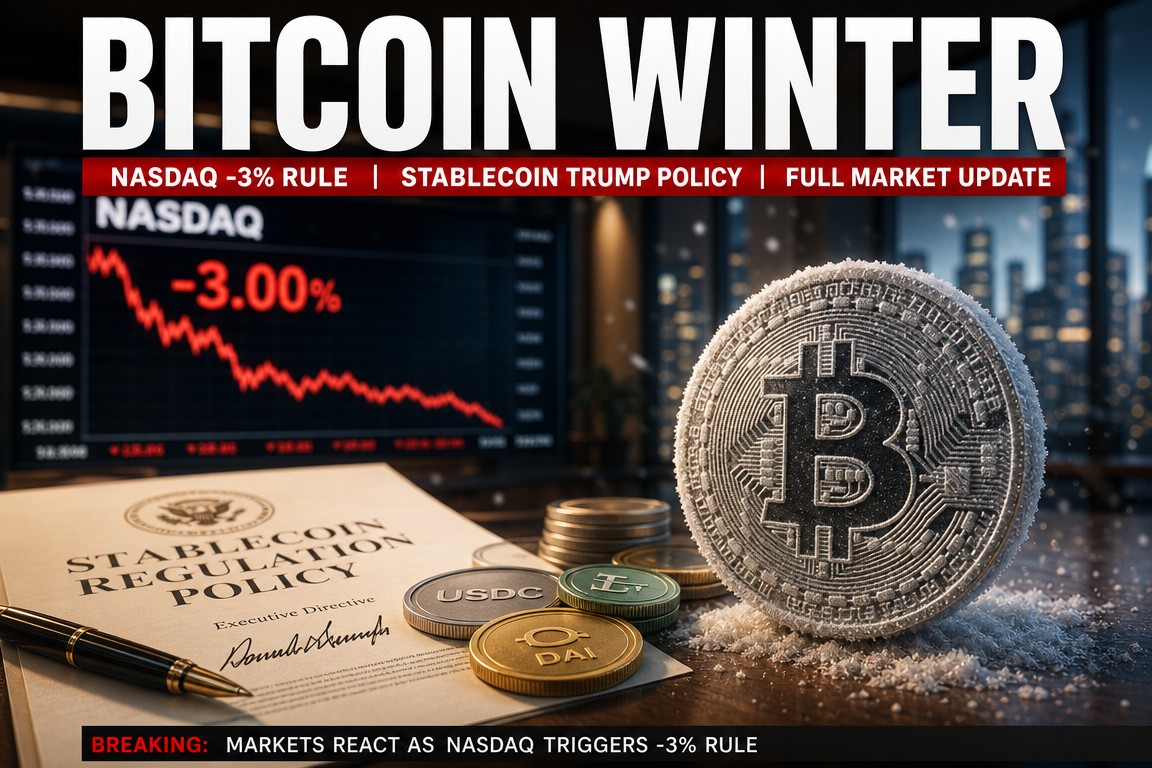
● Nasdaq Crash, Selloff Alert, Market Shock
What the “Minus 3% Rule” Means and How to Use It: Should Investors Sell When the Nasdaq Falls 3%?
This report reviews the widely discussed Minus 3% Rule and why a sharp decline in the Nasdaq is interpreted as an important market signal.
Many investors are unsure whether a daily decline of 3% or more in the Nasdaq should trigger an immediate sale, or whether they should wait for a V-shaped rebound.
The key issue is not simply whether the index is down 3%, but whether the market is in a liquidity-driven phase, a tightening cycle, or a period of rising recession risk.
This note covers the basic principles of the Minus 3% Rule, the 30-day observation period, how to respond when multiple declines occur within a month, the difference between the 2020 COVID selloff and the 2022 rate-hiking cycle, and the implications for Korean equities and semiconductor stocks.
The core point often overlooked elsewhere is that the Minus 3% Rule is not a trading formula, but a risk management tool for assessing the resilience of the U.S. equity market.
1. Current Market Conditions: Sharp Nasdaq Declines Are Again Affecting Investor Sentiment
Markets have recently turned volatile at a faster pace than expected.
In Korea, the KOSPI weakened significantly intraday, while U.S. equities also expanded losses after a weaker open.
The key benchmark investors are watching is the Nasdaq Composite.
Because the Nasdaq has a high weighting in large-cap technology, semiconductors, and AI-related names, it is one of the clearest indicators of global risk sentiment.
When the Nasdaq falls into the high minus 2% range intraday or approaches minus 3% at the close, market participants often refer to this as a “Minus 3%” signal.
The important reference point is the closing level, not the intraday move.
If the index briefly touches minus 3% intraday but recovers by the close, it is generally not treated as a valid Minus 3% signal.
By contrast, if the Nasdaq closes down 3% or more, the market is sending a signal that the move is more than a routine correction.
2. What Is the Minus 3% Rule?
The Minus 3% Rule is an empirical investment guideline that calls for reducing equity exposure and holding more cash when the Nasdaq falls 3% or more on a closing basis, followed by a period of market observation.
In this context, “minus 3” simply means a daily loss of 3% or more.
The basic structure is straightforward:
- The Nasdaq closes down 3% or more in a single day.
- Investors reduce some or all equity exposure and increase cash holdings.
- The market is observed for approximately 30 days.
- If no further significant decline occurs and conditions stabilize, re-entry is considered.
This rule is not an absolute formula.
There is no universally correct rule in equity markets.
The Minus 3% Rule is better understood as a loss-avoidance heuristic developed from market experience.
Its purpose is not to identify the exact top, but to help prevent portfolios from deteriorating sharply during severe market downturns.
3. Basic Trading Framework of the Minus 3% Rule
The rule is simple, but practical application requires attention to repetition.
A single 3% decline and several 3% declines within the same month have very different implications.
① First Minus 3% Event: 30-Day Observation
When the Nasdaq closes down 3% or more, it is treated as an initial warning signal.
At that point, investors reduce equity exposure, increase cash, and monitor the market for about 30 days.
During this period, the main issue is not the rebound itself, but whether further sharp declines recur.
If the market quickly recovers after a single down day, it may still have strong underlying resilience.
If the rebound is weak and another minus 3% decline follows, a prolonged downtrend becomes more likely.
② Second Minus 3% Event: Extend the Observation Period
If the Nasdaq falls 3% or more again within 30 days of the first signal, the market weakness is less likely to be temporary.
In that case, the observation period is extended for another 30 days.
The point is not to re-enter immediately after the first decline, but to wait for a second signal and manage risk more conservatively.
③ Four or More Minus 3% Events in One Month: A Market Shock Zone
If the Nasdaq records four or more 3% declines within a single month, this is better viewed as a market shock rather than a normal correction.
By simple arithmetic, four such declines indicate that investor sentiment has been substantially damaged.
In such conditions, a 60-day observation period after the final decline is sometimes used.
This is not a fixed rule.
However, four or more Minus 3% events in a month often indicate forced selling, leverage reduction, and liquidity stress within the market.
4. Markets Where the Minus 3% Rule Works Well and Where It Does Not
The rule does not function the same way in every market.
The key distinction is whether the market is in a V-shaped rebound phase or a prolonged downtrend.
① In a V-Shaped Recovery, the Rule Can Be Costly
When the Nasdaq drops 3% or more and then recovers quickly, the Minus 3% Rule can underperform.
A representative example is the market after the 2020 COVID crash.
Although equities fell sharply on the COVID-19 shock, the Federal Reserve cut rates rapidly and supplied substantial liquidity.
With quantitative easing and fiscal support both in place, markets rebounded faster than expected.
In that environment, selling stocks and staying on the sidelines for 30 days would likely have meant missing the early stage of the recovery.
In liquidity-rich markets, the rule may therefore create a larger opportunity cost than a defensive benefit.
② In a Prolonged Downtrend, the Rule Can Help Preserve Capital
By contrast, the rule is more useful when the Federal Reserve is less able to support markets.
In periods of aggressive rate hikes, persistent inflation pressure, and limited policy flexibility, markets must absorb shocks on their own.
In those settings, rebounds tend to be weaker and additional declines more frequent.
During the 2022 tightening cycle, the Nasdaq and growth stocks remained under pressure for an extended period.
In that environment, the Minus 3% Rule would likely have helped investors avoid deeper losses.
5. Advantages of the Minus 3% Rule
① It Is Simple and Fast to Apply
The main advantage of the rule is clarity.
The threshold of “Nasdaq closing down 3%” is easy to verify.
Even less experienced investors can identify when market conditions are deteriorating.
② It Reduces Emotional Decision-Making
During sharp selloffs, investor emotions tend to dominate decisions.
Some sell at the bottom out of fear, while others hold too long in the hope of a rebound.
The rule helps reduce emotional reactions and supports a more disciplined increase in cash exposure.
③ It Helps Protect Portfolios in Extended Downtrends
The most important benefit is loss reduction during prolonged declines.
When the Nasdaq falls sharply and continues lower, early de-risking can materially reduce losses.
This is particularly relevant for investors holding leveraged ETFs, growth stocks, and volatile semiconductor or AI-related names.
6. Limitations of the Minus 3% Rule
① It Can Miss V-Shaped Recoveries
The biggest limitation is the risk of missing a fast rebound.
If investors sell and wait 30 days while the market recovers sharply, re-entry becomes difficult.
This is especially true when U.S. equities recover quickly due to rate-cut expectations, stronger earnings, or increased AI investment.
② Frequent Trading Can Make Execution Difficult
Mechanical application can increase turnover.
If an investor re-enters and another Minus 3% event occurs, the portfolio may need to be reduced again.
For long-term investors, this process can undermine investment discipline.
③ It May Conflict With Long-Term Quality Investing
Investors who focus on accumulating high-quality companies for the long term may not need the rule.
If the strategy is to build positions in durable businesses over time, selling on every sharp decline may reduce the benefit of compounding.
The Minus 3% Rule is therefore not suitable for all investors and should be adapted to individual risk tolerance and portfolio structure.
7. The Most Important Issue in the Current Market Context
In the present environment, the Minus 3% Rule should not be treated as a simple sell signal.
What matters more is identifying the cause of the Nasdaq decline.
The same 3% drop can require different responses depending on the driver:
- Whether the move is driven by rising interest rates.
- Whether it reflects concerns over large-cap technology earnings.
- Whether AI-related valuations are under pressure.
- Whether a stronger dollar is weighing on emerging-market equities.
- Whether recession risk is becoming more pronounced.
If rates and the dollar rise simultaneously, technology shares weaken, and macro data deteriorate, the Minus 3% signal becomes more serious.
By contrast, if the move is driven by short-term profit-taking or volatility around specific earnings releases, the market may recover quickly.
8. Impact on Korean Equities: KOSPI and Semiconductors Track U.S. Technology Stocks
Korean equities are highly sensitive to the Nasdaq and semiconductor sector performance.
In particular, Samsung Electronics and SK hynix are closely linked to the global AI investment cycle, memory pricing, and U.S. technology trends.
If Nvidia, Micron, AMD, or Broadcom weaken in the U.S. market, sentiment in Korean equities is also likely to deteriorate the next day.
Conversely, if U.S. technology losses narrow or Micron delivers positive guidance, Korean semiconductor stocks may see short-term support.
Near-term direction for the KOSPI is often driven less by domestic factors than by overnight moves in U.S. technology shares.
For that reason, Korean investors should monitor the Nasdaq Minus 3% Rule as closely as U.S. investors.
9. The Most Important Point Often Missing From Other Coverage
The real purpose of the Minus 3% Rule is not to time sales, but to test market resilience.
Many investors interpret it as a simple “sell when the Nasdaq falls 3%” rule.
In practice, the more important issue is how the market behaves after the first decline.
If the market rebounds quickly, liquidity is still present.
If the rebound is weak and another 3% decline follows, buying power is likely insufficient.
In other words, the rule is not just a stop-loss mechanism; it also helps assess liquidity, sentiment, policy support, and deleveraging pressure.
This is especially relevant in the current environment, where AI-related leaders have been driving market gains and a small number of mega-cap names can move the entire index.
Investors should therefore avoid interpreting a Nasdaq decline as an automatic sell signal and instead evaluate three factors:
- Whether the Federal Reserve can still support rate-cut expectations.
- Whether U.S. Treasury yields and the dollar are creating headwinds.
- Whether earnings expectations for AI and large-cap technology remain intact.
If all three weaken at the same time and a Minus 3% event occurs, the risk of a broader downtrend should be taken seriously.
If rate pressure eases, earnings expectations hold, and policy support remains plausible, a V-shaped recovery is still possible even after a Minus 3% day.
10. How Different Investor Types Can Use the Minus 3% Rule
① Short-Term Investors
Short-term investors should follow the rule more closely.
This is especially relevant for leveraged ETFs, thematic names, and AI growth stocks, where a Nasdaq Minus 3% day may justify reducing risk.
For short-term trading, capital preservation often matters more than capturing every rebound.
② Medium- to Long-Term Investors
Medium- to long-term investors should use the rule as a position-sizing tool rather than a full liquidation trigger.
For example, an investor with 80% equity exposure could reduce it to 60% and increase cash to preserve flexibility for further declines.
For investors who own quality businesses, reducing overall portfolio risk is usually more practical than selling entirely.
③ Dollar-Cost Averaging Investors
Investors using systematic accumulation can apply the rule to pace their buying rather than to trigger panic selling.
After the first Minus 3% event, it may be preferable to scale in gradually rather than deploy a large amount at once.
Maintaining cash for the possibility of additional weakness is important.
④ Retirement Portfolio Investors
Retirement and conservative portfolios should treat the rule more defensively.
Because there is less time to recover from large losses, asset allocation between equities, bonds, and cash should be reviewed.
If repeated Nasdaq declines occur, investors may need to rebalance toward dividend stocks, bonds, and cash equivalents.
11. A More Important Principle Than the Minus 3% Rule
The Minus 3% Rule is a useful reference, but the most important principle remains buying good assets at reasonable prices.
The simplest investment rule is to buy low and sell high.
The difficulty is that no one can know with certainty what is cheap or expensive at any given time.
The practical approach is to buy quality companies at acceptable valuations and keep position sizes within levels that can be sustained.
However, staying invested requires one condition: the portfolio must remain intact during volatility.
That is why cash allocation, diversification, asset allocation, and drawdown limits matter.
The Minus 3% Rule is useful precisely in this context.
It should be used not as a market-timing model, but as a warning signal for whether a portfolio can withstand a sharp correction.
12. Key Indicators Investors Should Monitor
In a market where the Minus 3% Rule is relevant, the index level alone is not sufficient.
The following indicators should be monitored together to assess market conditions more accurately:
- Nasdaq closing decline: The key threshold is a daily loss of 3% or more.
- U.S. 10-year Treasury yield: Rising yields pressure growth stock valuations.
- Dollar index and exchange rates: A stronger dollar affects emerging markets and foreign flows.
- Large-cap technology earnings: Investors should confirm whether AI-related expectations remain intact.
- Semiconductor industry conditions: Micron and Nvidia trends also affect Korean equities.
- Federal Reserve commentary: This shapes expectations for rate cuts and liquidity support.
- Market breadth: Investors should determine whether losses are concentrated in a few names or broad-based.
Given the market leadership of AI-related stocks, it is especially important to determine whether earnings expectations are weakening or merely valuation pressure is increasing.
Those are materially different scenarios.
13. Conclusion: The Minus 3% Rule Is a Warning Signal, Not a Final Answer
The Minus 3% Rule gives investors a simple framework to avoid emotional reactions when the Nasdaq falls sharply.
However, it should not be treated as an absolute trading rule.
In a V-shaped recovery, the rule can reduce returns; in a prolonged downturn, it can help limit losses.
The essential question is the market regime.
Investors should assess whether the Federal Reserve can support the market, whether rates and currencies are creating pressure, and whether AI and semiconductor earnings expectations remain stable.
For individual investors, the rule is best used as a check on whether a portfolio can withstand a sharp drawdown, rather than as a simple decision to buy or sell.
Investment decisions should always reflect the investor’s time horizon, cash position, and tolerance for losses.
< Summary >
The Minus 3% Rule is an empirical guideline that calls for reducing equity exposure and observing the market for 30 days when the Nasdaq closes down 3% or more in a single day.
If additional Minus 3% events occur within a month, the observation period is extended; if they occur four or more times, the market is treated as a shock zone and approached more defensively.
The rule may underperform in V-shaped recoveries, but it can help protect capital in prolonged downturns.
The key issue is not the 3% decline itself, but market resilience, rates, currencies, Federal Reserve policy, and large-cap technology earnings.
The Minus 3% Rule is best used as a warning signal for market risk and portfolio resilience rather than as a definitive trading rule.
[Related Articles…]
*Source: [ Jun’s economy lab ]
– 마삼룰을 알아보자(ft.나스닥 -3%)