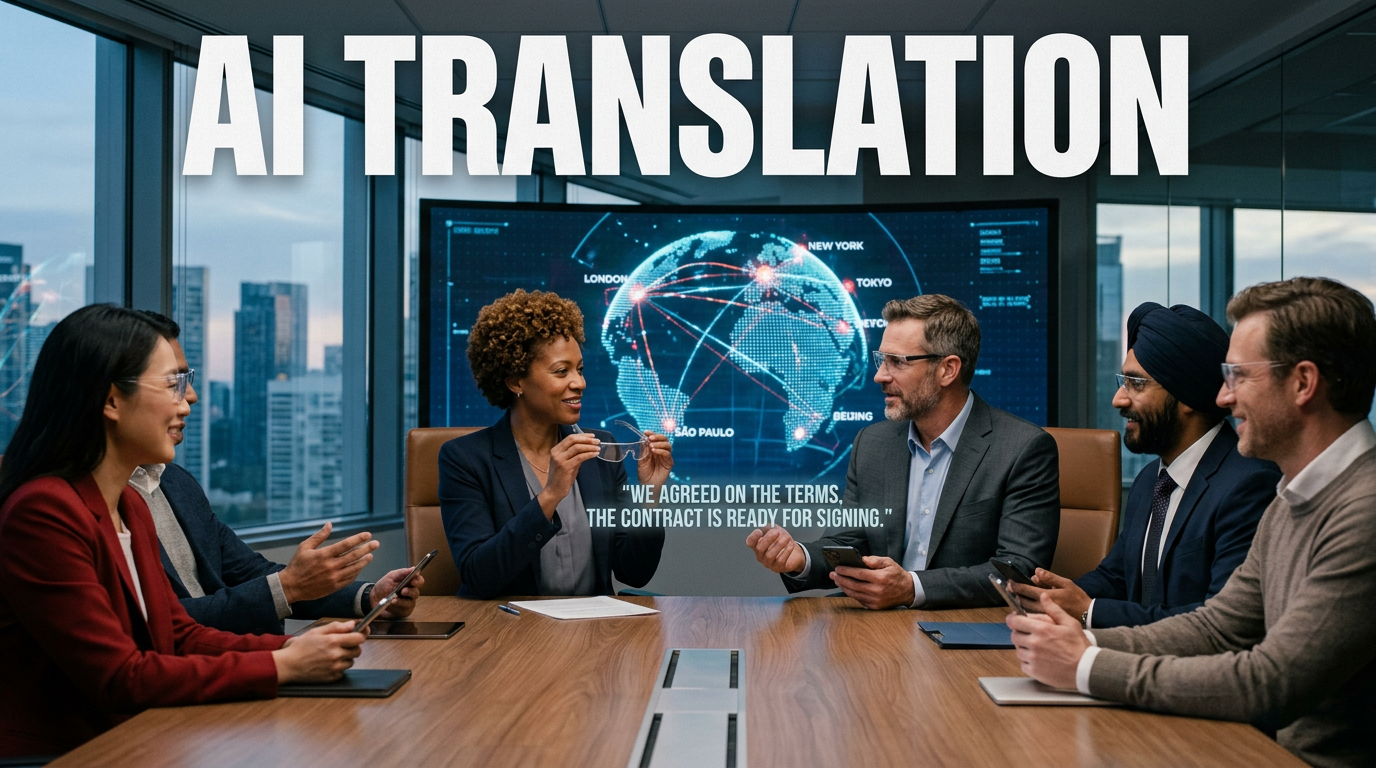
● Real Time Translation Disrupts Global Business and Drives On Device AI AR Glasses Boom
How AI Real-Time Translation Is Transforming Global Business: Breaking Language Barriers, AR Glasses, and On-Device AI Investment Points
The core point of this change is not simply that “translation has become faster.”
AI real-time translation is now moving beyond that, to a stage where it reads the speaker’s emotions, intonation, and conversation flow, and responds naturally before the other person has even finished speaking.
When AR glasses are combined with this, overseas business trips, global video conferences, travel, education, customer support, and B2B sales methods themselves are likely to change completely.
In particular, Google Gemini Live Translate, GPT-based two-way voice models, Meta and Google smart glasses, and the Qualcomm-centered on-device AI ecosystem are pillars that must be watched in future global economic outlooks and AI investment strategies.
1. Google Gemini Live Translate: Translation Has Shifted from “Sentence Units” to “Real-Time Voice Flow”
The feature that deserves attention this time is Gemini 3.5 Live Translate Preview, which can be found in Google AI Studio.
The usage method is relatively simple.
After accessing Google AI Studio and entering the Playground menu, selecting Speech under Model allows you to use the Live Translate Preview feature.
After that, pressing the Talk button starts a voice conversation, and the user’s speech is translated immediately with a short delay of roughly one second.
- Core feature: It generates translated speech in real time even while the user is speaking.
- Technical meaning: It is not the old method of waiting for a sentence to end before translating.
- User experience: It feels close to having an interpreter speaking almost simultaneously while talking with the other person.
The reason this matters is the difference in word order between Korean and English.
In the past, AI translation had to wait until an entire sentence ended, understand the full meaning, create the translated sentence, and then output it as TTS voice.
But Live Translate predicts meaning even while speech is in progress and keeps the translated voice flowing.
This is not just an improvement in speed; it means AI has entered a stage where it reconstructs language structure in real time.
2. The Era of Translating Emotion and Tone: Mechanical Awkwardness in Translation Is Decreasing
What is even more surprising in this feature is the reflection of emotion and tone.
For example, if the user speaks in an angry tone, the translated voice also delivers that strong emotion to some extent.
Conversely, if the user speaks in a sad mood, that emotion is reflected in the translated result.
- Traditional translation: Meaning could be conveyed, but emotion was mostly lost.
- New translation: It tries to convey not only the content of the speech but also the tone, emotion, and atmosphere.
- Business impact: Nuance loss in negotiations, sales, and customer communication can be greatly reduced.
In global business, nuance is often more important than words.
In price negotiations, investment meetings, job interviews, and partnership discussions, “how it was said” can change the outcome more than “what was said.”
The fact that AI real-time translation has started handling emotion means the cost of global communication can structurally decline.
3. Real-Time Interpretation Expands Through APIs: Now Anyone Can Build an AI App for Global Meetings
Google AI Studio provides an API key.
By using this API key, you can attach Live Translate functionality to external services or personal programs.
In the source example, Claude Code was used to capture the other party’s audio from Zoom or Google Meet and create an app that translates it into Korean in real time and displays it.
- Step 1: Capture video conference audio.
- Step 2: Translate in real time via the Live Translate API.
- Step 3: Deliver it to the user as Korean subtitles or voice.
- Step 4: After remembering the conversation flow, recommend what the user should say in response.
The truly important point here is not translation but response recommendation.
AI goes beyond simply converting the other person’s words into Korean and suggests what kind of response I should make in the current conversation context.
For example, if a foreign client proposes sponsorship terms, fixed fees, performance bonuses, and link signup conditions, AI understands this and recommends an appropriate English response draft.
In the past, a service like this alone could have been enough for a startup to attract investment.
But now we are in an era where even non-specialists can create a prototype in 30 minutes using AI coding tools.
This change shows how quickly the software entry barrier is falling in the AI industry.
4. The Meaning of Learning English Changes: It Is Not That “Studying Is No Longer Needed,” but That “The Purpose Changes”
When many people see this kind of technology, they may feel, “Do we not need to learn English anymore?”
In reality, the language barrier is likely to fall sharply in everyday conversation, overseas travel, and basic video meetings.
That is because the other person’s speech is told to you in Korean by AI, and your own reply is also recommended in English by AI.
However, English learning is unlikely to disappear completely; rather, its role will probably change.
- Basic conversation: The area replaced by AI real-time translation will expand.
- Specialized negotiations: The human ability to judge nuance directly remains important.
- Advanced communication: Cultural context, humor, and trust-building still require both AI assistance and human judgment.
- Education market: It is likely to shift from rote foreign-language education toward global practical communication training.
In other words, English may change from “a study you absolutely must do to survive” into “a strategic skill for using AI better.”
5. GPT Two-Way Voice Model: Interrupts, Responds, and Captures Conversation Flow Like a Human
Another noteworthy change is the new GPT-based two-way voice communication model.
In the original text it was introduced under the name GPT BD1, and the key point is that AI naturally responds in the middle of the user’s speech before the user has finished speaking.
For example, if the user says multiple fruit names, the AI responds in the middle of the conversation by repeating those fruit names and counting the total number, as shown in the demo.
Earlier voice AI systems were structured so that the user had to stop speaking before the AI could start responding.
As a result, conversations were often interrupted and felt less like talking to a person and more like communicating through a walkie-talkie.
- Traditional voice AI: User speaks → stops → AI processes → responds.
- New voice AI: Even while the user is speaking, AI listens, understands, and responds.
- Perceived change: It comes closer to the natural AI conversation experience seen in the movie Her.
This technology can directly affect call centers, educational tutors, healthcare consultations, sales assistance, and the personal assistant market.
Especially in customer service automation, there is a strong possibility that AI agents will emerge that go beyond simple chatbots by naturally reacting mid-conversation, detecting emotional states, and adjusting the flow of dialogue.
6. When AR Glasses Are Added, the Game Changes: Translation Appears in Front of Your Eyes, Not on a Screen
The next stage for AI real-time translation is not a smartphone screen but AR glasses.
The G2 smart glasses from China’s Even Realities, introduced in the original text, were described as a product with a design close to ordinary glasses and a fairly light weight.
It was said that when worn directly at CES, the real-time translation subtitles and navigation functions worked quite naturally.
- Main functions: Real-time subtitle translation, navigation, information display.
- Use cases: Overseas travel, exhibitions, global meetings, museum visits, on-site work.
- Core advantage: You can check information directly in front of your eyes without taking out your smartphone.
If another person’s speech is immediately shown as subtitles on the lens of your glasses while traveling abroad, the convenience is enormous.
When finding your way, you may no longer need to keep holding your smartphone and looking at a map app; instead, directional guidance can be displayed in front of your eyes.
This is not just a device innovation; it is a shift in the center of user experience from smartphones to face-worn devices.
7. Meta Ray-Ban Display and Google’s Reentry: The Possibility of AR Glasses Going Mainstream in 2027
Meta’s Ray-Ban Display is being mentioned as a high-end product among current AR glasses.
It supports a color display and is evolving in a direction that can show richer information than existing smart glasses.
Although official release in Korea is still limited, Meta is regarded as one of the leading players in the global market.
Personally, I believe the AR glasses market is highly likely to grow in earnest between 2027 and 2028.
There are three main reasons.
- First: display, battery, camera, and voice recognition technologies are improving simultaneously.
- Second: AI agents are not staying only inside smartphones, but are understanding real-world information through the user’s eyes and ears.
- Third: As on-device AI performance improves, cloud dependence can be reduced and latency lowered.
To use a smartphone, you must take it out of your pocket, unlock it, open an app, and type a question.
In contrast, AR glasses can give an immediate answer the moment you ask, “What is this?” about whatever you are looking at.
When looking at a painting in a museum, a menu at an overseas restaurant, a sign at an airport, or equipment at a work site, AI can instantly explain it.
8. The Real Key Change: AI Agents Gain “Eyes”
This is the most important point that is easy to miss in other news or on YouTube.
The essence of AR glasses is not that they are a translation device, but that they are a device that gives AI agents vision and hearing.
Most AI assistants today are trapped inside smartphones.
AI can understand a situation only if the user directly takes a photo, types text, or records audio.
But once smart glasses are worn, AI can understand much more richly what the user sees, hears, and experiences throughout the day.
- Current AI: It understands only the information the user inputs.
- AI after AR glasses: It understands the real world the user is seeing together with them.
- Result: AI agents are much more likely to behave like a real personal assistant.
For example, during a meeting with an overseas buyer, AI can translate the other party’s remarks, read facial expressions and atmosphere, remember previous conversation context, and then suggest candidate responses.
In a factory, AI can check the equipment status the worker is looking at and immediately display abnormal signs or manual information.
This is exactly why productivity innovation can occur in healthcare, manufacturing, logistics, education, and tourism.
9. Economic Ripple Effects: The Structure of the Global Labor Market and Service Industry Changes
When AI real-time translation and AR glasses are combined, they also become an important variable in the global economic outlook.
If language barriers are lowered, companies can find talent, secure customers, and sell services in a wider market.
- Global hiring: Practical skills may become a more important evaluation criterion than English proficiency.
- SME exports: Even companies lacking foreign-language staff can more easily handle overseas customers.
- Education industry: The foreign-language learning market is more likely to be reorganized than simply shrink.
- Tourism industry: As local language barriers decrease, demand for independent travel may increase further.
- B2B SaaS: The barrier to entry for simple translation and meeting-record services may fall rapidly.
Especially in the software market, services that differentiated themselves only with “one translation feature” may lose competitiveness.
If big tech companies such as Google, OpenAI, and Meta provide real-time translation as a basic feature, small SaaS companies will need to move toward solving deeper industry-specific problems.
For example, services that understand specialized contexts—such as AI for legal contract negotiations, AI for medical consultations, or AI for manufacturing sites—are more likely to survive than simple interpretation apps.
10. Investment Perspective: Why Qualcomm, Meta, and Google Are Getting Attention Again
As AR glasses and on-device AI grow, important changes also occur from a semiconductor investment perspective.
Smart glasses must solve voice recognition, translation, display output, camera processing, and battery efficiency all within a small device.
At that point, low-power AI computing becomes the key competitive edge.
- Qualcomm: A company with strengths in mobile chips and on-device AI.
- Meta: A strong player aiming to preempt the Ray-Ban smart glasses ecosystem.
- Google: A company that can connect Gemini, Android, AI Studio, and cloud APIs.
- Display and sensor companies: They may benefit from the expansion of the AR glasses supply chain.
- Battery and low-power semiconductor companies: They address the core bottlenecks of wearable AI devices.
Of course, from an investment perspective, there are still risks such as the timing of mainstream adoption, price, battery life, privacy regulation, and resistance to wearing such devices.
However, if AR glasses become commercially widespread in earnest between 2027 and 2028, they could become the biggest user-interface shift since the smartphone.
AI semiconductors, on-device AI, AR glasses, AI agents, and global productivity innovation are keywords that should all be viewed together going forward.
11. Risks Exist Too: Privacy, Meeting Security, and Regulatory Issues Cannot Be Avoided
As convenient as AI real-time translation and smart glasses are, privacy issues inevitably follow.
Capturing and translating another person’s voice, remembering conversation flow, and even recommending responses means sensitive information enters the AI system.
- Meeting security: The issue of sending internal company meeting content to external APIs.
- Consent issue: Whether the other party knows they are being recorded, translated, and analyzed.
- Data storage: Transparency about where conversation records are stored and how they are used.
- Industry regulation: Stronger regulations may apply in healthcare, finance, and legal fields.
From a corporate perspective, when introducing AI translation tools, security policies and data-processing methods must be checked carefully.
In particular, in global video conferences, investment meetings, and contract negotiations, a culture of notifying participants in advance about the use of AI tools may become necessary.
12. Conclusion: The Bigger Change Than Breaking Language Barriers Is the Emergence of AI That Understands Reality
This AI real-time translation technology is not simply a tool that converts English into Korean.
It is evolving into AI communication infrastructure that predicts speech flow, reflects emotion, remembers conversation context, and even recommends responses.
When combined with AR glasses, AI becomes a personal assistant that understands the user’s surrounding reality.
Going forward, important competitiveness will not be limited to how well you speak foreign languages.
How naturally you connect AI translation and AI agents to your work may become even more important.
Companies should quickly experiment with this technology in global customer support, overseas sales, remote collaboration, and on-site work support.
Individuals will gain opportunities to reduce English anxiety and access a broader global market.
Ultimately, when the wall of language collapses, competition broadens and speed increases.
Those who use AI well—both people and companies—can enter the global market more easily, while those who adopt AI too slowly may fall behind even faster than before.
< Summary >
Google Gemini Live Translate has reached a stage where it translates in real time even before a sentence ends.
By reflecting emotion and tone as well, the language barrier in global video meetings and overseas business is being greatly reduced.
By using the API, not only Zoom and Google Meet interpretation apps but also response-recommendation AI assistants can be quickly built by individuals.
The GPT-based two-way voice model naturally responds even before the user has finished speaking, creating human-like conversations.
AR glasses are likely to create a new user experience after smartphones by placing translation subtitles, navigation, and real-time information search right in front of your eyes.
The real core point is that AI agents gain eyes and ears.
Qualcomm, Meta, Google, on-device AI, and the AI semiconductor ecosystem can become important investment watchpoints in the AR glasses mainstreaming trend after 2027.
[Related Articles…]
- AI Agents Reshaping Global Productivity Innovation
- Semiconductor Investment Strategy in the On-Device AI Era
*Source: [ 월텍남 – 월스트리트 테크남 ]
– 차원이 다른 AI실시간 번역 기술.. 이제 언어의 벽이 완전히 무너집니다