● Portfolio Shift From All-Weather to High-Stakes Stocks
Why the Portfolio Shift Away from Pure Asset Allocation: The Real Evolution from All-Weather to Individual Stock Investing
The core message of this article is not that asset allocation is inferior.
Asset allocation remains a sound strategy; however, investment strategy can change as an investor’s lifestyle and market perspective evolve.
This summary traces the transition from algorithmic trading to All-Weather asset allocation, passive investing, and the current focus on individual stock selection.
1. The Initial Approach Was Algorithmic Trading, Not Asset Allocation
The first investment approach was trading, not long-term investing or asset allocation.
As with many beginners, the most accessible entry point was short-term trading.
The key difference was the use of coding and systematic rules rather than continuous chart monitoring.
At the time, minute-level data was purchased from Koscom, and strategies were developed through paid courses and investment communities.
Strategies included long-short positions using KOSPI and KOSDAQ ETFs, as well as swing trades held for one day to around five days.
- The starting point was equity trading.
- The primary tools were coding and algorithms.
- Strategies included day trading, swing trading, and ETF long-short positions.
- Performance was acceptable, but the process was not psychologically satisfying.
The key issue was not profitability, but sustainability.
Ultimately, algorithmic trading was judged to be effective financially but not suitable as a long-term investment style.
2. Why Trading Was Difficult: The Burden of Daily Performance Tracking
The main drawback of trading was the need to evaluate results every day.
A gain of 1 million KRW one day, another 1 million KRW the next day, and a loss of 1 million KRW the following day still leaves the total in positive territory.
However, investor psychology does not operate on simple cumulative returns.
Realized losses on a daily basis create significantly more stress than the experience of gains.
This is highly relevant for individual investors.
Investing is not only about generating returns, but also about managing mental stamina over time.
Even a strategy with attractive expected returns is difficult to sustain if it creates daily distress.
- Short-term trading requires constant monitoring of gains and losses.
- Interim losses can feel more burdensome than cumulative profits.
- Investors can become overly focused on stock prices, making it difficult to separate investing from daily life.
- The fatigue of the process may outweigh the performance itself.
This experience became the catalyst for moving toward the opposite approach: asset allocation.
3. The Alternative Strategy: Asset Allocation and All-Weather Investing
If trading requires daily decisions, asset allocation relies on restraint and long-term discipline.
The approach combines equities, bonds, commodities, and other asset classes, with periodic rebalancing to withstand market volatility over time.
During this transition, the All-Weather strategy associated with Ray Dalio and passive investing became central reference points.
The core view at the time was clear.
Consistently generating alpha above the market is extremely difficult.
Focusing on market beta through passive investing could still place an investor among the better long-term performers.
- Asset allocation combines equities, bonds, and commodities in a long-term framework.
- The All-Weather strategy is a representative model designed for multiple economic environments.
- Passive investing emphasizes staying invested rather than forecasting markets.
- It remains a strong option for investors who do not want to devote significant time to investing.
This approach later led to operating an advisory business and writing a book on the All-Weather framework.
However, another important realization followed.
4. Leaving Asset Allocation Was Not a Strategy Failure, but a Fit Issue
The current approach no longer uses All-Weather asset allocation.
This does not mean the strategy is viewed as flawed.
In fact, family members continue to use an All-Weather style allocation.
The central point is that there is no single correct investment strategy.
Some investors profit through short-term trading, others through long-term holding, and others through dividend investing.
In practice, investors tend to adopt strategies that fit their temperament and lifestyle.
- Asset allocation was not abandoned because it failed.
- The strategy changed as the investor’s interests and perspective changed.
- It remains suitable for investors who want market returns with less time commitment.
- For those who enjoy analyzing companies, individual stock investing may be a better fit.
This is a common misunderstanding among investors.
A good strategy is not always the right strategy for a specific person.
5. The Move to Individual Stocks: Discovering the Value of Company Analysis
Running a YouTube channel naturally led to contact with individual stock investors.
Participation in stock study groups and discussions with different investors increased interest in fundamental analysis.
At first, analyzing industries and companies did not seem like a personal fit.
Over time, however, the process of evaluating good businesses, industries, and management teams became genuinely engaging.
The preferred style became investing in strong businesses.
The focus was on companies with capable founders or management teams, favorable industry conditions, and a high probability of long-term success.
- Business models are analyzed.
- Industry growth potential is reviewed.
- Management quality and direction are assessed.
- Long-term competitiveness is prioritized over short-term price action.
One example of this approach was holding Sea Limited, often described as a potential Amazon of Southeast Asia.
6. What Sea Limited and Carvana Revealed About the Reality of Growth Investing
Even companies viewed as strong businesses can suffer severe price declines if the market does not support the valuation.
Sea Limited was initially viewed through the lens of Southeast Asian e-commerce and digital ecosystem growth.
However, the combination of 2022 rate hikes and valuation pressure on growth stocks led to a sharp decline in the share price.
A stock that appears cheap after a large drawdown can still fall much further from the entry price.
This reinforced the risk of assuming that a 70% decline from the peak automatically indicates value.
Carvana presented a similar lesson.
Although it appeared to be a strong business as an online used-car platform, market confidence weakened and valuation collapsed.
- A good business is not always a good stock.
- Growth stocks are especially sensitive to rising interest rates and valuation compression.
- Markets can remain skeptical of a company for a prolonged period.
- A large decline alone does not make a stock cheap.
This is also why interest-rate direction matters in global macro outlooks.
Higher rates reduce the present value of future earnings and tend to increase volatility in growth and technology stocks.
7. The Current Style: Combining Fundamentals with Market Signals
The current approach is not concentrated on a single method.
The focus remains on identifying good businesses, while also monitoring how the market prices them.
In other words, both fundamentals and price action are considered.
This does not imply reliance on complex technical analysis.
The main checks are whether the stock is in an uptrend on a monthly basis and whether it has attracted market attention over the past three months.
- Fundamentals are analyzed.
- Market flow and price trends are reviewed.
- Additional buying may be considered when a stock is trending higher.
- Declining stocks are not averaged down aggressively.
A key principle is avoiding averaging down.
Adding more capital to a falling position can increase concentration risk.
Following the Sea Limited experience, averaging down into weakness is no longer treated as a default response.
8. The Most Important Point Rarely Stated in Market Commentary
The most important point is that investment strategy is linked to lifestyle, not just returns.
Most content focuses on which stocks may rise, which asset classes may outperform, or whether the AI theme will continue.
In practice, long-term outcomes are often determined by whether an investor can maintain the strategy for five or ten years.
Trading may be profitable, but if it creates daily stress, it is difficult to sustain.
Asset allocation may be stable, but it can feel unengaging to someone who enjoys company analysis.
Individual stock investing may be appealing, but if volatility is intolerable, losses can widen.
- Investing is a lifestyle decision as much as a financial one.
- Personality, time availability, occupation, sleep patterns, and stress tolerance all matter.
- The most important factor is selecting a strategy that can realistically be maintained.
- Before choosing a good strategy, choose one that fits personal constraints.
The same principle applies to AI and technology investing.
Even if artificial intelligence has long-term growth potential, the associated volatility may make the strategy unsuitable for some investors.
9. Why Specific Holdings Are Not Publicly Disclosed
The reason for not disclosing specific holdings is also clear.
When a known investor mentions a stock, some investors may copy the position directly.
The problem is that selling is much more difficult than buying.
It is not always possible to explain every adjustment, reduction, or exit decision in real time.
For that reason, if full responsibility cannot be taken, it is better not to disclose holdings at all.
- Publicly naming holdings can create misleading signals.
- Investors should focus more on exit rules than on entry ideas.
- Following someone else’s portfolio can weaken independent judgment.
- Investment content is more useful when it teaches decision-making rather than stock picking alone.
This is practical guidance for individual investors.
Knowing someone else’s stock is less important than being able to explain why it was bought and under what conditions it would be sold.
10. Why Day Trading and Short Selling Are Avoided
Day trading is not used, and short positions are rarely taken.
Short selling depends heavily on timing.
Even if the direction is correct, a poor entry or exit can lead to significant losses.
Day trading is also incompatible with the current lifestyle.
Producing content, sleeping late, and not being able to monitor the Korean market during the morning session makes short-term trading difficult.
To trade Korean equities effectively, the opening period around 9:00 a.m. is important.
- Short selling depends heavily on timing.
- Day trading requires strong focus during market hours.
- If the lifestyle does not fit, the strategy can break down.
- Long-term investing does not require constant performance tracking.
Ultimately, investment strategy is determined not only by market knowledge, but also by daily schedule, concentration, and stress management.
11. A Common Beginner Mistake: Building a “Department Store” Portfolio
Beginners often hold too many stocks.
When a portfolio contains 20, 30, or 50 names, it becomes difficult to monitor each company in depth.
In such cases, the portfolio may begin to behave like the overall market index.
Meaningful individual stock investing requires some level of concentration.
This does not mean putting everything into one name.
However, holding 100 stocks at 1% each and expecting to outperform the market is not realistic.
- Too many holdings make active monitoring difficult.
- Portfolio breadth often reduces the depth of company analysis.
- Very small position sizes limit the impact of correct decisions.
- Investors should learn to allocate meaningful capital to the companies they understand best.
For individual investors, focusing on a smaller number of core positions may be more practical.
12. Why Investment Study Groups Are Useful
Investment study groups are not only for collecting ideas from others.
The main benefit is the discipline of organizing and presenting one’s own investment thesis.
Explaining why a company looks attractive, what risks exist, and whether the valuation is reasonable exposes the quality of the idea.
Beginners may find it difficult to join strong study groups.
In that case, forming a group independently is also viable.
Even among beginners, some participants will think more clearly than others, creating opportunities for mutual learning.
- Investment ideas can be structured in writing.
- Explaining ideas to others reveals weaknesses in the logic.
- Different perspectives help reduce bias.
- Study groups support consistent learning routines.
This is especially relevant in fast-changing sectors such as AI semiconductors, cloud infrastructure, electric vehicles, and platform companies.
A study group can help close information gaps in these areas.
13. The Right Mindset for the AI Investment Era: Flexibility Matters More Than Conviction
Markets are currently focused on AI, semiconductors, data centers, cloud services, and power infrastructure.
However, highly assertive public positions can make it difficult to change one’s view later.
For example, repeatedly insisting that AI-related technology stocks will always rise can reduce flexibility if market conditions change.
For that reason, overly categorical views on specific industries or companies should be avoided.
Investors must remain open to changing their minds.
Yesterday’s conviction can become today’s risk.
- Long-term growth in AI should be distinguished from short-term stock performance.
- Even in strong industries, expensive stocks can still correct.
- Industries with rapid technological change require flexible investment judgments.
- Repeatedly expressing strong public conviction can make reassessment more difficult.
In a market highly sensitive to AI themes, flexibility is a core element of risk management.
14. Building Wealth Requires Compounding, Not Day Trading
Day trading may appear feasible when capital is small.
As assets grow, however, transaction costs and liquidity constraints become more relevant.
In the Korean market, trading tens of billions or hundreds of billions of won through short-term methods is highly difficult.
Meaningful wealth creation requires a compounding framework.
Holding strong businesses over time or using stable asset allocation to accumulate long-term returns may be more appropriate.
- Day trading becomes less efficient as portfolio size increases.
- Long-term investing is better suited to compounding.
- Trading costs, taxes, and slippage must be considered.
- Scalability becomes increasingly important as capital rises.
The objective is not to make one large correct call, but to build a structure that can survive over time.
15. Core Investment Principles
- Asset allocation remains a sound strategy.
- However, it is not optimal for everyone.
- Trading is defined more by psychological durability than by returns alone.
- If daily performance tracking is stressful, the strategy may not be suitable.
- A good business can still be a poor stock if the market does not recognize it.
- Both fundamentals and market reaction should be considered.
- Averaging down can increase concentrated risk.
- Declines should be analyzed carefully rather than automatically bought.
- Investment study groups are useful for improving judgment.
- Writing and speaking through ideas helps clarify thinking.
- In the AI era, flexibility matters more than conviction.
- Industry growth and stock performance do not always move together.
< Summary >
The key message is not that asset allocation should be abandoned, but that investment strategy should match the investor’s temperament and lifestyle.
Algorithmic trading was difficult because it required daily monitoring and constant psychological engagement.
That led to All-Weather asset allocation and passive investing, which remain suitable for investors who want lower time commitment.
As interest in company analysis increased, the focus shifted to individual stocks, and experiences with Sea Limited and Carvana highlighted the risk that even strong businesses can fall sharply when markets reject the valuation.
The current approach emphasizes both fundamentals and price trends, while avoiding aggressive averaging down into weakness.
In the AI and technology environment, flexibility is more important than certainty.
Ultimately, the best investment strategy is not the one others recommend, but the one an investor can sustain over time.
[Related Articles…]
- Semiconductor Cycle and Global Market Outlook
- How Interest Rate Changes Affect Asset Allocation and Growth Stocks
*Source: [ 내일은 투자왕 – 김단테 ]
– 더 이상 자산배분을 하지 않는 이유● AI Premium Crash, Semis Sink, Nasdaq on Edge
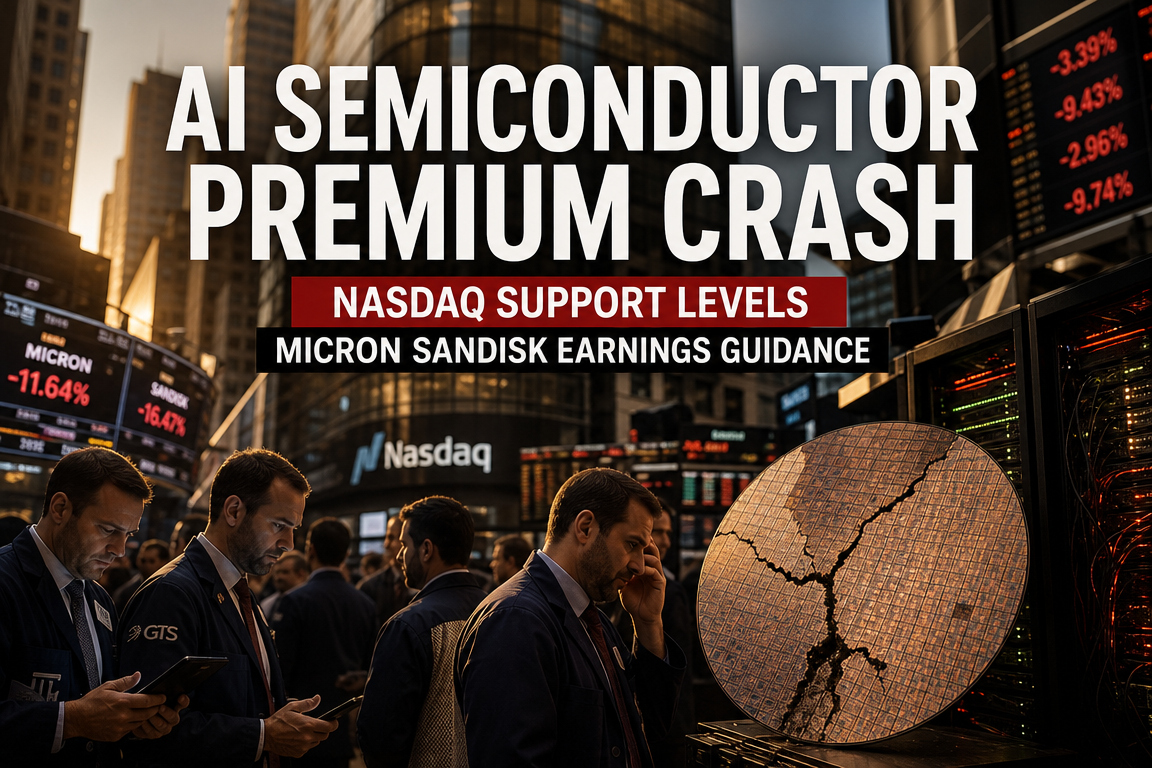
What Matters More Than the Sharp Selloff in Semiconductors Is Whether the AI Premium Is Disappearing: Key U.S. Equity Watchpoints for Next Week
The real focus for next week is not a single Meta headline.
What matters more than whether semiconductors keep falling is whether the premium margin built into the AI investment cycle remains intact.
The key questions are whether the Nasdaq can re-establish its uptrend, whether semiconductor names such as Micron and SanDisk can hold critical support levels, and whether the second-quarter earnings season can exceed market expectations.
This report summarizes the return-risk illusion that many U.S. equity investors overlook, how to use technical analysis properly, the substance of the recent Meta-related semiconductor news, and actionable Nasdaq reference points for next week.
1. Why “A stock is up 100% this year” can be misleading
One of the most common phrases in U.S. equity media is:
“Stock A is up 100%, Stock B is up 50%, and Stock C is up 20%.”
This naturally makes the 100% gainer appear superior.
However, investors cannot capture that full move in practice.
Most investors do not buy at the exact bottom and sell at the exact top.
They tend to notice the stock after it has already risen significantly.
They hesitate at first, miss the initial move, then enter during the middle stage and become unstable when a correction follows.
As a result, portfolio returns often differ materially from the stock’s headline performance.
- A stock may rise 100%, but investors rarely capture the full move.
- In practice, a 30% to 40% return is already a strong result.
- Stocks that have risen sharply usually carry higher downside volatility as well.
- Slowly trending winners may be more suitable for portfolio stability than short-term momentum names.
The key question is not how much a stock has already risen, but whether further upside remains from the current level.
This applies even to semiconductors, AI beneficiaries, and large-cap technology leaders. Chasing already extended names is not automatically the right approach.
Investors should also consider smaller growth names or undervalued large-cap names that have not fully participated in the market move.
2. The entry point matters more than the quality of the company
Investors often incur losses even when they buy fundamentally strong companies.
The reason is straightforward.
They paid too much for a good business.
No matter how strong the fundamental analysis is, returns are constrained if the purchase price is too high.
By contrast, buying a strong company that the market has temporarily overlooked, at an appropriate support zone, can materially improve risk-adjusted returns.
This is where technical analysis becomes useful.
Technical analysis is not a tool for predicting the future with certainty.
It is a framework for defining entry and exit conditions.
In simple terms, it is a tool for disciplined execution.
- Technical analysis is about probability management, not prediction.
- Being correct 60% to 70% of the time can still produce strong portfolio growth.
- The key is where to buy and how to respond when the trade is wrong.
- Charts reflect investor psychology and supply-demand dynamics.
Many investors say they do not use charts or prefer not to predict.
The issue is not the chart itself, but the way it is used.
Simply following others’ “buy here” signals is not sustainable.
Investors need to understand why a level is a valid entry zone and how to respond if it breaks.
3. One Meta headline does not justify declaring the semiconductor cycle over
Recent market commentary has focused on reports that Meta may be able to rent or sell unused AI computing capacity and cloud infrastructure.
Some investors interpreted this as a sign that AI demand is weakening or that the semiconductor cycle has peaked.
That conclusion may be premature.
It is reasonable to monitor any slowdown in AI infrastructure spending.
However, one Meta-related headline is not enough to conclude that the broader semiconductor cycle has ended.
Demand for AI data centers, high-bandwidth memory, GPUs, and server memory remains a central investment theme.
In the U.S. equity market, semiconductors are not just an industry; they are a core driver of Nasdaq sentiment.
Accordingly, the Meta headline should be treated as a potential risk signal, not as confirmation of cycle termination.
- The Meta headline appears to be a recurring issue rather than a new structural development.
- During sharp selloffs, short-term positioning and bearish flows can amplify the news.
- Whether AI demand is slowing should be confirmed through earnings and guidance.
- Semiconductor stocks remain in a phase of trend assessment, not a stage that justifies an outright collapse thesis.
4. The real issue is whether the semiconductor premium can hold
The most important term in the current semiconductor cycle is premium.
AI demand has surged, supply has remained tight, and certain products have therefore commanded higher pricing and stronger margins.
The sharp gains in Micron, SanDisk, and HBM-related names are closely tied to this premium effect.
Anyone who has run a business understands how a premium-priced product behaves.
At first, customers are willing to pay up because supply is constrained.
During that phase, revenue and margins improve rapidly.
Over time, however, supply begins to catch up.
As initial backlog demand is absorbed and inventories gradually build, the premium compresses.
At that point, the market shifts from asking whether earnings are good to whether the pace of earnings growth is slowing.
That is the central issue for the next semiconductor earnings season.
- Earnings may remain strong.
- However, expectations are already elevated.
- Whether high margins are sustained will be critical.
- Signs of AI premium compression should be monitored.
- Guidance and margin trends may matter more than revenue growth alone.
In other words, the key question is not whether results are good.
The key question is whether results are strong enough to exceed already elevated market expectations.
For stocks that have already rerated substantially, merely solid earnings may not be sufficient.
5. Micron and SanDisk should be evaluated based on trend preservation
Micron has recently moved sharply as a representative beneficiary of AI memory demand and semiconductor sentiment.
After a strong rally, whether key price levels can be defended becomes more important than further upside in the near term.
In the original context, a return to the $100 area was cited as an initial psychological threshold for Micron.
A move back above the $120 area and sustained trading there could support expectations toward the $150 region, but that should be treated as a conditional scenario rather than a fixed target.
SanDisk has also entered a corrective phase after a strong advance.
The $150 area was identified as an important short-term support level.
If that level breaks, the trading range may shift lower.
Conversely, if it holds, it would argue against the view that semiconductor sentiment has completely deteriorated.
- Micron’s return above $100 is an initial sentiment threshold.
- A breakout and stabilization above the $120 area would strengthen the case for additional upside.
- For SanDisk, holding the $150 area is important.
- If key support breaks, additional buying should be approached cautiously.
- Semiconductor names should be analyzed in the context of the broader industry trend.
6. For the Nasdaq next week, the key issues are upper-band recovery and the 50-day moving average
The U.S. equity market is not in an especially attractive entry zone.
For the Nasdaq to resume its uptrend, it needs to reclaim its upper reference band.
In the original discussion, roughly 350 points of additional upside were described as necessary from a chart perspective.
If the index moves back above that zone, it would suggest the market is absorbing semiconductor-related weakness.
By contrast, if the 50-day moving average or the recent low breaks, investors should reduce aggression and wait for earnings confirmation.
In a market led by AI and semiconductors, Nasdaq momentum remains the most important indicator.
Even strong individual names can weaken when broader sentiment deteriorates.
- A move back above the upper reference zone would support a renewed uptrend thesis.
- If the 50-day moving average breaks, a more defensive stance is warranted.
- Ahead of earnings, confirmation is preferable to aggressive chasing.
- The Nasdaq is a key indicator for semiconductor and mega-cap growth sentiment.
7. Before projecting Tesla at $800, investors should first assess the current setup
Predictions that Tesla will reach $800 are common.
However, anchoring an investment case to a fixed upside target is risky.
For Tesla to advance, strong vehicle sales alone are not sufficient.
The broader market environment must be constructive.
Economic conditions need to remain stable, equity sentiment must support growth stocks, and capital must continue flowing into the theme.
Only then can Tesla-specific catalysts matter meaningfully.
Robotaxis, AI, energy, and potential synergy with SpaceX can support valuation over time.
At the same time, auto sales alone are increasingly insufficient to justify a structurally elevated valuation.
A more practical approach is to monitor whether Tesla can break and hold the $440 to $460 area, which would open the door to a larger range expansion.
- Investors should focus on the current trading range before relying on an $800 thesis.
- Automotive sales alone do not fully explain long-term upside potential.
- Future catalysts may include AI, robotaxis, energy, and aerospace-related optionality.
- Broad Nasdaq and growth-stock momentum remain essential.
8. Large-cap technology leaders should not be discarded lightly
Microsoft, Meta, Nvidia, and Apple remain core holdings in long-term U.S. equity portfolios.
They can certainly correct.
Their charts may weaken, and bearish patterns may emerge.
However, over nearly two decades of U.S. market history, the assets that have best weathered crises and recovered strongly have often been large-cap technology and semiconductor leaders.
Therefore, a short-term correction in these names should not automatically be interpreted as a structural failure.
The more important question is whether the company itself is impaired.
Absent accounting issues, earnings credibility damage, or a broken business model, a correction can become an opportunity for long-term investors.
- Large-cap technology names remain a foundational part of long-term portfolios.
- Short-term chart weakness should be distinguished from fundamental impairment.
- If the business remains intact, pullbacks can support staged accumulation.
- Purchases should still be made with attention to support levels and market conditions.
9. Mid-cap names and speculative stocks must be handled differently
Mid-cap and smaller names can move sharply when market momentum improves.
However, volatility is significantly higher.
Energy, biotech, crypto-related names, and newer AI infrastructure companies can experience rapid gains and equally rapid reversals.
These stocks should not be approached like long-term quality compounders.
In the original context, names such as CoreWeave, SMR, X-energy, and BitMine were referenced.
These names may have strong narratives and thematic appeal, but their earnings stability and capital flow stability can be limited.
Investors should first define whether they are investing for the long term, swing trading, or trading short term.
Without that distinction, investors tend to rotate between names every time volatility increases.
That often leads to buying highs and selling lows.
- Mid-cap names tend to move with broader market momentum.
- Theme-driven stocks can react more to news and flows than to earnings.
- “Speculative stock” should be understood as a volatility profile, not necessarily a judgment on quality.
- Less experienced investors should keep exposure to difficult-to-manage names limited.
- Long-term and short-term accounts should be separated.
10. Gold and Bitcoin should be treated as cyclical assets
Gold is a safe-haven asset, but it does not rise continuously.
It trades in relation to the dollar, interest rates, recession risk, and stagflation expectations.
When gold has already run significantly and the dollar is comparatively weak, capital can rotate back toward the dollar.
For that reason, gold should be evaluated over a longer cycle rather than through short-term momentum alone.
Bitcoin should be viewed similarly.
Breaking above $70,000 does not necessarily confirm a durable trend reversal.
Market sentiment may require a stronger confirmation zone than the current level.
Leveraged Bitcoin ETFs require particular caution.
Even if the underlying asset rises, the ETF may not deliver the expected return.
Leverage is affected not only by direction, but also by volatility, trend persistence, and time decay.
- Gold should be analyzed in the context of the dollar and the macro cycle.
- Bitcoin requires confirmation of sentiment recovery.
- Leveraged ETFs can diverge materially from the underlying asset’s performance.
- Crypto-related names require active volatility management rather than passive holding.
11. The most important point that is often overlooked in other coverage
The real issue in the current semiconductor correction is not the Meta headline, but the durability of the AI premium.
Market commentary often focuses on headlines such as Meta potentially renting AI servers or signs that AI demand is slowing.
However, those headlines are not the core issue.
The key question is whether AI infrastructure companies can continue to command elevated pricing and margins at the levels seen over recent quarters.
When semiconductors are in short supply, customers are willing to pay up for allocation.
At that stage, revenue and operating margin improve sharply.
But once supply catches up and backlog demand fades, the premium naturally compresses.
The market often begins pricing that shift before it appears in reported earnings.
That is why, in the next earnings season, margin trends, inventory levels, backlog, guidance, and customer capex changes may matter more than top-line growth alone.
In short, the issue is not whether semiconductors are collapsing; it is whether the market can continue to sell at the premium pricing investors have been assuming.
Failing to recognize this distinction can lead investors either to overreact to a short-term decline or to mistake it for a simple dip-buying opportunity.
12. Next week’s strategy: confirmation first, buying second
For the U.S. equity market next week, four checkpoints should be reviewed in sequence:
- Confirm whether the Nasdaq reclaims its upper reference band.
- Check whether the index holds the 50-day moving average and recent low.
- Assess whether key semiconductor names such as Micron and SanDisk hold major support levels.
- Evaluate whether second-quarter earnings confirm the AI premium and margin structure.
In strong uptrends, aggressive buying can be appropriate.
But when the index is in an uncertain position ahead of earnings, confirmation-based trading is more appropriate.
Even highly extended semiconductor names can see profit-taking after good earnings.
Conversely, if guidance is stronger than expected, sharp rebounds are possible.
Accordingly, the priority now is response, not prediction.
“Semiconductors are finished” is too aggressive a conclusion, but “they will all recover unconditionally” is also too simplistic.
Investors need to track the index, earnings, margins, and positioning together.
13. Common mistakes individual investors should avoid now
- Chasing stocks after they have already doubled.
- Relying on price targets while ignoring current levels and support zones.
- Treating technical analysis as prediction rather than a decision tool.
- Drawing sector-wide conclusions from a single headline.
- Rotating into hotter names simply because a position is losing money.
- Assuming leveraged ETFs move one-for-one with the underlying asset.
- Focusing on individual stock narratives while ignoring macro and market momentum.
Investing is not a game of being right or wrong.
However, there are clearly wrong methods.
Selecting good companies matters, but entering them in a favorable market at a sensible price matters more.
In the current environment, investors should monitor the U.S. economy, interest rate expectations, Nasdaq trend, semiconductor earnings, and the AI investment cycle together.
< Summary >
Next week’s key issue is not the Meta headline, but whether the AI premium in semiconductors remains intact.
Semiconductor earnings may remain strong, but elevated expectations make margin trends and guidance more important.
The Nasdaq may resume its uptrend if it reclaims its upper reference band, while a break below the 50-day moving average would justify a more cautious stance.
For Micron, the $100 area and then the $120 area are important; for SanDisk, the $150 area remains a key support zone.
Technical analysis is a tool for probability and response, not prediction.
Individual investors should prioritize current positioning, market momentum, earnings expectations, and risk management over headline return figures.
[Related Articles…]
*Source: [ 미국주식은 훌륭하다-미국주식대장 ]
– 반도체 망하나? 다음 주 정신 똑바로 차려야 합니다.