● Tesla Slides on 4680 Bottleneck Unfilled Gigafactory Hype
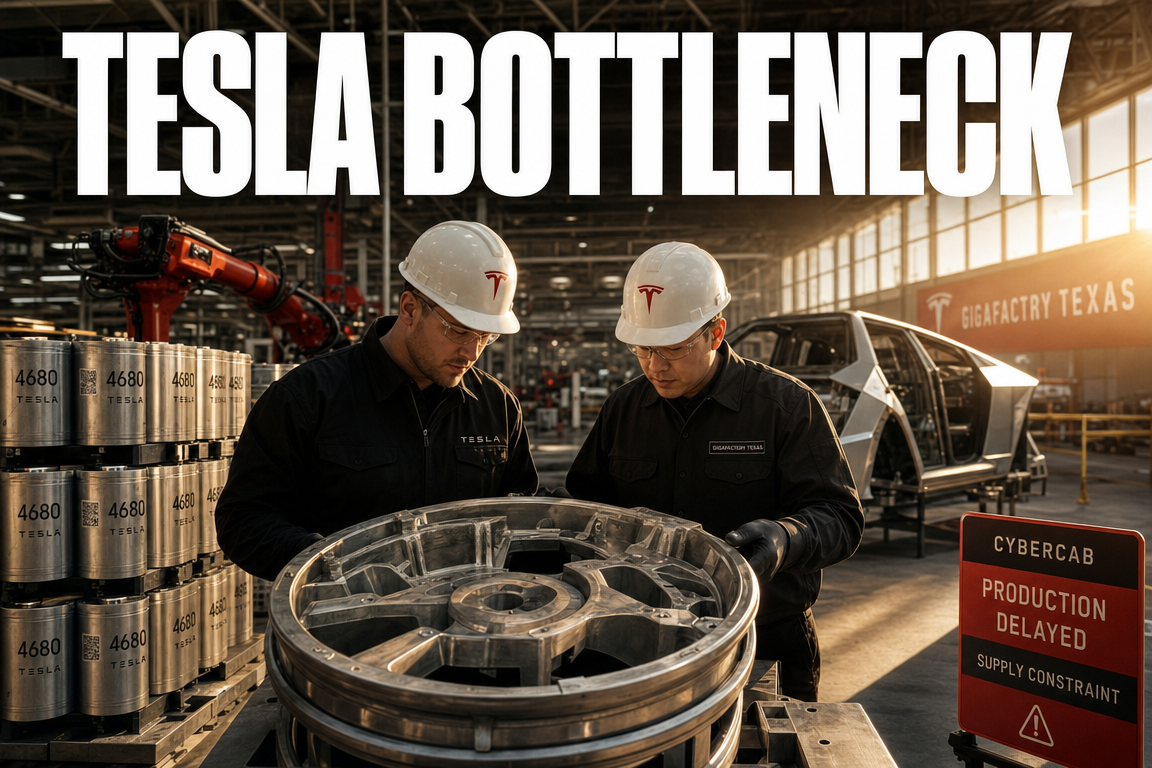
Tesla Falls 4.02% to $402.9; The More Important Issue Is the 4680 Battery Bottleneck
The main point of this Tesla news is not simply that the expected Giga Texas announcement did not happen.
Market expectations centered on a potential Cybercab production expansion announcement, but Tesla’s 216-page Impact Report included substantial discussion of Giga Texas, Cybercab, the 4680 battery, dry electrode manufacturing, a lithium refinery, and vertical integration.
With Tesla shares closing at $402.9, down 4.02%, investors should focus less on near-term disappointment and more on where Tesla is removing production bottlenecks.
For investors tracking the electric vehicle market, autonomy, robotaxis, the 4680 battery, and Tesla’s stock performance, this report contains more substance than a standard ESG document.
1. Market backdrop: weakness extended beyond Tesla
-
The S&P 500 fell 0.45%.
-
The Nasdaq declined 1.16%.
-
The Dow Jones Industrial Average fell 0.25%.
-
Tesla closed at $402.9, down 4.02% on the day.
-
The original source also noted a SpaceX-related stock closing at $149.47, down 6.83%.
The session reflected a general softening in risk appetite.
Tesla’s decline should be viewed in the context of broader weakness in growth stocks, particularly in the Nasdaq.
That said, Tesla had a separate catalyst in play, which likely amplified the market’s disappointment.
2. Why investors expected a Giga Texas announcement
The expectation was triggered by comments from Lars Moravy, Tesla’s Vice President of Engineering.
In a podcast, he said that interesting news would be shared around Giga Texas scaling on July 7.
That remark fueled market speculation across several areas:
-
A Cybercab production-line expansion announcement.
-
Specific Giga Texas capacity increase figures.
-
More detail on monthly production targets or ramp timing.
-
Potential updates on Optimus, robotaxi, or autonomy-related production plans.
The expectation supported Tesla’s short-term share price performance.
According to the source, Tesla shares rose as much as 6.69% at one point on the back of that anticipation.
However, the actual release was not a major production update but the 2025 Impact Report.
3. The key point: the expected Giga Texas announcement did not materialize
Investors were looking for concrete production numbers.
Examples would include monthly Cybercab output, a multi-fold expansion at Giga Texas, or a direct statement on 4680 battery production scale.
Instead, Tesla published a report with a sustainability and manufacturing focus.
The Impact Report primarily covered emissions reduction, energy efficiency, production process improvements, and supply chain strategy.
In other words, it was materially different from a product or business launch announcement.
Market reaction split into two views.
-
One view was that the announcement was underwhelming.
-
The other was that the market had overinterpreted Moravy’s comments.
Both interpretations are reasonable.
Given Tesla’s wording, market expectations were naturally elevated.
At the same time, the report did include meaningful information tied to Giga Texas scaling.
4. What matters in the 216-page Impact Report
The report is more substantive than a standard ESG publication.
It included detailed references to Cybercab, 4680 batteries, and Tesla’s vertical integration strategy at Giga Texas.
Investors should focus on the manufacturing strategy embedded in the report rather than on the absence of a standalone product announcement.
5. Cybercab priority 1: RIM process, reducing paint-time from hours to minutes
One of the most notable sections concerns Cybercab’s new coating process.
Tesla said Cybercab will use a RIM, or reaction injection molding, based coating process.
Traditional automotive paint workflows require separate coating and drying steps after the body is assembled.
By contrast, the RIM approach integrates coloring during the molding process.
The implications are significant for three reasons:
-
First, production time is reduced materially.
-
Second, paint-related equipment and process complexity may decline.
-
Third, Tesla said VOC, or volatile organic compound, emissions from traditional paint operations can be eliminated.
As EV competition intensifies, manufacturing simplification is directly linked to margin competitiveness.
For Tesla, Cybercab is less about design and more about low unit cost and fast throughput.
6. Cybercab priority 2: renewed use of gigacasting to increase throughput
Tesla already transformed manufacturing with gigacasting in Model Y.
Gigacasting replaces multiple stamped and welded parts with large single-piece castings.
The same approach is being applied again to Cybercab.
The rationale is straightforward:
-
Fewer parts.
-
Less welding.
-
Shorter assembly time.
-
Lower material waste.
-
Reduced manufacturing cost.
Robotaxis are different from consumer vehicles.
The business model is platform-based and built around fleet-scale deployment, not individual ownership.
For Cybercab, the key variables are production cost and speed, not styling.
7. Cybercab priority 3: 6.1 miles/kWh, a key metric for robotaxi economics
One of the most important figures in the report is Cybercab’s energy efficiency.
Tesla stated that Cybercab can travel 6.1 miles per kWh.
For comparison:
-
Cybercab: 6.1 miles/kWh
-
Tesla Model Y: 4.3 miles/kWh
-
Kia EV6: 3.5 miles/kWh
-
Hyundai Ioniq: 3.5 miles/kWh
-
Ford Mustang Mach-E: 3.4 miles/kWh
-
Volkswagen ID.4: 3.2 miles/kWh
-
Jaguar I-PACE: 2.7 miles/kWh
This metric matters because robotaxi economics depend heavily on energy consumption per mile.
Higher efficiency lowers charging costs.
Lower charging costs improve utilization.
Higher utilization improves revenue potential per vehicle.
As a result, 6.1 miles/kWh is a key input for evaluating Cybercab’s commercial viability.
8. The most important issue in the report may be the 4680 battery
The core focus of the source is the 4680 battery.
Tesla said it is manufacturing the 4680 cell using a dry process.
Conventional battery production relies on slurry application followed by energy-intensive drying in large ovens.
That approach increases energy use, requires larger facilities, and raises cost.
Tesla’s dry electrode process is intended to reduce or eliminate the drying step.
According to the report, the process can reduce greenhouse gas emissions in battery manufacturing by about 70%.
The key point is not the environmental framing.
The real significance is lower cost and faster production.
Batteries remain a major cost driver in EV manufacturing, and Tesla’s long-term valuation is also tied to battery cost competitiveness.
9. Limited Model Y use of 4680 cells, with broader expansion planned
Tesla said 4680 cells began appearing in some 2025 Model Y battery packs.
The company also stated that it is increasing production capacity to eventually deploy 4680 batteries across its full lineup.
This is an important statement.
Within the report, it is one of the clearest references to production ramping, and it appears in the battery section.
That suggests Moravy’s reference to Giga Texas scaling may have been about battery capacity rather than a new Cybercab assembly line announcement.
The market expected a finished-product production update, while Tesla appears to have emphasized battery bottleneck removal.
10. The larger Giga Texas strategy: linking lithium, batteries, assembly, and recycling in Texas
The report also highlights Tesla’s vertical integration strategy.
Tesla is building an EV manufacturing ecosystem centered in Texas.
-
A lithium refinery reduces upstream raw material constraints.
-
In-house cathode processing strengthens the battery supply chain.
-
4680 battery production expansion addresses a core manufacturing bottleneck.
-
Vehicle assembly takes place at Giga Texas.
-
Battery shredding and recycling are incorporated into the same ecosystem.
The source said Tesla’s lithium refinery is designed to be the largest in North America, with a target of 30 GWh of annual lithium production.
If completed as planned, Tesla would move closer to being an integrated manufacturing platform spanning raw materials, batteries, vehicles, and recycling.
That distinction remains an important investment case differentiator versus other EV manufacturers.
11. Three bottlenecks Tesla is trying to remove
Reframed from Tesla’s perspective, the Giga Texas scaling story is about removing three bottlenecks.
① Raw material bottleneck: lithium refinery
Large-scale EV production is often constrained first by raw materials.
Lithium is central to battery manufacturing.
Tesla’s refinery investment is aimed at reducing supply-chain risk.
② Battery bottleneck: 4680 batteries and dry electrode processing
Vehicle output cannot scale without battery availability.
Tesla is pushing 4680 in-house production and dry electrode manufacturing for that reason.
Lower battery cost and higher throughput are necessary to support Model Y, Cybertruck, Cybercab, and future robotaxi volumes.
③ Assembly bottleneck: RIM and gigacasting
Even with sufficient batteries, production cannot scale if assembly remains slow.
Tesla is therefore using RIM coating and gigacasting to simplify downstream manufacturing.
These three elements must progress together for true Giga Texas scaling.
12. Why the stock fell
From an investor perspective, the gap between expectations and reality was substantial.
Tesla’s disclosure was strategically relevant, but it did not contain the kind of direct production metrics that typically move the stock immediately.
The market was looking for:
-
Cybercab launch timing.
-
Specific Giga Texas capacity figures.
-
Monthly 4680 output.
-
Robotaxi geographic expansion.
-
FSD monetization timing.
Instead, Tesla released a 216-page report.
The content was meaningful, but the market had little immediate reason to re-rate the stock on the basis of indirect information.
That helps explain the move back toward the $402 area.
13. Tesla’s communication approach still needs improvement
The main weakness in this episode was communication.
Statements such as “interesting news” naturally increase expectations.
If the outcome is an annual report, investors may view the signal as too vague.
Tesla has historically seen market volatility driven by statements from Elon Musk, executive interviews, and teaser-style messaging.
That approach can generate attention, but repeated ambiguity can reduce credibility.
This matters more now because Tesla is no longer valued purely as an automaker.
The stock reflects AI, autonomy, robotics, energy storage, and robotaxi expectations.
Clearer communication is therefore increasingly important.
14. SpaceX and xAI updates should also be monitored
The source also referenced SpaceX and xAI developments.
It mentioned brand integration activity and the release of a new logo.
It also referred to reports that a first AI model developed with coding-tool company Cursor could launch around July 8, U.S. time.
These claims should be verified independently before any investment conclusion is drawn.
The broader point is that Musk’s ecosystem continues to connect Tesla, SpaceX, xAI, robotics, autonomy, and AI infrastructure.
That is one reason Tesla investors cannot focus solely on vehicle deliveries.
15. Wall Street valuation references for SpaceX highlight the gap between expectations and reality
The source also cited investment bank valuation views on SpaceX.
-
JPMorgan was said to have issued a $225 target by the end of 2027.
-
Raymond James was said to have issued the most aggressive target at $800.
-
Some institutions were said to have taken a neutral view around $131.
The discussion also noted criticism that a $30 trillion market estimate may be overly optimistic.
The same logic applies to Tesla.
A large future market does not automatically mean current valuation is justified.
In AI, autonomy, and space, long-term opportunity is real, but valuation ultimately depends on measurable execution.
16. The most important point not emphasized elsewhere
The key issue in this event is not the absence of a headline announcement.
It is that Tesla showed progress on bottleneck removal before scale.
Most investors focus on how many Cybercabs can be produced and when.
Tesla’s sequence is different:
-
Secure raw materials first.
-
Then expand 4680 battery production.
-
Use dry electrode manufacturing to reduce cost and emissions.
-
Use RIM and gigacasting to increase assembly throughput.
-
Then scale Cybercab and robotaxi production.
In that sense, the report describes the operating structure required to create future results rather than the results themselves.
Understanding that distinction changes how the report should be read.
It was disappointing for short-term traders, but important for long-term manufacturing competitiveness.
17. What Tesla shareholders should monitor next
Tesla shareholders do not need to interpret the decline as a structural setback.
However, a purely optimistic reading would also be premature.
Key items to monitor include:
-
How quickly 4680 production volumes increase.
-
Whether dry electrode manufacturing works reliably at scale.
-
Whether Cybercab maintains its reported 6.1 miles/kWh efficiency in production.
-
Whether RIM coating translates into lower manufacturing costs.
-
Whether Giga Texas vertical integration improves margins.
-
Whether Tesla provides explicit production numbers in future updates.
Tesla’s share price is unlikely to advance indefinitely on expectations alone.
The market is increasingly demanding evidence in the form of revenue, margins, output, and cost reduction.
18. Final assessment
The lack of a headline Giga Texas announcement was a negative near-term event.
Given Moravy’s comments, Tesla should improve how it frames expectations.
However, the 216-page Impact Report still gave a clear view of Tesla’s long-term manufacturing strategy.
Cybercab is being designed for lower unit cost through RIM coating and gigacasting.
The 6.1 miles/kWh efficiency figure is relevant to robotaxi economics.
The 4680 battery and dry electrode process remain central to Tesla’s cost structure.
Giga Texas is evolving into a vertically integrated ecosystem spanning lithium, batteries, vehicle assembly, and recycling.
As a result, the report should not be dismissed as non-material.
The market did not get the announcement it expected, but the document did clarify the strategic direction Tesla is pursuing.
< Summary >
Tesla closed at $402.9, down 4.02%.
The expected large-scale Giga Texas production announcement did not materialize.
Instead, Tesla released a 216-page Impact Report.
The report covered Cybercab’s RIM coating process, gigacasting, and 6.1 miles/kWh efficiency.
The most important themes were the 4680 battery, dry electrode manufacturing, and Tesla’s Giga Texas vertical integration strategy.
Near-term disappointment was offset by evidence that Tesla is working to reduce raw material, battery, and assembly bottlenecks.
Going forward, 4680 production expansion, Cybercab launch timing, and robotaxi monetization are likely to remain the key variables for Tesla’s stock.
[Related Articles…]
*Source: [ 오늘의 테슬라 뉴스 ]
– 예고했던 기가텍사스 발표, 결국 없었습니다 $402 테슬라 주주는?
● Debt-Driven Rally
Stocks Have Risen, but the Reality Is Debt-Financed Consumption: The 2026 Outlook in a Higher-Rate Era
The main point of this article is not simply that stocks have risen.
The key issue is whether a meaningful share of that advance has been supported by government debt, fiscal spending, and liquidity expectations rather than underlying economic strength.
As the low-rate era ends and a prolonged medium-rate environment becomes more likely, the price of money is changing materially.
When assessing the outlook, investors should focus not only on equity markets but also on policy rates, U.S. Treasury yields, government debt, inflation, and whether AI is delivering measurable productivity gains.
In simple terms, the market resembles a person looking well dressed in a luxury bag.
The risk is that the bag was not paid for in cash, but with borrowed money.
1. The Uncomfortable Reality Behind the Latest Global Equity Rally
Global equities have shown resilience despite multiple headwinds.
AI investment enthusiasm, expectations for rate cuts, hopes for a U.S. soft landing, and stronger earnings from large-cap technology companies have supported the advance.
The central question, however, is whether this reflects genuine economic strength or an asset-price effect driven by debt and fiscal spending.
-
First, when governments spend aggressively, the economy can appear stronger in the short term.
Higher fiscal outlays can lift corporate revenues, support employment, and sustain consumption.
Equities often respond positively in that environment.
-
Second, the risk increases when that spending is financed through borrowing rather than taxes.
Rapid debt accumulation may be manageable initially, but it eventually feeds through to higher bond issuance and larger interest burdens.
In effect, current demand is being funded by future income.
-
Third, higher stock prices do not necessarily imply stronger economic fundamentals.
Markets may welcome rising asset values, but weaker fiscal conditions can increase longer-term risk.
This can produce a debt-driven rally that looks healthy on the surface while becoming more fragile underneath.
2. Why the “Luxury Bag Bought on Debt” Analogy Is Appropriate
The most compelling metaphor in the original text is that stocks have risen, but the luxury bag may have been purchased with debt.
This captures the structural challenge facing the global economy.
-
The luxury bag represents visible equity gains.
This includes higher indices, stronger asset prices, and improved investor sentiment.
-
The debt represents government borrowing and fiscal deficits.
Governments have relied on bond issuance to support growth and cushion economic weakness.
-
The critical issue is the interest cost.
In a low-rate environment, leverage was relatively manageable.
In a medium-rate environment, the financing burden rises materially.
In other words, borrowing was easier to sustain when rates were near zero.
That is no longer the case.
Higher funding costs make debt-led policy less effective than in the previous cycle.
3. France as a Signal of Emerging Fiscal Strain
The original text refers to France as a relevant example.
France has long been associated with expansive fiscal policy.
Public spending, welfare commitments, and social safety nets have been maintained at elevated levels.
However, when the government signals a shift toward fiscal restraint, political resistance rises quickly.
The public has already become accustomed to expansionary policy.
In practical terms, the broader system adapts to continued government support.
-
Expansionary fiscal policy is attractive at first.
Public spending can soften downturns and reduce near-term social pressure.
-
Austerity is politically difficult.
Spending cuts often imply lower benefits, higher taxes, or reduced public services.
-
As a result, fiscal normalization is much harder than it sounds.
Debt reduction requires distributing the cost to groups that have benefited from the existing structure.
The France case is not only a European political issue.
It may be relevant for the U.S., Japan, Europe, and Korea as well.
When debt is elevated and rates remain high, fiscal policy flexibility narrows sharply.
4. The Core Meaning of the Shift from Low Rates to Medium Rates
The most important change is that the low-rate era has effectively ended.
Following the 2008 global financial crisis, the world became accustomed to low borrowing costs.
Leverage was cheap, asset prices rose more easily, and both companies and governments found it easier to borrow.
Conditions changed after COVID-19.
Inflation surged, and the Federal Reserve raised policy rates sharply.
Even if rate cuts begin, a return to near-zero rates is increasingly unlikely.
-
A medium-rate environment means capital is more expensive.
Loan rates, corporate bond yields, sovereign yields, and real estate financing costs all rise relative to the past cycle.
-
The neutral rate may also be higher than before.
If the economy now requires a higher rate to remain in balance, monetary policy must adjust accordingly.
-
FOMC rate cuts do not necessarily mean a return to the old low-rate regime.
The Fed may ease, but not to the depth or speed markets once expected.
The key question is therefore not simply when rates will fall, but how far they can fall.
Using the zero-rate environment as a benchmark for asset valuation would be a mistake.
5. Why U.S. Treasury Yields Matter
U.S. Treasury yields are the benchmark for the global financial system.
When Treasury yields rise, the discount rate used across asset classes increases.
That lowers the present value of equities and real estate.
-
Rising U.S. government debt increases bond supply.
Higher supply can require investors to demand higher yields.
-
Higher Treasury yields also increase the government’s interest burden.
As interest costs rise, additional issuance may be required, adding further pressure to yields.
-
If this cycle continues, confidence in fiscal sustainability can weaken.
Markets begin to ask whether the debt trajectory remains manageable.
The U.S. benefits from dollar reserve status and therefore has more fiscal capacity than most countries.
However, reserve currency status does not eliminate financing costs.
Even the U.S. must consider the limits of debt expansion in a higher-rate environment.
6. Inflation Has Not Ended; Its Structure Has Changed
Many investors still view inflation only through the headline CPI lens.
The more important issue is the structure of inflation.
Globalization previously helped suppress prices.
Cheap labor in China and other emerging markets, global supply chains, and free trade all reduced goods inflation.
Today, the forces are moving in the opposite direction.
-
U.S.-China strategic competition is reshaping supply chains.
Companies are increasingly prioritizing security and resilience over pure cost minimization.
-
De-globalization and geoeconomic fragmentation are raising costs.
Production is moving toward safer, more domestic, and less efficient structures.
-
Middle East conflict and energy risk continue to support inflation pressure.
Oil, natural gas, and shipping disruptions can quickly reintroduce price volatility.
Inflation should therefore be analyzed beyond the business cycle.
Investors must also consider war, strategic rivalry, supply chains, energy markets, and industrial policy.
That is the essence of a high-cost era.
7. What Investors Should Watch in the Fed and FOMC Outlook
Markets often focus on the timing of Fed rate cuts.
The more important issue is the Fed’s assessment of the new equilibrium rate.
This is one reason figures such as Kevin Warsh continue to attract attention in monetary policy debates.
Fed policy is not only about rate decisions; it is also about how the U.S. economy’s long-term structure is being interpreted.
-
If the Fed remains concerned about inflation, rate cuts may be limited.
Policy easing is difficult if policymakers believe price stability has not yet been secured.
-
Large fiscal deficits increase pressure on monetary policy.
When government spending remains elevated, the Fed may need to stay more cautious.
-
A higher neutral rate is a major variable for asset markets.
If the floor for rates is structurally higher than before, equity valuations must be reassessed.
A rate cut does not automatically imply a sustained rally in risk assets.
What matters is the size, pace, and policy rationale behind the move.
8. Why AI May Be the Only Meaningful Offsetting Force
If debt is high, rates are elevated, and inflation pressure remains, the economy needs higher productivity to maintain resilience.
That is where AI becomes important.
AI is not only a technology theme; it may be a productivity tool that helps offset a higher-cost environment.
-
AI can change corporate cost structures.
Automation in repetitive work, customer support, analytics, and software development can improve efficiency.
-
If AI productivity translates into earnings, equity support becomes stronger.
Valuations need to be backed by real revenue growth and cost reduction, not just expectations.
-
If AI lifts economy-wide productivity, debt burdens become more manageable.
Higher growth can offset the drag from higher interest costs.
There are, however, important risks.
AI infrastructure requires substantial capital spending, while power grids and semiconductor supply chains are also under pressure.
The key question for 2026 is whether AI becomes a genuine productivity regime shift or another investment bubble.
9. The Most Important Point Often Missing in Market Coverage
Most headlines emphasize higher stock prices, expected rate cuts, and the AI rally.
The more important issue is the fiscal structure behind those moves.
-
First, the recent equity rally has benefited significantly from liquidity and fiscal support.
Corporate earnings alone do not fully explain the move.
Government spending and rate-cut expectations have played a major role in supporting asset prices.
-
Second, government debt is no longer a background variable.
In the past, low rates made rising debt appear manageable.
Today, Treasury yields and fiscal sustainability are central market variables.
-
Third, fiscal tightening is as much a political issue as an economic one.
Reducing spending requires absorbing public resistance.
As the France example shows, fiscal normalization can quickly become a political risk.
-
Fourth, investors should not rely on rate-cut expectations alone.
In a medium-rate environment, even easing may not restore the conditions of the last cycle.
The valuation reference point has changed.
-
Fifth, AI is either a structural solution or a speculative excess.
If AI materially improves productivity, it can help offset higher rates and debt burdens.
If not, the AI rally could resemble a debt-financed luxury purchase.
10. Key Checkpoints for Investors and Professionals
Investors should look beyond headline equity indices such as the KOSPI, Nasdaq, and S&P 500.
The underlying flow of money matters more.
-
Track the U.S. 10-year Treasury yield.
Lower long-term yields are generally supportive for growth and technology stocks.
Rising long-term yields can compress valuations.
-
Focus on the neutral-rate debate, not only the policy-rate path.
The likely endpoint for rates is more important than the next cut.
-
Monitor government debt and fiscal deficits across major economies.
Countries with weaker fiscal positions are more vulnerable when rates stay high.
-
Assess structural inflation risks.
Energy, food, supply chains, and geopolitical conflict remain relevant.
-
Evaluate AI by productivity impact, not only by revenue growth.
The key question is whether AI is improving operating margins and overall efficiency.
11. Core Scenarios for the 2026 Outlook
The 2026 outlook can be framed in three broad scenarios.
-
Positive scenario: AI productivity spreads and rates ease gradually
AI improves corporate productivity, inflation remains contained, and the Fed lowers rates in a measured way.
In this case, equities could continue to rise on earnings support.
-
Base scenario: medium rates persist and growth remains modest
Rates decline, but not back to prior lows, while debt burdens remain elevated.
Equities may still advance, but sector divergence is likely to remain pronounced.
-
Negative scenario: fiscal stress and renewed upward pressure on Treasury yields
Bond supply rises, inflation reaccelerates, and U.S. Treasury yields move higher again.
In that case, equities, bonds, and property could all experience higher volatility.
The central issue is not whether the economy appears strong, but whether that strength is durable.
Growth, employment, and stock prices should be assessed together with debt costs and fiscal capacity.
12. Conclusion: The Era of Free Money Is Over
Over the past decade, the global economy benefited from low rates and abundant liquidity.
Governments borrowed more easily, companies financed themselves cheaply, and investors enjoyed rising asset prices.
That environment has changed.
As the world moves from a low-rate regime to a medium-rate regime, the burden of debt is becoming more visible.
Investors should not assume that higher stock prices alone justify confidence.
The key question is whether the rally is supported by productivity, AI-driven efficiency, or simply by government debt and fiscal spending.
The new hierarchy of wealth will be shaped by rates.
And the direction of rates will depend largely on inflation, government debt, Treasury yields, monetary policy, and AI productivity.
What matters more than a visible luxury bag is the cash flow that can actually pay for it.
The same applies to the economy.
What matters more than stock prices is the real strength behind them.
< Summary >
The current equity rally has been supported in part by expansionary fiscal policy and rising debt in some economies.
As the low-rate era ends and a medium-rate environment emerges, government debt and interest costs are becoming central risks.
The France case shows that fiscal tightening can become a political issue rather than only an economic one.
U.S. Treasury yields, policy rates, inflation, fiscal deficits, and AI productivity will be the main variables shaping the 2026 outlook.
AI may become a meaningful offset if it produces real productivity gains, but it could also become another bubble if expectations run ahead of execution.
Going forward, investors should focus less on headline gains and more on the fiscal and productivity foundations that support them.
[Related Articles…]
*Source: [ 경제 읽어주는 남자(김광석TV) ]
– 주가는 올랐지만, 사실 빚으로 산 명품백입니다 #경읽남 #경제읽어주는남자 #경제전망 #북리뷰 #머니쇼크