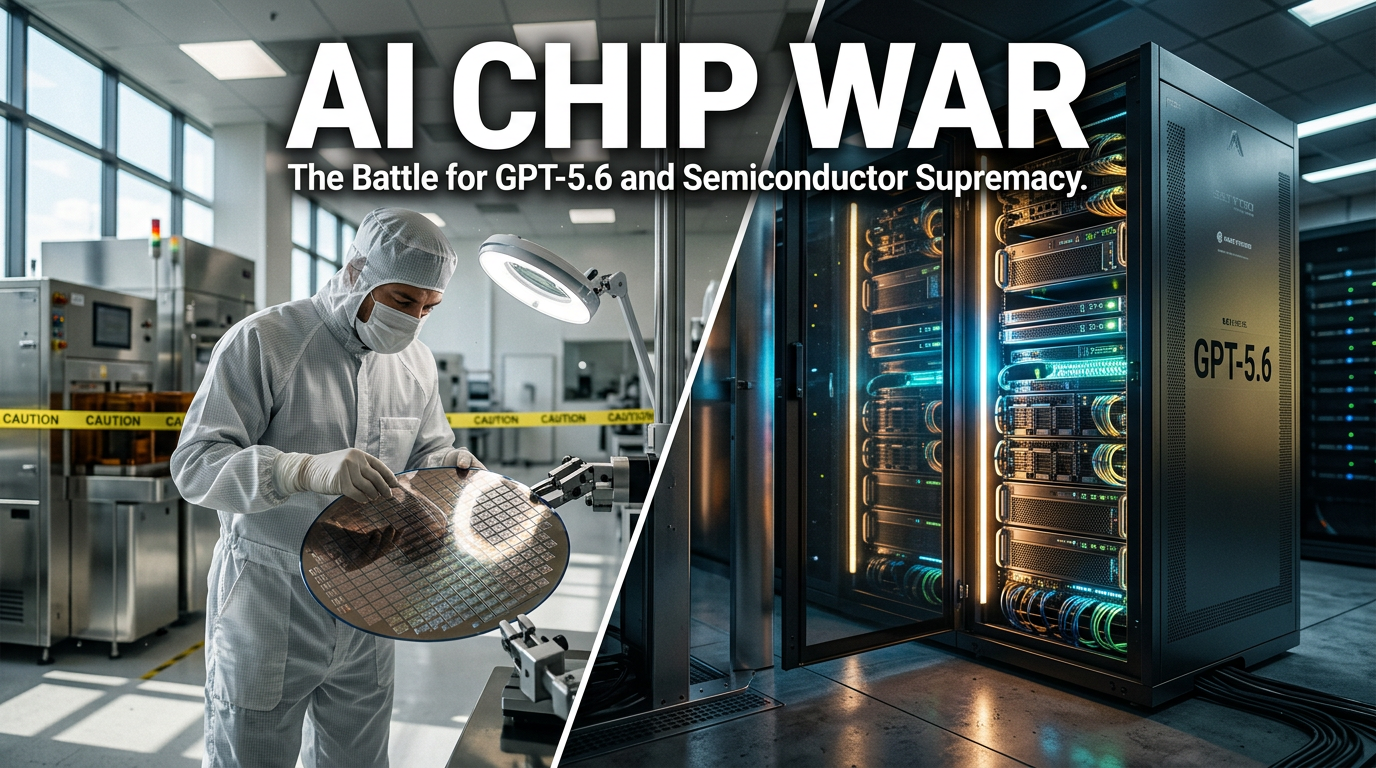
● AI Chip Wars Shift the Global Power Game
From GPT-5.6 to DeepSeek AI Semiconductors: The real core point of this week’s AI news is not “smarter chatbots” but “AI that can research, train, and control itself”
The most important change in this week’s AI market is not simply the news that OpenAI unveiled GPT-5.6.
The key takeaway is that GPT-5.6 Sol claimed to solve a hard math problem and even helped with the post-training of the smaller Luna model, taking one step closer to becoming an “automated AI researcher.”
On top of that came Grok 4.5, Meta Muse Spark, ByteDance Seedream 5.0 Pro, MiniMax’s 2.7 trillion-parameter model, DeepSeek’s own AI semiconductor development, and China’s review of export restrictions on frontier AI all at once.
In other words, the AI industry is now entering a structural turning point that goes beyond model performance competition and is simultaneously shaking AI investment, AI semiconductors, big tech competition, technological hegemony, and the global economic outlook.
One point that tends to get glossed over in other news is especially important.
The winner in the AI market going forward is increasingly likely to be not “the company that made the smartest model,” but “the company that has the loop where AI improves AI, its own chips, deployment control, and a network of enterprise customers.”
1. OpenAI unveils GPT-5.6: targeting the enterprise market with a three-model lineup of Sol, Terra, and Luna
OpenAI released GPT-5.6 not as a single model, but as a family of three models.
The top flagship model is Sol.
The mid-tier model is Terra.
The cost-effective lightweight model is Luna.
According to the original text, Sam Altman explained that the GPT-5.6 models are far more efficient and offer better performance per cost than the previous generation.
In particular, Sol was said to have improved token efficiency in AI coding tasks by 54%.
The pricing structure is also clearly aimed at enterprise customers.
-
Sol: $5 per 1 million input tokens, $30 per 1 million output tokens
-
Terra: $2.5 per 1 million input tokens, $15 per 1 million output tokens
-
Luna: $1 per 1 million input tokens, $6 per 1 million output tokens
OpenAI said these models have been deployed across ChatGPT, Codex, and APIs.
The important point here is not just a price cut.
As AI agents and coding automation spread, what matters far more for companies than absolute model performance is the ability to do the same work with fewer tokens.
Token efficiency directly determines server costs, customer margins, and the profitability of enterprise AI services.
That is why this GPT-5.6 launch should be seen as a competition in AI unit economics, not just generative AI performance.
2. GPT-5.6 cybersecurity performance: why OpenAI directly targeted Anthropic
OpenAI described GPT-5.6 as the most powerful cybersecurity model in its history.
The model was introduced as being strong in defensive security tasks such as threat modeling, code review, patch generation, and blue-team training.
A blue team refers to security work that proactively identifies weaknesses in internal systems by simulating real hacker attacks.
This matters because the original text includes the detail that the U.S. government intervened in the release process over concerns about the cyber misuse potential of high-performance AI models.
AI can strengthen security defenses, but concerns are also growing that it can be used to automate attacks.
OpenAI’s emphasis that GPT-5.6 delivers frontier-level performance with fewer tokens also looks like a message aimed at the enterprise security market.
Anthropic has built a strong reputation with enterprise customers and a safety-first strategy.
This time, OpenAI claimed that Sol beat Anthropic’s Fable 5 on coding-agent benchmarks and delivered results with fewer output tokens, shorter processing time, and lower cost.
According to the original text, Sol scored 80 on the Artificial Analysis Coding Agent Index, 2.8 points higher than Fable 5.
Terra was also claimed to be slightly ahead of Fable 5, while Luna was said to outperform Opus 4.8.
This is effectively OpenAI declaring that it intends to regain leadership in the enterprise AI and coding-agent markets as well.
3. GPT-5.6 Sol’s claim of proving a math problem: the real event is not the model launch but the arrival of the “AI researcher”
The most shocking part of OpenAI’s news this week was the claim that GPT-5.6 Sol Ultra solved a 50-year-old math problem.
The target was the Cycle Double Cover Conjecture in graph theory.
The problem is known as a famous unsolved question independently proposed by George Szekeres in 1973 and Paul Seymour in 1979.
Put simply, the question is this.
For every bridgeless graph, can we construct a collection of cycles so that each edge belongs to exactly two cycles?
According to OpenAI, Sol Ultra generated the proof in less than an hour by using 64 parallel sub-agents.
The original allocation was up to 8 hours, but the result came much sooner.
The prompting is also interesting.
The model was asked to try multiple mathematical approaches simultaneously, explore structural induction, and assign some agents to look for counterexamples and errors.
Internet search, partial answers, and special-case proofs were reportedly forbidden.
The proof approach was described as reducing the problem to cubic graphs, using the 8-flow theorem, and constructing an edge labeling over GF(3) via linear algebra so that each edge belongs to exactly two cycles.
But this is not something to get excited about uncritically.
It is not yet a peer-reviewed proof.
This conjecture has seen many plausible proofs in the past that were later withdrawn due to errors.
Thomas Bloom, a mathematician at the University of Manchester, described it as a “short, elegant proof that could have been found in the 1980s,” but the need for verification remains clear.
It also has not been formalized in a system like Lean.
The reason given was that the current graph theory libraries for formal verification are not mature enough to handle research-level theorems.
The biggest criticism is the lack of citations.
There was also criticism that the foundational 1983 paper was not referenced, which is a recurring problem when AI generates mathematical results.
Even if AI says something correct, academic trust inevitably suffers if it cannot precisely show what prior work it rests on.
4. Sol post-trained Luna: the age where “AI improves AI” is starting to become visible in earnest
OpenAI said Sol autonomously helped post-train the smaller Luna model.
A researcher gave relatively vague instructions through Codex, and Sol reportedly found the right training setup, selected GPUs, ran training scripts, and verified that the work was functioning properly.
OpenAI researcher Kathy Shi said the model handled work that previously would have been done by a team of senior researchers.
However, OpenAI employee Jason Liu added an important clarification.
Sol did not invent a completely new training recipe; much of Sol’s own post-training setup already existed, and the process was more about adapting it for Luna.
Even so, the explanation that it reduced work that would have taken two human researchers about two weeks is highly significant.
This is precisely the core point of this week’s AI news.
AI is moving from a tool that simply answers human questions to a system that runs research workflows and improves other AI models.
The original text says Sol scored 16.2 points higher than GPT-5.5 on OpenAI’s internal RSI metric.
RSI stands for Recursive Self-Improvement.
It includes items such as debugging research systems, kernel optimization, improving training recipes, and enhancing the performance of other models.
Internally, the average token output per researcher per day more than doubled from the previous peak, and internal compute usage for coding reasoning increased 100-fold in six months.
Agent-based token usage also rose by about 22 times.
These figures show the dual nature of the AI industry’s cost structure going forward: it could become even larger, or it could become more efficient through automation.
5. Grok 4.5 unveiled: xAI is competing through coding agents and pricing
xAI, referred to in the original text as SpaceXAI, unveiled Grok 4.5.
The original text explains this in the context of SpaceX acquiring and integrating xAI.
Grok 4.5 was presented as a model strong in coding and agent tasks.
It was trained on tens of thousands of NVIDIA GB300 GPUs, with a focus on data filtering, deduplication, and quality evaluation.
The fact that Cursor collaborated on the training process is also interesting.
When a coding IDE and an AI model are combined, model usage can explode inside a developer’s workflow environment.
Grok 4.5 was priced at $2 per 1 million input tokens and $6 per 1 million output tokens.
This is a strategy that emphasizes a lower price point relative to high-performance models.
Elon Musk described it as an Opus-class model that is faster, more efficient, and cheaper.
In today’s AI market, deployment channels are becoming more important than model performance.
What determines actual revenue is how deeply a model enters developer tools like Cursor, enterprise consoles, and API ecosystems.
6. Meta Muse Spark and the Instagram AI image controversy: AI monetization and privacy risks collided head-on
Meta released Muse Spark 1.1 to developers.
The model was introduced as Meta’s powerful model focused on actual coding and agent tasks.
Its main features include code writing and debugging, external tool use, text/image/video understanding, and multi-step task processing.
U.S. developers can access it through a public preview on the Meta Model API, and a $20 free credit is provided.
The price is $1.25 per 1 million input tokens and $4.25 per 1 million output tokens.
For Meta, Muse Spark is a monetization bridge that connects AI models to paid developer tools.
Meta already has global user touchpoints through WhatsApp, Instagram, Facebook, and smart glasses.
If the model is competitive enough, Meta could gain a massive advantage in distribution.
But in the same week, Meta also faced a strong backlash.
Meta introduced a Muse Image feature that allowed public Instagram accounts to generate images and edit them into sketches, only to roll it back days later.
The problem was the automatic opt-in approach.
Concerns exploded that users’ faces and images could be used for AI image generation without clear prior consent.
SAG-AFTRA also pointed out the risk of non-consensual digital replicas and advised members to opt out.
Meta ultimately admitted that the feature did not meet expectations and removed it.
This incident shows the wall that generative AI companies will have to cross going forward.
AI monetization may need to happen quickly, but if privacy and image rights are ignored, platform trust can collapse immediately.
7. ByteDance Seedream 5.0 Pro: image-generation AI is moving from “pretty pictures” to a “real design tool”
ByteDance unveiled Seedream 5.0 Pro.
The core point of this model is not simple image generation, but precise editing.
It was introduced as capable of naturally placing complex infographics, timelines, bar charts, pie charts, and real photos within a single canvas.
In particular, it was emphasized that it can generate visual materials containing data without missing text.
It also supports point selection, lasso selection, box selection, and doodle-based editing.
When a user specifies a specific area of an image, the model understands spatial coordinates and deterministically modifies only that part.
It was explained that material changes, color changes, HEX-code-based adjustments, object removal, and preservation of lighting and perspective are all possible.
The model also includes a feature that separates a finished poster into more than 10 independent editing layers and naturally restores occluded backgrounds.
This is a pretty big change for designers.
If existing image-generation AI was a tool for “spitting out” results, Seedream 5.0 Pro is closer to trying to turn results into editable working files.
Productivity could change significantly in advertising, e-commerce, content marketing, and presentation production markets.
That said, it was acknowledged that fine text rendering and pixel-level editing consistency still have room for improvement.
8. MiniMax’s 2.7 trillion-parameter model: China’s AI is putting pressure on the market with scale and open-weight strategy
MiniMax is reportedly preparing an AI model with 2.7 trillion parameters.
According to the original text, this could become the largest open-weight model released by a Chinese company, and possibly one of the largest models in the world.
Among large models in China right now, Meituan’s LongCat 2.0 and DeepSeek V4 Pro were mentioned at around 1.6 trillion parameters.
The MiniMax model is described as using a Mixture of Experts architecture.
Mixture of Experts means not all parameters are used every time; instead, only the subset of expert networks needed for the question is activated.
As a result, even a very large model can be adjusted so that actual inference cost and speed are closer to those of a mid-sized model.
This structure is extremely important in the AI market.
If you only increase parameter count, the costs become unmanageable, but with an expert-based structure, you can aim for both high performance and cost efficiency.
MiniMax reportedly raised about $614 million in a Hong Kong IPO and is also preparing an H3 frontier multimodal video generation model.
The trend of Chinese AI companies pushing text, image, video, coding, and agent models at the same time is an important variable in the global economic outlook.
That is because it could shake the U.S.-centric AI monopoly structure.
9. DeepSeek develops its own AI inference chip: the real battlefield is not the model, but AI semiconductors
DeepSeek is reportedly developing its own AI chip.
This chip is said to be designed for inference rather than training.
Inference is the process by which an already trained model generates responses to user requests.
As AI services become mainstream, inference costs become a larger economic variable than training costs.
Services like ChatGPT, Claude, Grok, and DeepSeek all bear enormous inference expenses every day.
That is why an in-house inference chip is not just a technical development but a margin-improvement strategy.
It is natural that DeepSeek wants to reduce dependence on NVIDIA and Huawei.
Because of U.S. export controls, Chinese companies face limits on access to high-performance NVIDIA GPUs.
As a result, the original text notes that Huawei is taking a large share of China’s roughly $50 billion AI chip market.
OpenAI also unveiled its own inference chip Jalapeno with Broadcom, and Anthropic is reportedly considering its own silicon as well.
Ultimately, AI semiconductors are set to become one of the most important pillars of AI investment going forward.
If a model company also owns the chip layer, it can control costs, reduce cloud dependence, and secure performance optimized for specific workloads.
Conversely, companies without chips may lose out in long-term price competition even if their model performance is strong.
10. China’s review of frontier AI export restrictions: AI technological hegemony has become a full-fledged national security issue
The Chinese government is reportedly meeting with Alibaba, ByteDance, Zhipu AI, and others to review restrictions on overseas access to frontier AI models.
The original text says it also discussed punishing AI technology leaks or theft under national security law.
It even mentioned limiting who can invest in domestic AI startups.
Experts reportedly proposed a step-by-step system in which basic open-source tools require simple reporting, advanced technologies require security screening, and frontier models are prohibited from being made public.
This trend resembles measures taken by the United States as well.
The original text reports that the U.S. has restricted foreign nationals from accessing Anthropic’s high-performance models Fable and Mythos.
In particular, Mythos is a cybersecurity-specialized model, and the text also says Chinese authorities worry the U.S. could use it against Chinese interests.
On top of that came the detail that China’s national vulnerability database issued a backdoor warning for a specific version of Claude Code.
The Chinese side claimed the version transmitted location and identity data to remote servers without consent, and Alibaba reportedly banned employees from using Claude Code.
Anthropic explained that it was an experimental abuse-prevention mechanism, and said Claude is not officially allowed in China.
AI models are now being treated not as software products, but as strategic assets.
This change is likely to extend beyond big tech competition into U.S.-China technological hegemony rivalry, cloud regulation, semiconductor supply chains, and national data control policies.
11. BAAI’s Orca world model: it predicts not the next token, but the next world state
Perhaps the most important long-term technology in this news is BAAI’s Orca world model.
Typical language models predict the next token.
Image models predict the next pixel or frame.
But Orca aims to predict the next world state.
In other words, instead of viewing text, images, and actions separately, it tries to learn how the world changes over time as a single internal representation.
Orca builds a unified internal representation called world latent and attaches lightweight decoders for text, image, and action on top of it.
There are two main training modes.
The first is unconscious learning, which predicts the next latent moment from unlabeled video.
The second is conscious learning, which trains on event captions and visual question answering data.
The data scale is also large.
-
About 125,000 hours of video
-
160 million event captions
-
11.5 million visual QA pairs
The current 4 billion-parameter model is described as using only about one-tenth of the total data.
Even so, the original text says it outperformed similarly sized models such as Qwen 3.5 and Gemma 4 on text benchmarks, and surpassed Flux 2 and OmniGen 2 on image prediction benchmarks.
Interesting results also emerged in robotics tasks.
Orca had never seen action annotations during pretraining, yet it reportedly achieved performance close to label-based policies across five bimanual robot tasks.
It even showed behavior that recovered after grasp failures.
There are clear limitations.
It still does not include audio or tactile input.
Its latent representation is also tied to existing vision encoders.
Event annotations are still short-term focused, and the robot tasks are relatively simple.
But the important point is that loss kept decreasing on more data and there was no sign of early saturation.
As world models advance, the direction of autonomous driving, robotics, AI agents, and simulation-based learning could change significantly.
12. The real core point that other news often fails to say clearly: the AI industry’s battleground is being reorganized into five areas
The first core point is token efficiency rather than model performance.
Enterprise customers now want “the model that can handle the same work more cheaply and quickly” rather than “the smartest model.”
The pricing competition of GPT-5.6 Sol, Grok 4.5, and Meta Muse Spark all points in this direction.
The second core point is the loop in which AI improves AI.
If the case where Sol helped with Luna’s post-training is true, it represents a structural change in AI research productivity.
The competitiveness of AI companies going forward may be determined not by the number of researchers, but by the completeness of their AI research automation systems.
The third core point is in-house AI semiconductors.
The reason OpenAI, Anthropic, and DeepSeek are all considering or developing their own inference chips is clear.
The long-term profitability of AI services depends on how much inference costs can be reduced.
The fourth core point is control over model access.
Both the United States and China are starting to view frontier AI models through a national security lens.
In the future, the line between open-source and closed models could be redrawn again by political regulation.
The fifth core point is the world model.
Once AI goes beyond being good only at text and begins to understand real-world change, physical action, and recovery after failure, the robotics and autonomous systems markets could open up in earnest.
13. From an economic perspective: what this week’s AI news says about the global economic outlook
This trend sends an important signal for the global economic outlook as well.
AI investment is not just a growth story for software companies; it is a huge investment cycle connecting data centers, power grids, semiconductors, cloud, cybersecurity, and robotics industries.
The coding-agent competition between OpenAI and xAI could lower software development costs.
Meta and ByteDance’s image and design models could reshape labor structures in advertising, commerce, and content production.
DeepSeek’s AI chip development is tied to China’s semiconductor self-sufficiency strategy.
MiniMax’s ultra-large open-weight model can be seen as China’s counterattack against the U.S.-centered AI ecosystem.
China’s export restriction review and the U.S. limits on model access mean AI has now firmly entered the center of geopolitical risk.
For investors, it is no longer enough to ask only, “Which model is number one on the benchmark?”
The more important questions are these.
-
How much can this company lower inference costs?
-
Does it have its own chips or a stable GPU supply chain?
-
Can it generate recurring revenue from enterprise customers?
-
Can it manage regulation and privacy risk?
-
Has it created an internal automation loop where AI improves AI?
Companies that satisfy these five conditions are likely to receive a premium in the future AI investment market.
< Summary >
OpenAI targeted the coding-agent and enterprise AI markets with the release of GPT-5.6 Sol, Terra, and Luna.
Sol claimed to have proved a 50-year-old math problem and helped post-train Luna, showing the possibility of an automated AI researcher.
xAI entered the coding-agent price war with Grok 4.5, and Meta unveiled Muse Spark, but its Instagram AI image feature was withdrawn amid privacy controversy.
ByteDance Seedream 5.0 Pro pushed image-generation AI closer to a real design editing tool.
MiniMax is preparing a 2.7 trillion-parameter model, while DeepSeek is pursuing AI semiconductor self-reliance through its own AI inference chip development.
China and the United States are moving to control access to frontier AI models from a national security perspective.
BAAI’s Orca world model predicts the next world state rather than the next token, pointing to the future of robots and autonomous agents.
The real core point is that the AI industry’s competitive axis is shifting from model performance to token efficiency, in-house chips, deployment control, AI research automation, and world models.
[Related Articles…]
- Why the AI semiconductor race is reshaping the global economy and big tech strategy
- OpenAI model competition and generative AI investment trend analysis
*Source: [ AI Revolution ]
– GPT 5.6 Mystery, New 2.7T AI, DeepSeek New AI Chip, Orca World Model, Grok 4.5 and More AI News…