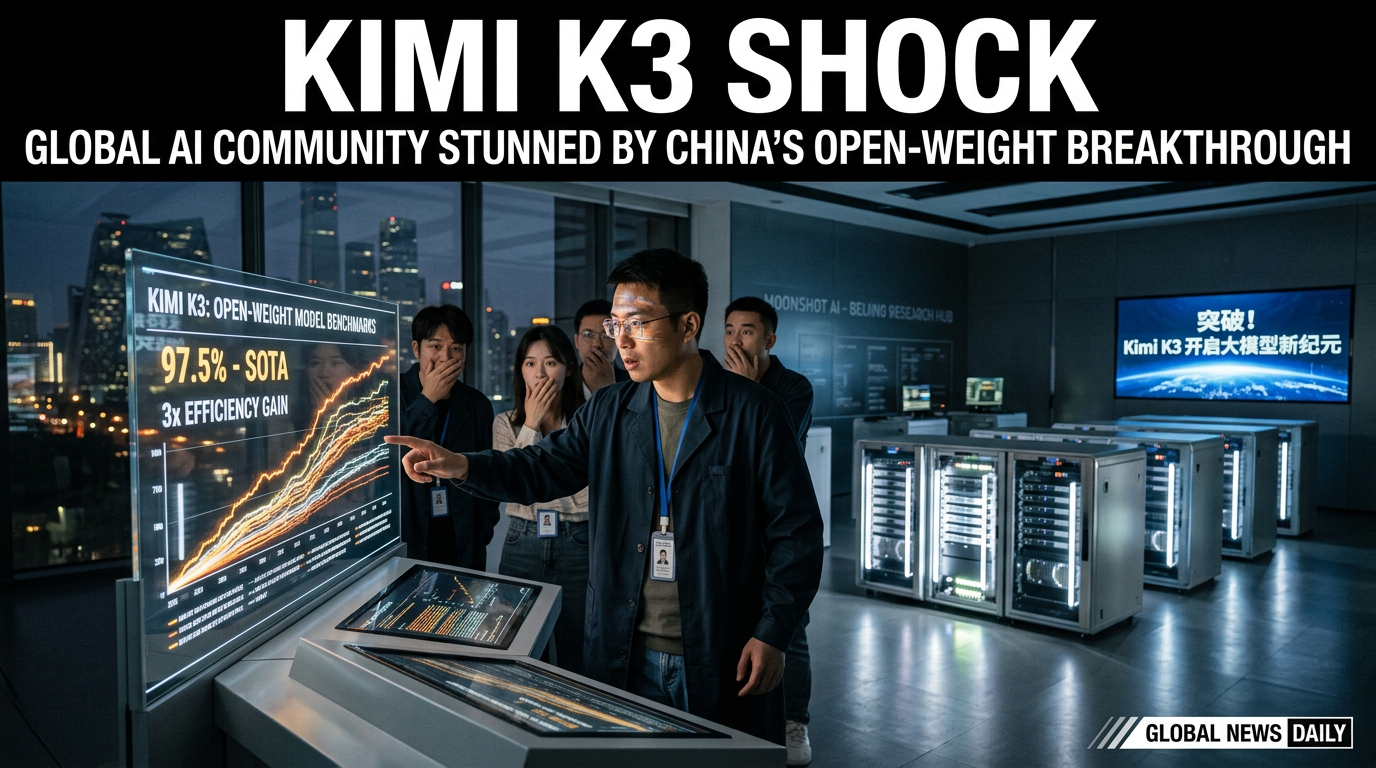
● Kimi K3 Shock
China’s Moonshot AI Unveils ‘Kimi K3’: Why It Could Be the Biggest AI Shock Since DeepSeek
The core point of this issue is not simply that “China built a large AI model.”
Kimi K3 was unveiled as one of the world’s largest open-weight AI models, and in some coding tests it was even evaluated as outperforming top U.S. closed AI models.
On top of that, Chinese President Xi Jinping also delivered a message in Shanghai that “China will not follow the AI rules set by the United States, and will create a new global AI order,” turning this announcement from a technology story into a major event connected to U.S.-China tech supremacy, AI semiconductors, global economic outlook, tech stock investing, and open-source AI.
For companies in particular, the question “Do we really need to pay expensive fees to OpenAI or Anthropic?” has started to reappear.
That is exactly why Kimi K3 is being seen as the most important Chinese AI event since DeepSeek R1.
1. Event overview: China’s Moonshot AI announces the world’s largest open-weight model, ‘Kimi K3’
China’s Moonshot AI has unveiled a new frontier AI model, Kimi K3.
According to the source text, Kimi K3 is a model with 2.8 trillion parameters, introduced as the largest publicly disclosed open-weight AI model.
Moonshot emphasized that Kimi K3 is the first open model to approach 3 trillion parameters.
The full model weights are scheduled to be released on July 27.
Once the weights are released, companies and research institutions will be able not only to use the model inside Moonshot’s app, but also download, modify, and operate it on their own infrastructure.
- Model name: Kimi K3
- Developer: Moonshot AI
- Country: China
- Parameter size: 2.8 trillion
- Model type: Open-weight AI model
- Main target: Agentic coding, long-horizon projects, complex knowledge work
- Key takeaway: A signal that Chinese open-source AI has come close to U.S. closed models
What matters here is not just the scale, but the performance.
Kimi K3 is not just a “large model”; the source says it ranked highly in coding evaluations used by real developers, and in some areas it reportedly scored higher than U.S. models.
2. Why it is called a “Chinese DeepSeek moment”
When DeepSeek R1 first shook the market, the core shock was that “China achieved performance close to top U.S. models at far lower cost.”
At the time, major volatility hit U.S. tech stocks and AI-related stocks, and some estimates suggested that around $1 trillion in market capitalization moved across major Big Tech shares.
Kimi K3 is being described as a model that could expand that shock one step further.
- DeepSeek R1: An event in which Chinese AI pressured U.S. models through cost efficiency
- Kimi K3: An event in which Chinese AI simultaneously delivered open-weight architecture, massive scale, coding performance, and price competitiveness
The strongest question raised in the source is this.
“If open models can perform this well, why should companies keep paying premium prices for U.S. closed AI models?”
That single question alone could put significant pressure on the U.S. AI ecosystem, including OpenAI, Anthropic, Google, and Microsoft.
3. Performance comparison: Has Kimi K3 really caught up with U.S. models?
According to the source, Moonshot claimed that Kimi K3 can compete with Anthropic’s Fable 5 and outperformed some Claude Opus 4.8, GPT 5.5, and GPT 5.6 models in demanding coding work.
The model names here follow the source text, and external verification will still be needed.
In the independent Artificial Analysis intelligence index mentioned in the source, Kimi K3 was reported to have scored 57 points.
Claude Opus 4.8 was mentioned at around 56 points, GPT 5.6 series at 55 points, and Gemini 3.1 Pro at a level similar to Kimi K3.
According to the source, only Claude Fable 5 and GPT 5.6 Soul were ahead of Kimi K3, and even that gap was said to be only 2 to 3 points.
| Category | Evaluation in the source | Key takeaway |
|---|---|---|
| Kimi K3 | Artificial Analysis intelligence index: 57 points | Close to top U.S. closed models |
| Claude Opus 4.8 | Around 56 points | Described as lower than Kimi K3 |
| GPT 5.6 series | Around 55 points, or some top models slightly ahead of Kimi K3 | The small gap is what matters |
| Gemini 3.1 Pro | Similar level to Kimi K3 | A signal that the Chinese model has entered the global top tier |
In the past, open-source AI models were widely seen as lagging closed models by 6 to 12 months.
More recently, Chinese AI models were often described as being 3 to 6 months behind the U.S.
But after Kimi K3, people even began saying, “Now it may not be 6 months behind, but 6 days behind.”
That phrase is exaggerated, but it captures market sentiment very well.
4. Number one in coding evaluations: The area where Kimi K3 stood out most strongly
The area that drew the most attention for Kimi K3 was frontend development and web development evaluations.
In Arena.ai’s frontend code arena, Kimi K3 was introduced as taking first place with 1,679 points.
Claude Fable 5 was mentioned at 1,631 points, and GPT 5.6 Soul at 1,618 points.
The source said Kimi K3 took first place in 6 out of 7 evaluation areas.
- Kimi K3: 1,679 points
- Claude Fable 5: 1,631 points
- GPT 5.6 Soul: 1,618 points
What matters especially is that it performed strongly in brand marketing work, data dashboards, and web interface building.
Moonshot’s earlier model, Kimi K2.6, ranked 18th, but Kimi K3 jumped 17 places in just one generation to reach number one.
A leap like that suggests not just improvement, but the possibility that the model architecture and training method changed substantially.
The Arena CEO was also quoted in the source as saying Kimi K3 could become the biggest AI release of the year.
It was also suggested that China may have pulled ahead of the U.S. in at least some parts of model competition.
5. The real purpose of Kimi K3: Not a chatbot, but an AI agent that works for a long time
Kimi K3 is not simply a chatbot that answers questions and stops there.
Moonshot designed Kimi K3 as a model optimized for long-duration work, especially software development.
The model was built to inspect large codebases, create plans, use tools, edit code, check results, and then improve again.
- Large codebase analysis
- Project planning
- Use of external tools
- Code writing and modification
- Result verification
- Revisions after identifying problems
- Long-horizon work lasting several hours or more
This structure aligns exactly with the direction of AI agents that companies want today.
Companies now want not just “AI that answers well,” but “AI that finishes the job.”
Kimi K3 was introduced as a model with strength in precisely that area.
6. “Vision in the Loop”: A method where AI sees and fixes the result itself
One of Kimi K3’s important features is what Moonshot calls Vision in the Loop.
In simple terms, after AI writes code, it directly looks at the rendered result, judges what is wrong, and edits the code again.
This function is especially important for websites, games, design tools, animations, and dashboard creation.
For example, a typical coding AI can usually tell whether “the code syntax is correct.”
But it is easy to miss problems such as buttons appearing in the wrong place on the screen, awkward colors, or unnatural animations.
Kimi K3 was designed to repeatedly improve its own work by reviewing the rendered output again.
This is a highly meaningful change for real business use.
That is because frontend developers, designers, and marketers do not need to manually review screenshots and provide feedback every time; AI can inspect and revise the output on its own.
7. Public demos: Games, rocket simulations, emulators, and GPU code optimization
The demos Moonshot 공개ed show Kimi K3’s direction very clearly.
According to the source, Kimi K3 created a 3D open-world game inside the browser.
During this process, it used Three.js, JS WebGPU, and GPU compute, and also generated horse and rider characters using external tools.
- Browser-based 3D open-world game creation
- Graphics implementation based on Three.js and WebGPU
- Character generation using external tools
- Creation of a simulation for China’s Long March 10 rocket
- Development of a Game Boy Advance emulator
- Cutting computation time by more than half after 15 hours of GPU code improvement
- Building a small GPU compiler called Mini Triton from scratch
- Designing a chip architecture that could operate for 48 hours using open-source engineering tools
- Reproducing astrophysics analysis in about 2 hours
In the astrophysics example in particular, it was said to have reviewed more than 20 papers and written over 3,000 lines of Python code.
Moonshot claimed Kimi K3 completed in about 2 hours a task that a skilled team would usually need 1 to 2 weeks to finish.
Of course, since these are examples released by the company itself, outside verification is necessary.
But the direction is clear.
Kimi K3 is not a model that answers once and ends; it aims to be an AI that continues working through difficult tasks all afternoon, overnight, or for several days.
8. 1 million token context: Processing long documents and massive codebases at once
Kimi K3 was introduced as being able to handle up to 1 million tokens in a single session.
That can be roughly described as about 750,000 words.
A context length of this scale is extremely useful for handling large codebases, long reports, bundles of research papers, project histories, legal documents, and internal corporate manuals all at once.
One common reason AI models fail in long-horizon work is that they forget what was read earlier or lose the overall context.
Because Kimi K3 is designed to maintain long context, it can be strong in complex project management and enterprise knowledge work.
The source also says it processes not only text but images and video in the same model.
Moonshot also stated that Kimi K3 edited its own promotional video using 56 clips.
The Kimi Work platform is also adding interactive widgets and dashboard functions, suggesting a move away from a simple chat window toward a persistent work environment.
9. Technical structure: A MoE model that activates only 16 of 896 experts
Kimi K3 uses a Mixture of Experts, or MoE, architecture.
Simply put, the model contains many specialized sub-teams, and instead of activating all of them for each question, it only activates the necessary subset of experts.
Kimi K3 reportedly has 896 total experts, with only 16 experts activated at a time.
This approach improves efficiency by avoiding the need to use the entire model every time, even while building a massive 2.8 trillion parameter system.
- Total number of experts: 896
- Experts activated simultaneously: 16
- Advantage: Pursues both massive model scale and computational efficiency
Moonshot also said it applied technologies called Kimi Delta Attention and Attention Residuals.
These technologies are described as systems that retain information longer in long tasks and reduce context loss during long-term reasoning.
Combined with a new training method, Moonshot claimed Kimi K3 achieved about 2.5 times more efficient scaling than Kimi K2.
10. Hardware requirements: Open, but not easy for everyone to run at home
Kimi K3 is an open-weight model, but that does not mean it is easy to run on a personal laptop.
According to the source, Moonshot recommended a system with at least 64 AI accelerators.
Training and inference were said to use low-precision formats such as MXFP4 weights and MXFP8 activations.
This helps reduce hardware burden, but it still requires substantial computing resources.
There was even a joke in the community that “all you need are 2 TB of VRAM, several Mac Studios, massive storage, and infinite patience.”
In other words, Kimi K3 is an open model, but not a small one.
It is less like a model for casual home use and more like a model that large enterprises, cloud providers, research institutions, and government agencies can run on their own infrastructure.
But that is exactly why it matters.
For large companies spending millions of dollars a month on AI, being able to run Kimi K3 on their own servers, customize it with internal data, and maintain data security becomes a very attractive option.
11. Price competitiveness: A structure that pressures U.S. frontier models
Kimi K3’s pricing was also presented very aggressively.
According to the source, Kimi K3 was introduced at $3 per 1 million uncached input tokens, $0.30 per 1 million cached input tokens, and $15 per 1 million output tokens.
It was explained that the price remains the same even for long contexts.
| Model | Input token price | Output token price | Meaning |
|---|---|---|---|
| Kimi K3 | $3 per 1 million tokens | $15 per 1 million tokens | Aggressive pricing versus frontier models |
| Kimi K3 cached input | $0.30 per 1 million tokens | – | Cost savings for repeated tasks |
| Fable 5 | Around $10 | Around $50 | Described as more expensive than Kimi K3 |
| GPT 5.6 Soul | Around $0.50 | Around $30 | Input is cheap, but output is described as more expensive than Kimi K3 |
Kimi K3 became about 5 times more expensive than earlier Kimi models, but compared with U.S. frontier models, it is still aggressively priced.
In particular, the low output token price can make a major difference in workloads that generate long outputs, such as coding, report writing, and automated agents.
Moonshot said Kimi K3 was launched by default in its maximum reasoning effort mode, with a cheaper mode to be offered later.
This can be seen as a strategy of first offering high-performance premium models to enterprise customers and then expanding a cost-efficient lineup afterward.
12. There are weaknesses too: controllability and reasoning log issues are variables
Kimi K3 is not a perfect model in every area.
Moonshot also acknowledged some weaknesses.
It explained that performance can drop if the agent system does not return the full reasoning record.
It also said that Kimi K3 can make decisions on its own when instructions are ambiguous.
- Performance may decline if reasoning logs are missing
- If instructions are ambiguous, the AI may make arbitrary judgments
- For tasks requiring strict control, clear rules are essential
- Overall user experience may still lag some top U.S. models
This is very important for enterprise adoption.
That is because when AI autonomously edits code or operates systems, even a small decision error can lead to cost losses or security issues.
So to use a long-horizon AI agent like Kimi K3, you need clear policies, log management, access restrictions, and human review systems alongside it.
13. Immediate impact on the Chinese AI industry
After Kimi K3 was announced, the stock prices of Chinese AI competitors reacted immediately.
According to the source, in the Hong Kong market JIEPU fell 21.9%, and MiniMax fell 13.8%.
Investors seem to have judged that Kimi K3 is not just a new product, but a model that could shake the competitive landscape of Chinese AI.
This reaction is quite important from a tech stock investing perspective.
As AI model competition accelerates, the valuations of individual AI startups move more sensitively.
That is because if a bigger, cheaper, and better-performing model appears overnight, the competitiveness of existing companies can be re-evaluated.
The source said MiniMax is preparing a 2.7 trillion parameter model and the frontier multimodal model H3 sometime in Q3 2026.
Meituan’s LongCat 2.0 and DeepSeek V4 Pro were mentioned at around 1.6 trillion parameters.
In China, several research labs and companies are already developing models that exceed 1 trillion parameters.
14. China’s AI ecosystem: It is not just Moonshot’s story
Kimi K3 is not an isolated event.
Chinese AI models are moving in a direction of becoming faster, cheaper, and more powerful.
The source mentions that Z.AI’s GLM 5.2 surprised analysts by coming close to U.S. closed models.
DeepSeek continues to evolve, and MiniMax is also preparing larger models.
- Moonshot AI: Kimi K3 unveiled
- DeepSeek: Continued model upgrades after R1
- MiniMax: Preparing a 2.7 trillion parameter model and H3
- Z.AI: Gaining attention with GLM 5.2
- Meituan: Developing LongCat 2.0
Moonshot is said to receive support from Alibaba and Tencent.
According to Bloomberg reporting, the source also included a plan to raise $2 billion at a valuation of about $30 billion ahead of a Hong Kong listing.
If that level of funding support is real, Kimi K3 should be seen not as a one-off model, but as part of a long-term AI strategy backed by Chinese Big Tech capital.
15. Distillation controversy: A new political issue in AI competition
One of the controversies surrounding Kimi K3 is model distillation.
The source explains that Anthropic previously raised allegations that Moonshot, DeepSeek, and MiniMax had used Claude’s capabilities through rule-violating distillation methods.
Model distillation is a technique that uses one model’s outputs or judgments to train another model.
Technically it is a common method, but once service terms, intellectual property, and national security issues are involved, it becomes highly sensitive.
Some U.S. officials also view certain distillation approaches as hostile technology acquisition.
By contrast, critics point out that U.S. AI companies also grew by training on vast amounts of publicly available internet data, so complaining when other companies learn from their models is contradictory.
Once Kimi K3’s weights are released, this debate may intensify.
In the future, copied capabilities, scraped data, export controls, AI semiconductor restrictions, and national security issues may all come into focus at once.
16. Xi Jinping’s message: China wants to be the side that makes the AI rules, not just follows them
Almost at the same time as the Kimi K3 announcement, Chinese President Xi Jinping emphasized a new, China-centered AI order at the World Artificial Intelligence Conference in Shanghai.
He described open-source AI as a rare and historic opportunity and warned that inequality in AI access could create new historical injustice.
He also compared AI to the invention of the steam engine and electricity, presenting developing countries with an alternative to U.S.-style closed models.
- Low-cost open technology
- Chinese-style AI education and training
- Chinese expert networks
- Greater participation by developing countries in AI governance
- An alternative to the U.S.-centered AI order
China is promoting the World AI Cooperation Organization, or WICO, and the source says 29 countries were participating the day before Xi’s speech.
China described this as an important milestone in AI history.
It also proposed building cooperation centers and training programs with BRICS, ASEAN, Latin America, and the African Union.
This is interpreted as a direct challenge to the U.S.-backed PAX Silica concept.
The United States is moving to strengthen AI infrastructure, semiconductor supply chains, critical minerals, and allied-ecosystem-based technology networks.
In response, China is putting forward the frame that it will “move with the Global South through open models and low-cost technology.”
17. China’s strategy to seize the lead in AI safety as well
An interesting point is that China did not emphasize open AI alone; it also emphasized AI safety.
Xi said AI must remain under human control and mentioned the need for early-warning systems, emergency plans, and defenses against situations where autonomous systems escape human supervision.
China is currently positioning itself with two images at once.
- First: A leader in open technology that provides powerful AI cheaply to the world
- Second: A governance leader responsible for AI safety and global standards
This strategy is highly political.
When the U.S. says “Chinese AI is dangerous,” China can respond, “We offer openness and safety at the same time.”
The AI supremacy competition is now moving beyond model performance and into competition over international norms.
18. The timing of the World Artificial Intelligence Conference and the U.S.-China AI talks
The World Artificial Intelligence Conference in Shanghai was described in the source as taking place from July 17 to July 20.
Attendees included major Chinese tech companies, UN Secretary-General António Guterres, the President of Kazakhstan, and the Prime Minister of Thailand.
The event is also important because it takes place just before the first U.S.-China government-level AI talks under President Donald Trump.
At a recent UN AI meeting, the U.S. side argued that excessive regulation could slow innovation.
China, meanwhile, emphasized that low-cost open models can reduce the global technology gap.
Now China has brought a concrete example in the form of Kimi K3.
It is no longer at the stage of merely saying, “Someday we will build a competitive open AI ecosystem,” but of actually presenting a model capable of competing with top U.S. models.
19. The most important change for companies: AI cost structure is being shaken again
For companies, the most important part of the Kimi K3 announcement is the cost structure.
AI adoption costs are not just about API fees.
They also include data security, model customization, long-context processing, integration with internal systems, and cloud dependency.
Using closed AI models lets you start quickly, but your data may move to external platforms and become dependent on pricing policies.
In contrast, open-weight models like Kimi K3 have higher initial infrastructure costs, but can bring long-term cost savings for companies with large-scale usage.
- Large enterprises can operate the model on their own servers
- Sensitive data does not need to be sent to external APIs
- Industry-specific model tuning becomes possible
- Long-term API cost savings may be possible
- Dependency on cloud and model vendors may be reduced
The value of open-weight models may become even greater in industries where data security is critical, such as finance, manufacturing, pharmaceuticals, defense, and public institutions.
This trend is also an important variable in the global economic outlook.
AI infrastructure investment will grow, AI semiconductor demand will keep rising, and the pricing power of closed AI service providers may be challenged.
20. Investment perspective: Who is pressured, and who gains opportunities?
When models like Kimi K3 proliferate, the first companies under pressure are those offering expensive closed AI APIs.
Of course, OpenAI, Anthropic, and Google still have strengths in brand, ecosystem, user experience, stability, and enterprise support.
But if the performance gap narrows and price differences widen, customers gain more bargaining power.
On the other hand, there are also areas that could benefit.
- AI semiconductor companies: Growing demand to run massive open models
- Data center companies: Increased demand for building in-house AI infrastructure
- Cloud providers: Growth in the open-weight model hosting market
- AI security companies: Increased demand for agent control, log management, and model safety verification
- Enterprise AI consulting: More open-model adoption and customization projects
By contrast, companies that merely say “we also have an AI chatbot” can quickly lose competitiveness.
As AI model performance rapidly converges, differentiation shifts away from the model itself and toward data, workflows, industry-specific application ability, and cost optimization.
21. The real core point that is easy to miss in other coverage
First, the core point of Kimi K3 is not “China built a large model,” but that it could change the logic by which companies buy AI.
Once enterprise customers begin to abandon the idea that they must use only closed models, the pricing structure of the AI market can be shaken.
Second, open-weight does not automatically mean democratization.
Kimi K3 is not a model that individuals can easily run; it is more favorable to players with large-enterprise or national-scale infrastructure.
So while it looks like AI democratization, it may actually increase the power of companies and nations that already have AI infrastructure.
Third, China is using AI models as a diplomatic tool.
China wants to expand its technological influence by offering low-cost open AI to developing countries.
If the past Belt and Road Initiative was about infrastructure, then in the future AI models, data centers, and training programs could play the role of a digital Belt and Road.
Fourth, the AI safety narrative is not a weapon unique to the U.S.
China has entered the competition for global standards by emphasizing openness and safety at the same time.
Going forward, the frame battle between the U.S. and China over AI rules in international organizations is likely to become even more intense.
Fifth, in tech stock investing, “cost curves” are becoming more important than “model performance.”
If models rapidly become similar, the market will focus on who can deploy more cheaply, more stably, and at greater scale.
At that point, open-source AI, AI semiconductors, and the data center supply chain are likely to remain key investment themes.
22. Checkpoints to watch going forward
- Whether the weights are released on July 27: The actual scope of open-weight release and the license terms are important.
- External benchmark validation: We need to see how well Moonshot’s demos match independent evaluations.
- Enterprise adoption cases: It must be confirmed whether large companies actually deploy Kimi K3 on their own infrastructure.
- U.S. government response: Export controls, distillation rules, and national security discussions may intensify.
- Chinese competitor response: Follow-up model announcements from MiniMax, DeepSeek, and Z.AI are likely.
- Price-cut competition: OpenAI, Anthropic, and Google may also adjust API pricing.
- AI infrastructure investment: Demand for data centers, power, cooling, and AI semiconductors may grow further.
< Summary >
Kimi K3 is a massive 2.8 trillion parameter open-weight AI model unveiled by China’s Moonshot AI.
According to the source, it outperformed top U.S. closed AI models in some coding evaluations and ranked first in Arena.ai’s frontend code evaluation.
The model is not just a chatbot, but an AI agent-type model aimed at long-duration coding, tool use, screen inspection, and repeated revisions.
Its core strengths are 1 million token context, multimodal processing, MoE architecture, and aggressive pricing.
However, it is not a model that individuals can easily run; it requires powerful infrastructure at the level of at least 64 AI accelerators.
For companies, what matters is that they gain an option to reduce dependence on closed AI APIs and operate AI on their own infrastructure.
Politically, it aligns with Xi Jinping’s message about reshaping the AI order and marks a new phase in U.S.-China tech supremacy competition.
Going forward, the core of the AI market is likely to shift beyond model performance competition to competition over price, infrastructure, open-weight models, and global standards.
[Related Articles…]
- China’s AI Power Race and the Global Tech Stock Trend
- AI Semiconductor Supply Chain Changes and Data Center Investment Outlook
*Source: [ AI Revolution ]
– Is This the Biggest AI Release of 2026? (China’s New DeepSeek Moment)