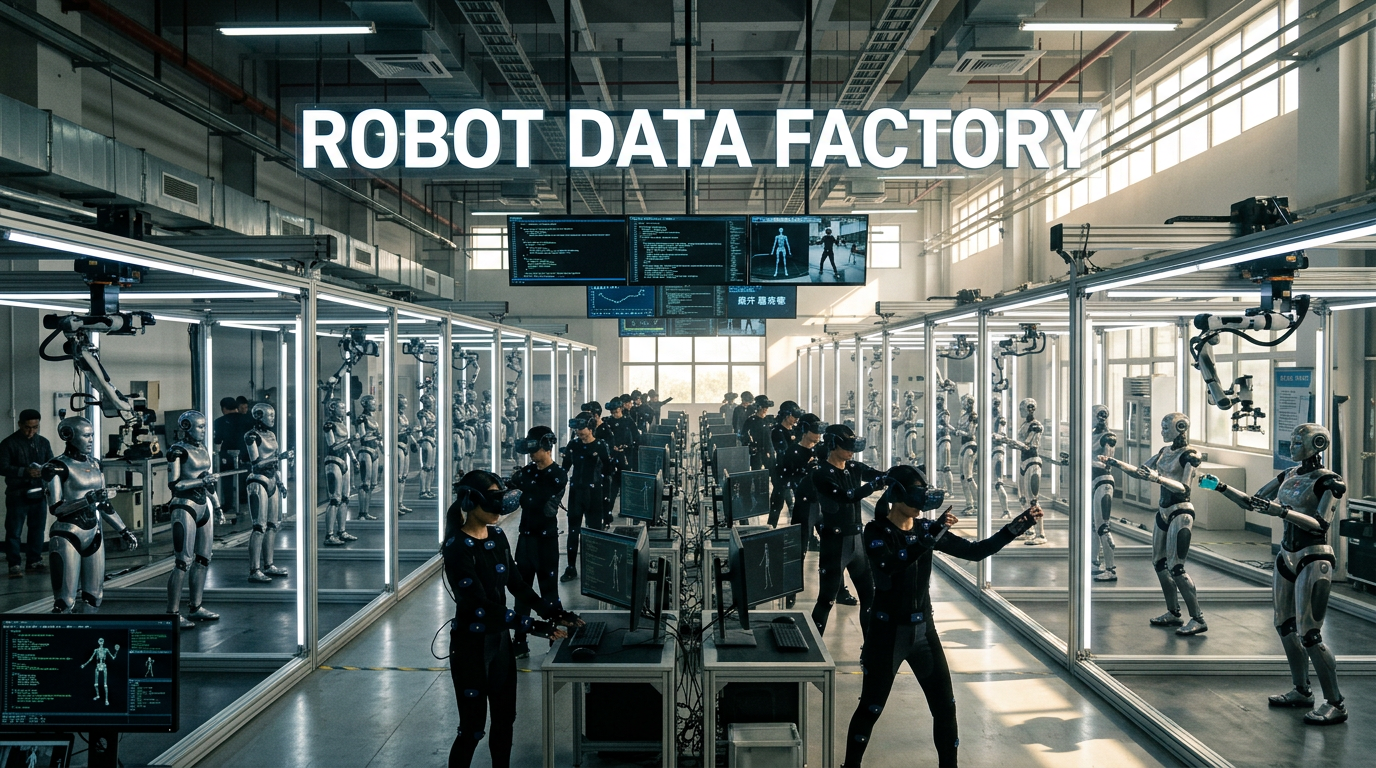
● China Builds Physical AI Data Factories
The Real Secret of Chinese Robots Is Not the ‘Robot’ but the ‘Data Factory’
The core point of China’s humanoid robot competitiveness is not dancing robots or flashy showroom demos.
What really matters is a massive physical AI infrastructure that recreates real-world spaces like kitchens, supermarkets, factories, nursing homes, and orchards, and then has people repeat the same motions thousands of times to generate behavioral data for robots.
In this article, let’s sort out why China is developing robot training grounds as national industrial infrastructure, how human part-time workers are producing data, and why this structure could become a strategy more formidable than the United States in the global economic outlook and AI industry competition.
1. Key News: China Is Not Building a ‘Robot School’ but a ‘Behavior Data Factory’
China does not see humanoid robots as mere manufactured products.
For robots to work in the real world, what they need is not text data, but physical behavioral data such as the force used to grasp a cup, the sequence for straightening clothes, hand motions for sorting items, and the body balance needed to avoid obstacles.
China regards this field as embodied intelligence, in other words, the core of embodied AI or physical AI.
The Chinese government has designated embodied intelligence as a future industry and is building training grounds at the national level where robots can learn in real environments.
In simple terms, if China used to be the world’s factory, now it wants to become the factory that produces both the body of robots and the textbook of robot behavior.
- China is fostering embodied intelligence as a national strategic technology.
- The number of humanoid robot companies is estimated to exceed 150 as of the end of 2025.
- Humanoid robot output is mentioned as rising from about 20,000 units in 2025 to over 40,000 units in just the first half of 2026.
- Annual production in 2026 is being discussed as potentially expanding to more than 100,000 units.
- As of July 2026, there are reportedly 64 robot data collection centers opened by local governments, with 20 more under construction.
This trend is not just a simple technology story.
It is a massive industrial restructuring that connects the AI industry, robot manufacturing, the data economy, supply chains, and investment strategy all at once.
2. The Chinese Government’s Strategy: Designating Robot Training Grounds as National Infrastructure
China does not leave robot training grounds at the level of a private company’s laboratory.
It puts them into government plans and connects local governments, state-owned enterprises, and private robot companies to build an industrial ecosystem.
Based on the original text, China included embodied intelligence training grounds in the first five-year plan in March 2026 as core infrastructure for nurturing future industries.
In June, it announced a special action for humanoid robots and embodied intelligence real-world training.
This includes opening actual sites such as factories, logistics centers, healthcare facilities, and care centers as training spaces, and developing more than 100 high-value work scenarios by the end of 2026.
The National Data Administration also plays an important role.
It is preparing implementation measures for how to collect, standardize, label, and evaluate the quality of the data created in training grounds.
In other words, China is not merely stacking robot datasets; it is trying to manage them as industrial-standard data assets.
- The government has designated embodied intelligence as a future industry.
- Local governments provide training-ground land and subsidies.
- State-owned enterprises handle operations and act as initial buyers.
- Private robot companies handle robot hardware, data production, and on-site operations.
- The National Data Administration manages data standardization and distribution systems.
The reason this structure matters is clear.
The bottleneck in the robot industry is no longer just hardware.
Now, high-quality behavioral data that enables robots to move in the real world has become the key production factor.
3. Major Training Ground Examples: Beijing, Shanghai, and Hangzhou Are Moving Toward Robot Data Hubs
China’s robot training grounds operate somewhat differently from region to region.
But they share a common trait: local governments, state institutions, and robot companies move together.
Beijing Shijingshan Humanoid Robot Data Training Center
The humanoid robot data training center located in Shijingshan, Beijing, is built within an industrial complex operated by a state-owned enterprise.
Private companies participate by providing robot hardware, producing data, supporting training, and cooperating in on-site operations.
Although it is called a training center, its actual operation is closer to a factory.
Trainers work in two shifts, day and night, training robots 24 hours a day.
Beijing Yizhuang Humanoid Robot Innovation Center
The training ground in Yizhuang, Beijing, is directly built and operated by the Beijing Humanoid Robot Innovation Center, a joint venture between a state-owned enterprise and private robot companies.
The English name of this company is known as X-Humanoid.
It is also the company that created Tiangong, mentioned as the world’s first marathon-winning robot.
Shanghai AgiBot Data Collection Center
The AgiBot data collection center in Shanghai is operated by the large Chinese robot company AgiBot, which builds and runs the data production line, while the government supports it.
It is reported that about 200 workers are deployed in shifts to train robots for 17 hours a day.
What is notable here is that robot training grounds are operated not like research labs, but like production lines.
China is mass-producing data for AI model training in a manufacturing style.
4. What Robot Training Grounds Actually Look Like: People Repeat the Same Motions in Kitchen, Supermarket, and Factory Sets
The inside of a robot training ground is a little different from the futuristic laboratory we might imagine.
It is closer to a set dressed up like a supermarket, factory production line, home kitchen, or laundry area.
Here, robot students are matched with human teachers.
One person wears a VR headset and controller and performs work motions.
When the person moves their arm, the robot follows the motion.
Another person sits in front of a computer and monitors the motion process, sensor status, and data quality.
- Cameras mounted on the robot’s head and hands film the work scene.
- Sensors inside the robot record joint angles, speed, force, and tactile information.
- Data staff label the intent, target, and trajectory of the motion.
- Unnecessary movements and failed scenes are filtered out.
- Finally, the data is processed into a learnable behavioral dataset.
The problem is that this process takes a very long time.
Even if data is collected for 8 hours a day, the amount of usable valid data is said to be only about 4 hours.
That is why physical AI data is far more expensive, slower, and harder to produce than ordinary text data.
5. Teaching One Motion Requires Repetition from Hundreds to 10,000 Times
Teaching a robot a single motion such as grasping a cup is not done after showing it just once.
Depending on the task, it must be repeated hundreds or thousands of times.
Precise tasks may require nearly 10,000 data points.
For example, suppose a robot is learning how to pick up and move objects.
If the object’s position, angle, lighting, nearby obstacles, or a person’s movement path changes even slightly, the robot can get confused.
So in the training ground, conditions are deliberately changed.
- The object’s position is changed.
- Lighting conditions are changed.
- A person’s movement path is changed.
- The height or layout of the workbench is adjusted.
- The same task is repeated at various speeds and angles.
Only then can the robot gain the ability not to memorize a specific scene, but to perform its mission even when the situation changes.
It reportedly takes about 7 to 8 days to master one task scene.
Here is the important point.
The goal of the training ground is not to turn a specific robot into a skilled worker.
The real product is standardized behavioral data that can be applied to multiple robots.
6. Robots Are Not Students but ‘Body-Carrying Data Generators’
When many people look at a robot training ground, they imagine a scene where one robot graduates and is sent to a factory.
But the actual structure is a little different.
The robots in the training ground are less like finished workers and more like devices that convert human demonstration motions into training data.
A person operates them, the robot moves, sensors record, and data staff refine the results.
The data created this way is later used to train AI models that will be installed in robots.
Once the trained model is installed back into a robot, the robot can begin attempting the task without direct human control.
In other words, the core asset created in the training ground is not the robot itself, but the data that grows a common brain for robots.
This is the essence of the physical AI industry.
The competitiveness of a humanoid robot company is not determined only by motors, batteries, and joint design.
How much real-world task data can be secured, how cheaply, and how standardized it is can make an even bigger difference.
7. A Recently Rising Method: Instead of Controlling Robots, Companies Collect Human First-Person Video
The VR control method can create high-quality data, but it has major limits in cost and speed.
The trainer must stay next to the robot at all times, and data collected using a specific robot’s joint structure and sensors may not fit other robots as-is.
That is why recently, a method in which people wear cameras and record everyday tasks directly has been rapidly spreading.
People wear cameras on their heads and perform tasks such as cooking, cleaning, laundry, product display, factory work, and deliveries as usual.
The method extracts hand positions, object positions, task sequences, behavioral intent, and three-dimensional relationships from the video.
- Homemakers provide household task videos.
- Factory workers record actual work processes.
- Delivery workers provide movement and delivery motion data.
- Rural workers provide harvesting, sorting, and transporting data.
- Nursing home workers can create caregiving-related behavioral data.
In the United States as well, platform companies such as Instawork and Micro1 are collecting this kind of data.
They buy household videos from homemakers or delivery videos from couriers, process them into datasets, and sell them to robot labs and humanoid companies.
But China is pushing this approach in a much more organized and regionally industrialized way.
8. The JD.com Example: Turning Household Labor into a Regional Data Industry
JD.com, one of China’s three major e-commerce companies, is turning first-person behavioral data collection into a regional industry rather than a personal side job.
It does this by recruiting residents on a large scale with support from Suqian City in Jiangsu Province.
The main recruitment targets are local residents under 50, especially women who stay at home to raise children full-time.
The city and the company jointly operate community hubs and provide simple training to participants.
Participants wear equipment, perform household tasks, and submit the data afterward.
After a first review at the community hub, the data is uploaded to JD’s specialized center.
Factories in Suqian are also used as industrial hubs.
Workers wear camera-equipped devices on their heads at work and perform real tasks to generate data.
JD’s Dedicated Device: Joy EgoCam
For this purpose, JD even developed its own device called Joy EgoCam.
This device is known to be equipped with two high-resolution cameras and an inertial measurement unit.
Because it can capture first-person stereoscopic video, it preserves the three-dimensional relationship between hands and objects more accurately than a regular smartphone.
If this device is distributed to thousands or tens of thousands of people, the effect is enormous.
Tens of thousands of real home layouts, lighting conditions, furniture arrangements, and daily movement paths become data as they are.
This can have much higher practical applicability than clean data made in a laboratory.
- JD has a plan to involve more than 100,000 internal employees in data collection.
- It is also mentioned that up to 500,000 external industry workers may be involved.
- More than 100,000 residents of Suqian City could also participate in data production.
- If plans proceed as expected, it is said that 5 million hours of real work video could be secured within one year.
This is not just about gathering a large number of videos.
China is building a system that transforms everyday human labor into a training asset for physical AI.
9. The Real Power of China’s Data Factories: What Is More Formidable Than Low Wages Is Organizational Capability
China’s strength is not only that labor costs are low.
The real power lies in its ability to bind the government, local cities, state-owned enterprises, private platforms, robot companies, schools, and local residents into one data production system.
According to China’s Ministry of Education, the number of college graduates in 2026 is expected to reach a record 12.7 million.
Trainers at robot training centers are said to be mainly students and graduates who majored in machinery, electronics, and computer science at vocational colleges.
In the case of the Hubei Humanoid Robot Innovation Center, the average age of trainers is said to be 21.
China can incorporate young technical workers, factory workers, homemakers, and local residents into a physical AI data production network.
The United States is structurally disadvantaged in this area.
- In the United States, the unit cost of behavioral data collection is generally mentioned as $25 to $50 per hour of valid video.
- This is roughly the same as or even higher than a day’s wage for a Chinese data collector.
- Daily pay for Chinese data collectors is said to be about 200 to 300 yuan per day.
- On a monthly basis, this is mentioned as roughly 7,000 to 9,000 yuan, or about 1.58 million to 2 million won.
Because of cost issues, U.S. companies are likely to outsource data collection to countries with lower labor costs such as India and Africa.
By contrast, China can directly connect large-scale manpower and manufacturing sites within its own country.
Over the long term, this difference could create a major gap in the training speed and cost structure of robot AI models.
10. The Government Also Creates the Initial Market: The Robot Buyers Are the State and State-Owned Enterprises
China’s public support does not stop at supplying training grounds.
At an early stage when private humanoid demand has not yet fully formed, local governments, training centers, and state-owned enterprises take on the role of initial buyers.
For example, UBTech is mentioned as having supplied humanoid robots worth about 566 million yuan, or roughly 120 billion won, to several data collection centers in Sichuan Province, Jiangxi Province, and elsewhere.
China Mobile is also cited as having ordered robots worth about 124 million yuan, or roughly 24 billion won, from Unitree and AgiBot for research and related purposes.
This structure is very important.
If the government creates initial demand, robot companies can increase production.
As production increases, component costs fall.
More robots can be deployed for training.
More training data accumulates.
AI model performance improves.
Improved robots are then deployed again in real industrial settings.
The deployed robots generate new field data.
This is China’s robot industry flywheel.
11. China’s Supply Chain Advantage: Build Cheaply, Train in Bulk, Improve Quickly
The reason China is formidable is not just data.
The fact that it can source a large portion of key humanoid robot components from domestic supply chains is also crucial.
Motors, reducers, sensors, batteries, controllers, metal processing, and assembly infrastructure are tightly connected within the manufacturing ecosystem.
If robots can be made cheaply and in large quantities, training robots can also be increased quickly.
When training robots increase, more real motion data accumulates.
As data accumulates, models improve, and as models improve, the chance of commercial deployment rises.
In addition, China uses a method in which some of the data produced with public support is released as open source, lowering the learning costs for small and medium-sized robot companies.
This lowers the entry barrier for the entire physical AI ecosystem.
In the end, China is tying together robot hardware, behavioral data, AI models, manufacturing supply chains, public procurement, and local industrial policy into one system.
From the perspective of the global economic outlook, this is not merely technological progress but a competition for the next-generation manufacturing order.
12. The Core Point Other News Rarely Says Clearly: The Winner in Physical AI May Be Determined by ‘Real-World Data Production Capability’ Rather Than Model Performance
Many reports focus on the price of humanoid robots, the number of joints, running speed, or dancing videos.
But the more important question is this.
Who can turn the most real-world scenarios into data the fastest and most cheaply?
In the era of text AI, core data came from internet documents, code, books, papers, and web pages.
But in the era of physical AI, the hand grasping a plate in a kitchen, the hand assembling parts in a factory, the hand arranging products in a supermarket, and the body supporting a person in a nursing home all become data.
This data cannot be scraped from the internet.
It can only be created when real people move in real spaces.
That is why physical AI ultimately becomes an industry that combines the labor market, local communities, manufacturing sites, data standardization, and robot hardware.
China understands this point precisely.
It wants to become not just a country that makes robots well, but a country that industrializes the process of teaching robots.
13. Economic Meaning: Robot Data Factories Are the Starting Point of a New Productivity Revolution
China’s strategy is not only a story about the AI industry.
It can affect manufacturing, logistics, healthcare, care services, distribution, and agriculture all at once.
For robots to work in real-world settings, they must ultimately perform repetitive physical tasks reliably.
Once that capability is secured, productivity innovation can go beyond simple automation.
Humanoid robots are increasingly likely to be deployed in logistics centers facing labor shortages, care industries dealing with rapid aging, manufacturing sites with a lot of repetitive assembly, and factories where hazardous work is common.
- Manufacturing can ease pressure from rising labor costs.
- The logistics industry can accelerate automation of sorting, loading, and transport tasks.
- The retail industry can improve the efficiency of product display and inventory management.
- The care industry can reduce labor burdens by automating support tasks.
- Agriculture can expand the possibility of automating harvesting, sorting, and transporting tasks.
Over the long term, this trend could also affect the reorganization of global supply chains.
If robot labor becomes sufficiently cheap, the 기준 for manufacturing location competition will change.
Rather than moving factories to low-wage countries, strategies that combine robots and AI to raise productivity may become more important.
14. From an Investment Perspective: Look at ‘Data Infrastructure Companies’ Alongside Humanoid Robot Companies
From an investment strategy perspective, looking only at finished humanoid robot companies is not enough.
The physical AI value chain is much broader.
- Humanoid robot manufacturers
- Robot sensor and camera companies
- Reducer, motor, battery, and actuator suppliers
- Data labeling and quality evaluation companies
- First-person video collection platforms
- Robot simulation software companies
- AI model training infrastructure companies
- Industrial automation solution companies
In particular, who secures robot datasets may become an important factor in evaluating company value going forward.
Just as driving data was the core asset in the autonomous driving industry, behavioral data is likely to become the core asset in the humanoid robot industry.
The next competition in the AI industry is expanding beyond larger language models to physical AI models with more real-world behavioral data.
15. There Are Risks Too: Privacy, Labor Exploitation, and Data Quality Problems Follow
China’s data factory strategy is certainly powerful, but the risks are also clear.
The first thing that comes to mind is privacy and surveillance.
Household videos, factory work videos, and nursing home work videos all capture people’s living spaces and work environments as they are.
How this data is anonymized, who owns it, and which companies it is sold to are very sensitive issues.
Another issue is labor exploitation.
A structure in which people repeat the same motion thousands of times or provide long hours of footage for low pay could become a new form of data labor.
Before AI replaces human labor, human labor is being used as a low-wage infrastructure to train AI.
There are also data quality issues.
Collecting a lot of data does not automatically make it good data.
Behavioral intent, object condition, failure causes, and environmental variables must all be properly labeled for the data to lead to real model performance.
Quantitative expansion and quality control are needed at the same time.
16. Final Watch Point: China Wants to Mass-Produce Not Robot Bodies, but ‘Physical Intelligence’
For the past 20 years, China has been the factory that made the world’s products.
Now what China wants to mass-produce is not just robot bodies.
It wants to mass-produce human experience, behavioral patterns, and physical intelligence that make those bodies move.
Manufacturing capability for making robots.
Data factories that train robots.
Policy support from local governments.
Initial procurement by state-owned enterprises.
Large-scale participation from young technical workers and local residents.
And a national data strategy that seeks to standardize all of this.
If all of these are combined, China can occupy a very strong position in the physical AI competition.
In the end, the contest in the humanoid robot market is likely to be decided not by who shows the coolest robot, but by who industrializes real-world behavioral data the fastest.
< Summary >
China is building large-scale robot data training centers across the country to teach humanoid robots.
There, human trainers repeatedly perform the same motions hundreds to thousands of times in kitchen, supermarket, factory, and home-like sets to produce behavioral data.
JD.com is using first-person camera equipment to collect large amounts of real work video from homemakers, factory workers, and local residents.
China’s strength lies not only in low labor costs but also in its ability to organize government, local cities, state-owned enterprises, robot companies, and communities into one system.
The core competitiveness in the physical AI era is likely to be how quickly and cheaply real-world behavioral data can be secured, rather than robot hardware itself.
China is trying to industrialize not only robot bodies, but also the physical intelligence that moves them.
[Related Articles…]
- The Future of the Global Robot Industry Under Physical AI
- AI Supply Chain Restructuring and China’s Robot Investment Strategy
*Source: [ 티타임즈TV ]
– 중국로봇의 비밀은 주방, 마트 세트장의 알바생들