● SpaceX AI Revenue Shock
Musk: “SpaceX AI Revenue Could Surpass Existing Businesses Next Month”
The moment AI revenue begins to rival Starlink, we need to look at how the global economy and industrial landscape could change.
This article covers the explosive growth of SpaceX’s AI business, changes in its Starlink-centered revenue structure, Grok’s training strategy, the concept of space-based AI infrastructure, and the key takeaway that AI-driven communications traffic could grow 1,000-fold over the next five years.
On the surface, this may look like just one statement from Musk, but in reality, it is a major issue that connects U.S. Big Tech competition, AI infrastructure investment, cloud and semiconductor demand, the global telecommunications market, and the debate over the use of internal corporate data.
1. The Core News at a Glance
SpaceX Mentions the Possibility That Its AI Business Could Surpass All Existing Businesses
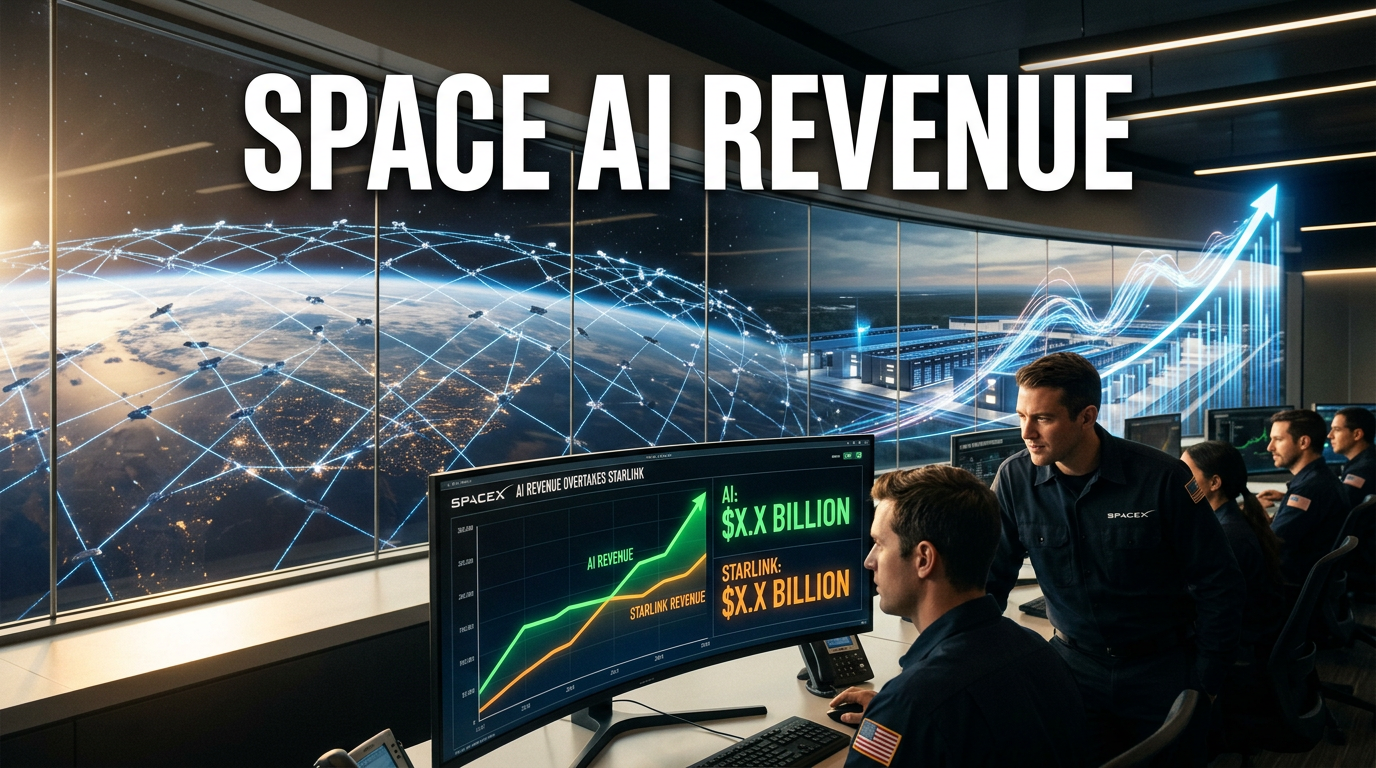
At an all-hands meeting with SpaceX employees, Musk projected that AI business revenue could surpass all existing business revenue as early as next month.This means the AI business could grow faster than the existing revenue structure supported by Starlink and the space business, which has created a considerable shock across the industry.What stands out in particular is that he clearly stated AI revenue would surpass the rest of the business by a “wide margin” in the fourth quarter.
Potential Cracks in the Starlink-Centered Revenue Structure
SpaceX’s largest cash generator today is its communications segment, including Starlink.However, if AI surpasses this pillar in a short period of time, SpaceX could be revalued not merely as a space and telecommunications company, but as an AI platform company.This means the very method of calculating the company’s valuation could change.
A Plan to Train Grok on Internal Information and Even Employee Ideas
Musk said SpaceX would train Grok on the company’s internal information.The even more unconventional part was his statement that employees’ thoughts and ideas would also be reflected in the AI.However, he did not explain what data would be collected, how it would be collected, or how personal information would be handled.
2. SpaceX’s Current Position in Numbers
Second-Quarter Revenue of $7.8 Billion, Up 92% Year Over Year
SpaceX’s total revenue reached $7.8 billion in the second quarter, showing extremely rapid growth.That figure represents a 92% increase from the same period a year earlier, meaning that in terms of growth speed alone, SpaceX is already outperforming many technology companies.
Communications Segment Revenue of $4.29 Billion, Accounting for More Than Half
Revenue from the communications segment, including Starlink, came in at $4.29 billion.Because this is a core business that accounts for more than half of total revenue, AI surpassing it should be viewed as a structural transition.
AI Segment Revenue of $2.56 Billion, Already Catching Up Quickly
AI segment revenue was also disclosed at $2.56 billion.Although it has not yet reached the communications segment, its pace of growth shows that it is catching up very quickly.At this stage, what matters more than “when it catches up” is “which business becomes the future cash cow.”
3. Why This News Matters
First, AI Is No Longer Just a Supporting Technology
Until now, AI has often been perceived as a tool that supports existing businesses.But the fact that AI can become a main revenue source even for a physical infrastructure-centered company like SpaceX means AI has become an independent industrial engine.
Second, Space, Telecommunications, and AI Are Being Tied Into One Ecosystem
SpaceX does not view satellite communications, space launches, and AI computing as separate businesses.It is now building a structure in which data generation, transmission, training, and distribution are connected as one continuous flow.This is also an important point in the outlook for the global economy.As more data moves, it creates chain demand for networks, semiconductors, power, cloud infrastructure, and satellite infrastructure.
Third, AI’s Growth Speed Is Being Confirmed Through Revenue Figures
AI-related news usually revolves around expectations and projections, but this time, actual revenue forecasts were presented.In other words, AI is no longer just a “future growth story”; it has entered a realistic money-making structure that directly changes corporate performance.
4. The Most Important Point That Other News Often Misses
What Matters More Than AI Revenue Overtaking Existing Businesses Is “Data Ownership”
Many people react only to the attention-grabbing figure that “AI revenue could surpass Starlink.”But the real core point is what data AI is trained on.SpaceX is trying to train AI not only on internal information, but also on employees’ ways of thinking, ideas, and decision-making standards.This means the company’s competitiveness is shifting from “equipment” to “data and knowledge structures.”
Training on Employee Ideas Means a Major Shift in How Organizations Operate
If AI learns employees’ thoughts, it can go beyond simple document automation and change the company’s decision-making process itself.Simply put, it creates a structure in which the tacit knowledge and experience of people inside the company are accumulated in AI.This can be powerful for productivity improvement, but it can also raise issues related to privacy, labor rights, and intellectual property at the same time.
Space-Based AI Infrastructure Could Shake Up the Power, Semiconductor, and Telecommunications Markets
Musk’s phrase “space-based AI infrastructure” is not just a flashy expression.As AI computing expands, demand for power, cooling, networks, and semiconductors rises sharply.In other words, as AI grows, electricity costs, data center capital expenditures, high-performance semiconductor supply and demand, and satellite network expansion all grow together.Ultimately, AI is becoming an engine that drives not only the software industry but the entire infrastructure industry.
The Forecast of a 1,000-Fold Increase in Communications Traffic Over the Next Five Years Means a Redesign of the Internet Economy
Musk believes that internet traffic generated by AI could reach 1,000 times the amount generated by humans.This is not merely exaggeration; it suggests that the main users of the internet in the future may not be humans, but AI agents.If AI takes over tasks such as search, purchases, reservations, analysis, and collaboration, the current traffic structure and billing structure could change completely.
5. Interpreting This From a Global Economic Outlook Perspective
U.S. Big Tech Will Move Deeper Into the AI Infrastructure Investment Race
This news can be seen as a signal that the U.S. AI investment cycle is not over yet.Instead, companies are likely to move into an even fiercer competition for power, servers, networks, and data, beyond just model competition.
Cloud, Semiconductors, Power, and Satellite Communications Could Benefit Together
As AI demand grows, many related needs naturally increase.High-performance GPUs, memory, data center power, cooling equipment, optical communications, and satellite networks are representative examples.That is why the global economic outlook going forward should not focus only on AI companies, but also examine the entire supply chain surrounding AI.
The Telecommunications Industry Will Become an AI Transport Network, Not Just a Connection Network
In the past, the internet connected people to people, but in the future, a structure that connects AI to AI could expand.In that case, the meaning of telecommunications will change completely.Satellite communications such as Starlink could especially emerge as new infrastructure for the AI era in terms of low latency and wide-area coverage.
6. Points to Watch From an AI Trend Perspective
Enterprise AI Revenue Is Growing Faster Than Consumer AI Revenue
Recently, the AI market has been growing faster around enterprise customers than individual users.That is because when companies adopt AI, it can be directly linked to cost reductions, productivity gains, and faster decision-making.The SpaceX case is also connected to this trend.
The Era of Agentic AI Could Begin in Earnest
Going forward, AI agents that can perform tasks on their own will become more important than chatbots that simply answer questions.For this kind of AI, data access rights and system integration are core factors.That is why how safely companies train on and use internal data will become central to competitiveness.
AI Regulation and Privacy Issues Will Inevitably Grow
The statement that AI will learn employees’ thoughts and ideas is attractive from a technical standpoint, but sensitive from a regulatory standpoint.There are many potential controversies, including personal information protection, worker consent, the scope of data use, and the possibility of corporate surveillance.Ultimately, the AI Trend is likely to move in a direction where technological innovation and stronger regulation proceed at the same time.
7. Implications for Both Investors and Workers
Investors Should Watch the Speed of AI Monetization First
What matters now is not “how big the dream is” for AI-related companies, but “how quickly they can make money.”Companies whose revenue is actually growing will gain market trust.So when evaluating AI growth stocks, investors should examine the customer base, recurring revenue, and infrastructure expansion capability together.
Workers Should Focus on How AI Collaborates With Work Rather Than How It Replaces Jobs
AI is more likely to change work methods first than eliminate all jobs immediately.Areas such as document writing, research, meeting summaries, planning drafts, and data analysis are already strong areas for AI.Going forward, “how well you use AI” is likely to create career differences.
Small and Medium-Sized Businesses Should Also Accelerate the Conversion of Internal Knowledge Into Assets
A structure in which AI learns internal knowledge, as seen at SpaceX, is not only a story for large corporations.Small and medium-sized businesses can also build AI competitiveness by properly organizing manuals, consultation records, sales know-how, and customer service data.This is a core point that connects to practical work more directly than many people expect.
8. Conclusion: The Real Meaning of This Statement
SpaceX’s AI Is Not a Supporting Business, but Its Next Growth Pillar
Musk’s statement is not just an optimistic forecast; it shows that SpaceX’s business center of gravity is shifting toward AI.If Starlink is the cash generator, AI could become the future growth engine.
AI Is Now at the Stage of Changing Revenue, Infrastructure, and Organizational Culture
This article once again shows that AI is not merely a technology story, but a variable that shapes corporate strategy and the global economic outlook.AI is generating revenue, changing infrastructure, and transforming the way people work.
The Key Points to Watch Going Forward Are Data, Power, Semiconductors, and Regulation
What truly matters is not the name of the model.The winner will be determined by who owns what data, what power source runs the systems, what semiconductors are used for training, and what regulations can be passed.
< Summary >
The possibility has been raised that SpaceX’s AI revenue could surpass its existing businesses.The signal of a shift from a Starlink-centered structure to an AI-centered structure has grown stronger.The core point is not just AI revenue, but data ownership, power, semiconductors, and telecommunications infrastructure.Over the next five years, enterprise AI, agentic AI, and space-based AI infrastructure are likely to become important trends.AI Trend is now not just a technology issue, but a variable that changes the entire global economic outlook.
[Related Articles…]AI Boom Pushes OpenAI Enterprise Revenue Ahead of Consumer Revenue
AI Demand Lifts Taiwan Toward Its Fastest Growth Since 1988
*Source: https://www.asiae.co.kr/article/2026081307185155089