● AI-Server, Yields-5, Uber-Cuts
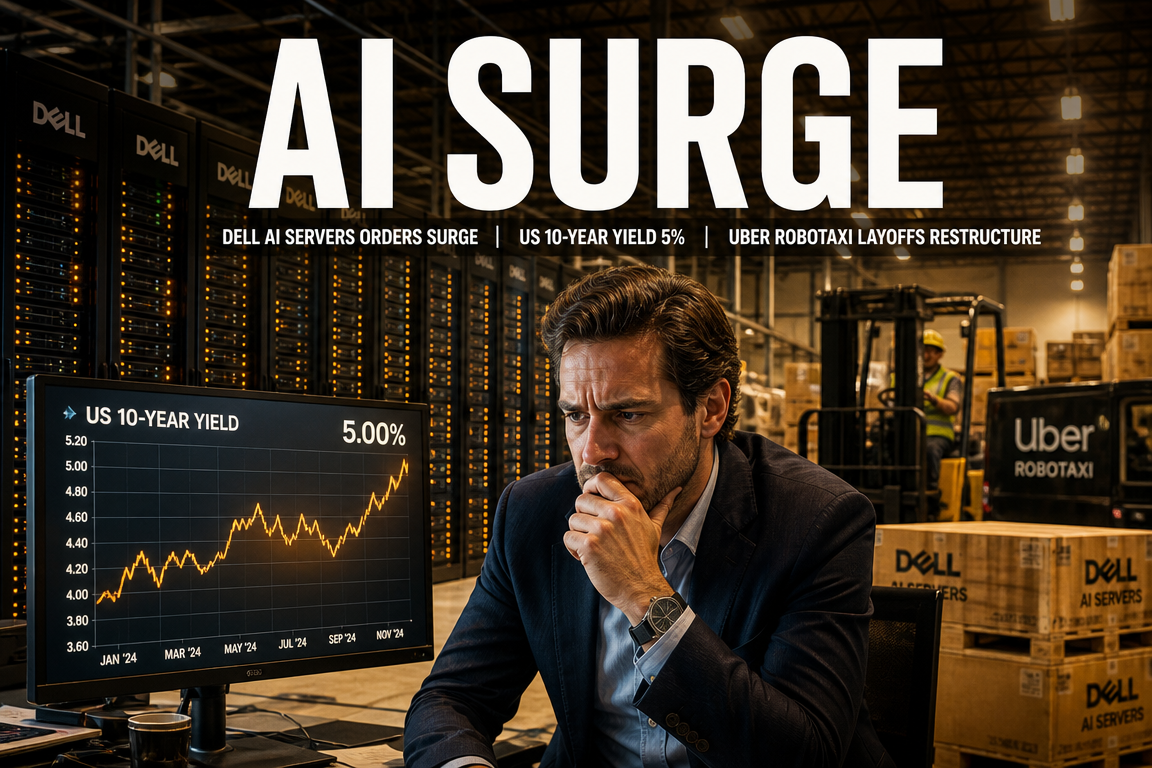
Dell AI Server Orders Surge, U.S. 10-Year Yield Nears 5%, Uber Restructures for Robotaxi Investment
Today’s market focus centers on four key developments.
First, Dell Technologies surged after confirming explosive demand for AI servers.
Second, the U.S. 10-year Treasury yield moved closer to 5%, renewing valuation pressure on the Nasdaq and other technology shares.
Third, the current bond-market stress differs materially from the 2022 bond shock, despite some superficial similarities.
Fourth, Uber announced large-scale job cuts to reduce costs and redirect capital toward robotaxi and future mobility investments.
In addition, Broadcom’s earnings release, the Federal Reserve’s Beige Book, stable crude prices, and rising global sovereign yields are reinforcing a market environment in which U.S. equities are no longer a broad-based rally, but a selective market in which only companies with visible execution are being rewarded.
1. Current U.S. Equity Trends: Oil and Yields Stabilize, but Technology Valuations Remain Pressured
U.S. equities were broadly mixed in early trading.
Dow futures advanced, the S&P 500 traded near flat, and the Nasdaq 100 was slightly lower.
The Russell 2000 outperformed, indicating selective buying in small-cap shares.
The most notable shift came from crude oil and Treasury yields.
WTI traded in the low $89 range per barrel, while Brent eased to the mid-$94 range.
After a recent oil rally raised renewed inflation concerns, the latest move provided some relief.
The U.S. 10-year Treasury yield briefly moved above 4.8% before easing back into the high-4.7% range.
The 30-year yield also declined modestly from around 5.25%.
However, the short-term pullback in yields does not eliminate the broader bond-market concern.
European sovereign yields remain under pressure, and global issuance needs continue to rise.
| Category | Market Move | Interpretation |
|---|---|---|
| Dow Jones | Higher | Some strength in cyclicals and financials |
| S&P 500 | Near flat | Offsetting effects from rates and earnings expectations |
| Nasdaq 100 | Slightly lower | Valuation pressure on high-multiple technology shares |
| WTI Crude | Lower | Some easing in inflation concerns |
| U.S. 10-Year Treasury Yield | High-4.7% range | 5% remains the key threshold |
2. Dell Technologies: AI Server Demand Exceeded Expectations
Dell Technologies was the most notable stock in the session.
The company reported results for fiscal 2027 second quarter and confirmed that AI server demand was significantly stronger than expected.
Second-quarter revenue reached $47.0 billion, up 58% from a year earlier.
That also exceeded the market estimate of $44.9 billion.
The most important figure was AI server orders.
AI server orders reached a record $60.9 billion in the quarter.
Backlog for servers not yet delivered climbed to $95.0 billion.
This indicates that AI demand is no longer only a theme, but an actual capital commitment from customers.
| Item | Dell Reported Figure | Market Significance |
|---|---|---|
| 2Q Revenue | $47.0 billion | Up 58% year over year |
| Street Revenue Estimate | $44.9 billion | Beat expectations |
| AI Server Orders | $60.9 billion | Record level |
| AI Server Backlog | $95.0 billion | Potential future revenue conversion |
| Annual AI Server Revenue Outlook | $60 billion to $74 billion | Guidance raised |
| Annual Total Revenue Outlook | $192.0 billion | Raised by $25 billion |
Dell shares jumped sharply in after-hours trading and were up as much as 10% in premarket trading.
The stock later gave back part of those gains after the open, but the tone remained strong.
The key takeaway is that AI investment is no longer limited to semiconductor names such as Nvidia.
The benefits are broadening to AI servers, data centers, networking equipment, and power infrastructure providers.
Dell is already up more than 260% year to date.
Other AI infrastructure names have also outperformed the Nasdaq 100 and the S&P 500 this year.
That said, expectations are now considerably higher.
The main question is how quickly Dell can convert the $95 billion backlog into revenue and profit.
Strong orders alone will not be sufficient if supply chains, margins, delivery schedules, or customer payment capacity become constraints.
3. Broadcom Earnings: The Market Is Watching AI Guidance, Not Just the Print
Broadcom is scheduled to report fiscal 2026 third-quarter results after the close.
The quarter covers the period from early May through early August.
Broadcom shares have fallen about 30% from their June peak.
The prior report modestly beat expectations, but the market was disappointed that the company did not raise its 2027 AI semiconductor revenue outlook.
This time, the key issue is not simply whether revenue and earnings per share beat estimates.
Investors want evidence that Broadcom can re-establish confidence in its AI growth trajectory.
| Broadcom Watch Item | Why It Matters |
|---|---|
| AI semiconductor revenue outlook | Confirms whether AI demand is translating into revenue |
| 2027 AI revenue guidance | Whether the existing $10 billion target is revised higher |
| Ongoing Google demand | Assesses customer concentration and revenue durability |
| Competition with Marvell | Google has also signed with Marvell, increasing share concerns |
| Credit risk | Potential strain in AI infrastructure financing structures |
Market attention has also focused on a financing structure in which Apollo and Blackstone provide capital, build AI computing infrastructure, and Anthropic leases the capacity.
If Anthropic fails to make lease payments or if the equipment cannot be sold for sufficient value, Broadcom could be exposed to a potential shortfall of up to $29 billion.
This is not just a semiconductor sales story; it suggests that suppliers may increasingly bear credit risk in order to support AI demand.
That issue is becoming central to AI infrastructure investment.
Consensus estimates call for adjusted EPS of $3.22 and revenue of $29.24 billion.
That compares with $1.66 in EPS in the same period last year.
However, Broadcom’s recent earnings beats have typically been modest, often in the 1% to 2% range.
As a result, a small beat may not be enough to drive a major share-price reaction.
The central question remains whether Broadcom can convince the market that AI semiconductor demand remains durable.
4. Why a 5% U.S. 10-Year Yield Matters
The most important macro variable for the market is the U.S. 10-year Treasury yield.
It recently moved from the mid-4.6% range to the high-4.8% range, the highest level since November 2023.
Although it later eased back into the 4.7% range, markets have begun pricing a possible move toward 5%.
A 5% 10-year yield is more than a round number.
For equities, it represents both a psychological resistance level and a valuation pressure point.
One global investment strategist at J.P. Morgan Private Bank identified rising rates as the market’s most significant risk.
The strategist suggested that if the 10-year yield rises above 5%, equities could correct by 5% to 8% from current levels, while describing that move as a healthy correction rather than a bear market.
The Relationship Between a 10-Year Yield of 5% and P/E Ratios
The P/E ratio measures how many times earnings investors are paying for a stock.
For example, a 20x P/E implies that a $100 stock generates $5 of annual earnings.
That equates to an earnings yield of 5%.
If the U.S. 10-year Treasury yield also reaches 5%, investors face a clear comparison.
They can earn 5% from a relatively safe Treasury bond, which reduces the appeal of paying a high multiple for a volatile stock.
| Comparison Item | Equities | U.S. Treasuries |
|---|---|---|
| Return Benchmark | 5% earnings yield at 20x P/E | 10-year yield at 5% |
| Risk | Earnings, growth, and valuation volatility | Relatively lower |
| Investment Appeal | Requires earnings growth | More attractive as yields rise |
| Most Affected Segment | High-P/E technology and growth stocks | Not applicable |
For equities to remain attractive, either earnings must rise quickly or valuations must come down.
High-multiple Nasdaq names are the most vulnerable in a 5% yield environment.
So far, strong corporate earnings have helped the market absorb higher yields.
If earnings growth slows, technology shares could face greater downside pressure.
5. How the 2022 Bond Shock Differs From the Current Environment
Recent bond-market stress has led some investors to compare the current environment with the 2022 bond shock.
However, the two periods are not the same.
In 2022, supply-chain disruptions, the war in Ukraine, and surging energy prices pushed U.S. inflation to 9.1%.
The Federal Reserve raised rates at an unusually rapid pace, moving from near-zero policy rates to above 4% in less than a year.
The European Central Bank and the Bank of England also tightened aggressively.
At that time, the key bond-market issue was the large stock of low-yield bonds already in circulation.
Older bonds paid around 1%, while newly issued bonds began offering more than 4%.
Investors sold existing low-yield bonds, and bond prices fell sharply.
In 2022, broad sovereign bond prices fell 22.3% from their peak, while long-duration government bonds declined 35%.
This year, broad government bonds are down about 4.2%, and long-duration bonds about 7.8%.
That is a decline, but not the scale seen in 2022.
| Category | 2022 | Current Period |
|---|---|---|
| Yield Driver | Rapid Fed rate hikes | Oil, fiscal deficits, and higher Treasury supply |
| Inflation Backdrop | U.S. CPI at 9.1% | Renewed inflation concern |
| Bond Losses | -22.3% for broad sovereign bonds, -35% for long-duration bonds | -4.2% for broad sovereign bonds, -7.8% for long-duration bonds |
| Average Coupon | 1.84% | 2.68% |
| Main Risk | Policy-rate shock | Rising long-term rates and funding costs |
The nature of the current yield rise is different.
This is less about an abrupt central-bank shock and more about fiscal deficits, Treasury issuance, oil prices, and AI infrastructure financing pushing long-term yields higher.
Higher current coupons also provide some buffer versus 2022.
Even so, the implications remain significant.
Rising long-term yields increase borrowing costs for governments, companies, and households.
That is particularly relevant for large AI infrastructure projects that require substantial financing.
6. Global Sovereign Yields Are Rising Across Markets
Yield pressure is not limited to the United States.
Yields are also rising in the U.K., Canada, France, Germany, Italy, and Japan.
The U.K. 10-year yield has already moved above 5%, placing it among the highest in the G7.
Australian and U.S. yields have both climbed into the high-4% range.
German and French yields are also materially higher than their pre-pandemic levels.
Japan’s 10-year yield recently moved above 3%, the highest level in roughly 30 years.
Although the underlying drivers vary by country, the common theme is clear.
Fiscal spending is rising, sovereign issuance is increasing, and higher oil prices are adding to inflation concerns.
When government borrowing costs rise, private-sector funding costs usually rise as well.
That translates into valuation pressure in equity markets.
Technology and growth stocks are especially sensitive because their valuations depend heavily on future earnings.
7. Uber Restructures to Reallocate Capital Toward Robotaxi Investment
Uber said it will cut 10% of its global workforce, or about 3,300 employees.
This is its largest reduction since the 6,700 layoffs during the pandemic.
The move is not simply a response to weak business conditions.
Over the past five years, Uber’s revenue has nearly tripled.
The company said its organization has become too large and complex.
It plans to reduce managers by 20% and cut the number of small teams of one to two employees by half.
The savings will be redirected toward future businesses such as robotaxis.
| Uber Restructuring Item | Detail |
|---|---|
| Layoff Size | 10% of global workforce, or about 3,300 employees |
| Manager Reduction | 20% cut in management roles |
| Small Team Reduction | Half of one- to two-person teams to be eliminated |
| Objective | Streamline operations and improve efficiency |
| Capital Allocation | Robotaxi and future mobility investment |
The market reaction was constructive.
Uber shares rose about 2% in premarket trading after the announcement.
Investors appear to view the move as a combination of cost discipline, margin improvement, and strategic capital reallocation.
However, the robotaxi market remains highly competitive.
If Waymo and Tesla win direct customer relationships, Uber’s traditional ride-hailing platform could face pressure.
On the other hand, if Uber becomes the leading platform for autonomous vehicle dispatch, it could gain a new growth engine.
The long-term outcome will depend less on whether Uber builds the vehicles itself and more on whether it becomes the most efficient platform connecting autonomous fleets with riders.
8. Fed Beige Book: Final Read on Economic Conditions Before the September FOMC
The Federal Reserve will release its Beige Book at 2:00 p.m. ET on September 2, or 3:00 a.m. Korea time on September 3.
The Beige Book is issued eight times a year and summarizes regional economic conditions.
It is based on interviews and surveys conducted by the 12 regional Federal Reserve Banks.
It covers employment, wages, inflation, consumer spending, manufacturing, and real estate.
The report is not a single data point; it reflects how businesses and consumers are actually experiencing the economy.
Its importance is elevated ahead of the September FOMC meeting.
If the report indicates persistent pricing pressure and resilient consumption, expectations for higher-for-longer rates could increase.
If it shows weakening demand, softer employment, or difficulty passing through price increases, the case for additional tightening would weaken.
The market is currently pricing the probability of a September rate hike in the 60% range.
As a result, the Beige Book could move U.S. equities, Treasury yields, and the dollar index.
9. Sector Performance: Markets Are Rewarding Only Verified Execution
The index level was near flat, but sector and stock-level dispersion was significant.
In semiconductors, Nvidia extended gains, while AMD, Intel, Broadcom, and Micron traded lower.
Nvidia also drew attention after reports that it is discussing a roughly $14 billion acquisition of AI startup Hugging Face, although the stock reaction was limited.
Apple was flat and Tesla traded slightly lower.
Meta strengthened, and financials were also firm, led by JPMorgan.
Healthcare names such as Eli Lilly and Johnson & Johnson also performed well.
Energy stocks weakened, with Exxon Mobil and Chevron pressured by lower crude prices.
Software shares also came under pressure, particularly those with elevated valuations.
The overall pattern is clear: stocks with visible earnings and guidance are attracting capital, while names trading primarily on expectations are being sold.
10. The Most Important Point Often Missed in the News
The key issue in the AI market is not only demand, but also how that demand is financed.
Most headlines focus on Dell’s AI server order surge, Broadcom’s AI semiconductor business, and Nvidia’s leadership.
But the more important question is where the capital for AI infrastructure comes from and who bears the risk.
Dell’s $95 billion backlog is a strong sign of growth.
At the same time, customers still need to take delivery, install the systems, and pay for them before revenue and profit are realized.
The Broadcom example points to a more complex structure.
If AI computing infrastructure is financed by capital providers and leased to AI companies, suppliers may begin to absorb some credit risk.
That suggests the AI boom is shifting from a pure technology cycle into a financial cycle.
In other words, investors should not evaluate AI stocks solely on demand trends.
They also need to assess the pace of backlog conversion, customer payment capacity, data-center power availability, debt-financing costs, and long-term yield pressure.
As the U.S. 10-year yield approaches 5%, the cost of building AI data centers rises further.
That environment is likely to reward companies with strong cash flow and punish those with weaker balance sheets.
Dell stands to benefit because it has demonstrated both order growth and guidance visibility.
More broadly, the winners in AI are likely to be not just the companies with the best technology, but those that can secure orders, deliver on schedule, collect cash, and withstand higher rates.
11. Investor Checklist: Execution Matters More Than Direction
- Monitor whether the U.S. 10-year Treasury yield breaks above 5%.
- Watch whether Broadcom raises AI semiconductor guidance.
- Track whether Dell’s AI backlog converts into revenue and margin expansion.
- Watch for renewed inflation pressure if oil prices rise again.
- Review the Fed Beige Book for signals on employment, consumption, and pricing.
- Assess whether Uber’s robotaxi investment becomes a genuine growth strategy beyond cost cutting.
- In high-P/E technology stocks, earnings visibility matters more in a rising-rate environment.
< Summary >
Dell reported $60.9 billion in AI server orders and a $95.0 billion backlog, showing that AI infrastructure demand is moving into a more tangible revenue phase.
For Broadcom, the focus is on AI semiconductor guidance and credit risk rather than the earnings print alone.
The U.S. 10-year Treasury yield is nearing 5%, increasing valuation pressure on high-P/E technology stocks and the Nasdaq.
The 2022 bond shock was driven by rapid policy tightening, while the current environment is being shaped by oil prices, fiscal deficits, Treasury supply, and AI financing needs.
Uber is cutting 10% of staff, or about 3,300 employees, and redirecting resources toward robotaxi investment.
Overall, the market is increasingly favoring companies with visible earnings, guidance, cash flow, and rate resilience over those trading primarily on narrative.
[Related Articles…]
- AI Server Supercycle and Data Center Investment Outlook
- U.S. Treasury Yield 5% Era and Technology Stock Strategy
*Source: [ Maeil Business Newspaper ]
– 델 AI 서버 주문 폭발ㅣ미 10년물 5% 찍으면 주가 위험ㅣ2022년 채권 쇼크, 지금과 뭐가 다른가ㅣ우버, 로보택시 투자 위해 감원ㅣ홍혜진의 뉴욕브리핑