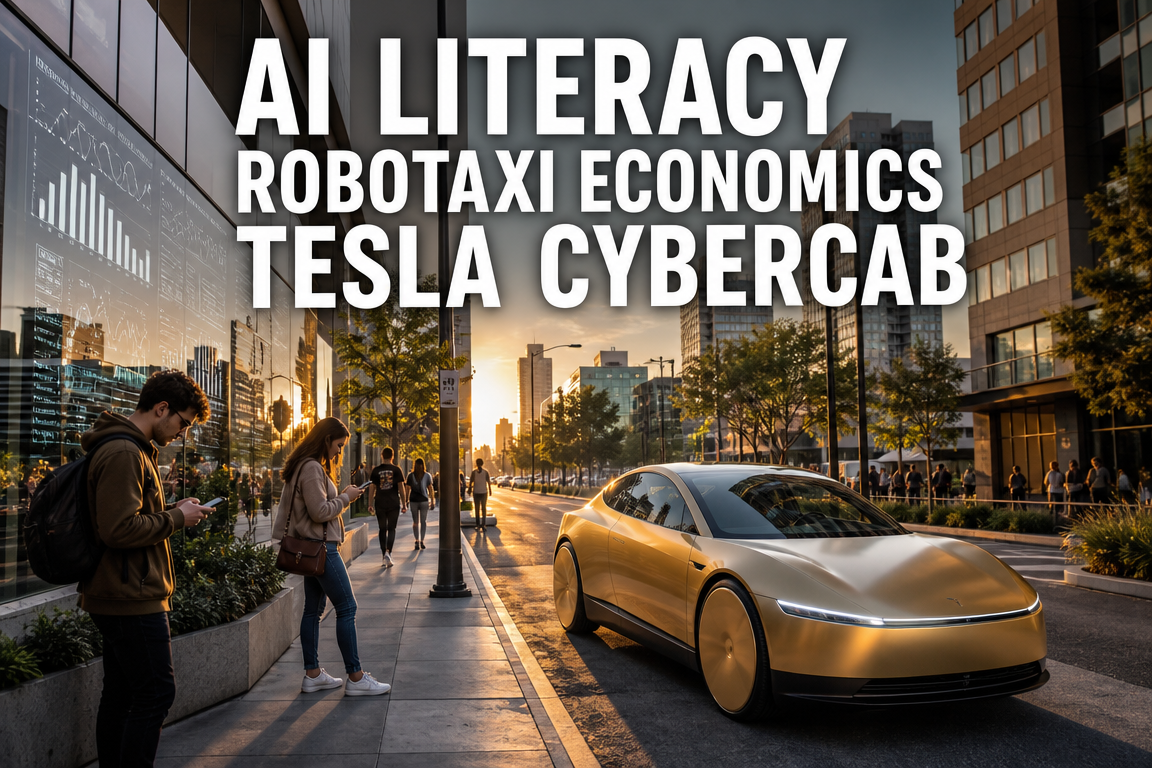
● Tesla Cybercab Shock, 2-Seat Robotaxi Revolution
Tesla Cybercab in 15 Minutes: “Two Seats” Is Not a Design Choice, but the Core of Robotaxi Economics
The most important point from Tesla’s Cybercab presentation was not simply that a driverless robotaxi had arrived.
The real focus was Tesla’s decision to design Cybercab not as an electric car, but as ultra-low-cost transportation infrastructure built on autonomous driving.
In particular, many observers missed why Cybercab has two seats, why Tesla remains committed to camera-based AI autonomy without lidar, and why it has reengineered the manufacturing process.
These three elements together make the implications for Tesla’s stock, the robotaxi market, the EV sector, AI investment, and the mobility industry much clearer.
The following is a news-style reconstruction based on the original presentation content, written for investors and general readers.
1. Tesla’s definition of Cybercab: not a car, but a mobile AI service
Tesla described Cybercab as a future transportation system.
Its core attributes were presented as safe, low-cost, on-demand, universally accessible, and designed to deliver an enjoyable riding experience.
The key point is that Tesla does not view Cybercab as an extension of the traditional taxi or vehicle sales model.
Tesla described Cybercab as a product optimized for passengers.
In other words, it is designed not for the driver, but as a space that converts travel time into productivity, rest, and entertainment.
- Passenger-centric rather than driver-centric design
- Support for work, rest, video, and music during transit
- Concept of first-class experience at mass-market pricing
- Goal of mainstreaming clean and safe transportation
While this may sound like a marketing message, it is effectively a description of Tesla’s robotaxi business model.
The model is not limited to one-time vehicle sales; it is built around a platform that generates recurring revenue as the vehicle continues operating.
2. The real reason Cybercab has two seats: more than 80% of trips involve one or two passengers
The most direct explanation in the presentation addressed why the vehicle has only two seats.
Tesla stated that more than 80% of all ride-hailing demand involves two passengers or fewer.
Cybercab was therefore designed from the outset around a two-seat configuration.
This is not a choice made merely to create a smaller car.
It is a structural decision intended to reduce the unit economics of the robotaxi business.
- Smaller body size lowers material cost.
- Lower weight improves efficiency.
- Reduced battery requirements lower vehicle cost.
- Lower vehicle cost shortens the payback period for robotaxi deployment.
- A shorter payback period accelerates fleet expansion.
In that sense, the two-seat design is not an inconvenient downsizing measure, but an economic design optimized for robotaxi economics.
Tesla’s statement that it aims to provide the “most affordable transportation option” is directly tied to this logic.
Eliminating the driver, reducing seating to match actual demand, maximizing energy efficiency, and lowering manufacturing cost can significantly reduce cost per mile.
This is the key point investors should focus on.
The two seats in Cybercab are not a matter of style; they are a structural choice intended to create price competitiveness in the robotaxi market.
3. Tesla’s autonomy philosophy: AI that predicts the future, not lidar
Tesla said it began developing autonomous driving 12 years ago.
Its objective was to build the safest, lowest-cost, and most scalable autonomy solution.
During that process, industry experts reportedly told Tesla that lidar, radar, and HD maps were necessary.
Tesla said it did not accept that view.
The company’s logic is straightforward.
The essence of autonomy is intelligence, not the number of sensors.
On the road, the important task is not only detecting objects currently visible, but predicting what will happen next and responding safely.
- Understanding the environment through camera-based imagery
- Using AI models to predict the next scenario
- Camera-based approach similar to how humans drive with vision
- Focus on scalability and cost efficiency over lidar or HD maps
- Emphasis on an end-to-end AI autonomy stack
This is the core of Tesla’s autonomy strategy.
If the market accepts that Tesla’s approach is sufficiently safe, robotaxi economics could become far lighter than those of competitors.
However, if regulators or consumers question the safety of camera-based autonomy, commercialization may slow.
For that reason, Cybercab is both a technology announcement and a test of regulatory and public trust.
4. The meaning of the “1 million miles of unsupervised robotaxi” claim
The presenter stated that Tesla had achieved 1 million miles of unsupervised robotaxi operation.
For investors, this is a highly significant claim.
In robotaxi operations, real-world driving data, accident rates, intervention rates, and passenger experience matter more than demonstration videos.
Tesla attributed this progress to driving data collected from its existing fleet.
The explanation was that the AI model was trained using data accumulated by Tesla vehicles on public roads.
- Use of real-world driving data from Tesla vehicles
- Emphasis on AI models trained on a large number of edge cases
- Coverage of events such as fallen trees and sudden lane intrusions
- Reference to training volume equivalent to thousands of human lifetimes of driving experience
During the presentation, Tesla also cited a case in which a robotaxi detected an elderly person crossing while pulling a bicycle on a road resembling a highway and waited naturally for about 20 seconds.
The key point is not the stop itself.
It was presented as an example of smooth driving behavior that reads the situation like a human and waits when appropriate.
Autonomy is not defined only by avoiding accidents.
It must also move in a way that feels natural and predictable to passengers.
Tesla described Cybercab as a software system for safe and smooth transportation.
5. The Cybercab app experience: fully automated from booking to boarding
Tesla also detailed the app experience for Cybercab.
Users enter their destination in the app and are assigned the vehicle that can arrive the fastest.
Tesla said the allocation system considers not only nearby vehicles, but also vehicles already in operation.
Dynamic pricing was also mentioned.
Prices adjust according to supply and demand.
- Destination entry followed by automatic dispatch of the fastest available vehicle
- Optimization across both idle and operating vehicles
- Dynamic pricing to balance supply and demand
- Reduced average wait times as the Cybercab fleet expands
- Ongoing strategy to improve price competitiveness
This is a direct comparison point with established mobility platforms such as Uber and Lyft.
In traditional platforms, driver supply is the key variable.
In Cybercab’s case, the vehicle itself is the supply.
If Tesla can control both vehicle production and operating efficiency, it may gain pricing power in robotaxi services.
6. Cloud-based personalization: the vehicle loads user settings automatically
Cybercab is designed to begin operating before the passenger enters the vehicle.
When the vehicle is requested through the app, personal settings are retrieved from the cloud account.
Interior temperature, seat position, and media accounts are restored automatically.
Users can begin listening to music or watching video as soon as they enter.
- Cloud account-based restoration of personal settings
- Automatic climate configuration
- Automatic seat adjustment
- Connection to music and video accounts
- Content search and playback preparation through the app before boarding
This is not just a convenience feature.
It aligns with Tesla’s broader strategy of turning the vehicle into a second living room.
If travel time becomes time for content consumption, work, or rest, the value of the in-vehicle experience increases.
This also creates potential for additional revenue streams such as advertising, subscriptions, premium media, and in-car AI assistance.
7. Vehicle identification: light bar and app-based navigation
As robotaxi fleets expand, helping users identify their assigned vehicle becomes an important user-experience issue.
Tesla said Cybercab’s front light bar displays a unique color for each passenger.
The cabin lighting uses the same method of identification.
The mobile app also includes a compass feature that indicates where the vehicle is located.
- Unique color display on the front light bar
- Interior lighting also used for vehicle identification
- App-based compass for vehicle location
- Local connection between the vehicle and the mobile app
These features may appear minor, but they are important in large-scale robotaxi operations.
At airports, concert venues, and dense urban centers, faster vehicle identification directly improves throughput and customer satisfaction.
8. Grok inside Cybercab: the vehicle is becoming an AI agent
The presentation also mentioned Grok.
Users can access Grok by saying “Hey Grok,” or through the mobile app and vehicle display.
Tesla said Grok is integrated into vehicle functions and boarding-related features, with additional capabilities expected later.
- Voice command access to Grok
- Availability through the mobile app and vehicle display
- Integration with vehicle controls and boarding experience
- Potential for broader future functionality
This is highly relevant from an AI trend perspective.
Tesla is positioning the vehicle not just as transportation, but as a personal space with an embedded AI agent.
As AI assistants operate on smartphones, future vehicles may connect AI to schedules, content, destinations, climate, payments, and customer support.
As robotaxis become more common, in-vehicle AI usage could become a new platform advantage.
9. Accessibility design: consideration for visually impaired users and mobility-limited passengers
Tesla said Cybercab should be a transportation option for all users, not just a premium experience for a narrow segment.
To support that goal, the design reportedly incorporated feedback from disability groups and emergency responders from the early stages.
In particular, braille was applied to doors and pull buttons.
Tesla also said the butterfly doors are not only a design feature, but also serve a functional purpose by creating more space for entry and exit.
- Collaboration with disability groups during early design stages
- Input from emergency responders
- Braille on doors and pull buttons
- Butterfly doors to improve boarding and exiting space
- Expanded accessibility for mobility-limited passengers
This also supports the social rationale for robotaxis.
The point is that autonomous transportation should not serve only tech-savvy users, but also expand mobility access for older adults and people with disabilities.
10. Drag coefficient below 0.2: efficiency is robotaxi profitability
Tesla said Cybercab’s drag coefficient is below 0.2.
The presenter described that figure as remarkable for a vehicle of this size.
Drag coefficient is not just a technical specification.
In robotaxi operations, efficiency directly affects profitability.
- Lower drag reduces energy consumption during driving.
- Lower energy use reduces charging cost.
- Shorter charging time increases vehicle utilization.
- Higher utilization increases revenue per vehicle.
- Higher revenue per vehicle shortens fleet payback periods.
Cybercab’s low drag is therefore an economic feature, not just an aesthetic one.
In autonomous ride-hailing competition, vehicle cost, operating cost, electricity cost, and utilization are all interconnected.
Tesla appears to be optimizing this structure from the design stage.
11. Manufacturing innovation: reconfiguring the production line with the unboxed process
One of the most important points late in the presentation was manufacturing.
Tesla said Cybercab will use an unboxed manufacturing process.
Traditional automobiles are assembled around a completed body moving through the production line.
Tesla views that method as inefficient.
The unboxed approach divides the vehicle into modules that are produced in parallel and integrated at the end.
- Departure from conventional body-centered assembly
- Production of vehicle modules in parallel
- Reported reduction of production-line footprint by 50%
- Higher output despite smaller line size
- Shorter cycle times to improve mass-production efficiency
- Structure designed for cooperation between human workers and automation
This indicates that the next competition in the EV sector may be determined not only by battery technology, but also by manufacturing cost.
Tesla previously reshaped production with giga-casting, and with Cybercab it is once again pursuing manufacturing cost reduction through the unboxed process.
If successful at scale, this could give Cybercab a cost advantage over competing robotaxis.
That would support both price competitiveness and fleet expansion.
12. Eliminating paint and using recycled materials: lowering cost and emissions simultaneously
Tesla said Cybercab’s exterior panels use a RIM-based injection molding process.
The company emphasized that this is a new manufacturing approach for large-scale vehicle production.
Of particular importance is the ability to eliminate the paint process.
Automotive paint shops require substantial capital investment and consume significant energy.
Tesla appears to be reducing or removing this process to lower both production costs and environmental burden.
- RIM-based exterior panel manufacturing
- Described as a new method for large-scale application
- Potential cost savings from eliminating paint shops
- Expected reduction in emissions
- Use of recycled materials in Cybercab exterior components
This is one of the most important points often overlooked in other summaries.
In robotaxi operations, even a modest reduction in vehicle-level manufacturing cost becomes significant at fleet scale.
For example, a savings of several thousand dollars per vehicle, multiplied across hundreds of thousands or millions of units, could create a very large financial impact.
This manufacturing innovation appears to support Tesla’s description of Cybercab as the “most affordable, beautiful, and enjoyable product.”
13. The most important point often omitted by other coverage
Most coverage focuses on Cybercab’s appearance, the absence of a steering wheel, launch timing, and Tesla’s stock reaction.
But the real significance of this presentation is that Tesla has redesigned the unit economics of robotaxis from the ground up.
Cybercab is not merely an autonomous vehicle.
It combines demand data, seat count, aerodynamics, manufacturing process, paint elimination, app-based dispatch, dynamic pricing, and AI personalization into a single economic model.
Five elements are especially important:
- A two-seat design aligned with demand data showing that more than 80% of trips involve two passengers or fewer
- Drag coefficient below 0.2 to reduce energy cost
- Unboxed manufacturing to reduce line footprint and increase output
- RIM exterior panels and paint elimination to lower production cost
- App-based dynamic pricing and fleet expansion to reduce wait times and operating cost
This is not simply a car announcement; it is a broader attempt to redesign the economics of robotaxi operations.
From an investment perspective, this is the most important issue.
If autonomous driving safety is accepted and regulatory approval follows, Tesla could be revalued not as a vehicle manufacturer, but as an AI mobility operator.
If commercialization is delayed, the market is more likely to continue valuing Tesla primarily as an EV manufacturer.
14. What investors should watch before Tesla’s stock price
① Robotaxi cost structure
The success of Cybercab depends more on cost structure than on design.
Vehicle price, maintenance, electricity, insurance, cleaning, and charging infrastructure all matter.
If Tesla proves that transportation can be materially cheaper, the robotaxi market structure could change.
② Regulatory approval pace
Autonomy is not commercialized by technology alone.
Regional regulatory approval, accident data, insurance frameworks, and liability allocation must all be addressed.
The claim of 1 million miles of unsupervised robotaxi operation is meaningful, but large-scale deployment will require more public data and broader trust.
③ Manufacturing scalability
It is important to determine whether Tesla can implement the unboxed process reliably in mass production.
If the reported 50% reduction in line size and higher output are achieved, cost competitiveness should improve.
However, any new manufacturing approach also carries early-stage quality and supply-chain risks.
④ AI platform potential
Grok and cloud personalization are the beginning of a broader in-vehicle AI service layer.
As robotaxis expand, travel time becomes a new period of digital consumption.
From an AI investment perspective, this could support a view of Tesla not only as an EV company, but also as an AI platform company.
15. Industry structure that Cybercab could reshape
- The taxi industry could shift from driver-centric to fleet-centric economics.
- Platforms such as Uber and Lyft could face pressure as competition moves from drivers to robotaxi supply.
- The EV market may place greater importance on autonomous operating revenue than on vehicle sales volume.
- Insurance pricing may move from human-driver risk to AI-operation risk.
- Urban real estate could be affected by lower parking demand and changes in mobility access.
- Demand for AI semiconductors and data centers may remain strong as autonomy training and inference expand.
If Cybercab succeeds, the economic impact will extend well beyond the automotive sector.
It could affect transportation costs, city planning, energy demand, battery supply chains, AI infrastructure, and content consumption time.
For that reason, the presentation is better understood not as a simple vehicle launch, but as a convergence point for AI and mobility within the broader fourth industrial revolution.
16. Risks remain clear
That said, the presentation alone does not confirm success.
Tesla’s vision is strong, but commercialization depends on multiple variables.
- Regional regulatory approval for unsupervised autonomy
- Actual accident rates and insurance costs
- Production timeline and early quality for Cybercab
- Operating costs for cleaning, charging, and maintenance
- Consumer acceptance of dynamic pricing
- Safety comparison with lidar-based competitor robotaxis
- Degree to which expectations are already reflected in Tesla’s stock price
Investors should distinguish between technical feasibility and commercial profitability.
Technology may appear viable while regulation and operating costs delay profitability.
Conversely, if real-world operating data accumulates faster than expected while the market remains skeptical, Tesla’s valuation framework could change again.
< Summary >
The core of Tesla’s Cybercab is not a steering-wheel-free future car, but a comprehensive design intended to lower the cost structure of robotaxi operations.
The two-seat layout is aligned with demand data showing that more than 80% of trips involve two passengers or fewer.
Camera-based AI autonomy, a drag coefficient below 0.2, the unboxed manufacturing process, RIM exterior panels, and paint elimination all point toward low-cost robotaxi economics.
App-based dispatch, dynamic pricing, cloud personalization, and Grok integration position Cybercab not as a vehicle alone, but as an AI mobility platform.
For investors, the key issues are not Tesla’s short-term stock reaction, but whether autonomy safety, regulatory approval, manufacturing cost, and fleet operating returns can be demonstrated in practice.
[Related Articles…]
- Tesla Robotaxi Strategy and AI Mobility Investment Framework
- How Autonomous Driving Is Reshaping Global EV Competition
*Source: [ 오늘의 테슬라 뉴스 ]
– 테슬라 주주가 못 본 15분 — 사이버캡 좌석이 두 개인 이유를 무대에서 말했습니다
● AI Shock, Jobs, Literacy
The Essence of the 2027–2028 AI Shock: The Difference Between Those Replaced and Those Who Survive Is Literacy
Over the next two years, AI will move beyond a simple productivity tool and become a key variable reshaping employment structures in manufacturing and services.
This article treats 2026 as the AI adoption phase and 2027–2028 as the period of broad-based expansion, and summarizes where AI-driven job displacement is likely to emerge first.
It also reinterprets the issue through the lens of the more fundamental survival capabilities often overlooked by the media: literacy, integrative thinking, critical thinking, and digital literacy.
In short, those who will remain valuable in the AI era are not those who consume information quickly, but those who read, interpret, connect, and convert information into independent judgment.
This distinction is likely to shape income, job stability, future career selection, and the ability to respond to macroeconomic conditions.
1. Core News: AI Transformation Will Accelerate Across Industry in 2027–2028
The AI shock is not expected to arrive abruptly, but to progress through the 2026 adoption phase and into broad industrial diffusion in 2027–2028.
Companies are moving beyond basic chatbot use and redesigning workflows around AI in production, sales, customer service, planning, accounting, HR, education, and content creation.
-
2026: AI Adoption Phase
Companies experiment with generative AI, automation tools, internal AI assistants, and data analytics systems.
At this stage, AI is used primarily to improve employee productivity rather than replace workers outright.
-
2027–2028: Broad AI Transition
AI moves from a support function to the center of operational execution.
Companies begin to ask whether tasks should be performed by people or by AI.
-
Manufacturing AX: Manufacturing AI Transformation
Manufacturing is likely to see rapid adoption in equipment maintenance, quality inspection, demand forecasting, production planning, and inventory optimization.
As a result, repetitive monitoring tasks and basic quality-control functions may face significant substitution pressure.
-
Services SAX: Service AI Transformation
In services, AI is increasingly integrated into customer support, reservations, document preparation, customer analytics, marketing copy, reporting, and basic legal or tax inquiries.
White-collar roles are no longer insulated from automation risk.
2. Common Traits of Those at Risk of Replacement: Not Skilled Workers, but Passive Task Executors
AI is more likely to replace repetitive and predictable tasks within jobs than entire occupations.
As a result, within the same occupation, some workers may be displaced while others gain higher compensation and greater influence.
-
Tasks with High Replacement Risk
Document preparation based on fixed templates.
Repeated data entry and data organization.
Summarization or simple translation of existing materials.
Customer responses based strictly on manuals.
Media production, editing, design, and reporting tasks with limited creative judgment.
-
Tasks with Lower Replacement Risk
Work that requires contextual judgment.
Work that connects disparate information into strategy.
Work that requires reading emotions, incentives, and organizational culture.
Work that validates AI outputs and makes final decisions.
Work that defines new questions and reframes problems.
The key issue is not whether a person uses AI.
The real difference is whether a person accepts AI-generated answers at face value, or interprets and verifies them before forming a judgment.
3. The Decisive Survival Capability: Literacy Is More Than Reading Words
Korea is generally regarded as a country with a literacy rate below 1% in terms of basic illiteracy.
However, the ability to read text and the ability to understand it deeply are fundamentally different.
The central point raised in the original discussion is that the practical literacy level of Korean adults tends to fall below the OECD average with age.
This reflects a long-standing emphasis on selecting the correct answer rather than training people to think critically.
-
Functional Literacy
The ability to read text and understand its meaning.
This is closely aligned with solving test questions and selecting the correct answer.
-
Practical Literacy
The ability to identify the writer’s intent, context, implicit assumptions, and argument structure.
The ability to read information critically and reconstruct it into one’s own thinking.
-
AI-Era Literacy
The ability to avoid accepting AI outputs at face value and to examine why a given answer was produced.
The ability to connect multiple sources of information into original insight.
In this sense, literacy in the AI era is both a survival skill and an economic asset.
People with stronger literacy ask better questions, make better decisions, and produce higher productivity.
4. Why Short-Form Content May Weaken Survival Capacity in the AI Era
Short-form video and fragmented digital content are fast and convenient.
However, they may train the brain to favor rapid scanning over deep reasoning.
The original discussion notes that this trend may weaken the prefrontal functions and cognitive endurance needed for complex logical reasoning.
-
Information Consumers
They rely on short videos, short news items, and attention-grabbing headlines.
They quickly accept claims such as “buy this stock,” “this job is finished,” or “this industry will lead the next cycle.”
They borrow conclusions from others instead of forming their own.
-
Information Interpreters
They verify why a claim was made.
They look for counterarguments.
They connect macroeconomic outlook, industry change, and labor-market trends into their own judgment.
As AI increasingly summarizes information, human value will depend even more on deeper thinking.
In an era where AI provides answers, those who survive are not those who memorize answers, but those who question them and redefine the problem.
5. Literacy Is a Core Asset in a Knowledge-Based Economy, Affecting Income and Job Security
Adult literacy is not merely a cultural or educational issue.
In a knowledge-based economy, it is a core asset influencing personal value, compensation, promotion potential, and business scalability.
In a high-rate, low-growth, and structurally changing environment, independent judgment becomes even more important.
Individuals who rely heavily on others’ opinions are more likely to be vulnerable in capital markets, labor markets, and career decisions.
-
Risks Associated with Low Literacy
Inability to verify AI-generated outputs.
Investment decisions based only on headlines.
Inability to structure complex workplace problems.
Failure to read others’ intent or organizational context.
-
Opportunities Associated with High Literacy
Using AI as a tool for faster analysis.
Connecting fragmented information into strategy.
Improving persuasion in meetings, reports, and negotiations.
Redefining one’s role amid future labor-market change.
The economic gap in the AI era will not simply be between people who understand technology and those who do not.
It will be between those who use technology to expand thinking and those who delegate thinking to technology.
6. The Most Important Point Often Missing from Other Coverage
Many discussions focus on which jobs AI will eliminate.
A more important question is which types of thinking will be displaced.
Judging safety or risk by job title alone is misleading.
Even doctors, lawyers, accountants, developers, designers, journalists, and marketers may see parts of their work automated.
Conversely, administrative, field, or service workers with strong contextual judgment and problem-solving skills may become more valuable.
-
Key Point 1: AI does not eliminate whole occupations first; it breaks jobs into tasks.
Within each occupation, tasks are divided between what AI can do and what humans must do.
Career strategy should therefore be built around task portfolios, not job titles.
-
Key Point 2: Human competitiveness comes from interpretation, not just correctness.
AI can generate answers quickly, but humans must judge whether those answers fit the organization and market context.
Those without interpretive ability may remain limited to simply reproducing AI outputs.
-
Key Point 3: Literacy is directly linked to investment judgment.
Evaluating AI semiconductors, robotics, power infrastructure, cloud services, and data centers requires literacy.
The issue is not simply following a theme, but reading earnings, demand, supply chains, interest rates, exchange rates, and policy together.
-
Key Point 4: If labor income weakens, capital income is difficult to sustain over time.
As AI disrupts jobs, investment in oneself becomes the most important strategy.
7. Five Survival Capabilities Required in the AI Era
In the era of digital transformation, practical problem-solving matters more than formal credentials alone.
The following five capabilities are relevant for employees, self-employed workers, students, and parents.
-
1) Integrative Thinking
The ability to connect fragmented information into a coherent structure.
This means reading AI technology trends together with labor markets, corporate investment, productivity, interest rates, and consumption patterns.
-
2) Critical Thinking
The ability not to accept AI outputs, expert statements, or headlines at face value.
It involves checking evidence, counterarguments, and hidden incentives.
-
3) Empathy
Literacy is not limited to reading text.
It also includes reading facial expressions, tone, context, emotion, and intent.
Even with advanced AI, the ability to build trust through human nuance is difficult to replace.
-
4) Digital Literacy
The ability to assess online information credibility, algorithmic bias, and the limitations of AI-generated answers.
Effective AI use requires not only prompt writing, but also verification and revision of outputs.
-
5) Creative Writing and Expression
Reading ability is becoming less important than the ability to write and communicate clearly.
People who can express their ideas effectively through text, speech, reports, content, and proposals will have more opportunities.
8. What Office Workers Should Prepare for Now
Self-development in the AI era must go beyond obtaining additional certifications.
The first step is to identify which parts of a job AI can replace and which parts must be upgraded by the worker.
-
Step 1: Break Down Your Work
Separate repetitive work, judgment work, communication work, and creative work.
Repetitive work should be delegated to AI, while judgment, communication, and planning skills should be strengthened.
-
Step 2: Use AI as an Amplifier, Not a Competitor
AI should be used actively for research, draft writing, data organization, and idea expansion.
Final judgment and contextual adjustment must remain human responsibilities.
-
Step 3: Restart Reading Habits
Move beyond short-form content and return to long-form articles, reports, and books.
In particular, the ability to read macroeconomic reports, industry research, and corporate earnings materials is directly linked to job resilience.
-
Step 4: Write in Your Own Words
Summarize what you read and express it in meetings or writing.
Thought becomes clearer when translated into language.
9. What Parents Should Teach Children for the AI Era
One of the most common questions among parents and grandparents is which jobs children should pursue in the AI era.
More important than choosing a job title is deciding which capabilities to develop.
-
Ask Better Questions Rather Than Seek Only Answers
AI provides answers quickly.
Children therefore need training in how to ask strong questions.
-
Interpret Rather Than Simply Read
Reading widely matters, but explaining why something is true matters more.
Children should be encouraged to discuss characters’ choices, social context, and implicit intent rather than only summarizing plots.
-
Understand People, Not Just Technology
Coding and AI literacy matter, but understanding people remains a longer-lasting competitive advantage.
Collaboration, empathy, persuasion, and ethical judgment are likely to matter more in future careers.
10. The Core Message of Literacy Depth
Literacy Depth does not treat literacy as a simple language skill.
The book defines literacy as a basic force that connects the self and the world.
People do not read only text; they also read facial expressions, tone, context, intent, and social trends.
For this reason, literacy is both the first step toward becoming a better person and a tool for protecting one’s life in the AI era.
-
Theoretical Dimension
Explains why literacy matters and how it affects human thought and life.
-
Practical Dimension
Provides concrete methods covering spelling, vocabulary, speaking, reading, writing, workplace judgment, and digital literacy.
-
Connection to the AI Era
As AI summarizes more information, humans must decide how to absorb and reconstruct that information.
Critical reading and creative writing become core human capabilities in the AI era.
11. AI Shock from an Economic Perspective: It Is Ultimately About Productivity and Income Divergence
AI transition is not merely a technology trend; it is a major productivity shift.
For companies, it can mean higher output with the same workforce and, in some cases, lower staffing needs.
This may affect inflation, interest rates, corporate investment, employment, and wage structures.
-
For Companies: Cost Reduction and Higher Productivity
Companies that adopt AI effectively may reduce costs and improve decision-making speed.
This can also affect earnings and equity market performance.
-
For Individuals: Income Polarization
Workers who use AI to raise productivity may gain more opportunities.
Those whose work is displaced by AI may see weaker income foundations.
-
For Countries: Industrial Reconfiguration
AI semiconductors, cloud services, data centers, power grids, robotics, and cybersecurity are emerging as key infrastructure sectors.
The speed at which AI is applied across industries may become a major determinant of national competitiveness.
When evaluating the AI outlook, the relevant question is not only which technologies will benefit, but how they will alter the allocation of labor and capital.
12. Practical Ways to Build Literacy Starting Now
Literacy is not fixed; it can be improved through training.
The key is to build a routine of reading deeply, thinking carefully, and expressing ideas clearly.
-
1) Read One Article and Retitle It
Assess whether the headline is exaggerated and whether it captures the main point.
This helps train recognition of framing effects.
-
2) Challenge AI Outputs with Follow-Up Questions
Do not use an AI answer as-is. Ask: What are the counterarguments? What variables are missing? How does this apply in Korea?
This strengthens critical thinking.
-
3) Summarize a Long Text in Three Sentences
State the main claim, the supporting evidence, and your own view in separate sentences.
Summarization is not compression alone; it is structural understanding.
-
4) Record Meetings in Your Own Language
Write down what was decided, what was implied, and what actions follow.
Workplace literacy often appears most clearly in post-meeting notes rather than formal reports.
-
5) Read for 10 Minutes a Day
This helps recondition the brain for sustained attention.
Reading across economics, technology, humanities, and psychology supports integrative thinking.
13. Final View: The AI-Era Survival Strategy Is to Become Non-Replaceable
As AI advances, the value of simple knowledge will decline.
However, the value of thinking, judgment, empathy, and connection will rise.
The central question is no longer whether AI will take a job.
The real question is whether a person can make judgments that go beyond AI-generated output.
More people will learn to use AI effectively.
Far fewer will be able to transform AI-generated information into original insight.
Those who can do so are likely to have stronger resilience in labor markets, capital markets, and industrial transition.
< Summary >
2026 can be viewed as the AI adoption phase, while 2027–2028 may mark the period when AI transformation spreads across industries.
AI is more likely to replace repetitive and predictable tasks than entire occupations.
The key survival capabilities in the AI era are literacy, integrative thinking, critical thinking, and empathy, rather than AI usage alone.
As short-form content becomes more dominant, deep thinking may weaken, making long-form reading and self-directed summarization increasingly important.
The most important investment in the AI era is not stocks or real estate, but the development of one’s own thinking and literacy.
Ultimately, those who will be replaced are not the incapable, but those who execute tasks without thinking; those who survive are the ones who use AI to make deeper judgments.
[Related Articles…]
*Source: [ 경제 읽어주는 남자(김광석TV) ]
– “2년 뒤 AI 충격 옵니다” 대체되는 사람과 살아남는 사람의 결정적 차이| 김광석의 북리뷰 | 문해 내공 [1편]