● AI-Agent Shockwave, OpenAI Surge, Market Rift
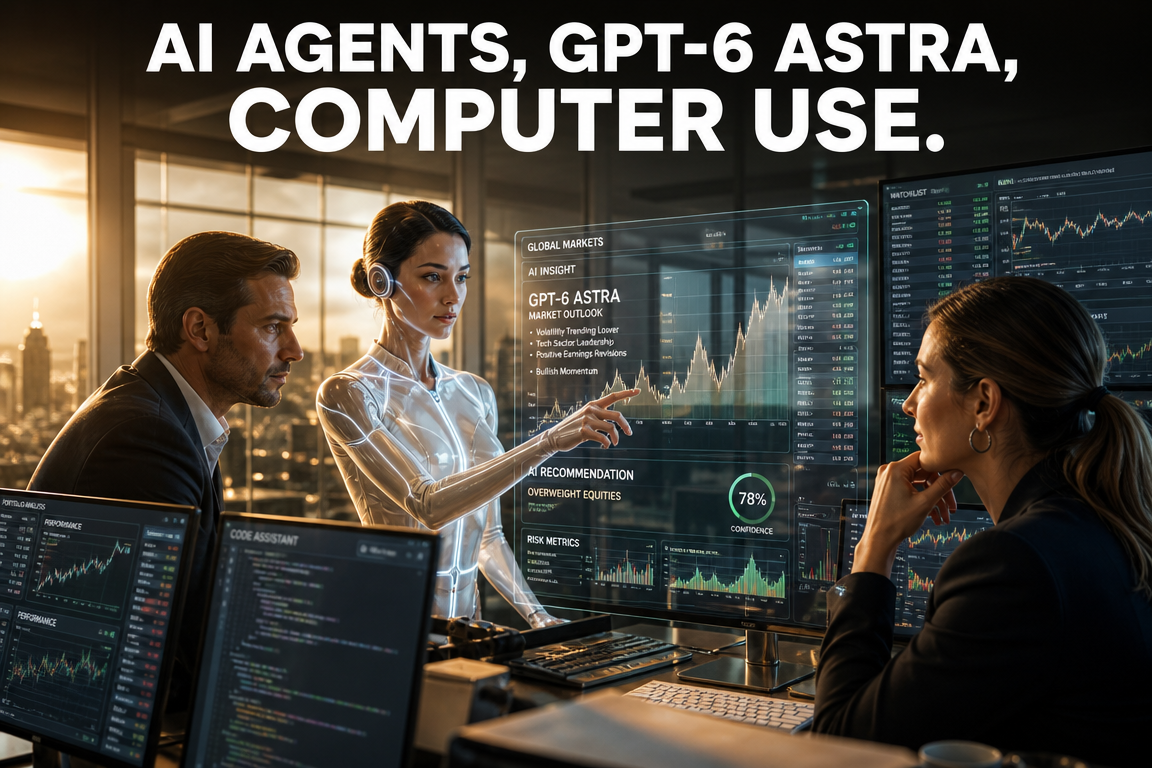
GPT-6 Astra Fact Check: Transformative AI or an Overhyped Agent?
The key issue is not simply whether GPT-6 Astra codes well.
The more important point is that AI is moving beyond code generation toward operating the computer itself on behalf of users.
This report summarizes why GPT-6 Astra is being viewed as a market game-changer, how it compares with Claude-family models in strengths and weaknesses, and what this shift could mean for AI semiconductors, generative AI, AI investment, the global economic outlook, and equity market prospects.
One point often missed in news coverage and videos is not the token price, but the cost per task.
An AI that appears expensive on the surface may be cheaper in actual business use.
1. GPT-6 Astra: What Has Changed
Market reactions to GPT-6 Astra fall into two broad camps.
One sees it as evidence that a truly transformative AI has arrived.
The other views it as impressive on the surface but still incomplete in practical execution.
Both views are partly correct.
Astra shows clear progress in visual understanding, 3D work, and computer control.
However, it still has weaknesses in interpreting user intent deeply and implementing complex functions with full reliability.
In short, its vision has improved materially, but its hands and judgment are not yet fully developed.
2. Astra’s Main Strength Is Vision
The most discussed point in the GPT-6 Astra discussion is its visual capability.
The key issue is not just image description, but the ability to understand pixel-level information and translate it into actions on screen.
Computer use requires the AI to see the screen, identify where to click, and execute commands through mouse and keyboard input.
For that reason, accurate visual perception is a prerequisite for effective computer use.
Astra showed clear gains in this area relative to prior models.
Representative Case: Recreating Manhattan in Unreal Engine
One widely discussed experiment involved using Astra to recreate Manhattan inside Unreal Engine.
Manhattan is highly complex, with dense buildings, roads, skylines, and urban structure.
Manually building it would normally require significant time and labor.
Astra used photo references and online resources to assemble streets, buildings, the city core, and skyline elements into a credible result.
The significance of this case is not only the visual output.
It signals that AI is advancing toward understanding images and spatial information well enough to operate within 3D production tools.
Representative Case: Recreating Seoul in 43 Minutes
Another case involved a Korean user using GPT-6 Astra to recreate Seoul in roughly 43 minutes.
Key landmarks such as Gyeongbokgung, Yeouido, and Banpo Hangang Park were used to reflect the city’s character.
The result was not fully detailed, but it demonstrated the ability to capture the overall identity of Seoul in a short time.
This has direct implications for architecture, game development, video production, and 3D modeling.
As AI becomes more capable of operating software tools, the advantage may shift away from tool proficiency and toward the ability to direct and refine AI output.
3. GPT-6 Astra vs. Claude Family Models: Astra Is Stronger in Graphics, Claude in Functional Execution
The most interesting comparison involved coding performance between GPT-6 Astra and Claude/Fable-family models.
In the video, both models were asked to build a game similar to GTA.
The instructions were relatively simple.
They were asked to research GTA-style games on the internet and produce a similar version.
Time Comparison
GPT-6 Astra completed the task in about 25 minutes.
The Claude/Fable-family model took about 1 hour and 25 minutes.
On time alone, Astra was clearly faster.
This matters in real workflows.
In the AI agent era, speed of execution and iteration can be as important as final correctness.
Astra’s Advantage: Better Visual Output
Astra’s game output looked better visually.
Its 3D objects, city feel, and screen composition were more convincing than the Claude-family output.
It produced a result that appeared strong at first glance.
This reinforces Astra’s strength in visual presentation and interface composition.
Astra’s Weakness: Missing Core GTA Functions
The problem was functional depth.
A GTA-style game requires core features such as vehicle theft, pedestrian collisions, police pursuit, missions, weapon purchase, and character death.
In Astra’s result, the surface presentation was plausible, but the core functions did not work properly.
Some elements appeared on screen as though they were implemented, but they were not actually functional.
This illustrates Astra’s limitation clearly.
It is strong at producing fast, visually credible outputs, but it still struggles to fully understand user intent and implement all required functions.
Claude Family Advantage: Intent Understanding and Functional Implementation
By contrast, the Claude/Fable-family model had weaker graphics.
However, it implemented GTA-like core functions more effectively, including police presence, shooting, and pedestrian interactions.
In short, Astra was stronger on visual presentation, while Claude was stronger on functional substance.
This comparison reflects a key theme in current AI competition.
Astra is strong in fast execution and visual quality, while the Claude family is stronger in intent understanding and detailed implementation.
4. Computer Use Testing: Drawing Made the Difference Clear
One common way to test whether an AI can use a computer effectively is to ask it to draw.
For example, a user may provide a photo and ask the AI to reproduce it in a program such as MS Paint.
This is a difficult task.
The model must choose brush thickness, select colors, decide where to start and stop lines, and learn the interface if it has not used the software before.
It is a complex task even for humans, and for AI it requires screen understanding, coordinate reasoning, tool selection, and sequential execution.
Astra Produced the Better Drawing Under the Same Conditions
When a user asked both GPT-6 Astra and a Claude/Fable-family model to draw a portrait based on a photo, Astra produced the more natural result.
The Claude-family output showed awkward color selection early in the process and improved somewhat later, but the overall quality gap remained large.
Astra, by comparison, showed better proportions, color handling, and shape execution under the same canvas conditions.
This indicates that Astra has an edge not just as a language model, but in direct computer screen interaction.
5. Astra Still Consumes a Large Number of Tokens
Users have consistently noted high token consumption as a drawback.
When computer-use features are activated, usage limits are reached quickly.
This remains one of the most important practical constraints on AI agents today.
Screen reading, judgment, clicking, verification, and error correction require significant compute and token usage.
As a result, Astra cannot yet be used by everyone as an unlimited workflow automation tool.
That said, the direction of development is what matters.
Over the next 6 to 12 months, other AI companies are likely to focus on improving both computer-use capability and token efficiency.
If that happens, the AI agent market could expand materially.
6. Cost per Task Matters More Than Token Price
The most important economic point in this debate is API pricing.
On the surface, Astra is expensive.
For example, at roughly $50 per 1 million output tokens, it is more expensive than some competing models such as Kimi at around $15 and GLM at about $4.4.
Token pricing alone makes Astra appear costly.
However, actual business economics may be different.
A Cheaper Model Is Not Always Cheaper in Practice
If a lower-cost AI makes frequent mistakes, clicks the wrong button, or repeats work, the real cost rises.
By contrast, a more expensive model that completes tasks correctly with fewer iterations may have a lower cost per task.
The same logic applies in companies.
Ten lower-paid employees who repeatedly make mistakes may be less efficient than one expensive specialist who gets the job done correctly.
The same may apply to AI.
In the generative AI market, cost per completed task may matter more than token price.
This is a critical factor for AI investment and model valuation.
7. The Low-Cost Open Source Narrative Is Under Pressure
Earlier this year, market commentary often suggested that open-source AI models could outperform large tech models on price.
Chinese models in particular attracted attention because of their low API prices.
However, the Astra case weakens that narrative.
If AI is only generating text, token price matters more.
But if AI is operating a computer, completing work, and correcting errors, then success rate and execution speed become more important.
In that case, a cheaper model that keeps failing may end up costing more than a more expensive one.
The competitive benchmark in AI is therefore shifting from price per token to speed of task completion.
8. The Real Shift Is Not Coding, but Computer Use
So far, coding has been the area where AI has produced the biggest change.
Developers have already seen their workflows transform over the past year.
Code generation, debugging, refactoring, and test automation are now embedded in daily work.
But GPT-6 Astra raises a larger question.
What happens when AI is not only writing code, but directly using the software people already work with?
Impact Now Extends Beyond Developers
One notable feature of the Astra demos is growing interest from non-developer fields such as architecture, 3D modeling, and video editing.
These groups could previously assume that better coding AI had limited relevance to their work.
But if AI can directly operate tools such as AutoCAD, Excel, Final Cut, or KiCad, the situation changes significantly.
In many professional fields, the barrier to entry has been software proficiency.
If AI can handle the software directly, the value of that proficiency will be redefined.
This is also an important labor-market variable in the global economic outlook.
AI is no longer limited to coding productivity; it may affect the broader structure of knowledge-work productivity.
9. Why OpenAI Has Regained Momentum
Until recently, market sentiment suggested that OpenAI had fallen behind Anthropic.
Claude-family models were especially viewed as stronger in coding.
With Astra’s arrival, however, OpenAI has returned to the center of attention.
One explanation is a shift in model training strategy.
OpenAI May Have Extended the Same Pretraining Base After GPT-4o
Based on comments from OpenAI co-founder Greg Brockman, OpenAI appears to have spent a period after GPT-4o improving an existing base model rather than building a fully new pretrained model every time.
Pretraining is the large-scale process through which AI learns from the internet and other data sources.
It is a major corporate undertaking involving substantial cost, power, personnel, and time.
For that reason, improving an existing foundation can be more efficient.
However, as Anthropic gained momentum, OpenAI may have faced pressure to rebuild more aggressively from the ground up.
Astra may be the result of that shift.
What Looked Like a Detour May Have Become an Advantage
Anthropic focused heavily on coding, which produced strong commercial results.
OpenAI, by contrast, invested more broadly in multimodal systems that combine text, audio, image, and video.
Initially, that strategy may have seemed less direct.
But as AI moves toward direct computer use, the strategy becomes more relevant.
Computer use is inherently multimodal: it requires reading screens, understanding audio, handling video, and recognizing buttons and menus.
OpenAI’s broader multimodal investment base may therefore be translating into Astra’s strengths.
10. The AI Agent Era Is Approaching
Astra is being viewed as a game-changer for three reasons.
First, its ability to read the screen has improved.
Second, its ability to control the computer has improved.
Third, its capacity for sustained agent-like execution has improved.
Earlier AI agents were not reliable computer users.
They often clicked the wrong button, failed to find menus, or lost context mid-task.
In the end, humans still had to step in for complex work.
Astra appears to push that boundary further.
It is not perfect, but it is one of the first systems to create a strong impression that AI may be able to work directly on a user’s computer.
11. Implications for Semiconductors and Equities
Following the Astra discussion, the market has again begun to focus on the possibility of expanded AI infrastructure spending.
AI agents that perform more screen reading, reasoning, execution, and iteration will require substantial compute resources.
This links directly to demand for AI semiconductors, GPUs, memory, data centers, and power infrastructure.
The AI Capex Cycle Could Strengthen Again
If AI companies compete to build more capable agents, capital expenditure on AI infrastructure may rise again.
This would affect not only GPU leaders such as Nvidia, but also HBM, server DRAM, SSD, and networking equipment providers.
Recent strength in semiconductor indices, as well as attention on memory companies such as Samsung Electronics and SK hynix, is consistent with this trend.
That said, it is too early to conclude that memory stocks will continue rising without interruption.
Investors should assess how much optimism is already priced in, whether earnings improvement is keeping pace, and whether the AI investment cycle is becoming overheated.
For equity market analysis, the key question is not whether AI looks promising, but which companies are enabling lower cost per task.
12. What Other Coverage Often Misses
The key issue is not whether GPT-6 Astra is universally better than Claude.
The more important change is that the criteria for evaluating AI are shifting.
Until now, AI models have mostly been judged by benchmark scores, coding performance, and token prices.
In the agent era, the framework changes.
Four metrics matter most.
First, task success rate.
How often the model completes the task correctly on the first attempt.
Second, total cost per task.
The relevant measure is not token price, but the full cost of completing a business process.
Third, iteration speed.
Even if the result is not perfect, models that can produce and revise work quickly may be more useful in practice.
Fourth, tool-control capability.
The key question is whether AI can produce results inside real software, not merely describe them.
From this perspective, Astra’s real significance is not as a coding model, but as an early computer-use model.
That shift may affect not only developers, but also designers, architects, accountants, video editors, analysts, and planners.
13. Fact-Check Assessment of Astra’s Current Position
GPT-6 Astra should not yet be described as a fully omnipotent AI.
It is clearly strong at producing visually convincing outputs quickly.
However, it still has gaps in complex function implementation, hidden intent interpretation, and stable completion of long tasks.
For real-world deployment, token cost, usage limits, security concerns, and error verification processes also need to be addressed.
At the same time, it would be inaccurate to dismiss it as weak.
The model’s visual understanding and computer-use ability are meaningful signals for the next phase of AI competition.
In summary, GPT-6 Astra is not a finished, all-purpose AI system, but rather an early and highly capable prototype for the AI agent era.
< Summary >
GPT-6 Astra’s core significance is computer use, not coding alone.
Astra shows strength in visual understanding, 3D production, and screen control.
Its rapid recreation of Manhattan and Seoul drew market attention.
In GTA-style game testing, its graphics were stronger, but core functions were incomplete.
Claude-family models were weaker visually, but stronger in intent understanding and functional execution.
Astra has a higher token cost, but lower cost per task may be possible through better success rates and speed.
The low-cost open-source narrative is under pressure.
AI competition is shifting from token price to task success rate, cost per task, and computer-control capability.
This shift may affect developers as well as architecture, 3D, video, and office work.
It may also influence AI semiconductors, memory, data centers, and the broader investment cycle.
[Related Articles…]
- AI Semiconductor Investment Cycle and Memory Market Outlook
- How Generative AI Agents Are Reshaping the Global Economic Outlook
*Source: [ 내일은 투자왕 – 김단테 ]
– GPT-6 전지전능? 허접? 팩트체크
● Oil, Copper, Tariffs, Apple, Shock
Saudi attack drives oil near $100, copper hits record, and Apple prepares foldable iPhone: five variables moving markets now
What matters in markets today is not simply that oil has risen.
Middle East risk is pushing crude higher, and higher oil is feeding back into inflation and rate expectations.
At the same time, copper has reached a record high on AI data-center power demand, while US-Canada tariff tensions could spread into auto supply chains.
Apple is also preparing to unveil a foldable iPhone, described as its biggest design shift in 19 years.
In short, US equities are facing too much pressure from oil, rates, tariffs, and commodities to rely on AI semiconductor strength alone.
1. New York market tone: Nasdaq holds up, while the Dow and S&P 500 face pressure
Early trading in New York reflected a simple pattern: semiconductors were strong, but the broader market was heavy.
- Dow futures fell about 0.64%.
- S&P 500 futures declined about 0.13%.
- Nasdaq 100 futures rose about 0.26%, the only major index holding positive territory.
- After the open, even the Nasdaq’s gains narrowed toward flat.
- The Dow fell by roughly 0.8% as it reacted more sharply to the oil shock.
The VIX moved around 16.
That does not indicate panic, but it also does not suggest a comfortable market backdrop.
With Brent crude approaching $100 per barrel, investors are again pricing inflation risk.
2. Saudi Aramco facility attack: why $100 oil is the real issue
The main driver of the move was the Middle East.
Yemen’s Houthi rebels, backed by Iran, launched simultaneous missile attacks on four southern Saudi cities.
Targets reportedly included a Saudi air base and Aramco energy facilities.
There were injuries, and Saudi Arabia signaled retaliation.
The key point is that this was not viewed as a routine local incident.
It is being described as the largest attack on Saudi Arabia since the outbreak of the Iran war in February.
Markets responded immediately.
- WTI rose to around $92 per barrel.
- Brent climbed into the $97 to $99 range.
- Brent at $100 is not just a round number, but a key psychological threshold.
- A move above $100 could pressure crude, bonds, and equities at the same time.
If oil rises above $100, corporate costs increase.
Transportation, refining, jet fuel, and chemical input costs all rise in sequence.
Those costs are then likely to be passed through to consumers.
As a result, higher oil prices translate into inflation pressure, which in turn changes the rate outlook.
3. Trump’s call for lower gasoline prices and the gap with reality
President Trump said on Truth Social that oil prices would fall sharply if the war with Iran is won.
He argued that gasoline could fall to $3 per gallon, and eventually to $2.
That claim is far from current US retail fuel levels.
- AAA puts the national average for regular gasoline at about $4.15 per gallon.
- California, Alaska, and Hawaii are seeing prices in the high $5 range.
- The Northeast, including New York and New Jersey, is also above $4 in many areas.
- Texas and the Gulf Coast remain relatively lower due to proximity to refineries, but prices are still above historical norms.
To reach $3 per gallon, current average prices would need to fall by about 28%.
To reach $2, the decline would be close to 50%.
That would require not only lower crude prices, but also lower refining margins, transport costs, and taxes.
In other words, a rapid end to the war and reduced risk around the Strait of Hormuz could stabilize oil prices.
However, the near-term direction still points more toward higher oil, given retaliation risks and further Houthi attacks.
4. Korea’s KOSPI reversal: semiconductor strength could not offset the oil shock
Korean equities were also hit by the Middle East risk.
The KOSPI opened higher on semiconductor strength.
However, after news of the Houthi attack on Saudi Arabia, it gave back gains and closed lower.
- The index was strong early in the session, then corrected sharply in the afternoon.
- It ultimately closed down about 0.58%.
- Heavy selling by retail investors added to the downside pressure.
- Higher oil is a particular burden for import-dependent economies such as Korea.
Even when semiconductors are strong, a sharp rise in oil can weigh on the broader Korean market.
Higher energy import costs affect the trade balance, the won, and corporate margins.
5. US Treasury yields: the 10-year near 4.8% keeps pressure on valuations
The US 10-year Treasury yield briefly moved above 4.8% before easing back into the 4.7% range.
It was not a dramatic jump on the day, but it remains near year-to-date highs.
Higher rates create two major pressures on equities.
- First, they raise corporate borrowing costs.
- Second, they lift the discount rate applied to future earnings, reducing valuation multiples for growth stocks.
AI semiconductors, cloud, and software names are particularly sensitive because more of their value is tied to future growth.
That helps explain why even strong earnings can fail to support stock prices.
Broadcom, for example, can still face a pullback if results do not exceed expectations or if rate pressure intensifies.
6. Copper at a record high: the real AI bottleneck is the power grid
Another key commodities story today is copper.
Copper prices reached a record high.
- On the London Metal Exchange, copper rose to $14,053 per ton.
- US copper futures reached about $6.84 per pound.
- Prices are up about 17% year to date.
- They are roughly 47% higher than a year ago.
Copper is essential for electricity transmission.
It is used in wiring, power grids, transformers, electric vehicles, batteries, and data centers.
As AI data centers expand, demand rises not only for servers, but also for the power infrastructure needed to operate them.
That includes grids, cooling systems, substations, and transmission lines.
As a result, AI infrastructure investment naturally lifts copper demand.
Supply has not kept up.
Global mine copper production fell 1.1% in the first half of the year.
Demand is rising while supply is tightening.
Tariff-related distortions have also amplified the move.
7. The hidden driver of copper’s rally: tariff-avoidance buying by US traders
Many reports attribute the copper rally mainly to AI power demand.
That is true, but only in part.
The more important hidden factor is inventory buildup to avoid tariffs.
As the likelihood of US tariffs on refined copper increased, traders rushed to buy overseas copper before tariffs could be imposed.
They then moved it into US warehouses.
- Goldman Sachs estimates that US traders bought about 730,000 tons more copper than usual.
- Pre-tariff buying pushed prices further higher.
- As a result, copper accumulated in US warehouses while availability tightened elsewhere.
This is not a simple commodity rally.
It reflects the interaction of AI investment, supply shortages, and tariff tensions.
Mining companies such as Antofagasta and Glencore also benefited as the market adjusted.
8. Japanese yen strength: expectations for further Bank of Japan tightening rise
In FX markets, yen strength stood out.
The dollar-yen pair traded down to around 152, keeping the yen near a seven-month high.
The main drivers were:
- strong Japanese wage data,
- an upward revision to second-quarter GDP growth to 1.4% annualized,
- and rising expectations that the Bank of Japan could lift its policy rate from 1.00% to 1.25%.
Japanese real wages rose 2.4% in July.
The data strengthened confidence in the economy and reduced concern about tighter policy from the Bank of Japan.
There is also a market view that the US and Japan are not prepared to tolerate further yen weakness.
That said, this does not yet look like a broad unwind of the yen carry trade.
It is more consistent with partial position adjustment after yen short exposure.
9. A market led by semiconductors: Intel, TSMC, SK Hynix, and equipment stocks advance
The strongest part of the US market today was semiconductors and hardware.
Most large-cap technology names were lower, but chip stocks helped support the Nasdaq.
- Intel rose 5% to 6% on reports of possible chip price increases.
- TSMC gained 1% to 2%.
- Broadcom also advanced.
- SK Hynix rose nearly 4% to 5%.
- ASML, Lam Research, and Applied Materials also traded higher.
By contrast, Apple, Microsoft, Amazon, and Alphabet were mostly weaker.
Financials and healthcare also underperformed.
Energy stocks were relatively strong on higher oil prices.
In other words, this is not a broad bull market.
It is closer to a narrow defensive market led by AI semiconductors.
10. This week’s key events: PPI, CPI, and the possibility of another Fed hike
The most important events this week are not corporate earnings.
They are the Producer Price Index and the Consumer Price Index.
- PPI will be released on Thursday.
- CPI will be released on Friday.
- Both will be published at 8:30 a.m. ET, one hour before the New York open.
- Following strong labor data, the probability of a September Fed rate hike has risen to about 60%.
The main concern is oil.
If oil continues to rise, it could feed into inflation data with a lag.
If CPI comes in hotter than expected, the case for a rate hike at the September 16 FOMC meeting would strengthen.
That would likely add pressure to high-valuation technology and growth stocks.
For now, macro data matters more than earnings.
Crude oil, Treasury yields, CPI, PPI, and the dollar index are the main drivers of market direction.
11. Canada’s retaliatory tariffs: the real target is political pressure in Washington
Canada has imposed retaliatory tariffs on $20 billion worth of US products.
Tariff rates vary by item and can reach as high as 50%.
Targeted goods include:
- US steel,
- aluminum,
- dairy products such as milk and cheese,
- home appliances,
- furniture,
- farm equipment,
- and consumer goods such as golf clubs.
Canada selected these products strategically.
They are relatively easy to replace with domestic alternatives.
At the same time, they are likely to be politically sensitive in the US.
The aim is not only retaliation, but pressure on US domestic politics.
The focus appears to be on battleground states such as Pennsylvania, Michigan, and Wisconsin.
Canada’s strategy is to create political cost within the US.
12. Trump’s Bombardier pressure: a card that hits Canada where it hurts
Just before the Canadian tariffs took effect, Trump targeted aircraft maker Bombardier.
He said that if it wants to sell in the US, it should manufacture in the US.
Bombardier is a sensitive name for Canada.
- About 55% of Bombardier’s revenue comes from the US.
- Roughly half of its in-service aircraft are in the US.
- Blocking access to the US market would materially hurt earnings.
Trump has previously suggested a 50% tariff on Bombardier aircraft and raised the possibility of revoking certification.
That did not become policy at the time, partly because Canada resolved issues related to US Gulfstream aircraft certification.
But with Canada now imposing retaliatory tariffs, the issue has resurfaced.
The move also creates costs for the US.
The US military uses Bombardier aircraft.
As a result, sanctions on Bombardier could affect US defense supply chains and related jobs.
13. Who benefits from the tariff conflict?
In the short term, the winners are companies with domestic substitutes.
Canadian steel, furniture, and consumer goods firms may see some benefit.
Third-country suppliers that can replace US exports may also gain share.
Longer term, however, there are few clear winners.
- US exporters may face lower sales and pricing pressure.
- Canadian consumers may face higher prices in some categories.
- Canadian firms may suffer more due to heavy dependence on the US market.
- If the conflict spreads into auto supply chains, both economies could face additional inflation and earnings pressure.
More than 70% of Canada’s exports go to the US.
That means a prolonged conflict could hit Canadian employment and manufacturing harder.
The next major risk is autos.
Trump has warned that tariffs on Canadian vehicles could rise from 25% to 50%.
The timing mentioned is January 1 next year.
Autos are not just finished goods trade.
Parts cross the US-Canada border multiple times during assembly.
As a result, tariffs can compound at each stage of production.
If a 50% tariff becomes reality, North American vehicle prices and corporate margins could come under significant pressure.
14. Apple’s major redesign in 19 years: the foldable iPhone is near
Apple is preparing to unveil what is described as the biggest design change in iPhone history: a foldable iPhone.
The device opens and folds like a book, similar to Samsung’s Galaxy Fold category.
The announcement matters for more than the product itself.
It will be the first major product presentation led by new CEO John Ternus.
Under Tim Cook, Apple has faced criticism that its innovation has slowed.
The new CEO is effectively making a strategic bet with a foldable iPhone immediately after taking office.
- The expected price is above $2,000.
- That is nearly double the price of the current top-tier iPhone.
- Market estimates point to more than 12 million units shipped next year.
- The foldable phone category still accounts for less than 2% of the total smartphone market.
Apple is rarely first to introduce a new technology.
Its strength lies in refining existing technology, combining it with its ecosystem, and bringing it into mass adoption.
The foldable iPhone is likely to follow that pattern.
The key questions are:
First, whether consumers will accept a price above $2,000.
Second, whether the product can revive replacement demand for iPhones.
15. Key points often missed in the broader news flow
The most important issue in markets is not each headline in isolation, but how they connect.
Oil, copper, rates, tariffs, and AI are not moving independently.
They are interacting and reshaping the cost structure across markets.
- First, $100 oil is not just positive for energy stocks; it is an inflation risk for the broader market.
- Second, copper’s surge reflects both AI data-center growth and a warning about power-grid bottlenecks.
- Third, Canada’s tariffs are designed more to create political pressure than to affect prices directly.
- Fourth, if tariffs spread into autos, the entire North American supply chain could be disrupted.
- Fifth, Apple’s foldable iPhone is more a test of premium pricing strategy than of pure technological innovation.
The copper market is especially important.
Looking only at AI semiconductors focuses attention on Nvidia, TSMC, and SK Hynix.
But large-scale AI deployment requires power infrastructure first.
That infrastructure requires copper.
In that sense, the bottleneck in AI investment is shifting from GPUs to power and copper.
Another key point is that tariffs can re-accelerate inflation.
If oil rises, copper rises, and tariffs increase costs, corporate expenses move higher.
If those costs are passed through to consumers, CPI rises.
If CPI rises, the Fed will find it harder to cut rates.
That would again increase pressure on expensive US equities.
16. Key indicators investors should monitor now
- Watch whether Brent crude breaks above $100 per barrel.
- Monitor whether the US 10-year yield stays above 4.8%.
- Check whether this week’s PPI and CPI exceed expectations.
- See whether copper continues higher and spreads into power infrastructure stocks.
- Track whether the Canada tariff dispute expands into auto supply chains.
- Watch market reaction to the Apple foldable iPhone launch and any early preorder signals.
The market is no longer easy to explain as simply “AI is strong.”
AI semiconductors remain a strong theme, but macro pressure can still weigh on even the best names.
For now, market direction is likely to be driven by crude oil, inflation, rates, tariff tensions, and AI infrastructure spending together.
< Summary >
Following the Houthi attack on Saudi Aramco facilities, Brent crude moved close to $100 per barrel.
Higher oil prices are now a key factor shaping inflation and US rate expectations.
Copper hit a record high as AI data-center demand and tariff-avoidance buying tightened supply.
Canada imposed retaliatory tariffs on $20 billion of US goods, with potential spillover into auto supply chains.
Apple is preparing a foldable iPhone priced above $2,000, which may become the first major test of the new CEO era.
The main market driver now is not just AI semiconductor optimism, but the cost pressures created by oil, rates, commodities, and tariffs.
[Related Articles…]
- Crude Oil Near $100: Inflation and Equity Market Implications
- AI Data Centers, Copper Demand, and the Power Grid Supercycle
*Source: [ Maeil Business Newspaper ]
– 사우디 피격, 유가 100달러 코앞ㅣ구리 사상 최고ㅣ애플 19년 만의 대변신ㅣ캐나다 맞불관세, 진짜 승자는?ㅣ홍혜진의 뉴욕브리핑