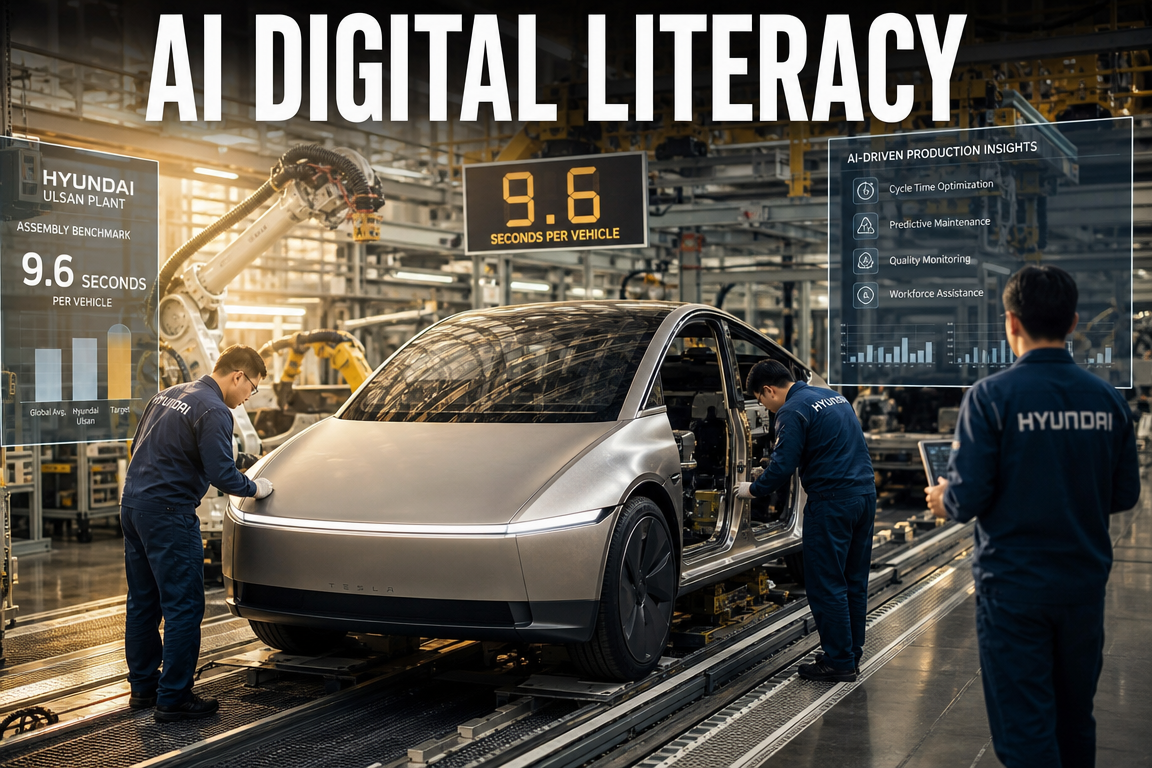
● Tesla Cybercab, 10-Second Shock, Hyundai 9.6-Second Myth
Tesla Cybercab’s 10-Second Production Target: Why It Should Not Be Compared Directly With Hyundai’s 9.6 Seconds at Ulsan
The key issue here is not a simple “Hyundai at 9.6 seconds, Tesla at 10 seconds” comparison.
The core point is that Tesla is eliminating labor-intensive tasks from the automotive production line itself.
In particular, the unboxed manufacturing process shown in Cybercab production footage is a major shift that affects EV manufacturing costs, autonomous robotaxi scalability, and Tesla’s valuation premium.
This report reviews why Tesla rose sharply even on a down day for U.S. equities, what Hyundai’s 9.6-second figure at the Ulsan plant actually means, Tesla’s Cybercab production method, the potential role of Optimus robots, and the investment implications that are often overlooked in other coverage.
1. Tesla Rose While the Market Fell: The Day’s Background
On the reported date, Tesla closed at $368.16, up 3.98% on the day.
By contrast, U.S. equities were broadly weaker.
The Dow Jones fell 1.17%, the S&P 500 declined 0.5%, and the Nasdaq lost 0.32%.
Rising oil prices, renewed Middle East tensions, and uncertainty around the Federal Reserve’s rate outlook weighed on the market.
In a risk-off session such as this, growth and technology stocks often weaken together.
However, Tesla rose nearly 4%, moving against the broader market.
This suggests that company-specific developments were a larger driver of the stock than external macro factors.
The main catalyst was the Cybercab production video and the market’s interpretation of the unboxed manufacturing process.
2. The Key Takeaway From Tesla’s Cybercab Production Video
Tesla’s Robotaxi account released a roughly 48-second Cybercab assembly video.
The central message was that vehicle modules are assembled in parallel and then merged into the final body in a single step.
Tesla said this approach simplifies automation and can reduce line length by half.
The company even described it as a “manufacturing revolution not seen in 100 years.”
While that language may sound overstated, it is not entirely inaccurate in the context of automotive manufacturing history.
Most auto plants still follow a model that traces back to Ford’s conveyor system introduced in 1913.
The vehicle moves along a long line, while workers and robots install components from both sides.
Robotic welding, modularization, and automation equipment have been added over time, but the basic structure of a car moving through a long production line has remained largely unchanged for more than a century.
Tesla’s unboxed process is an attempt to eliminate that long linear workflow.
3. What Is the Unboxed Manufacturing Process?
The unboxed process does not place a complete car onto a single line.
Instead, the vehicle is divided into several large modules, which are built simultaneously and then joined at the end.
In simple terms, it is not a process of inserting parts into a completed shell, but a structure in which preassembled modules are combined into a car at the final stage.
Conventional vehicle production typically proceeds as follows.
- Steel sheets are stamped in the press shop.
- Body panels are welded together to form the vehicle shell.
- The completed body moves to the paint shop.
- Interior trim, seats, wiring, and dashboard components are installed in the trim and final assembly stage.
- Final inspection and delivery preparation follow.
The key difference is that in the traditional process, the shell is built first.
Workers then enter the confined body or work in awkward positions to connect wiring and install components.
Tesla’s unboxed process reverses this sequence.
The car is divided into modules such as the front body, rear body, left and right structures, and the structural battery pack.
Each module is assembled in a separate area at the same time.
The final vehicle is then joined in one step.
A useful analogy is building a kitchen, bedroom, and bathroom separately and then combining them into a single house.
4. Why the Structural Battery Pack Matters
The structural battery pack is a particularly important element in the Cybercab’s unboxed process.
It is not simply a container for battery cells.
It also serves as part of the vehicle floor structure.
In addition, seats and some interior components may already be installed before the final assembly stage.
In the traditional process, seats must be inserted into the body and fixed in place.
Wiring also has to be connected inside a confined space.
With the unboxed process, the floor module remains open during assembly, making access easier for both humans and robots.
This structure should be viewed not only as a production-speed improvement, but also as a design intended for future robot automation.
5. Tesla’s Efficiency Targets: Half the Line Length, 40% Less Floor Space, 30% Lower Labor Cost
Tesla says the unboxed process can cut production line length by half.
It also claims floor space can be reduced by about 40% and labor costs by about 30%.
The key point is not simply that Tesla wants to use fewer workers.
Rather, it is reorganizing the process to eliminate the tasks that workers previously had to perform.
Paint operations could also change materially.
In conventional auto plants, the entire body is painted after the shell is fully assembled.
Tesla, however, is proposing a model in which modules are painted in advance.
If implemented, this could reduce reliance on a traditional large-scale paint shop.
Paint shops are among the most expensive and space-intensive areas in automotive manufacturing.
Reducing that burden could materially improve cost competitiveness in the EV market.
6. Hyundai Ulsan’s 9.6 Seconds and Tesla’s 10 Seconds Are Not the Same Metric
In Korea, the comparison has recently emerged that Hyundai’s Ulsan plant produces one vehicle every 9.6 seconds, while Tesla’s Cybercab target is 10 seconds, implying Hyundai may be faster.
However, the two figures are based on different definitions.
Hyundai’s Ulsan plant is one of the largest automotive manufacturing complexes in the world.
The site covers about 5 million square meters, or roughly 1.5 million pyeong.
It has 44 internal bus stops and even operates internal shuttle buses due to its scale.
The workforce is about 32,000 people, and multiple vehicle lines are produced simultaneously.
The plant’s annual production capacity is estimated at about 1.4 million vehicles.
There are five independent factories within the complex.
Factory 1 produces Kona and Ioniq models, Factory 2 produces SUVs such as Santa Fe and Palisade, and Factory 3 produces models such as Avante and Kona.
If the Ulsan plant produces about 6,000 vehicles per day and operates 16 hours per day, that equals 57,600 seconds.
Dividing 57,600 seconds by 6,000 vehicles yields 9.6 seconds.
In other words, 9.6 seconds is a simple average derived from the plant’s total output.
It does not mean that a car leaves a single line every 9.6 seconds.
7. The Comparison Changes When Measured by Line
Measured at the line level, Hyundai Ulsan’s production speed is different.
For example, if Ulsan Plant 3 produces about 90 vehicles per hour, then 3,600 seconds divided by 90 equals one vehicle every 40 seconds.
If Plant 3 has two lines, such as Line 31 and Line 32, then one line may correspond to roughly one vehicle every 80 seconds.
By contrast, Tesla’s 10-second Cybercab target appears closer to the time required for one vehicle on a specific production line.
Therefore, comparing Hyundai Ulsan’s plant-wide 9.6-second average directly with Tesla’s 10-second line target is not appropriate.
This is the most commonly misunderstood point in the debate.
8. What Tesla’s 10-Second Target Means for Annual Output
If Tesla can produce one Cybercab every 10 seconds, theoretical annual output on a single line could reach about 1.44 million units.
If Tesla eventually reaches the 5-second target mentioned by Elon Musk, theoretical annual output could rise to about 2.88 million units.
These figures assume ideal utilization and no production bottlenecks.
In practice, initial mass production would be much slower.
According to the source material, the first production Cybercab reportedly rolled out of Giga Texas on July 17.
It was also noted that there are about 420 autonomous vehicles registered in Texas, including roughly 45 Cybercabs.
These numbers indicate that Cybercab is still in an early stage rather than full-scale mass production.
For now, the appropriate framework is production validation and early ramp-up.
9. What Tesla Is Quietly Removing From the Factory
The most important question is not how fast Tesla can produce vehicles.
The real question is what Tesla is removing from the factory.
The Cybercab no longer has a steering wheel.
The steering column is also gone.
Instead of a mechanical steering linkage, the vehicle uses steer-by-wire.
This technology first appeared in the Cybertruck and is being extended to Cybercab.
Removing the steering wheel changes more than the cabin design.
It reduces parts, assembly steps, inspection steps, and supply-chain complexity.
When parts disappear, assembly time, failure risk, and cost structure also change.
This is the core of Tesla’s manufacturing strategy.
10. Why Tesla Wants to Remove Human Labor
At first glance, Tesla appears to be trying to reduce labor costs.
Indeed, the company has suggested that the unboxed process could reduce labor costs by 30%.
However, the more important objective is not simply to cut headcount, but to eliminate tasks that humans previously had to perform.
The most difficult area to automate in traditional auto manufacturing is the trim and final assembly stage.
This stage includes seats, dashboards, wiring, interior trim, and various connectors.
Robots are good at placing heavy objects accurately.
But they are less effective when handling wiring harnesses, hoses, or sealants that vary slightly in shape each time.
Wires bend when picked up, hoses flex, and connectors can fail to seat if the angle is even slightly off.
For that reason, trim and final assembly still depend heavily on skilled labor.
According to the source material, the automation rate of Hyundai Ulsan’s trim line is estimated at around 10%.
This indicates that even in a highly automated auto industry, the final assembly stage remains human-intensive.
11. The Unboxed Process May Be a Factory Built for Robots
In a conventional process, workers must place their upper bodies into the finished body shell and perform assembly in confined spaces.
They bend, twist, and reach into areas that are difficult to access.
This is physically demanding for people and even more difficult for robots.
But if the vehicle is split into modules, the work surfaces become open and accessible from the outside.
It becomes easier to install components behind the dashboard and to attach seats to the battery pack without entering the cabin.
This structure is more convenient for humans, but more importantly, it is better suited to robots.
Tesla may therefore be designing Cybercab not only as a robotaxi, but also as a vehicle that is easier for robots to assemble.
This highlights the difference in manufacturing philosophy between Tesla and traditional automakers.
12. Optimus Is Not Yet the Factory’s Main Labor Force
That said, Optimus is not yet meaningfully replacing humans on the factory floor.
Elon Musk has stated in an earnings call that Optimus is not yet used in a material way at Tesla’s factories.
Current reported tasks are mainly simple repetitive functions.
- Selecting battery cells.
- Transporting parts.
- Preparing components for workers.
- Supporting certain inspection tasks.
These are largely pick-and-place operations.
Optimus has not yet reached the stage of wiring installation, seat mounting, or complex trim work.
The most important development to watch is therefore Optimus’s task list.
If Tesla begins assigning wiring, seat installation, or interior assembly to Optimus, the narrative changes materially.
At that point, the unboxed process could be interpreted not just as a production-efficiency initiative, but as a manufacturing platform designed for humanoid robots.
13. Why Other Automakers Will Find This Hard to Copy
Gigacasting is already being pursued by several automakers.
Volvo, Chinese EV makers, and Hyundai are all moving in similar directions under the name Hyper Casting.
However, Gigacasting and the unboxed process are not equally difficult to replicate.
Gigacasting is a manufacturing technology that consolidates multiple parts into one large component.
The unboxed process, by contrast, requires a redesign of the entire vehicle production architecture.
In other words, this is not a matter of installing a few machines.
Vehicle design, battery structure, paint operations, assembly sequence, robot automation, and supply-chain layout all have to be redesigned.
For established automakers to follow Tesla, modifying part of an existing line would not be enough.
The vehicle blueprint itself would need to be redesigned.
Line retrofits may take only months, but developing a completely new vehicle structure and taking it to mass production can take years.
Those years of lead time could become a structural gap between Tesla and its competitors.
14. The European FSD Approval Process Also Matters
The source material also noted that Slovenia approved supervised FSD, making it the sixth approval country in Europe.
In autonomous driving, regulatory approval is as important as technical capability.
Europe in particular has a complex framework of national approvals and broader regulatory processes.
According to the source material, a key vote after October 6 was highlighted as an important milestone.
For Tesla, Cybercab production capacity and FSD regulatory approvals must advance together for the robotaxi business to scale.
Fast vehicle production does not translate into revenue without operating permission.
Conversely, even with regulatory approval, a lack of production capacity would limit market penetration.
For that reason, Tesla’s key variables should be viewed as two pillars: manufacturing innovation and autonomous-driving regulatory approval.
15. What to Watch in Tesla’s Third-Quarter Earnings
There are several key items to monitor in Tesla’s third-quarter earnings release.
First, investors should check how many Cybercabs are actually being produced.
Given the current registration figures, the company still appears to be in an early stage, so ramp-up speed matters.
Second, the scale of capital expenditure tied to the unboxed process should be monitored.
Whether the targets of 40% less floor space and 30% lower labor cost translate into real capital efficiency remains an important question.
Third, investors should track what tasks Optimus is performing at the factory.
If it begins moving beyond simple transport work into trim operations, Tesla’s manufacturing automation story would become materially stronger.
Fourth, the expansion of FSD approvals and robotaxi operating regions should be tracked.
Cybercab is not a conventional EV; it is hardware for the autonomous robotaxi business.
Fifth, investors should assess whether Tesla is being valued not only as an EV seller, but also as an AI-based mobility platform with lower manufacturing costs.
16. The Most Important Point Other Coverage Often Misses
The key issue is not whether Tesla is faster or slower than Hyundai.
The real issue is that Tesla is redesigning cars to be easier for robots to assemble, rather than easier for humans to assemble.
This could change the competitive basis of the auto industry.
Traditional automaker strengths have been large plants, skilled labor, dense supply chains, and stable quality control.
But if Tesla reduces part counts, parallelizes production, and removes human-dependent tasks, the basis of competition changes.
Going forward, the key question may become not who has the larger factory, but who can produce more in less space and with a simpler process.
In an environment of uncertain rates and higher capital costs, factory footprint and capital efficiency can have a major effect on valuation.
If a company can achieve the same output without building a larger plant, the long-term impact on cash flow could be substantial.
From this perspective, the unboxed process is not only a manufacturing technique, but also a direct investment theme tied to Tesla’s long-term margin structure.
17. The Investment Significance of Tesla’s Manufacturing Innovation
Many investors focus on deliveries, average selling prices, and operating margins when evaluating Tesla.
These metrics remain important.
However, if Cybercab and the unboxed process become commercially viable, the investment framework should shift somewhat.
Tesla is trying to move from an EV manufacturer toward an autonomous mobility platform company.
The key variable in that transition is how cheaply, quickly, and at what scale robotaxis can be produced.
As the manufacturing cost per robotaxi falls, per-unit economics improve.
As production speed increases, network expansion accelerates.
And if Optimus enters the factory in a meaningful way, the economics of automation could improve further.
Ultimately, Cybercab’s production method is where Tesla’s AI, autonomy, robotics, and manufacturing strategy converge.
That is why this is more than a simple auto production story.
18. Conclusion
Hyundai Ulsan’s 9.6 seconds is an impressive figure that reflects world-class production capacity.
However, it is a plant-wide average converted into seconds.
Tesla’s 10-second Cybercab target should not be compared to it directly.
The real change Tesla is showing is in the production structure, not just the speed.
The vehicle is no longer moved through a conventional line as a whole body; instead, multiple modules are built in parallel and then joined at the end.
In doing so, Tesla is redesigning paint, welding, trim, steering components, and worker workflow.
Ultimately, the goal is a factory that is easier for robots to operate than for humans.
Cybercab is not simply a steering-wheel-free robotaxi.
It is closer to a new vehicle platform designed from the outset for autonomous driving, mass production, robotics, and cost reduction.
Going forward, investors should monitor not only vehicle sales, but also which tasks are disappearing from Tesla’s factories.
The more tasks disappear, the stronger Tesla’s long-term competitive position may become.
< Summary >
Tesla’s Cybercab 10-second production target and Hyundai Ulsan’s 9.6 seconds are not measured on the same basis.
Hyundai’s 9.6 seconds is a simple average derived from total output at the Ulsan plant.
Tesla’s main focus is manufacturing-structure innovation through the unboxed process, not production speed alone.
The unboxed process builds vehicle modules in parallel and joins them at the end.
This approach is linked to targets such as half the line length, 40% less floor space, and 30% lower labor costs.
In Cybercab, components such as the steering wheel and steering column have been removed.
Tesla appears to be reducing human-intensive trim work and building a factory structure that may be more suitable for Optimus robots in the future.
Key variables to watch include Cybercab production volume, the extent of Optimus deployment in factories, FSD approval expansion, and manufacturing cost improvements.
[Related Articles…]
- Tesla Manufacturing Innovation and EV Market Transformation
- Autonomous Robotaxis and AI Mobility Trends
*Source: [ 오늘의 테슬라 뉴스 ]
– 현대차 울산공장은 9.6초에 한 대를 만듭니다 — 근데 테슬라 공장에는 사람이 하던 일이 없습니다 $368 테슬라 주주는?
● AI, Digital-Literacy, Jobs, Economy
The Difference Between Using AI and Being Used by AI: Why Digital Literacy Will Ultimately Shape Future Employment and the Economic Outlook
The core point of this article is not simply that “AI should be used well.”
The real issue is whether, in an era where generative AI produces answers on our behalf, we can still think and judge independently.
Smartphone dependence, algorithmic recommendations, generative AI responses, digital transformation, and AI-driven job changes are all connected.
The connecting factor is digital literacy.
Those who possess it use AI as a tool; those who do not increasingly delegate their thinking to AI and algorithms.
This gap is likely to shape the economic outlook, interest rate expectations, investment decisions, and occupational competitiveness.
1. News Key Point: DX Was the Era of Search, AX Is the Era of Questions
We have already moved through the era of digital transformation.
During the DX, or Digital Transformation, period, the ability to search for needed information was essential.
When questions arose, people searched portals, compared multiple articles and videos, and connected information independently.
This process naturally trained integrated thinking.
People reviewed multiple sources, compared differing perspectives, and formed conclusions on their own.
Today, however, we are entering the AX, or AI Transformation, era.
We now ask questions rather than search.
Generative AI provides a structured answer immediately.
The problem is that this convenience is highly efficient.
As convenience increases, people are more likely to skip the process of searching, comparing, and questioning information.
As a result, if AI-generated conclusions are accepted without scrutiny, the initiative in thinking shifts from people to AI.
2. Why Literacy Has Become an Economic Capability
Literacy is no longer limited to reading and understanding text.
It now includes the ability to identify, understand, interpret, reconstruct, communicate, and produce new judgments from information.
In the past, literacy centered on reading books and newspapers well.
Today, people must interpret text, video, images, data, algorithmic recommendations, and AI outputs.
This capability is also decisive in economic analysis.
For example, understanding interest rate expectations requires more than looking at the policy rate alone.
It requires consideration of GDP growth, unemployment, consumer price index, producer price index, import prices, crude oil, exchange rates, household debt, government bond yields, and financial stability.
These factors must be connected to assess why the Bank of Korea may raise or cut rates.
This connecting ability is digital literacy, and it is the skill that underpins economic forecasting.
Those who accept only AI-generated summaries become vulnerable to statements that merely appear correct.
Those who ask questions and verify independently can use AI to expand their thinking more effectively.
In the future, AI-related job competitiveness is likely to depend not only on coding skills but also on the literacy required to interpret and validate AI output.
3. Smartphone Zombies and AI-Dependent Individuals: The Problem Is Not the Machine, but the Outsourcing of Thinking
One increasingly common term is “smbies,” a blend of smartphone and zombie.
It refers to people who walk and move while focused on smartphone screens.
The term also describes people who have become functionally merged with their phones.
It is now common for people to search on their phones even during conversation whenever a question arises.
Smartphones already substitute for memory.
People no longer need to memorize phone numbers.
They no longer need to remember routes.
They no longer need to carry cards.
Maps, payments, contacts, schedules, news, and financial transactions are all contained in the smartphone.
The issue is that this trend is advancing further.
In the digital transformation era, smartphones replaced memory and routine actions.
In the AI transformation era, generative AI seeks to replace thinking itself.
This difference is material.
Not remembering a route and failing to exercise judgment are fundamentally different problems.
Once thinking is outsourced, people become increasingly confined within AI’s decision structure.
4. Characteristics of Those Likely to Be Replaced by AI: They Do Not Search, Compare, or Question
Those most likely to be displaced by AI are not necessarily those who use AI frequently.
Frequent users who retain control may become more productive.
The real risk lies with those who accept AI-generated answers without scrutiny.
The first characteristic is consuming content without a clear purpose.
Following algorithmically recommended videos and posts may feel like a personal interest, but it often keeps the user within a platform-defined flow.
In such cases, the user does not choose information; information guides the user.
The second characteristic is treating the first answer as the correct answer.
Accepting the top search result, the most viewed video, or the first generative AI response without review weakens critical thinking.
This is especially risky in areas such as economics, investment, real estate, and stock markets, where conflicts of interest are significant.
The third characteristic is judging based only on titles and thumbnails.
In digital content markets, strong titles and attention-grabbing thumbnails drive clicks.
However, a title is not the same as the content.
Judgment based on titles alone quickly reduces information quality.
The fourth characteristic is using AI answers to dismiss professional judgment.
Generative AI is highly useful, but it is not always accurate.
AI often produces plausible language based on probability.
Therefore, challenging expert analysis or data-driven judgment solely because AI said otherwise is risky.
5. Core Capability for Dominant Use of AI: The Biliterate Brain
Among the concepts proposed by cognitive neuroscientist Maryanne Wolf is the biliterate brain.
The biliterate brain refers to a mind that can read both print-based and digital-based information effectively.
In practical terms, it combines the capacity for deep reading with the ability to rapidly filter digital information.
Print reading supports deeper thinking.
It requires following context, tracing an author’s logic, and interpreting meaning between sentences.
Digital reading, by contrast, is stronger in fast search and information access.
PDF search, data search, news archives, and AI summarization functions significantly reduce time costs.
However, relying only on digital tools can reduce depth of thought.
Conversely, reading only print and avoiding digital tools can lead to slower information processing.
The key going forward is not choosing one over the other, but combining both.
This is the real literacy required in the AI era.
6. How This Changes Economic Learning
One effective way to study economics is to assume the role of the governor of the Bank of Korea.
The exercise is not merely to predict whether rates will rise or fall.
It is to ask what data should be reviewed in order to make that decision.
To assess economic stability, one should examine GDP growth, employment changes, unemployment, consumer sentiment, and corporate investment trends.
To assess price stability, one should review CPI, PPI, import prices, crude oil, geopolitical risks in the Middle East, and shipping conditions.
To assess financial stability, one should examine exchange rates, household debt, lending rates, the property market, government bond yields, and bank liquidity.
This process turns a person from a passive recipient of economic forecasts into an active judge.
That is the more important method of economic study in the AI era.
Rather than asking generative AI, “What will happen to interest rates?”, a stronger question is, “Summarize the variables needed for an interest rate decision and compare their risks.”
7. Nine Practical Principles for Improving Digital Literacy
First, define what you are trying to find.
Without a clear purpose, algorithmic feeds control information consumption.
If you are studying economics, begin with a question.
Examples include: “Why is the exchange rate rising?”, “How does AI semiconductor investment affect the business cycle?”, and “When does a policy rate cut affect equities?”
Second, do not treat the first answer as the correct answer.
The first page of search results, the first video on YouTube, and the first AI response are reference points, not conclusions.
They should be treated as starting points.
Third, focus on the content rather than the title and view count.
High views do not guarantee accuracy.
A strong title does not guarantee meaningful content.
In investment and economics, evidence and data matter more than headlines.
Fourth, do not rely only on what the algorithm selects for you.
Algorithms tend to show what users already like, already believe, and already spend time on.
This reinforces confirmation bias.
Those on the left should examine conservative arguments, and those on the right should compare progressive arguments.
Investors should review bearish views as well as bullish ones.
Fifth, restate what you read in your own words.
Information that is merely memorized is quickly forgotten.
Information that is rephrased in one’s own language is better understood structurally.
It is important to recompose AI summaries in your own wording.
Sixth, pause and verify before sharing.
Accuracy matters more than speed.
Content about economic crises, rate cuts, property crashes, or equity rallies should always be checked against sources.
Seventh, read people as well as content in digital spaces.
There is a person behind every piece of content.
One must read the speaker’s perspective, interests, and intent.
This is contextual reading in the digital age.
Eighth, read and verify generative AI output.
AI responses are useful, but they are not final conclusions.
Figures, policy, law, investment decisions, and recent economic indicators must be rechecked.
AI should be used like a search tool, while judgment remains with the user.
Ninth, design your time use.
Using digital media is not the same as being controlled by it.
Using AI is not the same as surrendering the initiative in thinking to AI.
Without time discipline, algorithms will shape the day.
8. The Most Important Point Rarely Covered in Other News and Videos
Most AI trend content focuses on which AI tools to use.
The more important question is different.
It is whether a person can evaluate the answer produced by AI.
The digital divide in the AI era is not only about access to tools.
Generative AI is now available to almost everyone.
However, outcomes are not the same for everyone.
Those who ask better questions, provide context, verify responses, and connect data use AI as leverage.
Those with vague questions and no verification are confined to average answers.
More importantly, AI may not equalize human capability; it may widen gaps in thinking ability.
Individuals with weak basic literacy may struggle to determine whether AI output is correct.
Those with strong critical thinking can use AI drafts to produce higher-quality outcomes.
AI is available to all, but results depend on literacy.
9. The Core of AI-Driven Job Change: Those Who Can Judge, Not Just Those Who Know Technology, Will Remain
In discussions of AI-driven employment change, displacement is the most common theme.
Routine tasks, basic document work, elementary analysis, customer service, translation, and summarization are already being automated rapidly.
However, not everyone is displaced in the same way.
Those who are less likely to be replaced are not people who can ignore technology.
They are people who understand technology and can judge its output.
What matters is the ability to read data, interpret context, distinguish interests, and design alternatives.
The same applies to companies.
Adopting AI does not automatically increase productivity.
Employees must be able to review AI output and adapt it to business processes.
As a result, corporate competitiveness may depend more on AI literacy than on AI adoption rates.
10. Survival Strategies in the AI Era for Investors and Employees
Employees should use AI as a thinking partner, not merely as an assistant.
Instead of asking only “Draft this report,” they should ask, “Identify the logical weaknesses in this report,” “Summarize opposing views,” or “Point out where the data support is insufficient.”
Investors should not use AI responses as buy or sell signals.
It is appropriate to ask AI for market views, but final investment decisions should be based on data and risk analysis.
Equity markets, exchange rates, and interest rates are not driven by a single variable.
Those studying economics should ask AI to structure information, not merely summarize it.
For example, “Summarize how a U.S. rate cut affects the Korean won” is less useful than “Explain the link between U.S. rates, the dollar index, foreign capital flows, Korean exports, and the won.”
Students and job seekers should develop question design skills rather than search for answers alone.
In the AI era, defining the problem well is more important than finding the answer quickly.
When the problem is well defined, AI becomes a powerful tool.
When it is not, AI will drive the user’s decisions.
11. Conclusion: AI Should Be Used, but Not Allowed to Use You
In the AI era, the key issue is not whether AI is used.
AI is already embedded across work, learning, investment, economic analysis, content production, and customer service.
A complete refusal to use AI will become increasingly difficult.
The central issue is control.
AI should be used without surrendering thought and time.
Digital media should be used without allowing algorithms to define interests and judgments.
Generative AI output should be used, verified, and reconstructed.
Ultimately, the difference between using AI and being used by AI is digital literacy.
Its core components are critical thinking, integrated thinking, and the ability to reconstruct information in one’s own language.
These capabilities will shape economic forecasting, AI-era employability, and individual productivity.
< Summary >
DX emphasized search skills, while AX emphasizes questioning and verification.
As generative AI increasingly produces answers, human critical thinking may weaken.
To avoid being displaced by AI, people need digital literacy, integrated thinking, and the ability to reconstruct information in their own language.
Economic forecasting, interest rate expectations, and investment judgments require interpreting connected indicators rather than accepting AI output at face value.
AI is available to everyone, but outcomes are not equal.
Ultimately, the difference between using AI and being used by AI depends on the ability to think independently.
[Related Articles…]
*Source: [ 경제 읽어주는 남자(김광석TV) ]
– “AI를 쓰는 ��람과 AI에게 쓰이는 사람” 결국 ‘이 능력’에서 갈립니다 | 김광석의 북리뷰 | 문해 내공 [3편]