● AI Agents Reshape Corporate Workflows
Can Hermes AI Agents Be Used in Organizations? What Matters More Than Installation Is Work Design
The core point of this article is not simply that “Hermes is good.”
The truly important point is that autonomous AI agents are beginning to change not just personal productivity tools, but an organization’s work structure, workforce roles, cost management, and security framework.
In particular, as installable multi-agent environments like Hermes become easier to use, even non-developers can automate tasks such as news clipping, meeting note organization, report writing, content publishing, and schedule management.
However, if you try it for just one day and give up, you will see almost no effect.
An AI agent is not a fully finished assistant from the start, but rather a “smart new employee” that needs about a week of training to work properly.
In this piece, we have organized in a news-style format which tasks Hermes agents should be used for first, what to be careful about when introducing them into an organization, how to view token costs and security, and how to train them from Day 1 to Day 7.
1. Why Hermes AI Agents Are Getting Attention
Autonomous AI agents like Hermes and OpenClaw have traditionally been fairly difficult to install and set up.
You had to open a terminal and enter commands, and for ordinary office workers unfamiliar with a CLI environment, the barrier was high from the very beginning.
Recently, however, they have evolved into a system where you can build a multi-agent environment directly on your desktop just by downloading an installation file.
The reason this change matters is that the center of AI use is shifting from “chatbots that ask questions and receive answers” to “agents that are given work and return results.”
-
Traditional AI tools were strong at assisting users with summarization, translation, and image generation.
-
AI agents directly carry out work steps like a user’s hands and feet.
-
Multiple agents can divide roles and work automatically 24 hours a day or at scheduled times.
-
Instead of personally performing every step, people move into the roles of designer and reviewer.
This trend is likely to go beyond simple task automation and become a core infrastructure for digital transformation and productivity innovation.
Companies need to rethink the direction of their AI investment, and individuals need to consider how to hand over their work to agents.
2. What Kind of Work Should Hermes Handle First?
If you try to build a massive automation system from the start, most attempts fail.
The core point emphasized by Minjung Kim, Vice President of HRX Lab, is “first break down your own work.”
You need to divide what you do into broad categories and then find repetitive and inconvenient tasks within them.
-
Daily news clipping
-
Writing meeting minutes and organizing action items
-
Sending emails to the people in charge based on meeting results
-
Drafting reports
-
Researching and summarizing content
-
Creating draft card news posts
-
Converting posts for each channel, such as LinkedIn and Instagram
-
Organizing educational materials and prompt guides
-
Planning the table of contents for a book or report
The best starting point is work that is low in difficulty but repeated frequently.
For example, you can start with something like “Find and summarize 5 major AI industry news items for today.”
Then you can expand it to “Turn the summary into 3 card news slides.”
After that, you can broaden the role further by saying “Rewrite it separately for LinkedIn and Instagram.”
The important thing is not to assign research, summarization, image creation, publishing, and review all at once, but to expand step by step.
This approach increases the agent’s accuracy and is the most realistic way to keep users from giving up.
3. How AI Agents Change Work Design
The core of the AI agent era is “how well you can explain your work.”
In the past, consultants would enter an organization and spend one or three months analyzing processes and redesigning R&R.
Now, the person in charge can act as the subject matter expert, or SME, for their own work and reorganize business processes through conversation with AI.
When designing work, you should first organize the following questions.
-
What is the final output of this task?
-
Where does the input data come from?
-
Which parts can AI handle?
-
Where must a human make the judgment?
-
What are the review standards?
-
Which expressions must be included, and which must never be included?
-
What are our company’s report style, sentence tone, and layout standards?
In the end, introducing agents is not a tool installation issue, but a work redesign issue.
If you cannot distinguish what AI should do and what humans should do, automation turns into confusion rather than efficiency.
On the other hand, if you make this distinction well, you can achieve much greater results with the same workforce.
This is an important change that can affect not only corporate productivity innovation but also the long-term global economic outlook.
4. How Are AI Agents Built for Organizations?
The way AI agents are introduced in an organization depends on the company’s security policies and IT infrastructure.
Some companies may choose to provide employees with a “bare-bones agent.”
A bare-bones agent is an empty agent with only the basic framework.
Employees then configure the roles, inputs, outputs, and system prompts to fit their own work.
For example, if you automate news clipping, you can design it like this:
-
The first agent collects major domestic and international news.
-
The second agent summarizes the collected content.
-
The third agent selects issues important from the company’s perspective.
-
The fourth agent organizes everything into a report format.
-
At the final stage, a human performs the final review.
This structure is similar to automation tools like Make and n8n.
However, AI agents differ in that they go beyond simply moving according to fixed conditions and also understand context and make partial judgments.
Rather than letting employees use external tools indiscriminately, companies are likely to move toward providing an infrastructure where agents can be built safely in-house.
5. Security Issues: Telegram, Tokens, and API Key Management Are the Core Point
Hermes can be used in connection with Telegram.
Through a Telegram bot, you can instruct the agent or receive results without keeping your laptop turned on.
But the most important thing here is managing tokens and key values.
-
Each Telegram bot has its own unique token.
-
If the user ID and bot token are exposed, there is a risk of external access.
-
API keys must be managed like passwords.
-
If a laptop is lost or an account is compromised, the agent’s work history and personal schedule may be exposed.
For personal use, careful attention may be enough to avoid major problems.
But for organizations, the story is different.
That is because agents can access company schedules, customer information, internal documents, and decision-making materials.
Therefore, from a corporate governance perspective, you must design access rights, log management, data storage location, external transfer restrictions, and approval processes.
This is the part that many content pieces gloss over lightly.
An AI agent is a convenient tool, but at the same time it can become the entity that executes the company’s work flow on behalf of people.
So security is not optional; it is a prerequisite for adoption.
6. Should 24-Hour Agent Operation Really Stay On All the Time?
The appeal of autonomous AI agents like Hermes is that they can keep working while the user rests.
For example, you can set up a cron job so that every morning at 10 a.m. it collects and summarizes global AI news and market trends.
You can also make it monitor channels like specific sites, Reddit, and X to detect hot issues.
But not every task needs to run 24 hours a day.
24-hour operation directly leads to higher token costs.
For companies, the more important question is not whether the agent keeps working, but which tasks are worth running continuously.
-
Security, customer support, and outage detection tasks that require real-time monitoring are worth 24-hour operation.
-
News summaries, report writing, and weekly reports are sufficient when run only at scheduled times.
-
For tasks with high token costs, you should limit execution frequency and output volume.
-
Tasks that require final decision-making must always involve a human.
From an AI investment perspective, the important thing is not to use as much as possible, but to measure effectiveness against cost.
In the future, companies are likely to manage agent operating costs much like cloud costs.
In other words, token cost management may become a new IT budget item.
7. Hermes Usage for Beginners
There is no need to start by building a Telegram bot and full automation from the beginning.
The first thing to do is reduce your fear.
Many office workers already have ChatGPT or Claude installed on their phones.
In fact, that alone is enough to begin an agent-like experience.
For example, you can ask like this:
-
“Check my calendar and find time this week for 2 hours of focused work.”
-
“For that time slot, recommend a nearby quiet café with reviews included.”
-
“Read the meeting minutes and organize the action items and tasks by person in charge.”
-
“Turn these 3 news items into a one-page summary for executives.”
In this process, AI performs multiple steps such as checking calendars, location-based search, review analysis, and document summarization.
That is the basic concept of an agent.
You can think of Hermes as a tool that goes one step further by splitting work among multiple agents with different roles.
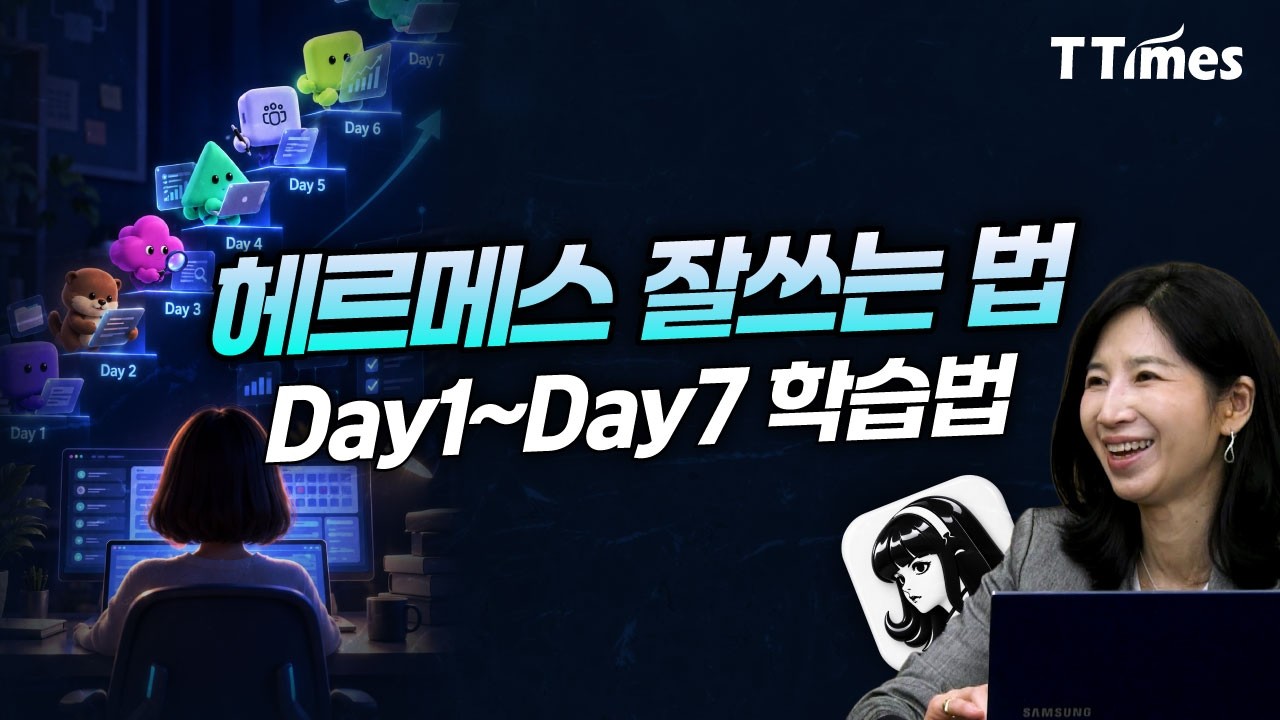
8. Hermes Agent Training Method from Day 1 to Day 7
Many users try it for a day and give up, saying “it is not as good as I thought.”
But an AI agent does not become a customized assistant in a single day.
Vice President Kim advises using it for at least a week.
This week is like an OJT period for a person.
Day 1: Choose Only One Repetitive Task
On the first day, you should decide on only one task to automate.
Repetitive and inconvenient tasks such as news clipping, meeting note organization, or drafting reports are good choices.
At this point, it is helpful to write down the task’s final output, input materials, and review criteria together.
Day 2: Tell It the Form of the Desired Output
On the second day, you need to specify the output format in detail.
For example, give detailed conditions such as “one A4 page,” “for executive reporting,” “include a table,” “5 key points,” and “separate risks and implications.”
It is normal if the AI does not get it right on the first try.
The important thing is to review the result and give feedback again.
Day 3: Match the Company Style and Sentence Tone
On the third day, you should teach it your company’s report style.
You can also tell it the expressions you often use, the expressions to avoid, title format, paragraph structure, and even font or layout standards.
After this stage, the output gradually becomes closer to “the documents I write.”
Day 4: Add One More Role
On the fourth day, expand one step beyond simple summarization.
For example, you can ask the agent that only summarized news to also create a draft card news post.
However, it is better not to assign research, summarization, images, publishing, and review all at once.
Day 5: Strengthen the Review Criteria
On the fifth day, clearly define the points where a person must intervene.
Facts that need verification, sensitive expressions, numbers and sources, and customer information must all be reviewed by a human.
Even if the AI agent works quickly, the final responsibility remains with people.
Day 6: Set the Automatic Execution Time
On the sixth day, decide whether repeated execution is necessary.
Determine whether it should run at 9 a.m. every day, once a week, or only manually when needed.
At this stage, you need to consider token cost and work efficiency together.
Day 7: Organize It as Your Own Office Chief
After about a week of repeated feedback, the agent begins to understand the user’s style to some extent.
At this point, frequently used tasks can be separated into dedicated bots or fixed agents.
From here on, it is no longer just a test but something you can use like a personal office chief who can actually be put to work.
9. Does an Agent Eliminate Human Jobs or Change Them?
The most sensitive issue when introducing AI agents into organizations is jobs.
Agents actually replace part of the work people used to do.
In particular, repetitive tasks, document drafts, research, summarization, and writing emails can be automated to a significant degree.
That said, you should not simply conclude that “people are no longer needed.”
More precisely, people’s roles are changing.
-
Workers who handle repetitive tasks may decrease.
-
Work designers will become more important.
-
Roles that review AI outputs will be needed.
-
Prompt skills for giving agents good instructions will matter more.
-
The value of field experts who know where human judgment is needed will increase.
This change is also connected to inflation, the labor market, and corporate cost structures.
If AI increases work productivity, companies can produce more results with the same number of people.
On the other hand, some jobs may face pressure to retrain and shift roles.
So introducing AI agents is both a technology strategy and a human resources strategy.
10. Governance That Is Absolutely Necessary for Organizational Adoption
If a company wants to introduce agents like Hermes at the organizational level, it should not simply say, “Please try it.”
If it is forced in a top-down way, internal resistance may grow.
That is because employees may feel anxious, wondering whether their jobs will disappear.
Before organizational adoption, the following system is needed.
-
Separate tasks where AI agents are allowed from tasks where they are prohibited
-
Standards for handling personal data and customer information
-
Access rights settings for each agent
-
Designation of the person responsible for reviewing outputs
-
Monitoring of token costs and usage
-
Redesign of R&R by job role
-
AI utilization training and organizational culture management
-
A strategy for what to do with the time saved through automation
This is the most important point in corporate governance.
Organizations that introduce AI agents well can improve not only cost savings but also decision-making speed, customer responsiveness, and internal document quality.
On the other hand, if introduced without a management system, security incidents, unclear responsibility, employee resistance, and quality deterioration can happen at the same time.
11. The Core Point That Other YouTube Videos or News Pieces Often Miss
Most content focuses on “Hermes installation has become easier,” “it can be used through Telegram,” and “it works 24 hours.”
But the real important content is elsewhere.
-
First, the performance of an agent depends more on the quality of the work description than on the tool itself.
-
No matter how good the skill is, if it does not know the context of your work, the output will be ordinary.
-
Second, AI agents are about training, not installation.
-
If you expect perfect results from the beginning, you will be disappointed.
-
You need to keep giving feedback for about a week so it can learn your style.
-
Third, the essence of organizational adoption is not automation but R&R redesign.
-
You need to clearly divide what AI will do, what people will do, and what people will review.
-
Fourth, 24-hour operation is both an advantage and a cost risk.
-
An agent that runs continuously will keep generating token costs.
-
You must distinguish between tasks that truly require real-time operation and tasks that are fine with scheduled execution.
-
Fifth, competitiveness in the agent era is about process design, not prompts.
-
The ability to structure work and divide roles becomes more important than the ability to type good sentences.
In the end, Hermes is not a “free and interesting AI tool,” but a signal of change that forces individuals and organizations to redesign the way they work.
12. Real Use Cases: Content, Education, and Even Book Planning
Vice President Kim actively uses Hermes for content production and organizing educational materials.
A representative example is organizing prompt guides requested by learners after vibecoding training.
Collecting prompts used during training and organizing them into a learner guide is repetitive, but quality matters.
This kind of work is well suited to an agent.
It can also be used when planning a book.
During the research stage, an agent can gather relevant materials, create a draft table of contents, and play the role of a planner comparing ideas.
However, assigning every task at once is not recommended.
A realistic approach is to define about five major work categories and then separate agents one by one within them.
For example, a personal work agent setup could look like this:
-
News research agent
-
Summarization and report agent
-
Content transformation agent
-
Educational material organization agent
-
Schedule and to-do management agent
Even if you only build that much well, the workload for office workers can be reduced quite significantly.
The time gained is better used for more important decision-making, customer communication, strategic planning, and time with family.
13. The AI Trend and Economic Meaning Revealed by Hermes
The spread of autonomous AI agents like Hermes is not just an IT trend.
It can directly affect corporate cost structures, labor productivity, the job market, and AI investment strategies.
In particular, in an environment where companies strongly demand cost efficiency after high interest rates, AI agents are likely to become important productivity tools.
In the future, companies may move away from simply buying SaaS and instead operate an internal portfolio of agents by task.
This could be a structure where a finance agent, HR agent, marketing agent, customer support agent, and research agent each take on their own role.
This trend can be seen as the next stage of digital transformation.
However, for the economic effect to truly appear, certain conditions must be met.
-
The work process must already be organized before introducing agents.
-
Employees must accept AI as a collaboration tool rather than a threat.
-
Token costs and operating costs must be managed.
-
Security and permission systems must be clear.
-
Time saved through automation must be shifted to higher-value work.
Companies that meet these conditions can experience substantial productivity innovation through AI agents.
On the other hand, companies that adopt them without preparation may end up with many tools but poor results.
< Summary >
Hermes AI agents have evolved into an environment where non-developers can begin automating work as installation has become easier.
But the core point is not installation; it is work design and repeated learning.
At first, it is best to start with just one repetitive and inconvenient task, such as news summaries, meeting note organization, or drafting reports.
Because AI agents are not perfect from the start, they need to be trained with feedback for at least about a week.
When introducing them into an organization, corporate governance such as security, token costs, access rights, R&R, and review systems is essential.
24-hour automation is appealing, but because it carries cost risk, you need to distinguish between real-time tasks and scheduled tasks.
In the end, the biggest change Hermes shows is that AI is moving beyond a simple assistant tool into an era where it works alongside people and sometimes even works without people.
[Related Articles…]
*Source: [ 티타임즈TV ]
– 헤르메스를 조직에서도 쓸 수 있을까? (김민정 HRX랩 부대표)