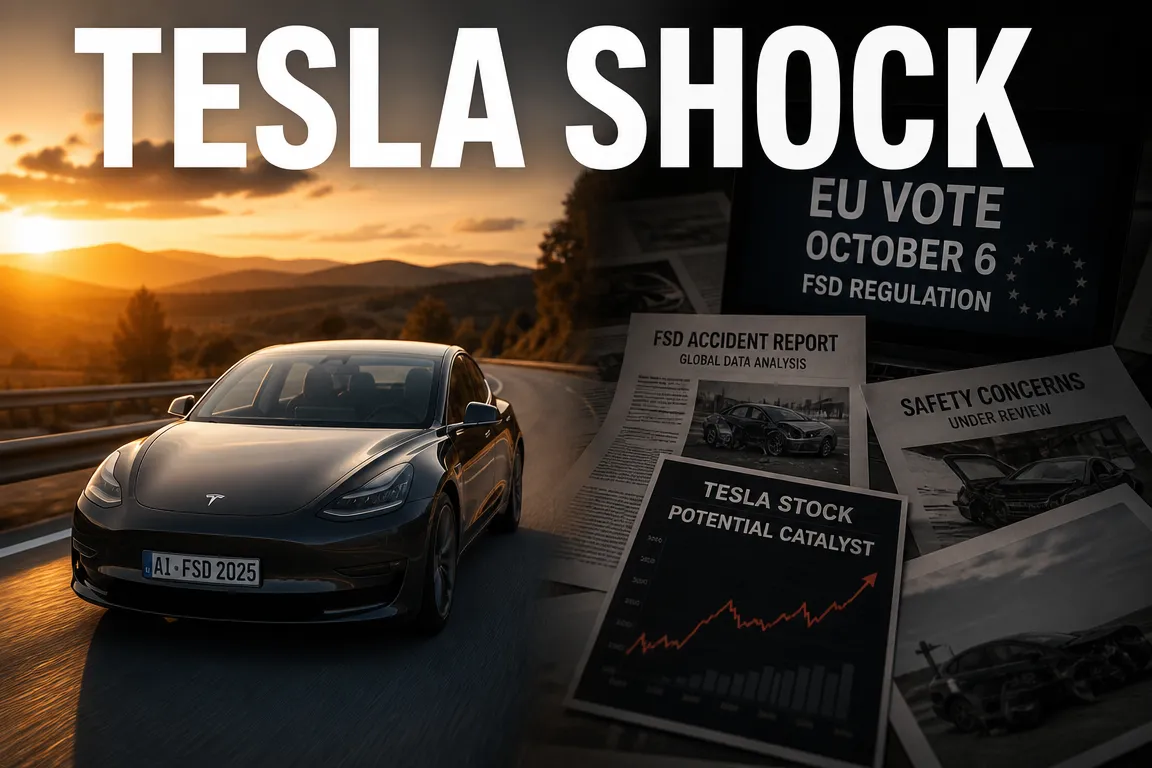
● Tesla FSD Shock, EU Vote, Stock Catalyst
Belgium Discloses FSD Accident Data; Why the October 6 EU Vote Could Be a Short-Term Inflection Point for Tesla Stock
The key issue is not simply whether Tesla’s FSD is safe.
Official data submitted by the Belgian government to parliament show that Tesla FSD recorded 1 accident over 9.5 million km driven on non-highway roads.
Over the same period, Tesla vehicles driven manually recorded 150 accidents across 146.9 million km.
On a distance-adjusted basis, the data indicate that collision risk was about 9.6 times lower when FSD was in use.
The more important point is that these figures were not published by Tesla as marketing material, but were submitted to the Belgian government and regulators.
The data are also likely to be a key reference point for the European Union’s October 6 vote on expanding FSD across 27 member states.
Sweden has already formally opposed the measure, and France has raised concerns over driver responsibility.
In Europe, Tesla’s autonomous driving technology is now facing a direct conflict between actual accident-reduction data and legal and liability standards.
For Tesla shareholders, the October 6 FSD vote may be a more immediate stock catalyst than Optimus.
1. Tesla has entered a consolidation phase in today’s market
In the original report, Tesla stock closed at $364.27, down 0.53%.
SpaceX-related pricing was cited at $152.71, down 1.36%.
U.S. equities were mixed.
- The S&P 500 rose 0.16%.
- The Nasdaq rose 0.4%.
- The Dow Jones Industrial Average fell 0.19%.
The market continued to reflect residual uncertainty after the rate-hike cycle, but the session was characterized by a pause in momentum.
The U.S. 10-year Treasury yield rose to around 4.9%, moving closer to the 5% threshold.
Oil prices declined to around $99 per barrel after Saudi Arabia announced increased supply volumes to Asia.
From a global macro perspective, the market remains in a period where growth-stock momentum and higher-rate pressure coexist.
For a growth stock such as Tesla, valuations are currently being affected simultaneously by interest rates, oil, AI investment expectations, and autonomous driving regulation.
2. Why the Belgian FSD data matter
Belgian Transport Minister Annick De Ridder disclosed Tesla FSD data in the Flemish Parliament.
The data were submitted by Tesla under the conditions of its Belgian approval.
Accordingly, the figures are important because they were provided within a regulatory framework, not as investor-facing marketing material.
Belgium approved FSD with the condition that real-world driving results be reported regularly.
The reported period covered June 11 through August 31.
During that period, Tesla vehicles in Belgium drove 24.6 million km with FSD enabled.
Of that total, 9.5 million km were driven on non-highway roads with FSD enabled.
There was 1 collision in that segment.
Over the same period, Tesla vehicles driven manually covered 146.9 million km and recorded 150 collisions.
| Category | Distance Driven | Collision Count | Implication |
|---|---|---|---|
| FSD use on non-highway roads | 9.5 million km | 1 | Approximately 1 collision per 9.5 million km |
| Manual driving | 146.9 million km | 150 | Approximately 1 collision per 979,000 km |
| Distance-adjusted comparison | Normalized basis | FSD risk approximately 9.6 times lower | Relevant to regulatory review |
On a simple calculation, collision risk was about 9.6 times lower when FSD was active.
Of course, 1 collision is a small sample, and the result could be subject to chance.
However, the more important point is not only the collision count.
3. The key point is that risk events declined, not only accidents
The Belgian data are more noteworthy when viewed through the lens of automatic emergency braking and abrupt driving inputs.
Automatic emergency braking refers to situations in which the vehicle applies sudden braking before an accident.
According to the report, automatic emergency braking events were 93% lower when FSD was in use.
Harsh inputs such as abrupt braking and sudden steering were also reduced by 82% to 90%.
- Collision counts declined.
- Pre-collision risk events declined.
- Unstable driving patterns such as sudden braking and abrupt steering declined.
- The reduction was more pronounced in complex non-highway environments.
This is important because collision counts alone can be affected by short-term sample size.
By contrast, emergency braking, evasive maneuvers, and abrupt steering events accumulate across millions of kilometers and provide a broader safety indicator.
For regulators, it is therefore reasonable to assess not only actual crashes, but also leading indicators of crash risk.
In evaluating autonomous driving safety, the more relevant question may be how much risk is reduced, not only whether an accident occurred.
4. Why non-highway data matter more than highway data
Highways are relatively simple driving environments.
Lane structure is more uniform, pedestrians and cyclists are rare, and signals or complex left-turn situations are less common.
By contrast, non-highway roads are significantly more complex.
- There are traffic lights.
- There are pedestrians.
- There are cyclists.
- There are trams.
- There are frequent left and right turns.
- Lanes can narrow or disappear.
- Traffic culture and road design vary by country.
Belgium is significant because FSD produced favorable results in non-highway driving.
On highways, even human driving tends to have a relatively low accident rate, so the performance gap versus FSD is harder to distinguish.
In non-highway settings, however, the accident risk is materially higher.
The fact that FSD showed a materially lower collision rate in this more difficult environment may be difficult for European regulators to dismiss.
5. Why Belgium approved FSD
Belgium had already approved Tesla FSD in June.
Before that approval, Tesla conducted about one month of test driving and covered 5,000 km on Belgian roads.
The testing evaluated Belgium-specific road conditions.
- It assessed tram-heavy urban environments.
- It reviewed bicycle-priority roads.
- It tested mixed traffic lanes shared by cars and bicycles.
- It evaluated whether FSD could interpret Belgian road signs and signal systems.
- It checked whether the system could adapt to country-specific traffic rules.
The Belgian transport minister stated that new technology should be evaluated critically, but if data show that it makes roads safer, regulators should have the willingness to use it.
Belgium’s approach is therefore not an endorsement of FSD in absolute terms, but a data-driven assessment of road safety outcomes.
This may become an important reference point for the future direction of EV and autonomous driving regulation in Europe.
6. Why the October 6 EU vote matters for Tesla
On October 6, the European Union’s automotive technical committee is scheduled to vote on whether FSD can be expanded across all 27 member states.
Conditional approvals for supervised FSD have already expanded across multiple countries.
- In April, the Netherlands granted conditional approval.
- In May, Lithuania and Estonia joined.
- In June, Denmark and Belgium approved the system.
- This month, Slovenia was added.
The number of FSD users in Europe is now reported to exceed 70,000.
Daily FSD driving distance is said to exceed 1 million km.
Europe is a region where cross-border travel is common.
If FSD can be used in one country but is disabled upon crossing into another, the user experience is materially reduced.
By contrast, approval across all 27 member states would create a fundamentally different value proposition for European consumers.
FSD could remain active during long-distance travel across national borders.
This is not simply a software feature addition; it could materially improve Tesla’s competitive position in Europe.
7. The EU approval threshold is stricter than it appears
The vote is not approved merely by a simple majority among 27 countries.
Two conditions must be met simultaneously.
- At least 15 of the 27 countries must vote in favor.
- The supporting countries must represent at least 65% of the EU population.
This makes the position of larger countries especially important.
Even if many smaller countries support the measure, opposition or abstention from larger member states can block approval.
At present, Sweden and France are the main sources of concern.
Sweden has already moved toward recommending opposition.
France has raised concerns over whether drivers can take their hands off the wheel and over liability in the event of an accident.
Ultimately, the vote will not be decided solely by technical performance data.
It also involves politics, regulation, insurance liability, driver obligations, and national traffic culture.
8. Sweden’s opposition is centered on speed offsets
Sweden’s main concern is the speed offset.
A speed offset allows the vehicle to travel slightly above the posted speed limit.
In real traffic, drivers often move slightly faster than the limit to match traffic flow.
Tesla FSD appears to allow some buffer in order to reflect normal traffic conditions.
However, Sweden views any setting that exceeds the speed limit as problematic.
Its position is straightforward: a system that violates the law cannot be accepted, even if accident rates are lower.
This is where the core regulatory conflict in Europe emerges.
- Belgium is focused on real-world outcomes.
- Sweden is focused on compliance with the law.
- France is focused on driver responsibility.
FSD is therefore caught between the question of whether superior outcomes are sufficient, and the question of whether the system must fully comply with every rule.
9. France’s concerns center on driver responsibility
France has questioned whether drivers are allowed to take their hands off the wheel and how liability should be assigned if an accident occurs.
Supervised FSD is not fully autonomous; it requires driver monitoring.
Legally, that means the driver remains responsible.
However, if users overestimate the system’s capabilities, intervention may come too late.
That is the core concern for France.
Tesla can state that drivers must remain attentive at all times.
But regulators may still ask whether that explanation is sufficient.
In autonomous driving, liability structure is often more difficult than the technology itself.
10. FSD approval in Europe could be directly linked to sales
European FSD approval matters to Tesla because it could affect both sales and software revenue.
According to the original report, Tesla said in its second-quarter materials that vehicle interest is increasing in markets where FSD has been approved.
There was also a reference to 55% of new vehicle deliveries in North America including an FSD subscription.
If that trend were extended to Europe, the implications would be meaningful.
Tesla could increase both vehicle margin and recurring software revenue.
FSD is a high-margin software product that can generate revenue repeatedly after the vehicle sale.
This matters because Tesla is no longer being valued solely as an automaker.
Its equity story now also includes electric vehicles, battery production, autonomous driving software, AI investment, and robotics expectations.
A European FSD approval could be one of the fastest-moving catalysts for earnings expectations.
11. Key Tesla dates for the coming weeks
The following Tesla-related dates were cited in the original report.
- September 30: Deadline related to Cybercab questions.
- October 1: A public disclosure event related to Road.
- October 2: Third-quarter delivery results are scheduled to be announced.
- October 6: The EU vote on FSD expansion is scheduled.
Of these, the most market-sensitive near-term events are the October 2 delivery release and the October 6 FSD vote.
Deliveries will indicate the underlying strength of Tesla’s core automotive business.
The FSD vote could support a re-rating of Tesla as an AI-driven autonomous driving platform company rather than only an automaker.
With these events arriving in close succession, investors should expect elevated volatility.
12. The Optimus factory is progressing, but the near-term stock driver is still FSD
Construction linked to Optimus is reportedly under way near Tesla’s Texas Gigafactory.
Drone footage indicates that steel framing is nearing completion at the northern end of the site.
Concrete has already been placed in some sections, while rebar work and foundation construction continue below.
The project appears to be following a build-from-the-top-and-bottom-at-the-same-time approach to compress the timeline.
If earthwork began in the spring, construction has now been underway for about six months.
The northern parcel allocated to Optimus was described as 5.2 million square feet.
That is more than 14 acres, with a building length of more than 1.2 km.
The Fremont factory in California is also undergoing line conversion for Optimus-related work.
Tesla has shown the removal of concrete, piping, and equipment, followed by new rebar installation.
According to the report, the line removal work took 46 days.
However, one important point remains.
The infrastructure for Optimus is visible, but large-scale production of finished Optimus units has not yet been demonstrated.
Elon Musk has repeatedly said that most of Tesla’s future value will come from Optimus.
For investors, however, the time horizon matters.
- FSD could affect the stock in the near term, depending on the October 6 vote.
- Optimus has the potential to reshape Tesla’s long-term valuation.
- But meaningful revenue recognition from Optimus will likely take more time.
In short, the near-term catalyst is FSD, while the long-term thesis is Optimus.
13. Broader AI market conditions make Tesla’s positioning more notable
The original report also referred to AI companies’ listing schedules and valuation discussions.
The Wall Street Journal was cited as reporting that Anthropic is considering shifting its IPO timeline from October to November.
Market expectations around Anthropic’s valuation and capital raise remain elevated.
OpenAI was also said to be targeting a 2027 public-market timing.
Elon Musk believes AI could lift U.S. growth from 2% to 4% next year.
By contrast, Wall Street still includes views that point to economic slowing through 2027.
This divergence matters.
It reflects a conflict between the bullish case that AI will improve productivity and the cautious view that higher rates, weaker consumption, and reduced corporate investment may persist.
Tesla sits between these two narratives.
It is an electric vehicle manufacturer, an autonomous driving AI company, and, in the long term, a robotics company.
As a result, Tesla’s valuation can no longer be explained by vehicle deliveries alone.
Interest rates, the global macro backdrop, EV demand, autonomous driving approvals, and the AI investment cycle are all now reflected in the stock.
14. The most important points often missed in other coverage
First, the real value of the Belgian data is that they are regulatory data.
Safety figures disclosed by Tesla for promotional purposes carry less weight than data submitted to parliament and regulators.
In advance of the EU vote, the release of actual operational data is highly significant.
Second, the 93% decline in automatic emergency braking matters more than the single accident.
Accident counts can be controversial when the sample is small.
By contrast, the reduction in harsh braking and abrupt steering is a broader measure of driving stability.
Third, the vote is less about technology than about legal interpretation.
Sweden is focused on the speed offset issue.
France is focused on driver responsibility.
In other words, the outcome may depend less on whether FSD is safer and more on whether it fits national legal and liability frameworks.
Fourth, a pan-EU approval matters more than separate national approvals.
European drivers frequently cross borders.
A system that works in one country but turns off in another has limited practical value.
Approval across all 27 member states could materially change the user value of FSD in Europe.
Fifth, the near-term stock catalyst is FSD, not Optimus.
Optimus remains a major long-term valuation theme for Tesla.
However, because it is still in the construction and pre-scaling phase, meaningful earnings contribution will take time.
By contrast, a European FSD approval could translate more quickly into vehicle demand, subscription revenue, and software monetization expectations.
15. Key questions Tesla investors should watch now
- Can Tesla secure support from at least 15 countries in the October 6 EU vote?
- Can the supporting countries reach 65% of the EU population?
- Could Sweden’s opposition to speed offsets spread to other member states?
- Could France’s driver-liability concerns delay the vote?
- Is the Belgian data strong enough to persuade large countries such as Germany and France?
- Could the October 2 third-quarter delivery report reinforce or weaken FSD expectations?
- Can Optimus construction progress support long-term investor sentiment?
The key issue for Tesla investors is not simply whether the stock rises or falls in the near term.
The more important question is whether Tesla is entering a phase in which it is re-rated from an electric vehicle manufacturer into an autonomous driving software company.
The first major test of that transition is the EU FSD vote.
< Summary >
Belgium reported to parliament that Tesla FSD recorded 1 accident over 9.5 million km of non-highway driving.
Over the same period, manually driven Tesla vehicles recorded 150 accidents across 146.9 million km.
On a distance-adjusted basis, collision risk was about 9.6 times lower when FSD was in use.
Automatic emergency braking fell by 93%, while harsh driving inputs such as abrupt braking and steering declined by 82% to 90%.
The EU is scheduled to vote on October 6 on expanding FSD across 27 member states, and approval requires support from at least 15 countries and 65% of the EU population.
Sweden opposes the measure on speed-offset grounds, while France has raised concerns over driver responsibility.
For Tesla, European FSD approval could support both vehicle demand and software subscription revenue.
Optimus factory construction is progressing in Texas and Fremont, but the near-term stock catalyst is likely to be the FSD vote.
Tesla investors should focus on the October 2 third-quarter delivery release and the October 6 EU FSD vote.
[Related Articles…]
*Source: [ 오늘의 테슬라 뉴스 ]
– 벨기에 정부가 의회에 낸 숫자는 950만km에 사고 1건, 그런데 스웨덴은 이미 반대를 정했습니다 $364 테슬라 주주는?
● AI Bubble, Debt Crisis, Gold Surge, Cash Strategy
AI Bubble, U.S. Debt Risk, and Rising Gold: Standards for Cash and Core Assets Investors Should Preserve Now
In today’s market, the key issue is not whether the AI boom is a bubble, but whether investors have already decided what to sell and what to hold through a downturn.
This discussion connects rising U.S. Treasury yields, the $40 trillion U.S. national debt, the rationale for higher gold prices, AI bubble scenarios, cash allocation, and asset allocation strategy.
When media coverage focuses only on warnings of crisis, the more relevant question is how to structure a portfolio that can survive when the crisis actually arrives.
The core point is simple.
Crises will occur, but the greater risk is a portfolio that leaves investors unable to act when they do.
In the current AI-driven cycle, holding too much cash is risky, but holding none is also risky.
This report therefore outlines a 21st-century investment framework that balances crisis-reserve cash with core assets that can preserve purchasing power.
1. The main source of market risk: the U.S. debt problem before the AI bubble
The most frequently cited concern in recent global macro commentary is the U.S. debt issue.
U.S. national debt has surpassed approximately $40 trillion, while annual interest expense is increasingly viewed as exceeding $1 trillion.
$1 trillion is roughly KRW 1,400 trillion.
The U.S. is now facing interest costs that exceed the annual government budget of many countries.
In addition to interest, principal refinancing pressure means the government must continue issuing debt to repay existing obligations.
In practical terms, this is a structure in which new debt is issued to service old debt.
This does not automatically imply an imminent financial crisis.
However, for investors, rising U.S. Treasury yields remain a key variable that can affect global asset prices across markets.
2. Why higher U.S. Treasury yields pressure corporate activity
When U.S. Treasury yields rise, investors tend to prefer the relative safety of government bonds.
If returns are similar, there is less incentive to buy corporate bonds.
This creates a crowding-out effect.
Large-scale government bond issuance can absorb market liquidity and make it harder for companies to issue debt.
High-quality firms can still access capital.
However, many mid-sized or financially weaker companies may struggle to refinance maturing debt.
This can tighten liquidity and slow broader economic growth.
As a result, U.S. Treasury yields are not only a bond-market issue.
They influence equities, real estate, gold, the dollar, and capital flows into emerging markets.
3. Crises will occur: the issue is preparedness, not timing
A central message of 21st-century investing is that crises are inevitable.
No one can predict their timing precisely.
The dot-com bubble in 2000, the global financial crisis in 2008, the 2020 pandemic shock, and the 2022 rate-hike shock all demonstrate that markets repeatedly experience major corrections.
The question is not whether a crisis will happen.
The issue is whether investors have already determined how much loss they can absorb, what they will sell, and what they will buy.
Unclear fear paralyzes investors.
Quantified risk enables action.
4. Crisis response step 1: convert fear into numbers
Investors should begin with a stress test of their portfolio.
For example, if the market falls 20% tomorrow, how much loss would the portfolio sustain?
Can it withstand a 30% decline in the index and a 50% to 70% decline in individual holdings?
Four questions matter most.
First, if the index falls another 20% from here, what is the portfolio loss?
Second, can that loss be tolerated emotionally?
Third, would living expenses remain secure in that scenario?
Fourth, are the criteria for buying and selling already defined?
Without answers to these questions, investors are likely to sell in panic during a correction.
By contrast, investors who quantify risk in advance are more likely to use a downturn as an opportunity.
5. Crisis response step 2: maintain cash in the portfolio
A 100% equity portfolio may look optimal during a rally.
However, in a downturn it becomes a portfolio that cannot act.
Even if strong assets fall by 30%, 40%, or 50%, there is no cash available to buy more.
Cash is therefore not a low-return asset; it is an asset that provides optionality during crises.
The cash discussed here is not permanent idle money.
It is reserve capital intended to buy core assets at lower prices during drawdowns.
Many investors believe cash reduces returns.
That is true.
But without cash, the opportunity to recover returns during a crisis may disappear.
Cash allocation should therefore reflect risk tolerance, age, income stability, and investment horizon.
Even aggressive investors need some cash, while conservative investors require a larger allocation.
6. Crisis response step 3: distinguish core assets from satellite assets
A practical concept in 21st-century investing is the distinction between core assets and satellite assets.
Core assets are those investors can hold through market volatility over the long term.
They may experience temporary corrections, but they are expected to maintain structural value over time.
Satellite assets are used for shorter-term trading or tactical opportunities.
During a crisis, satellite positions should be reduced while core holdings are protected.
It may also be rational to sell less-affected satellite assets and use the proceeds to buy core assets that have declined more sharply.
The problem is that many investors treat all assets as core assets during stable periods.
When markets fall, everything appears risky, and even the best assets may be sold.
That is why this distinction should be made in advance.
Investors should define which assets they can hold for more than 10 years and which are intended for short-term trading.
7. The AI revolution is the largest post-mobile shift in investment logic
Smartphones drove the mobile revolution.
Retail shifted from offline to online, and education, meetings, media consumption, and corporate operations changed materially.
AI is now driving a comparable transformation.
Companies are taking on functions that were once believed to be possible only at the level of nation-states.
SpaceX, for example, has demonstrated satellite launch capacity that rivals or exceeds that of many countries, showing how corporations can replace state-level capabilities.
In the AI era, it is difficult to value corporate ceilings using legacy frameworks alone.
Companies with exposure to power, communications, AI data centers, AI models, AI services, and physical AI must be viewed differently from traditional industrial or software firms.
Such companies may eventually have output and influence comparable to the GDP of smaller nations.
As a result, traditional industry classification is no longer sufficient as a sole investment lens.
8. What changes and what does not: the structure of 21st-century investing
A key principle in this framework is distinguishing what changes from what does not.
What does not change is human nature and the basic rules of the market.
Markets change, technology changes, and industries change, but greed and fear remain constant.
The fundamental principles of corporate value creation also remain unchanged.
ROI, cash flow, competitive advantage, and capital efficiency remain important across cycles.
What changes is the investment framework.
In the AI era, investors must identify which companies control bottlenecks in the value chain, where shortages are forming, and where pricing power is emerging.
Where internet infrastructure and platform companies once led the market, AI now shifts attention toward GPUs, HBM, DRAM, data centers, power infrastructure, AI models, and robotics.
9. An AI bubble may exist, but that does not mean it will burst soon
The debate over an AI bubble continues.
The key issue is not simply whether the market is in a bubble.
Even if an AI bubble exists, that does not imply an immediate collapse.
Bubbles can last longer than expected, and the final stage is often the steepest.
During the dot-com bubble, many investors were too early in short positions or too late in re-entering, and suffered significant losses.
Stanley Druckenmiller also misjudged the timing of market excess during the dot-com era.
Isaac Newton once said he could calculate the movement of celestial bodies, but not human madness.
The same applies to the current AI cycle.
Assuming prices will continue rising indefinitely is arrogance, but assuming they will soon collapse is equally unwarranted.
10. Two types of AI bubble: destructive bubbles and inflection-point bubbles
Not all bubbles are the same.
The first type is a mean-reversion bubble.
This occurs when prices rise excessively and then revert toward underlying value.
It is typically found in assets with weak fundamentals or unsustainable business models.
The second type is an inflection-point bubble.
In this case, prices may fall after the bubble, but the technology continues to reshape the economy, and surviving firms gain even greater market share.
Many companies disappeared after the dot-com bubble, but Amazon and Google survived.
The internet did not disappear when the bubble burst.
It transformed the economy.
AI may follow a similar pattern.
Investors should therefore focus not on avoiding AI entirely, but on identifying which companies and sectors can survive after the bubble phase.
11. If the AI bubble breaks, the cause may not be AI itself
If the AI bubble does unwind, the cause is likely to be macroeconomic rather than technological failure.
More plausible triggers include U.S. Treasury yields moving decisively above 5%, a widening war, or a loss of confidence in public debt sustainability.
In such conditions, even high-growth companies are affected by rising discount rates.
Higher rates reduce the present value of future earnings.
Firms with growth expected far in the future are particularly sensitive.
Another variable is China.
Rapid progress in Chinese AI models, semiconductors, and memory companies could challenge the valuation premium embedded in the U.S.-centered AI supply chain.
If China gains influence in DRAM, HBM, open-source AI models, or low-cost inference infrastructure, valuation assumptions may weaken.
12. AI bubble checklist: caution signals
Several signals often appear in overheated AI markets.
First, the phrase “this time is different” begins to dominate the narrative.
Second, valuation discipline gives way to the belief that prices no longer matter.
Third, FOMO drives investment decisions.
Fourth, investors with little prior market interest begin entering in large numbers.
Fifth, the same stocks and themes dominate conversations in both professional and casual settings.
In such an environment, risk management becomes more important than aggressive buying.
By contrast, when the market becomes openly negative and investors are relieved not to be participating, conditions may become favorable for acquiring quality assets at lower prices.
13. The key to gold price strength: not gold rising, but currency value falling
Gold price movements should not be interpreted solely through demand for the metal.
The core issue is currency debasement.
War, fiscal deficits, rising public debt, and large-scale bond issuance all pressure the value of money.
In a crisis, governments issue more money to preserve stability.
War-related spending and defense needs can expand fiscal requirements further.
Those requirements are often financed through debt issuance, increasing money supply conditions in the market.
When money supply expands, the purchasing power of money declines.
Investors then seek assets that they believe can preserve trust when currencies weaken.
Historically, gold has played that role.
Gold is therefore not just a precious metal; it is a reserve asset that tends to attract attention when confidence in the monetary system weakens.
14. Three conditions for a strong gold market
Three conditions matter for a sustained rise in gold prices.
First, U.S. Treasury yields should decline.
When Treasury yields are high, investors may prefer bonds over non-yielding gold.
Second, the U.S. dollar index should weaken.
Because gold is generally priced in dollars, a weaker dollar typically supports higher gold prices.
Third, geopolitical risk should intensify.
War, financial instability, and sovereign debt stress increase demand for safe assets.
However, gold does not always outperform in the earliest phase of a crisis.
The dollar can strengthen first because it is also viewed as a safe asset.
Accordingly, gold should be analyzed together with U.S. Treasury yields, the dollar index, and geopolitical risk.
15. Why asset prices have risen faster than the real economy since 2008
After the 2008 global financial crisis, the Federal Reserve launched large-scale quantitative easing.
Zero rates and QE injected substantial liquidity into markets.
As a result, financial assets rose much faster than the real economy.
From the 2009 low to 2025, the Nasdaq rose by more than 1,600%.
By contrast, global economic growth remained in the low single digits annually.
This shows that real economic growth and capital markets have moved at very different speeds.
Asset price appreciation cannot be explained solely by earnings growth.
Falling currency value also contributed to higher nominal prices for equities, real estate, and gold.
This perspective remains important today.
Holding cash alone may appear safe, but in an environment of currency debasement, purchasing power can erode quietly.
16. Cash is risky, but having no cash is riskier
This creates an important paradox.
Holding only cash over the long term is risky.
In a system where currency value declines over time, purchasing power can erode even without market losses.
But having no cash at all is also risky in the short term.
Investors may miss opportunities to buy quality assets during a correction.
Cash should therefore be viewed not as idle capital, but as reserve capital for future decisions.
Long-term purchasing power preservation should come from core assets such as equities, gold, real estate, or productive assets.
Short-term crisis response should come from cash.
The central investment principle is to hold both.
17. The most important point often missed in media coverage
Many commentaries reduce the issue to simple conclusions such as “AI is a bubble” or “AI will continue.”
However, the more important issue is not the direction of the AI narrative, but the state of capital markets.
AI expansion requires substantial capital.
Data centers, GPUs, power systems, semiconductors, communications infrastructure, and cloud systems all demand large investment.
If U.S. Treasury yields remain elevated, the cost of capital rises.
The real risk is therefore not that AI is a false technology, but that the cost of financing AI infrastructure becomes too high.
That is the central market issue.
AI investment is ultimately as much a liquidity and rates issue as it is a technology issue.
Another important point is that a debt crisis narrative can sometimes lead to more liquidity in the short term.
Governments may respond to stress with additional fiscal support, which can increase market liquidity.
In that case, asset prices may continue rising even as crisis warnings intensify.
For that reason, a simple “move entirely to cash because a crisis is coming” strategy is not sufficient.
A more balanced approach is to hold core assets while preserving cash for future opportunities.
18. What investors should actually review now
First, distinguish core assets from satellite assets in the portfolio.
Core assets are long-term holdings.
Satellite assets can be reduced or replaced according to market conditions.
Second, determine the cash allocation.
There is no universal answer.
Investors with stable income and long time horizons can hold less cash.
Those nearing retirement or sensitive to volatility should hold more.
Third, identify where bottlenecks are shifting within the AI value chain.
In 2025, GPUs were the primary bottleneck, and in 2026, attention shifted toward memory semiconductors such as DRAM and HBM.
Later bottlenecks may move toward power, cooling, data-center land, communications infrastructure, and physical AI components.
Fourth, monitor U.S. Treasury yields and the dollar index continuously.
These variables affect equities, gold, emerging markets, and USD/KRW.
Fifth, avoid buying based on FOMO.
When everyone around you is discussing the same assets, risk premiums may already be elevated.
19. Investment scenario for the second half of 2026: both outcomes should remain open
The first scenario is that the AI cycle continues for several more years.
In this case, the market may rise through repeated corrections, led by core AI companies and infrastructure firms.
Leadership may continue to rotate.
Attention could shift from GPUs to memory, from memory to power, and from power to physical AI.
The second scenario is that the AI cycle is nearing its later stage.
In that case, the final leg may be very steep.
However, if external shocks such as rates, war, debt stress, or China-related competition intensify, a sharp correction may follow.
No one knows which scenario will prevail.
Investors should therefore avoid making an all-or-nothing bet and instead build a portfolio that can participate in upside while surviving downside.
20. Conclusion: what should remain is cash and a decision framework
The main point of this report is not cash itself.
More precisely, it is cash reserved for future crises and a decision framework that remains stable under stress.
Cash is meaningless if investors do not know what to buy.
Even strong holdings can be sold at the wrong time if investors do not know whether they are core or satellite assets.
AI bubbles, U.S. debt risk, higher Treasury yields, gold strength, and a weaker dollar are not separate issues.
They converge on one question.
In an era of currency debasement, rising debt, and technological transformation, which assets should investors hold through the cycle?
And how much cash should they preserve so they can buy more if those assets decline?
Investors who are prepared on both counts will not view crisis solely as risk.
They can also use it to improve portfolio quality.
< Summary >
U.S. debt risk and rising Treasury yields are major variables for global assets.
An AI bubble may exist, but an eventual correction is more likely to be driven by rates, liquidity, war, or debt stress than by AI technology failure.
The core response is to quantify risk, maintain cash, and distinguish core assets from satellite assets.
Gold’s strength is driven less by the metal itself than by currency debasement and safe-haven demand.
Holding only cash is risky over the long term, but holding no cash is more dangerous during a crisis.
The appropriate strategy is to participate in the rally while preserving the ability to buy core assets during a drawdown.
[Related Articles…]
*Source: [ 경제 읽어주는 남자(김광석TV) ]
– [풀버전] “위기는 반드시 옵니다” 그때 살아남으려면 지금 ‘이것’을 남겨두세요 | 김광석의 북리뷰 | 이효석의 21세기 투자법