● Tesla Shock, Musk Skips Semi Launch, Joins Trump Xi Banquet, Stock Drops, FSD Delayed, Rare Earths Sway Future
What Mattered More Than the Tesla Semi Factory Opening Was the White House Main Table: Tesla Stock at $372, EU FSD Delay, and Rare Earth Supply Chains
The key point in this Tesla news is not simply that the Semi truck factory opened.
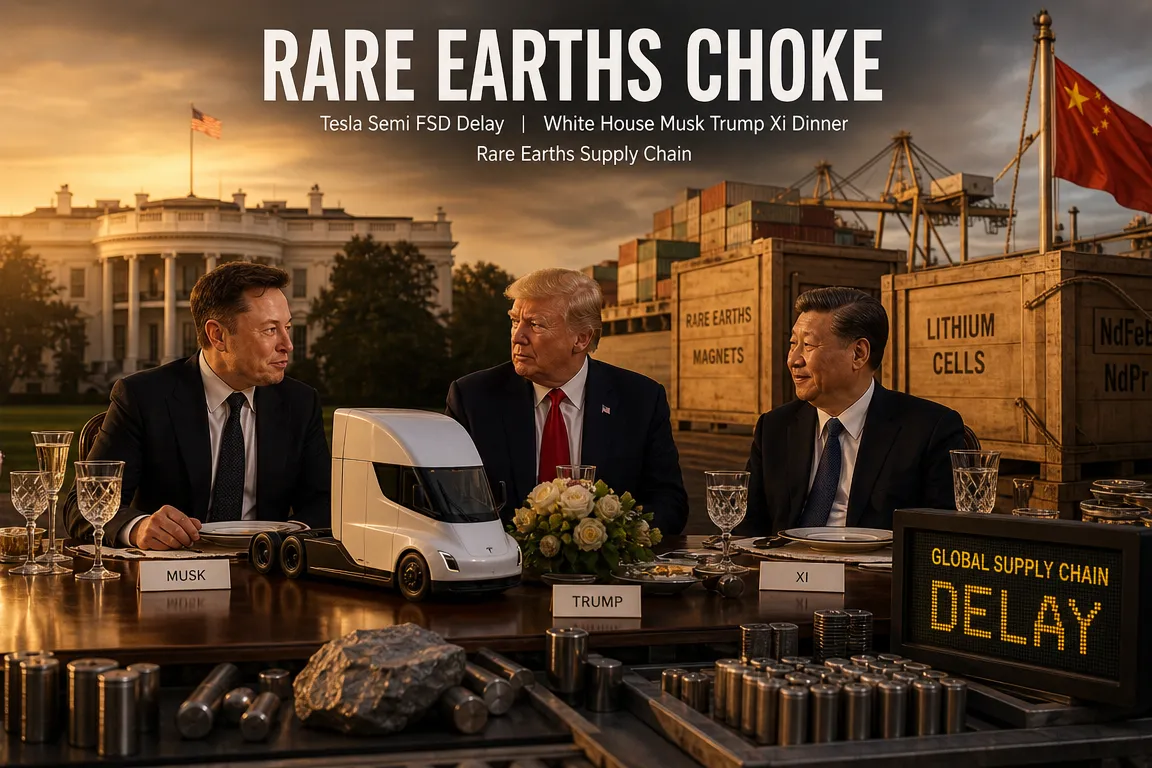
The real significance is that Elon Musk did not attend Tesla’s Semi factory opening after nine years, and instead sat at the main table during the White House state dinner with Trump and Xi Jinping.
This single scene connects Tesla stock, U.S. interest rates, the EV market, autonomous driving, AI semiconductors, and rare earth supply chains.
On the surface, it was a Semi truck production event. In substance, it highlighted where Tesla’s future competitiveness is being determined.
This article summarizes Tesla Semi production targets, delays in European FSD approval, the hidden meaning of the White House dinner, the economics of rising diesel prices for electric trucks, and the key points the market has not yet fully priced in.
1. Why Tesla Fell Even as the Broader Market Rose
Tesla closed at $372.11, down 1.54% on the day.
By contrast, the Dow rose 0.93%, the S&P 500 rose 0.51%, and the Nasdaq rose 0.48%, with major indices finishing the week higher.
The broader market was strong, but Tesla underperformed.
A single clear cause is difficult to isolate, but three factors likely contributed simultaneously.
First, the market did not receive the level of production detail and timing guidance it had expected after the Tesla Semi event.
Second, reports suggested that the European FSD vote may slip from October to after December.
Third, the U.S. 10-year Treasury yield briefly rose above 5.2%, pressuring technology stocks.
When interest rates remain elevated, growth and technology equities face a higher discount-rate burden.
Tesla is especially sensitive because it is valued not only as an automaker, but also as a future cash-flow story tied to AI and autonomous driving.
2. Why U.S. Rates and Oil Prices Must Be Viewed Together with Tesla Semi Economics
One of the most important market variables is the U.S. interest-rate environment.
The original report noted that the U.S. 10-year yield rose above 5.2%, reaching a 19-year high intraday.
The 30-year yield also closed at its highest level since 2004.
In such a high-rate environment, Tesla and other technology names face valuation pressure.
At the same time, a very different opportunity is emerging in logistics.
The reason is diesel prices.
The original report stated that U.S. diesel retail prices reached $6.5 per gallon, which corresponds to roughly KRW 2,326 per liter.
As diesel prices rise, the operating-cost advantage of electric trucks increases.
This is why Tesla Semi may be viewed not only as a green truck, but also as a cost-reduction tool for logistics operators.
In trucking, total cost of ownership matters far more than sticker price.
Fuel, maintenance, utilization, charging infrastructure, and driver fatigue must all be considered.
If Tesla Semi can demonstrate a clear power-cost advantage versus diesel trucks, the next growth leg in electric vehicles may come from commercial logistics rather than passenger cars.
3. Key Semi Factory Number: “1,000 Units Per Week” Is Not Current Output
The most notable number from the Tesla Semi event was the annual production target of 50,000 units.
Dan Priestley, director of Semi engineering, said the Nevada factory is targeting 50,000 units per year, or about 1,000 units per week.
One important distinction must be made here.
1,000 units per week is not the current production rate, but rather a target after the factory is fully ramped up.
Dividing 50,000 by 52 weeks gives about 962 units.
In other words, 1,000 units per week should be understood as the long-term full-capacity target.
Some outlets may interpret this as if Tesla is already producing 1,000 units per week, but the original report correctly notes that this is not accurate.
Tesla has not officially disclosed current weekly Semi production.
CNBC also suggested that large-scale production expansion may not happen until next year.
For investors, the key issue is not that the factory opened, but how quickly the ramp-up progresses.
This is also why Tesla stock weakened after the event.
The market had already priced in expectations and now wants hard numbers.
4. The Real Reason Elon Musk Missed the Semi Event: The White House Main Table
The most symbolic detail in this event was that Elon Musk did not attend the Semi factory opening in person and instead sent a video message.
The reason was attendance at the White House state dinner in Washington.
Trump and Xi Jinping were present, and of more than 130 guests, only four business leaders reportedly sat at the main table.
NVIDIA’s Jensen Huang, AMD’s Lisa Su, Apple’s Tim Cook, and Tesla’s Elon Musk.
This group is highly significant.
NVIDIA and AMD are advanced AI semiconductor companies.
Apple and Tesla both rely on China as a major production base and consumer market.
In simple terms, two companies with chips and two companies with factories were seated next to the U.S. and Chinese leaders.
This was not merely ceremonial. It showed which industries matter most in the U.S.-China technology rivalry.
AI semiconductors and EV supply chains are likely to remain key bargaining chips in the global economy.
5. What Tesla Gained from the White House Dinner: No Direct Announcement, but Rare Earths Matter
There was no special announcement for Tesla.
There was also no concrete announcement regarding a China FSD launch, according to the original report.
However, one important agreement was reached.
The U.S. and China agreed to extend the existing trade truce for about two additional months, until January 10, instead of letting it expire in mid-November.
The original report said this extension includes U.S. tariff reductions and a suspension of China’s rare earth export controls.
This is directly relevant to Tesla because of rare earths.
High-performance magnets used in electric motors are closely tied to rare earth materials.
A large share of rare earth processing is concentrated in China.
Elon Musk has previously said in earnings calls that the motors used in Optimus could be affected by China’s rare earth export restrictions.
Tesla faces rare earth supply-chain risks not only in vehicles, but also in robots, autonomous-driving hardware, and manufacturing automation equipment.
For Tesla, the extension of the trade truce is therefore a quiet but meaningful positive.
Even if the market did not immediately reflect it, supply-chain stability has a direct long-term impact on EV competitiveness.
6. Tesla’s Rare Earth Workaround Strategy: Why the Cybercab Motor Matters
Tesla continues to work on reducing rare earth dependence.
The original report said Elon Musk stated during the Cybercab unveiling that Tesla had developed a motor that uses no rare earths at all.
This motor is said to be 18% smaller and 25% lighter than the prior version while maintaining driving range.
This matters not because one component improved, but because it reduces strategic dependence on China’s supply chain.
According to the report, this motor currently applies only to Cybercab, and it remains unclear whether it will expand to other models.
Still, the direction is clear.
Tesla is moving toward vertical integration across batteries, motors, AI chips, and software in order to reduce external risks.
This point is often overlooked in headline news, but it is important for long-term investors.
7. European FSD Delay: The October Vote Has Been Pushed Beyond December
Another event Tesla investors were watching was European FSD approval.
The original report said there was an expectation that a vote on whether to allow FSD across Europe would be held on October 6.
However, after reviewing the agenda of the automotive technical committee, only a 25-minute discussion of the Netherlands’ request was included, with no vote scheduled.
As a result, the next meeting is in December, meaning a vote can now be confirmed no earlier than then.
The seven countries that have approved FSD so far represent a combined population of about 53 million, or roughly 12% of the EU population, according to the report.
For EU-wide approval, at least 15 of 27 countries must agree, representing 65% of the population.
Moving from 12% to 65% is a long process.
Germany and France remain especially important.
If FSD is approved in Europe, it could place direct pressure on the autonomous-driving competitiveness of European automakers.
8. Tesla’s FSD Safety Data and Remaining Questions
Tesla is actively presenting FSD safety data to European regulators.
According to the report, Tesla said more than 70,000 customers in Europe are using FSD and driving more than 1 million kilometers per day.
Tesla also claimed that accident probability is about 4.1 times lower when FSD is used compared with manual driving.
However, these figures were provided by Tesla itself.
It remains unclear whether they have been independently audited or externally verified.
Regulators may therefore be reluctant to approve FSD based solely on Tesla’s data.
Sweden has raised concerns about FSD exceeding speed limits, while approved countries emphasize that speed compliance remains the driver’s responsibility.
In the end, European FSD is not only a technology issue but also a matter of regulation, liability, and industrial policy.
Even if the technology is strong, commercialization will remain slow unless the legal and insurance frameworks adapt.
9. Tesla Semi Product Competitiveness: 805 km Range and a 30-Minute Charging Demo
The Tesla Semi long-range model was presented as capable of traveling about 805 km with a full load.
That is roughly comparable to a round trip on a long highway route between major cities.
The event also included a Megacharger charging demonstration.
According to the report, the live demo charged the vehicle from 0% to 60% in 30 minutes, enabling about 483 km of driving range.
This is highly relevant for logistics operators.
For long-haul freight, charging time is part of the cost structure.
If several hundred kilometers of range can be secured in 30 minutes, charging can potentially be integrated into rest periods.
This may allow faster adoption in fixed-route operations such as logistics hubs, ports, large warehouses, and factory-to-factory transport.
10. Elon Musk’s Semi Message: A Truck with Sports-Car Feel and Autonomous Driving
In his video message, Elon Musk described the Tesla Semi as an “innovative truck.”
His key points can be summarized as follows.
First, the Semi is said to deliver a sports-car-like driving feel and strong acceleration.
Second, it supports long-haul charging systems and 1 MW Megacharging.
Third, its power cost is lower than diesel, creating economic advantages.
Fourth, autonomous-driving capability is expected to be added in the near future.
The most important part for the market is autonomy.
If an electric truck simply reduces fuel cost, it is a cost-efficiency improvement.
But if FSD reduces driver fatigue and eventually enables unmanned operation, the industry structure changes significantly.
11. Even with FSD, Semi Will Not Immediately Run 24 Hours a Day
Many assume that once autonomy is added, trucks can operate continuously.
In reality, that is not the case.
Under U.S. federal rules, freight truck drivers may drive up to 11 hours per day.
After 8 hours of driving, a 30-minute rest break is required.
Even if FSD assists driving, the regulations are likely to remain in force if a driver must still sit in the cab and supervise the vehicle.
At least in the initial phase, FSD is therefore more about reducing driver fatigue and improving safety than extending operating hours dramatically.
That still matters.
Truck driving is physically demanding, and long-haul operations carry significant fatigue and nighttime accident risks.
If FSD reduces the burden on drivers, logistics companies may also benefit in hiring and retention.
12. The Real Game Changer Is When the Driver’s Seat Becomes Empty
The greatest long-term potential of Tesla Semi comes in the unmanned autonomy phase.
The original report referenced Aurora, which is already operating unmanned trucks in Texas.
Aurora claims that while human-driven trucks travel about 160,000 to 200,000 km per year, unmanned trucks can exceed 400,000 km.
This difference would fundamentally change logistics economics.
Trucks are expensive assets, but if they can run around the clock, utilization rises sharply.
When lower energy costs are combined with unmanned autonomy, Semi becomes not just an electric truck, but an AI logistics platform.
This is the part the market has not yet fully priced in.
Investors are currently focused on how many Semi units are being produced.
But the more important question is when the driver’s seat becomes empty.
Once Tesla provides a clearer Semi FSD timeline and autonomy roadmap, the valuation framework may change.
13. A Roadster Teaser Also Appeared: Tesla Did Not End with One Event
The Semi factory opening also included a brief Roadster teaser.
The presentation reused the same visual idea from the original Semi unveiling nine years ago, when the Roadster appeared behind the trailer.
This time, part of the front design was shown, and the report noted that it looked different from the 2017 concept car.
In particular, the design appeared to move away from round headlights toward a horizontal light bar, suggesting a sharper direction similar to the Cybertruck.
The full reveal was scheduled for October 1 in Waco, Texas.
Interest also remains around whether the Roadster will demonstrate a hover feature.
From an investment perspective, however, the Roadster is more of a technology symbol than a mass-market product.
The items more likely to affect Tesla stock directly are Semi production pace, FSD approval, robotaxi development, and autonomous-driving commercialization.
14. Key Tesla Dates to Watch
According to the report, Tesla is approaching its Q3 delivery update in early October.
However, Semi production figures may not be disclosed separately in that report.
Delivery data will likely continue to be dominated by Model 3 and Model Y volumes.
On October 6, the EU automotive technical committee is scheduled to meet, but FSD voting is not included, according to the report.
Tesla’s Q3 earnings report is expected on October 28.
That will be the more important event.
Investors will look for Semi production volume, ramp-up speed, FSD deployment plans, margin impact, and energy business growth.
On October 29, a domestic FSD-related refund lawsuit ruling was also noted.
Near-term market volatility may therefore remain elevated around these dates.
15. The Most Important Point Not Emphasized in Other Reports
The most important issue here is not the Semi factory opening itself.
The real takeaway is that Tesla is expanding from an automaker into an energy, AI, logistics, and supply-chain company.
Many reports focus on how many Semi units are produced or whether Musk attended the event.
But the more important structure is different.
First, Tesla Semi is emerging as a logistics cost-reduction tool during a period of rising diesel prices.
Second, once FSD is added, Semi becomes autonomous logistics infrastructure rather than just an electric truck.
Third, rare earth supply stability affects Tesla’s EV production and Optimus robot manufacturing directly.
Fourth, Musk’s seat at the White House main table suggests Tesla has entered the center of U.S.-China strategic-industrial negotiations.
Fifth, the European FSD delay appears to be more about industrial protection and regulation than technology.
For Tesla, it is no longer sufficient to focus only on quarterly delivery numbers.
Investors now need to track AI chip regulation, rare earth export controls, U.S. rates, European regulation, EV demand, and autonomous-driving data together.
Even if Tesla stock remains volatile in the short term, long-term value will likely depend on how these variables evolve.
16. Investor Checklist
The first checkpoint is actual Semi production volume.
More important than the 50,000-unit annual target is current monthly output and the pace of quarterly ramp-up.
The second checkpoint is Semi customer adoption.
Investors should watch whether large logistics companies, retailers, and port operators join early customers such as Pepsi.
The third checkpoint is Megacharger infrastructure.
Electric trucks cannot succeed on the vehicle alone; charging networks must scale alongside them.
The fourth checkpoint is European FSD approval.
Whether a vote is placed on the December agenda and how Germany and France respond will be critical.
The fifth checkpoint is China-related developments.
FSD launch plans in China, data rules, Shanghai factory policy, and rare earth supply conditions can all affect Tesla.
The sixth checkpoint is Q3 margins.
Vehicle price cuts, energy business growth, AI investment spending, and early Semi production costs may all affect earnings.
< Summary >
Tesla closed at $372.11, down 1.54% despite a broader market rally.
At the Semi factory opening, Tesla set a target of 50,000 units annually, or about 1,000 units per week, but this should be viewed as a full-capacity target rather than current output.
Elon Musk did not attend in person because he was seated at the White House state dinner main table with Trump and Xi Jinping.
NVIDIA, AMD, Apple, and Tesla were represented there, highlighting the strategic importance of AI semiconductors and China-linked supply chains.
The U.S.-China trade truce extension and easing of rare earth controls are positive for Tesla’s EVs, Optimus, and motor supply chain.
European FSD approval appears to have slipped, with the October vote likely pushed to after December.
Tesla Semi was presented with an 805 km range and a 30-minute charging demo reaching 60%, showing its potential for logistics cost reduction.
However, the real game changer is when FSD is added to Semi and, eventually, when the driver’s seat becomes empty.
Investors should now track Semi ramp-up, FSD approval, rare earth supply chains, U.S. rates, and AI regulation alongside production numbers.
[Related Articles…]
*Source: [ 오늘의 테슬라 뉴스 ]
– 머스크는 트럼프·시진핑 메인 테이블에 — 같은 날 세미 공장엔 영상 한 편만 보냈습니다, 테슬라 $372 주주는?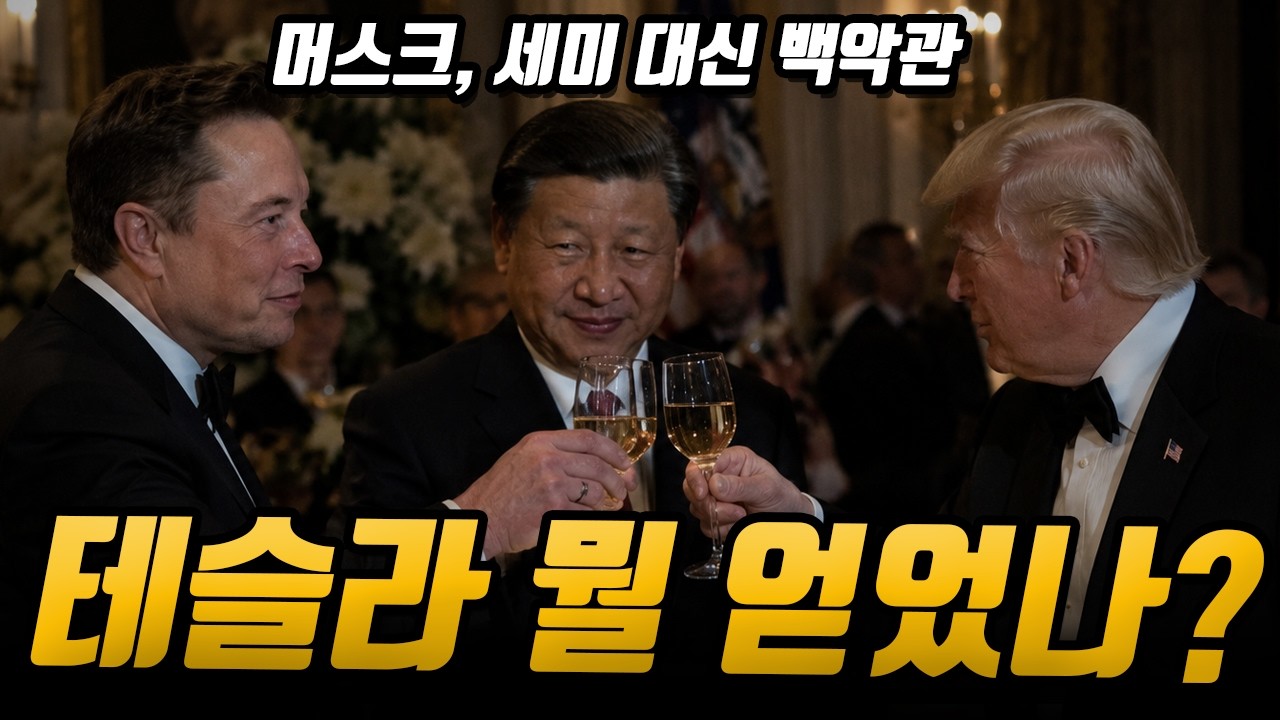
● Pension Shock, NPS Eyes Retirement Market Grip
The Real Reason the National Pension Service Is Seeking Entry Into the Retirement Pension Market: The Bigger Issue Goes Beyond Low Returns and High Fees
The core issue in this discussion is not simply whether the National Pension Service will enter the retirement pension business.
The more important point is that a structural shift is beginning across the National Pension Service, retirement pensions, retirement income, capital markets, and pension reform.
The National Pension Service alone is insufficient to support retirement living costs, while retirement pensions are still operated more like lump-sum payouts than true pensions.
Against this backdrop of low retirement pension returns and high fees, the National Pension Service is signaling that it intends to reset the market benchmark.
Most importantly, the message is not that the National Pension Service plans to displace private financial firms, but rather that it aims to serve as a platform to expand Korea’s asset management industry globally.
1. Key News Summary: National Pension Service Participation in Retirement Pensions Is Not Yet Finalized
The most important fact is that the National Pension Service’s entry into the retirement pension market has not been decided.
For this to happen, the National Assembly must create the legal basis.
In other words, the current stage is limited to the National Pension Service explaining how it would participate if permitted.
- Current status: Participation in retirement pensions is not finalized
- Required condition: Legislative approval and institutional design
- Core objective: Supplement retirement income beyond the National Pension Service
- Market reaction: Banks, insurers, and securities firms are highly alert
Chairman Kim Sung-joo’s explanation is clear.
The reason the National Pension Service is considering retirement pensions is not to expand market share, but to address Korea’s retirement poverty problem through institutional support.
2. Why the National Pension Service Is Focusing on Retirement Pensions: Korea’s OECD-Highest Elderly Poverty Rate
Korea is one of the world’s top 10 economies, yet its elderly poverty rate remains among the highest in the OECD.
The main reason for this contradiction is that the pension system has not yet fully matured.
As the National Pension Service matures, elderly poverty is gradually declining, but the problem is that the National Pension Service alone cannot provide sufficient retirement income.
- Current average National Pension Service benefit: Around KRW 700,000 per month
- Total number of recipients: Around 7.6 million
- Recipients receiving KRW 2 million or more per month: Over 100,000
- Recipients receiving KRW 3 million or more per month: A small minority
- Long-term expected average retirement income: Likely only KRW 1 million to KRW 1.5 million per month from the National Pension Service alone
In practical terms, the National Pension Service alone cannot secure a stable retirement.
That is why retirement pensions must function properly as a second layer of retirement income protection.
3. The Biggest Problem in Current Retirement Pensions: They Are Used Like Lump Sums, Not Pensions
By definition, retirement pensions should provide monthly income after retirement.
In reality, however, many are withdrawn as lump sums at retirement and used for consumption or other purposes.
As a result, retirement pensions remain a short-term cash payout mechanism rather than a retirement income safeguard.
Chairman Kim’s stated direction is straightforward.
The goal is to make retirement pensions function like true pensions.
- National Pension Service KRW 1 million per month + retirement pension KRW 500,000 per month can create a basic retirement income floor.
- National Pension Service KRW 1.5 million per month + retirement pension KRW 500,000 or more can support retirement living without substantial additional assets.
- The key is to convert retirement pensions from lump-sum payouts into long-term cash flow.
From this perspective, the National Pension Service’s entry is not a simple financial product initiative.
It should be viewed as one component of Korea’s broader pension reform.
4. Why Private Financial Firms Are Concerned: The Emergence of a Powerful Public Competitor
Banks, insurers, and securities firms view the National Pension Service’s potential entry as a serious concern.
The reason is straightforward.
The National Pension Service already has large-scale asset management experience, specialized personnel, and long-term portfolio capabilities.
For private firms, the concern is that they could lose customers if the National Pension Service enters the market.
In particular, if the National Pension Service emphasizes low fees and stable performance, existing business models based on fees and product competitiveness will face direct comparison.
- Private sector concern: The National Pension Service could dominate the market
- National Pension Service position: It seeks to establish a market model, not push out private firms
- Core issue: Whether public sector participation promotes competition or intrudes into private business
The important point is that the National Pension Service sees itself not as a competitor, but as a guide.
5. The National Pension Service’s Rebuttal: It Has No Intention of Pushing Out Private Financial Firms
The National Pension Service does not directly manage all of its assets.
A substantial portion of its fund is outsourced to private asset managers.
In other words, the National Pension Service is not only a competitor to private firms; it has also been a major source of capital that has helped develop Korea’s capital markets and asset management industry.
Chairman Kim’s logic is as follows.
- The National Pension Service is not a private financial company seeking maximum returns.
- If it receives retirement pension assets, a significant portion could still be outsourced to private managers.
- Private firms could reduce distribution costs by no longer having to seek retirement pension clients directly.
- If the National Pension Service raises and private firms manage, the overall market could expand.
This point is highly important.
The National Pension Service’s entry does not necessarily mean losses for private financial firms; through role specialization, it could instead create a larger market.
6. Low Returns and High Fees: The Real Issue Retirement Pension Providers Must Address
The sharpest issue in this debate is whether low returns and high fees in retirement pensions can be blamed entirely on the system.
The retirement pension market has grown in size, but participants have not been satisfied with the returns.
Meanwhile, financial firms have continued to earn stable fee income.
From the National Pension Service’s perspective, this structure is problematic.
- Participant perspective: If long-term retirement assets produce low returns, retirement planning becomes difficult.
- Financial firm perspective: Fee income is maintained regardless of investment performance.
- National Pension Service perspective: The market benchmark should change through low fees and long-term management.
If private firms truly support free competition, they should compete with lower fees and better returns rather than block the National Pension Service’s entry.
7. The Jeonju Headquarters Debate: Do Global Investors Really Come to Meet the National Pension Service?
Another notable issue is that the National Pension Service headquarters is located in Jeonju.
Some argue that global investors should be met in Seoul or near Incheon International Airport for convenience.
Chairman Kim’s response is firm.
The side holding the money is the National Pension Service, while the side seeking asset management mandates is the global investment industry.
The National Pension Service is not in a position to travel to New York or London asking firms to manage its assets.
- Global investment bank CEOs and asset managers travel to Jeonju to meet the National Pension Service.
- Some reportedly use private jets and helicopters because the relationship is considered highly important.
- This reflects the National Pension Service’s bargaining power in global capital markets.
The Berkshire Hathaway example in Omaha was also cited.
Omaha is not a financial center like New York, yet investors from around the world visit every year.
Ultimately, location matters less than capital scale, investment judgment, and market trust.
8. Korea’s Changing Position: The National Pension Service, AI Semiconductors, and Global Investment Flows Are Becoming Connected
One brief but important point is that Korea’s position has changed from the past.
Global investors now travel to Jeonju to meet the National Pension Service, and AI company CEOs respond to requests from the Korean president.
Korea also has clear strengths in AI semiconductors, memory semiconductors, and advanced manufacturing.
These industrial capabilities are linked to the National Pension Service’s global investment leverage.
- AI semiconductor competitiveness: A factor increasing global interest in Korea’s capital markets
- National Pension Service capital scale: A key reason global managers want to cooperate with Korea
- Retirement pension expansion: A basis for stable long-term capital inflows into domestic markets
- Economic outlook: Aging, pension reform, capital market growth, and AI investment may move together
In this context, the National Pension Service’s entry into retirement pensions should not be viewed merely as a dispute among domestic financial firms.
It is a question of how Korea’s long-term capital base can be strengthened and connected to global investment competitiveness.
9. The Most Important Point Rarely Discussed by Other Media or YouTube Channels
Most discussions focus on whether private financial firms will be harmed if the National Pension Service enters the retirement pension market.
However, the more important issue is elsewhere.
The Key Point Is That the National Pension Service Could Change Market Price and Performance Benchmarks
If the National Pension Service enters retirement pensions, it would not simply add another provider.
It could reset the benchmark for the entire market.
- Fee benchmark shift: A low-fee structure from the National Pension Service would pressure existing firms to reduce fees.
- Stronger performance comparison: Transparent long-term returns would reduce the viability of low-performing products.
- Greater participant choice: Workers may move beyond deposit-type products and consider global diversification and long-term portfolios.
- Capital market structure change: If retirement pensions accumulate as long-term annuities rather than lump sums, domestic equities and alternatives could receive more stable capital.
- Business model shift in finance: Competition could move from sales-driven to performance-driven models.
In that sense, the National Pension Service’s entry may be less a threat to private firms than a catalyst for reforming an overly complacent retirement pension market.
10. Necessary Safeguards Must Still Be Put in Place
The National Pension Service’s participation in retirement pensions is not automatically positive.
Because a public institution would be entering the market, clear principles and safeguards are required.
- Political independence: Retirement pension management must not be influenced by political objectives.
- Transparent outsourcing standards: Private managers should be selected through fair and public criteria.
- Performance disclosure: Returns, risk, and fees should be easily comparable for participants.
- Participant choice: Any National Pension Service model should be an option, not a mandatory selection.
- Role specialization with private firms: The National Pension Service should set standards and provide the platform, while private firms deliver specialized management.
Without these safeguards, the National Pension Service’s entry could create new disputes.
With them in place, Korea’s retirement pension market could move to a higher level.
11. What Individual Investors and Employees Should Check Now
This discussion appears to be a policy issue, but it is directly connected to individual retirement planning.
Workers should review how their retirement pensions are currently managed.
- First, check the last 3-year and 5-year returns of your retirement pension.
- Second, verify how much is being deducted in fees.
- Third, determine whether your assets are concentrated in principal-guaranteed products.
- Fourth, compare long-term allocation products such as TDFs, global ETFs, bond funds, and dividend funds.
- Fifth, establish a strategy now for whether to take the pension as a lump sum or as an annuity.
A retirement pension is not a short-term investment product; it is a long-term asset that creates cash flow 20 or 30 years later.
That is why a 1 percentage point difference in returns or a 0.5 percentage point difference in fees can become substantial by retirement.
12. Conclusion from an Economic Outlook Perspective: Pension Reform Is Capital Market Reform
The discussion about the National Pension Service’s entry into retirement pensions is not simply a welfare policy issue.
It is linked to Korea’s long-term growth strategy.
- As population aging intensifies, retirement income security becomes more important.
- If retirement pensions accumulate as long-term investment capital, domestic capital market stability improves.
- Cooperation between the National Pension Service and private firms could increase Korea’s presence in global investment markets.
- It could also expand the foundation for investing in long-term growth sectors such as AI semiconductors, infrastructure, energy, and global alternatives.
Ultimately, the issue is not whether the National Pension Service should enter retirement pensions.
The real question is how Korea can supplement retirement income beyond the National Pension Service and make retirement pensions function as true pensions.
At the same time, the key question is whether private financial firms can shift from fee-driven sales to performance-driven competition.
< Summary >
The National Pension Service’s entry into retirement pensions is not yet finalized and requires National Assembly legislation.
The reason it is considering entry is Korea’s high elderly poverty rate and insufficient retirement income.
Current retirement pensions are still closer to lump-sum payouts than true annuities, and low returns and high fees remain major concerns.
The National Pension Service says it does not intend to push out private firms, but rather to establish market standards and encourage healthy competition.
The most important point is that its participation could alter fee benchmarks, performance standards, and the structure of the capital market.
However, safeguards such as political independence, transparent outsourcing, and participant choice are essential.
Workers should now review their retirement pension returns, fees, asset allocation, and pension withdrawal strategy.
[Related Articles…]
- National Pension Reform and Retirement Income Strategy
- Retirement Pension Returns and Capital Market Outlook
*Source: [ 경제 읽어주는 남자(김광석TV) ]
– “낮은 수익률·높은 수수료, 문제 있습니다” 국민연금이 퇴직연금에 들어오려는 이유 | 경읽남과 토론합시다 | 국민연금 김성주 이사장 [3편]