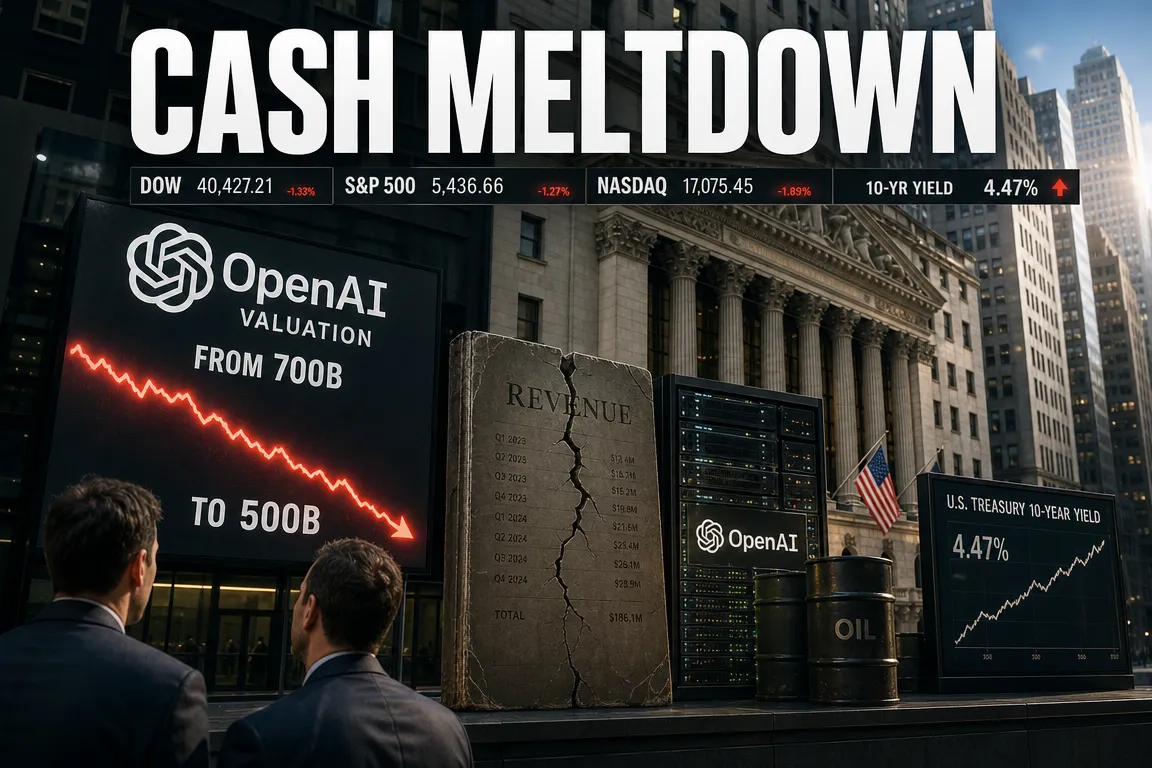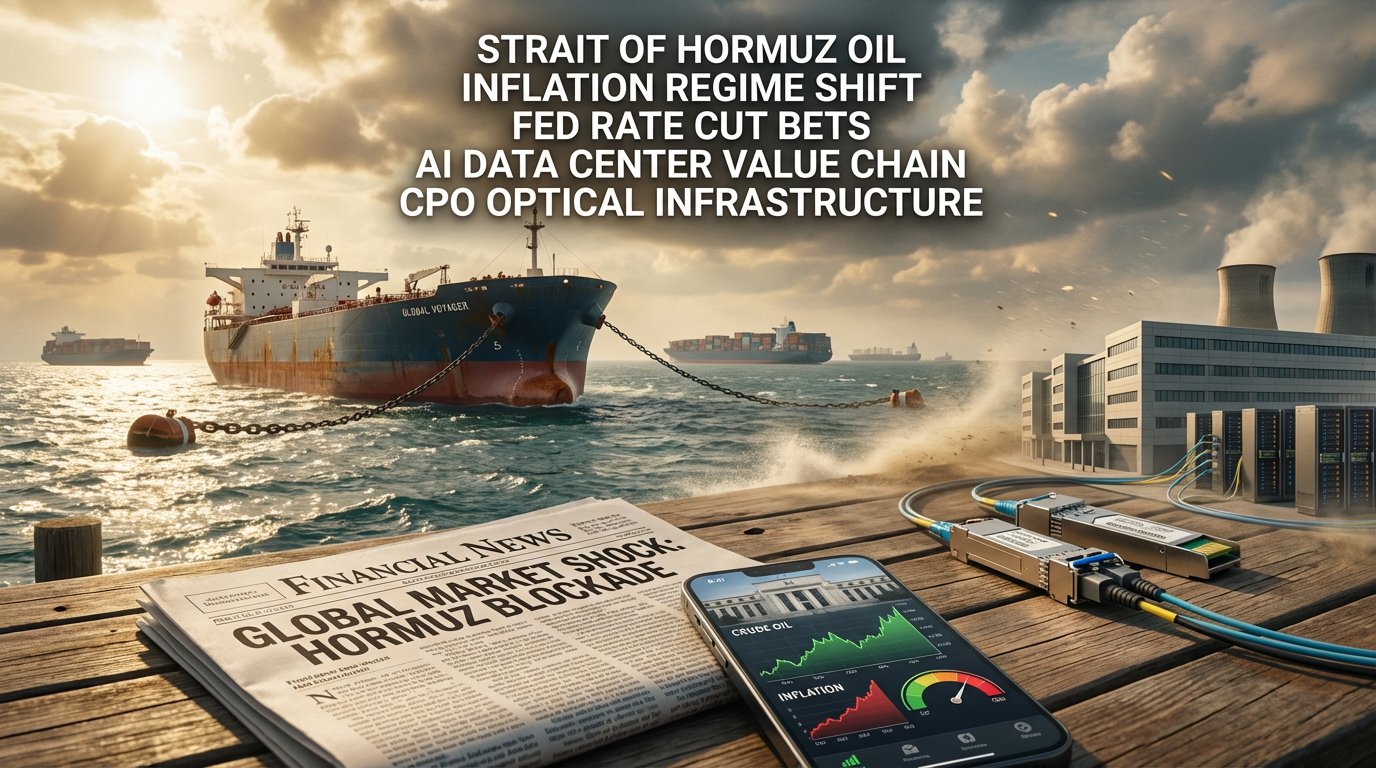
● Hormuz Shock, Oil Spike, Rate Cut Hopes Crushed, AI Bottleneck Shifts to CPO
From the Strait of Hormuz to oil prices, interest rates, and even the AI value chain… I’ll organize in one go what the real variable is that’s scarier than “the war itself”
Today’s post includes these key takeaways.
How much stocks fall and when they recover when war breaks out (historical averages).
Why a blockade of the Strait of Hormuz can reignite global inflation again (with numbers).
How U.S. Treasury yields and expectations for Fed rate cuts get knocked down when tariffs and energy prices overlap.
The structure by which the U.S. uses Middle East issues to shake China, Europe, and Japan all at once (dollar/energy/supply chain).
The real reason why the AI data center bottleneck shifts from GPUs to “optical interconnect infrastructure (CPO)” after Nvidia.
1) Market news briefing: Rather than “war = crash,” it’s more accurate to see it as “initial wobble + the real variable is inflation”
The main point of the original text is clear.
Historically, geopolitical events have repeatedly followed a pattern of “short-term weakness → recovery around two weeks.”
So there’s an underlying warning that panic selling driven by fear could be the worst choice.
However, in this phase, the key takeaway is not “war news,”
but whether oil and gas trigger inflation and, through that, shake interest rates (especially U.S. Treasury yields) and valuations again.
2) Historical data: the “average shock to stocks from war”
Message presented in the original text:
Right after wars/geopolitical events, markets often start weak for about 1 day to 1 week,
and there is a historical average where they turn positive after two weeks.
The event examples mentioned had this kind of nuance.
Gulf War: recovered within 2–3 weeks.
Iraq War: rebounded after about 4 weeks.
Crimea: faded in about 2 weeks (market shock eased).
From an investor’s perspective, the conclusion is simple.
Rather than assuming “war = a long-term bear market is guaranteed,”
a phased approach when market volatility (risk premium) expands may be more reasonable.
3) The real hinge: why the Strait of Hormuz (20–25% of oil) connects directly to “inflation”
The Strait of Hormuz matters not because of symbolism but because of the numbers.
It is a chokepoint through which about 20–25% of global oil flows,
and the original text describes it as “about 20 million barrels per day” passing through.
In other words, if this corridor is blocked, the supply shock is not “partial” but “structural.”
Even if OPEC+ announces a production increase, if it’s around 200,000 barrels,
the metaphor is that it’s not the same weight class to offset a 20 million barrel chokepoint (a burst water main with a paper cup).
Also, the key takeaway from the JPMorgan report reference is this.
If producer inventories are thin at around 25 days,
once a blockade lasts beyond one month, the fear becomes less about “price spikes” and more like “supply-chain paralysis.”
4) Wall Street scenarios (oil): organized into base / mid / worst cases
The basic Wall Street framework in the original text is “blockade intensity.”
-
Base case
The blockade eases and oil returns to the $60s. -
Somewhat worse case
Partial blockade persists and rises into the $70s. -
Worst case
If it stays blocked for more than a month, $100+ is possible → inflation spike risk.
The point here is not a numbers fight of “$70 vs $100,”
but that if the market starts pricing $100 as a ‘sustainable’ regime,
reheated inflation → rising rates again → simultaneous pressure on stock valuations (especially growth stocks).
5) The variable scarier than war: if already-elevated inflation indicators and oil overlap, it’s a “finishing blow”
The argument the original text pushes hard is this.
The ISM Prices Index rose to 70.5 (the highest since June 2022),
and the fact that this number is “pre-war” is even scarier.
In other words, there was inflation pressure even without war,
and if oil jumps on top of that, expectations for Fed monetary policy (rate cuts) could be pushed back further.
In fact, the flow is also mentioned that the probability of rate cuts fell from 57% to 47% as of June.
From an SEO perspective, this section naturally links the key keywords as one cluster.
Inflation, U.S. Treasury yields, Fed rate cuts, and dollar strength can easily move as one bundle.
6) Europe natural gas surge (35.4%) and what it means: energy is not “price” but “industrial competitiveness”
A sharper part of the original text is this.
More than the fact that European natural gas jumped 35.4%,
the problem is the structure that Europe’s dependence on Qatari LNG grew after Russian gas.
If supply on the Qatar side wobbles, Europe’s electricity and gas costs jump again,
and that becomes a direct hit to European manufacturing competitiveness.
The original text goes a step further and interprets that
the U.S. may have even calculated the flow of “European factories relocating to the U.S. (reshoring).”
This perspective is very important for the global economic outlook.
Because energy prices go beyond a simple commodity chart
and become a trigger that changes industrial geography (where production happens).
7) The claim that “the U.S. designed it” and how to read it: simultaneous pressure via energy, the dollar, and supply chains
The original text ties U.S. intent together like this.
China buys a lot of Iranian oil.
It has the effect of cutting the lifeblood of China’s Belt and Road (BRI) infrastructure.
Europe weakens further due to energy costs, and the U.S. gains a windfall from LNG exports.
Dollar strength is added on top of that.
In wartime phases, the dollar strengthening often repeats like a “rule,”
and this time it pointed out as a notable detail that even the yen, which tends to strengthen as a safe haven, was weak.
To sum up,
rather than the war itself, if “dollar strength + energy reshuffling + supply-chain reshuffling” hit simultaneously,
China, Europe, and Japan each get pressured in different ways—this is the frame.
8) AI trend: Is Nvidia over? → more weight on “there is no cycle-ending signal”
The original text treats the Morgan Stanley semiconductor research team’s stance change as important.
Last September they switched top picks to Micron/SanDisk,
and this time they turned the top pick back to Nvidia.
It also mentions Nvidia’s valuation as 18x 2027 expected earnings (forward P/E 18x),
arguing there is no evidence the AI investment cycle has rolled over and big-tech CAPEX is likely to keep increasing.
A $260 target price is also mentioned (with the nuance that it’s on the low side versus the Wall Street average).
The investor’s key takeaway here is not simply the “target price,”
but the question of whether AI data center spending can remain structurally resilient despite growth-slowdown concerns.
9) (Core point) The AI data center bottleneck shifts from “GPU” to “optical interconnect infrastructure (CPO)”
The most practical AI insight in the original text is this part.
The bottleneck Nvidia acknowledged is not the GPU itself,
but that it is shifting to optical infrastructure that handles connections inside the data center / between racks.
So structures like CPO (Co-Packaged Optics) rise,
and in that context related names like Coherent and Lumentum were strong.
It also mentions Nvidia’s $2 billion investment story.
This is not at the level of “AI theme stocks,” but a value-chain shift.
As GPU performance rises, data movement (bandwidth/latency/power) problems grow,
and it is a natural sequence for the bottleneck to move to networking/optics.
10) Storage (NAND) vs memory (HBM/DRAM): separate “demand” from “moat”
The original text expects storage companies (SanDisk, Western Digital, Seagate) could correct after a big run,
and adds a personal view that pure-play NAND companies have weaker moats.
On the other hand, it sees companies with HBM/DRAM technology as relatively more defensive.
The point here is,
as AI grows, storage demand may increase, but chasing “assets that have already priced too far ahead” is risky.
11) Themes amplified by supply-chain risk: rare earths/core minerals, and the trap behind defense-stock surges
Middle East instability → supply-chain risk highlighted → need to secure core minerals (rare earths) highlighted.
It notes that names like U.S. Rare Earths and MP Materials reacted strongly.
However, the original text also warns about the nature of theme stocks.
These kinds of names can cool off quickly,
and chasing highs is emphasized as risky with the expression “if you get stuck, there’s no answer.”
Defense stocks are similar: short-term flows can be strong,
but if the war does not become prolonged, valuations can quickly become a burden.
12) Practical response strategy: “No panic selling + adjust cash allocation + phased buying framework”
The conclusion presented in the original text is clear.
The worst strategy is panic selling into fear.
Instead, it argues it is more reasonable to slightly increase cash allocation and look for phased buying opportunities in a volatile zone.
And it summarizes the number-one variable that decides the whole game as “whether the Strait of Hormuz reopens.”
Ultimately, oil must be contained for inflation to be contained,
inflation must be contained for rates to stabilize,
and only then can the stock market return to a normal risk-on/risk-off regime.
13) The “most important point” that other YouTube/news rarely say (reinterpreted in my view)
From here is the real core point.
Most content these days ends at about “if war happens, oil goes up,”
but the essence hidden in the original text is the ‘combination of structural benefits the U.S. gains.’
-
① What determines stocks’ survival is not war news but an ‘inflation regime shift’
What the market fears is not bombing footage,
but a scenario where inflation becomes re-anchored and Fed rate cuts move further away.
In that case, growth-stock valuations get hit first. -
② Hormuz pushes not just “oil prices” but “global logistics/insurance/spreads”
The real shock often spreads later through more than crude futures prices—
shipping risk premia (insurance), delivery delays, and corporate margin damage.
News usually shows only oil, but for corporate earnings this side can be more fatal at times. -
③ European manufacturing may shift not because of “gas prices” but because the “factory map” can change
Once energy costs cross a certain level, companies respond not with cost-cutting but with ‘relocation.’
If this aligns with reshoring, the U.S. can capture jobs, investment, and tax revenue as well. -
④ In AI, looking only at “GPU demand” is late; now the next-cycle alpha is the “optics (CPO) bottleneck”
In the 2024–2026 AI value chain, the share of networking/optics is likely to grow after GPUs.
So Nvidia’s signal of direct investment can be interpreted as an event confirming the value-chain shift. -
⑤ Themes (rare earths/defense) can be the “right direction,” but “timing” is everything
Supply-chain risk is a mid-to-long-term trend,
but stocks often repeat a pattern of overheating on short-term flows and then dropping sharply.
Even if you agree with the direction, chasing often worsens the risk-reward profile.
14) Core SEO keywords that connect naturally to this post (reflected in-context)
In the end, from the global economic outlook perspective, this issue ties together at once
the inflation trajectory, the direction of U.S. Treasury yields, shifts in expectations for Fed rate cuts, whether dollar strength persists,
and even whether reshoring actually translates into real investment and jobs.
< Summary >
War issues often show a historical pattern of short-term declines followed by recovery within 2–4 weeks.
In this phase, the main game is not the war but whether oil-and-gas-driven inflation gets reignited.
The Strait of Hormuz is a chokepoint for 20–25% of global oil, so a one-month blockade could make an oil-$100 scenario realistic.
The surge in the ISM Prices Index is a signal that inflation pressure existed even before the war, which could further undermine rate-cut expectations.
In AI, the next bottleneck after GPUs is shifting to optical interconnects (CPO), bringing that value chain into focus.
The investment strategy favored is not panic selling but adjusting cash allocation and taking a phased approach.
[Related posts…]
- When dollar strength lasts, how do emerging markets, commodities, and U.S. stocks change?
- Inflation re-ignition scenario: checklist for rates, oil, and stock valuations
*Source: [ 월텍남 – 월스트리트 테크남 ]
– 극단으로 치닫는 현재상황.. “미국이 다 설계한 거라구요?”