● AI Bubble Debate Sparks Micron Samsung Hynix Rally
“AI memory bubble?” vs “There’s still 2 years left”… Why Micron, Samsung, and SK hynix’s landscape has grown bigger again
3 key points you absolutely must take away from this article (this is the core point)
1) The debate has heated up around the claim that “AI memory (Micron/Samsung/SK hynix) stock has risen too much—so isn’t it a bubble?” but the article’s conclusion leans toward “the grounds for declaring a bubble are weak”.
2) As support, it says you need to look at valuation (PER) and earnings (operating margin), along with the demand structure (need HBM and DRAM at the same time) together.
3) In particular, the game changer in this cycle is the point that “long-term memory contracts (fixed pricing) could soften supply shocks”.
News-style summary: A renewed trend in which semiconductors are re-evaluated again as “AI’s core infrastructure”
– This wave is a “bubble” debate about AI, but the way the market actually moves prices comes down to earnings and demand persistence.
– Micron’s stock jumped significantly after ChatGPT, yet the background behind the claim that it’s “still cheap” is summarized, and it also notes that Samsung Electronics and SK hynix jumped in global market-cap rankings as HBM demand was strongly underpinned.
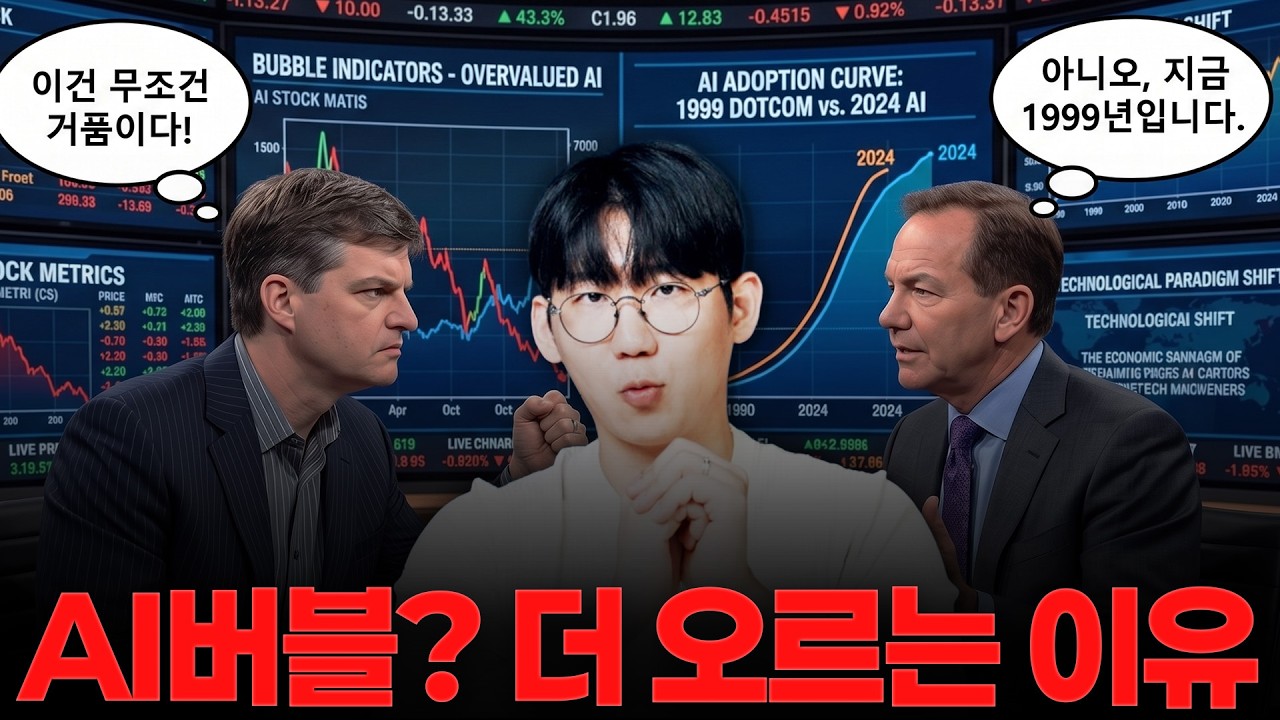
– At the same time, on Wall Street, opposing viewpoints like “it ended like the dot-com bubble / there are still 2 more years” (the logic of sell vs. like Paul Jones-level thinking) also show up side by side.
Market story 1: Nvidia and Big Tech are treated as “constants, not variables” in AI
– The article describes Nvidia as a company that is “closer to a constant than a variable in the AI era.”
– Big Tech (Google Alphabet, Apple, Microsoft, Amazon) is also viewed as good from a long-term perspective, but there’s a nuance that the direction of profits may be relatively constrained in “the segment where capital flows” rather than in “direct beneficiaries of technological innovation.”
– So an approach appears that separates the portfolio into “semiconductors (Nvidia/TSMC/Broadcom) vs. AI beneficiary bottleneck stocks.”
Here are the SEO keywords that connect naturally (core themes): AI semiconductors, the semiconductor cycle, HBM, data-center demand, valuation ( PER ).
Market story 2: Samsung Electronics and SK hynix’s “HBM reappraisal”… even shifts in market-cap rankings
– As Samsung Electronics rises, its market-cap ranking moves significantly, and alongside it, SK hynix also goes up—highlighting the flow that “global investor attention is concentrating on memory.”
– The message is clear. HBM deal (high-bandwidth memory) demand remains strong and seems likely to require even more going forward.
– This reappraisal is based not just on expectations, but on the view that it’s grounded in “HBM volume and supply bottlenecks.”
Market story 3: Why the “Micron is still cheap even after a surge” argument is coming up
– The article’s core question is: “After Micron has risen sharply since ChatGPT, why are people still saying it’s ‘cheap’?”
– The answer is summarized into three main points.
1) The basis of technical overheating (bubble debate) vs a rebuttal based on “earnings”
– It mentions “overheating signals,” saying the semiconductor indicator RSI has risen to the highest level since the dot-com bubble and that volatility has also gone into extreme territory.
– So some investors say, “The bubble will surely burst,” but the article counters that you have to look at earnings and value (valuation) together against that claim.
2) The dot-com bubble and the “decisive difference”: sales and profits exist now
– There’s a comparison saying that back then, it was a period where neither sales nor profits were really coming through.
– In contrast, now Samsung Electronics/SK hynix/Micron are making money through earnings (mentioning the scale of operating profit), and the difference is that “AI demand is penetrating real life/industries quickly.”
3) The claim that the multiple ( PER ) is ‘lower than you’d think’
– The article compares PER as a valuation indicator.
– For example, it connects a logic that while Nvidia’s PER looks relatively high, it’s still low versus the average, and that Micron’s PER is in a lower range (roughly “in the single digits like ~7”)—leading to the conclusion that it’s “hard to view it as excessive overvaluation based on performance alone.”
Wall Street debate: “The bubble bursts (Burry)” vs “There’s still 2 years left (Polly Jones)”
– The article contrasts the logic of two characters.
– Michael Burry: sees stocks that have still risen as “the show (bubble)” even now, like the tail end of the dot-com bubble, and leans toward emphasizing actions like short selling.
– Polti Jones: takes the view that “This is 1999. There are still 1–2 more years left,” meaning upside potential is sufficient.
– The reason this standoff structure itself matters is that the market is digesting “the AI narrative vs. technical overheating” at the same time.
The most important variable: Long-term memory contracts may reduce “cycle shocks”
This is where a truly different conclusion comes out.
The traditional formula of the memory cycle
– In the past, when demand surged, memory companies made big investments,
– and the explanation says the “big cycle” pattern repeated—where supply increases all at once around the timing when factories get completed, causing prices to plunge sharply.
‘Game rule change’ point of this cycle
– The article emphasizes that in the memory industry, the trend of expanding long-term contracts (e.g., 5-year fixed pricing / changes to the concept of futures) is important.
– What that means is simple.
– the typical pattern of supply popping out all at once and prices collapsing could weaken.
– That leads to a logic that, as in the “semiconductor bubble” claim, you may not be able to declare things simply by looking at overheating indicators alone.
A simultaneous need structure of HBM demand + DRAM demand creates the bottleneck
– In AI infrastructure, HBM is core, and at the same time, the structure emphasizes that DRAM (DDR series) is also needed together.
– The more important explanation is in this part.
– It says HBM and DRAM are, in part, produced together under the same wafer/production system, so “there are constraints where if you make one, the other’s volume has to follow too.”
– In other words, the view is that if there’s a period where you need both but can’t physically produce them at the same time (a bottleneck), then prices/earnings might not break down.
Still, there is risk: the possibility of supply increases from China
– The article acknowledges risks, too.
– If Chinese companies (e.g., expressions like “Yangchi/Chuangxin”) produce more memory and supply increases,
– there’s a possibility that prices could fall temporarily.
– But it puts more weight on the idea that the AI trend remains valid for at least a few years (roughly the demand logic through 2026–2027).
From an earnings-graph perspective: the claim that the stock price “followed earnings”
– The article explains the chart in terms of “the stock price hasn’t been too far off from earnings (forward EPS).”
– Another point is the nuance that operating margins are extremely high, and if semiconductors were truly a “bubble,” it would be difficult for profitability at that level to persist for the long term.
– Of course, it leaves room for short-term corrections, but it pushes toward the conclusion that “it’s hard to see it as overvaluation only.”
Korea issue: Even though “AI dividends/regulation” controversy shook the stock, it might be an excuse
– The article mentions a debate that because SK hynix’s and Samsung Electronics’ profits are large, the government should split the gains via regulation and dividends,
– and it notes that semiconductor stocks fell that day.
– However, an interpretation in the spirit of Bloomberg’s wording came up as “pressure to regulate is increasing,”
– but the article’s author argues that it wasn’t the main cause of the actual decline and interprets it as “a healthy adjustment period that could occur simply because it had risen too much.”
Conclusion: The view that “it could fall, but it could become a buying opportunity”
– The article’s final tone is this.
– Trust the AI narrative,
– look at earnings/valuation/demand structure (HBM·DRAM bottlenecks, long-term contracts),
– and with excessive fear, it’s hard to say it’s “already over.”
– So it says that even if there’s short-term volatility (a correction), an opportunity for additional buying could come.
An additional message: The “stocks = gambling” frame should change
– The writer mentions personal experience and generational perceptions,
– and emphasizes that in the AI era, you should approach things by reading data, earnings, and technology.
– In other words, it concludes that the “bubble debate” should ultimately be judged by financial statements (numbers) + technology (structure), not by emotion.
[The truly critical point that’s not usually well organized elsewhere, pulled directly from the article]
– The deciding battle in a bubble/overheating debate isn’t technical overheating (RSI, sigma), but “changes in demand structure (long-term contracts) + production bottlenecks (need HBM and DRAM at the same time)”.
– Especially, the reason the assumption “it’s a cycle industry and therefore it will break soon” can be shaken is because long-term contracts could soften supply shocks—and this is the article’s strongest logical point.
– So instead of declaring an “AI bubble” outright, the key approach is to check whether demand validity holds through 2026–2027 and whether earnings follow.
If you want, in the next article, I can organize this logic in a more hands-on way as an actual investment checklist (what to look at in quarterly earnings / HBM price, shipments, and operating-rate signals / when PER looks “low”).
< Summary >
– The view is presented that semiconductors (especially Micron, Samsung, and SK hynix) move together with AI demand and earnings, and that the grounds for “declaring a bubble” are weak.
– Unlike the dot-com bubble, sales and profits are big now and AI’s penetration speed is fast, making comparisons hard to justify.
– Even though corrections are possible due to technical overheating indicators (like RSI), the argument is that PER, operating margin, and long-term contracts plus HBM/DRAM bottlenecks can defend the downside.
– As a risk, the possibility of increased supply driven by China is mentioned, but the tone leans toward demand validity being more significant through at least 2026–2027.
[Related articles…]
HBM demand and the reappraisal flow of the memory cycle
Adjustments vs. buying from a semiconductor valuation (PER) perspective
*Source: [ 월텍남 – 월스트리트 테크남 ]
– 삼전, 닉스..마이크론 AI수혜주 곧 버블 꺼진다 vs “아직 2년 남았다”