● Nvidia Jensen Huangs Korea Visit Sparks AI Hardware and Data Center Boom
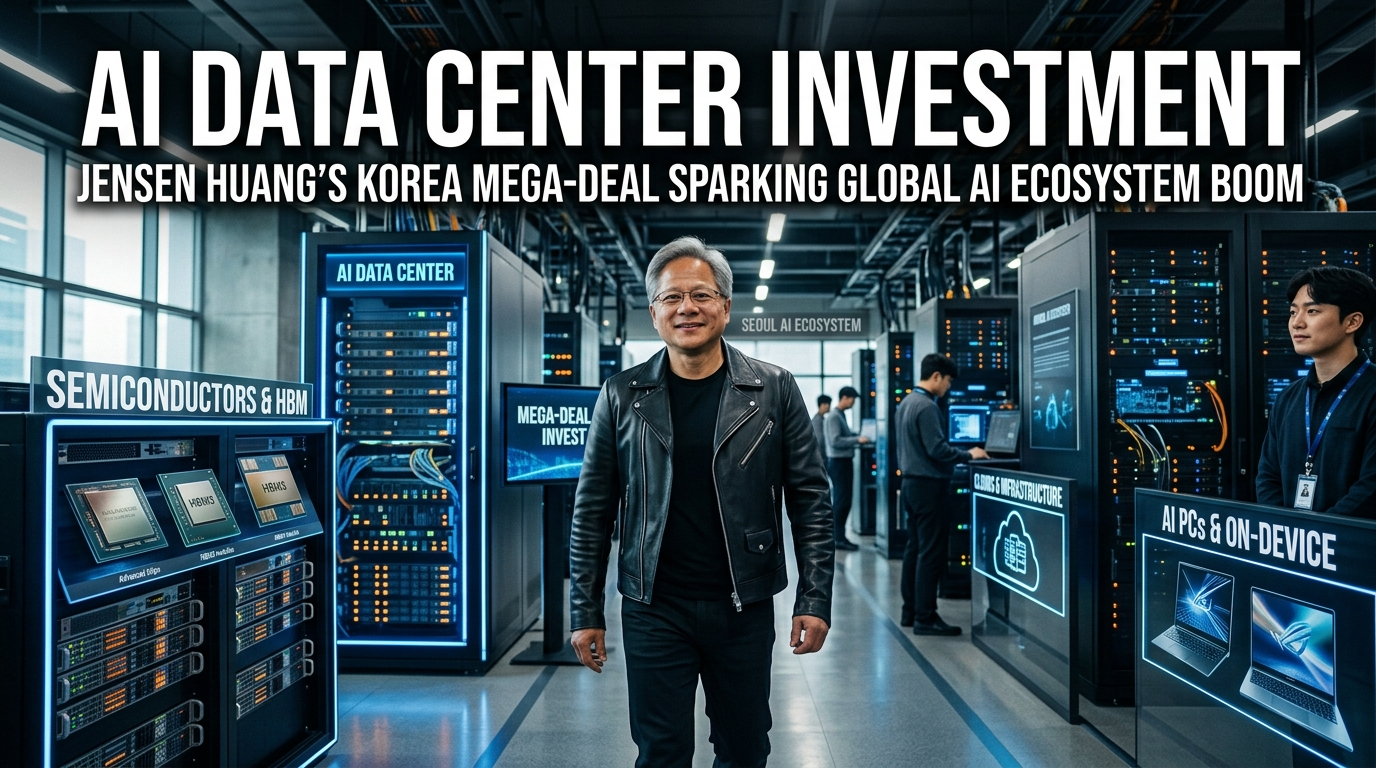
The Real Meaning of Jensen Huang’s 3 Days and 4 Nights Visit to South Korea: Not Here to Sell GPUs—But to “Buy, Grow, and Expand” Korea’s AI Ecosystem
Why the Market Shook Now (From the Core Point)
Jensen Huang’s visit schedule from NVIDIA was so tight, and he met with Korea’s major conglomerate chairmen in large numbers, so
the stock price moved “like a theme” first.
But this time, analyses suggest it wasn’t just about investor expectations for investment.
In particular, the following three items are what you can organize so it’s easy to understand if you follow them to the end.
The only takeaways from this article are exactly these.
- 1) NVIDIA didn’t come just to “sell” (GPUs); it came bundled with “selling/buying/growing/expanding”
- 2) The biggest beneficiaries narrow down to the SK group (semiconductors) + Naver (AI data center/cloud operations)
- 3) The focus is a three-stage expansion structure that goes beyond data centers: on-device AI (PC) and physical AI (robots/factories)
If you catch just these three, you’ll get a sense of both “why the stock price moved” and “who will move more next.”
News-Style Timeline: Who Jensen Huang Met and What He “Delivered”
1) Met Korea’s top corporate chairmen broadly
Based on media coverage/video content, Jensen Huang handled meetings with multiple CEOs within a short period.
The people/institutions mentioned include the following.
- SK (Chairman Taewon Choi) and the SK AI-related lineup (including details from Vice President Jihyun Kim’s interview)
- Hyundai Motor (Chairman Euisun Chung)
- LG (Chairman Kwang-mo Goo)
- Naver (Chairman Jae-jin Lee)
- Doosan (Chairman Park Jeong-won)
- Krafton (Chairman Byung-kyu Jang)
- NCsoft (Representative Taek-jin Kim)
- Mentions of touchpoints with government/policy such as Deputy Prime Minister Hunbae Park
With this kind of “wide-ranging move,” the market usually
first calculates
- who he met
- what investment/agreements might come out
2) The “four gifts” were essentially a roadmap
It’s summarized that, in the interview content, Jensen Huang officially mentioned “four kinds of gifts (= sales/supply/expansion packages).”
- Bena Rubin (= the core AI factory/GPU key system)
- Bena CPU (= next-generation computing expansion)
- RTX Spark (a PC line dedicated to Windows AI)
- Jensen Thor (systems for physical AI/robot training)
The important point is that, unlike “just selling GPUs” as in the past,
you can see a picture of growing the entire platform together with Korean partners.
Interpretation of Jensen Huang’s “Three Purposes”: Sell / Buy / Grow / Expand
Here, the interview emphasizes that you should look at Jensen Huang’s purposes from three perspectives.
In the end, it’s an interpretive framework that reduces misunderstanding in the market.
1) ① Selling purpose: Not selling GPU supply, but expanding sales of a “next-generation product lineup”
There was a period when GPU supply was already tight, and
people raised the counterargument: “If it doesn’t sell, why is he here?”
But the analysis point is this.
- Even so, short-term quantities could have strong reservations/demand
- Still, for NVIDIA, it needs to secure the “food for the next 5 to 10 years”
- So the need grows to bundle not only Korea’s specific company but the AI ecosystem itself as a partner
In other words, it’s a logic of a move to preempt the next generation of computing/memory/systems more than just short-term revenue.
2) ② Buying purpose: Long-term contracts for key memory like HBM + expansion with next-generation memory
What was reflected most significantly in the market was news related to the SK group (especially SK hynix).
The core is that they discussed “HBM securing” and “next memory” together.
- HBM is effectively indispensable in data centers/AI factories
- For AI PCs like RTX Spark, a memory specification other than HBM is needed (mentioned as LPDDR 5, etc.)
- Therefore, NVIDIA is interpreted as aiming to obtain not only HBM but also next-generation memory specifications/designs
A long-term contract (mention of a 2-year LTA stamp) is the link that leads into “expanding product sales afterward.”
3) ③ Growing purpose (co-growth): AI factory + data centers/cloud/on-device + robots
Here, NVIDIA places the “AI factory” at the center.
Based on the flow of the interview, an AI factory doesn’t simply mean building servers;
it means a structure that produces tokens (generation volume) cheaply, in large quantities, and efficiently.
And NVIDIA wants to expand this with Korean partners.
- Data centers (Naver, SK-related axis)
- On-device AI (expansion of AI PCs like RTX Spark)
- Physical AI/robots (combining Jensen Thor + robot training/platform)
This is read as the “biggest meaning” of this visit.
Companies Mentioned as Biggest Beneficiaries: Why SK (hynix) + Naver
1) SK hynix (or from the SK group perspective): The “buying” side is the clearest
In the interviews, the top beneficiary candidates are described as SK hynix and Naver.
Among them, SK hynix has a stronger character of “coming to buy.”
Why? Because what NVIDIA requires isn’t simply GPU supply;
it’s memory (especially HBM), the bottleneck of the AI factory, supply, and
design collaboration to expand with next-generation memory.
Also, since they mentioned “not only the end of HBM but jointly discussing next memory,”
it creates a logic for re-evaluating medium- to long-term valuation beyond a short-term cycle benefit.
2) Naver: The key is ‘joint design/joint expansion’ of AI data centers
Naver isn’t just the side buying GPUs;
it’s described as an axis that grows AI data centers together with NVIDIA.
The interview specifically mentions the data center roadmap.
- 55MW in the first half of next year
- 100MW in the second half of next year
- 200MW in 2028
- Further aiming for 1GW (mentioned)
The answer to “why Naver?” is clear here.
- Naver already has capabilities in operating cloud/GPU clusters
- With only domestic demand, the limit is large, so it ultimately needs to sell overseas
- Unlike existing cloud, AI data centers need “models (foundation models) + engines (serving/agents)”
So, the point is that based on NVIDIA’s design blueprints like DSX (standards such as networking/servers/power),
Naver can connect to global expansion as well.
The “Three Main Pillars of the AI Industry” They Mentioned: Data Center – On-device – Physical AI
If you treat this visit as a “one-time event,” it’s easy to miss.
The flow of the interviews suggests NVIDIA expands the AI ecosystem by breaking it into layers.
1) Data center: AI factory (token production factory)
It’s a structure that bundles memory (HBM/next-generation memory) + GPU + power/cooling + networking.
Standards like DSX (design framework) are included here.
In the end, companies that “operate AI data centers cheaper/more efficiently” are what attract attention.
2) On-device AI: AI-dedicated PCs like RTX Spark expanding to the edge
In the interview, they explain why RTX Spark matters in this way.
- Window-based AI PCs (not only for developers; B2C/ecosystem expansion)
- Expansion to more consumer and enterprise devices via AIPC (on-device AI)
- The route that previously introduced GPUs in the gaming market is reconnected
- Game-room PCs/PC bang environments serve as a channel to experience GPUs
So it reads as a signal that they’ll take it not only from data centers but also to the edge.
In this segment, it naturally connects up to the semiconductor (memory) + PC ecosystem.
There’s also a flow that often bundles this as SEO keywords, but the core of this issue is that “AI PCs/on-device AI” has entered a truly money-making segment.
3) Physical AI (robots/factory automation): “Robot training” is the next game
Jensen Thor, and the shift in robots/manufacturing processes, show up as key.
Physical AI isn’t limited to humanoids;
it’s described to include a structure such as:
- manufacturing plant automation
- industrial robots
- a training approach built on data from the field
And through the robot intelligence network, approaches like world model (LWM) are connected.
They also explained that because games already contain “interaction/physical rules,” they have an advantage in world model training.
Companies Mentioned as Physical AI Partners: Hyundai Motor/Doosan/LG/Naver are also connected
In this article, “newness” is interpreted not as a simple exploration of meetings in the robot space, but as a connection of technology/platform.
If we summarize the observation points for each company mentioned in the interviews:
- LG Electronics: Chloe (robot reference), value-chain related to actuators/batteries, robot foundation model (technology-based) growth
- Hyundai Motor: robot and software that can be deployed in factories, robot operation capabilities connected to things like Dymix/Atlas
- Doosan: Doosan Robotics (industrial robots), Doosan Enerbility (power/energy solutions), and the DSX power axis can be connected
- Naver: possibilities for advancing the robot business through robot technology/investment experience + combining the NVIDIA platform (described more as “use/combination” than direct joint development)
Here’s the real “core takeaway”—the part other news/YouTube rarely says less
Based on the interview content, beyond the commonly stated “since Jensen Huang came, semiconductors/AI will rise,”
here are only the most important conclusions from this article’s perspective, separated out.
-
Not a “GPU sales event,” but an “AI factory ecosystem contract” viewpoint
It’s strongly characterized by selecting partners by bundling beyond short-term GPU demand: memory (including next-generation), data center blueprints (DSX), operational capabilities, and robot training systems. -
The direction of benefit moves from “who has GPUs” to “who operates the AI factory”
This is why operational/cloud partners like Naver become more valuable. -
On-device AI (PC) is formalized as the “next expansion market after data centers”
AI PC lines like RTX Spark are read as signals of an “edge entry.”
In other words, even if the data center investment boom ends, there will still be demand for the next layer. -
Physical AI is likely bottlenecked not by the robot product itself, but by “training/simulation/world models”
Jensen Thor + world model linkage is the point. It suggests that companies attached to the “training ecosystem” may be more advantageous than simple robot manufacturing companies.
Investment checklist investors should look at (“flow,” not just “who met”)
What moves the stock price is ultimately expectations, and for that expectation to sustain, it matters whether “contracts/standards/roadmaps actually materialize.”
The emphasized points in the interviews are similar.
- What is this company here to “sell”?
- What is it here to “buy”?
- What is it trying to “grow together” (whether it’s a new business/expansion)
By comparing these three items by each company’s position,
you’ll be able to tell who ends up as a short-term theme and who carries forward into medium- to long-term benefits.
Bonus: Why NVIDIA views Korea as a “core partner” (policy/talent/manufacturing competitiveness)
Finally, the background related to Korea is also summarized toward the end of the interview.
- Korea has a strong talent pool, and R&D expansion is also possible
- As a manufacturing powerhouse, it’s naturally connected to the transition to physical AI-driven robot/factory automation
- Already, Korean companies have strengths in memory/cloud/devices among the AI layers, making them easy to bundle as partners
So this connects to the flow that Jensen Huang evaluated Korea with a message like “within the top 3 in AI ranking, after the U.S. and China.”
SEO Core Keyword Natural Inclusion Points
Based on the search intent of this issue, the following keyword flow is included so that the whole article stays naturally connected.
- AI data center: connected to Naver/implementation roadmap/operational capabilities
- Semiconductor (memory) supply chain: collaboration on HBM and next-generation memory
- On-device AI: AI PC expansion like RTX Spark
- Physical AI: robot training (Jensen Thor) and world model-based approach
- AI factory: token production/power/serving efficiency-focused framework
< Summary >
- Jensen Huang’s visit to Korea is interpreted not only as GPU sales, but as a strategy to buy (memory) / grow (AI factory) / expand (on-device AI, physical AI)
- The biggest beneficiary axes are SK (especially collaboration on HBM and next-generation memory) and Naver (global expansion based on building and operating AI data centers)
- NVIDIA’s layer strategy follows data center → cloud/models → device (AI PC) → agents → robot training (physical AI)
- For physical AI, the bottleneck is likely to be training/simulation (world models) and dedicated systems rather than robot products themselves, so companies attached to that ecosystem may be more advantageous
- For investment checks, you should look at what they’re selling/buying/growing together (contracts/standards/roadmap materialization) rather than just “who they met”
If you want, based on this content, I can also neatly organize it into a table in the form of “Three-tier expectations by company (Naver/SK/Hyundai Motor/LG/Doosan/game companies) (short-term/medium-term/long-term)”.
*Source: [ 티타임즈TV ]
– 엔비디아와 삼성, SK, 현대차, LG, 네이버의 득실은 (김지현 부사장)