● Market Shock, CPI Fears, Geopolitical Jolt, Japan Liquidity Panic
KOSPI Sidecar Trigger: Why the Market Sold Off in Unison
U.S. inflation risk, Middle East tensions, and Japan rate dynamics: three key headwinds driving today’s move
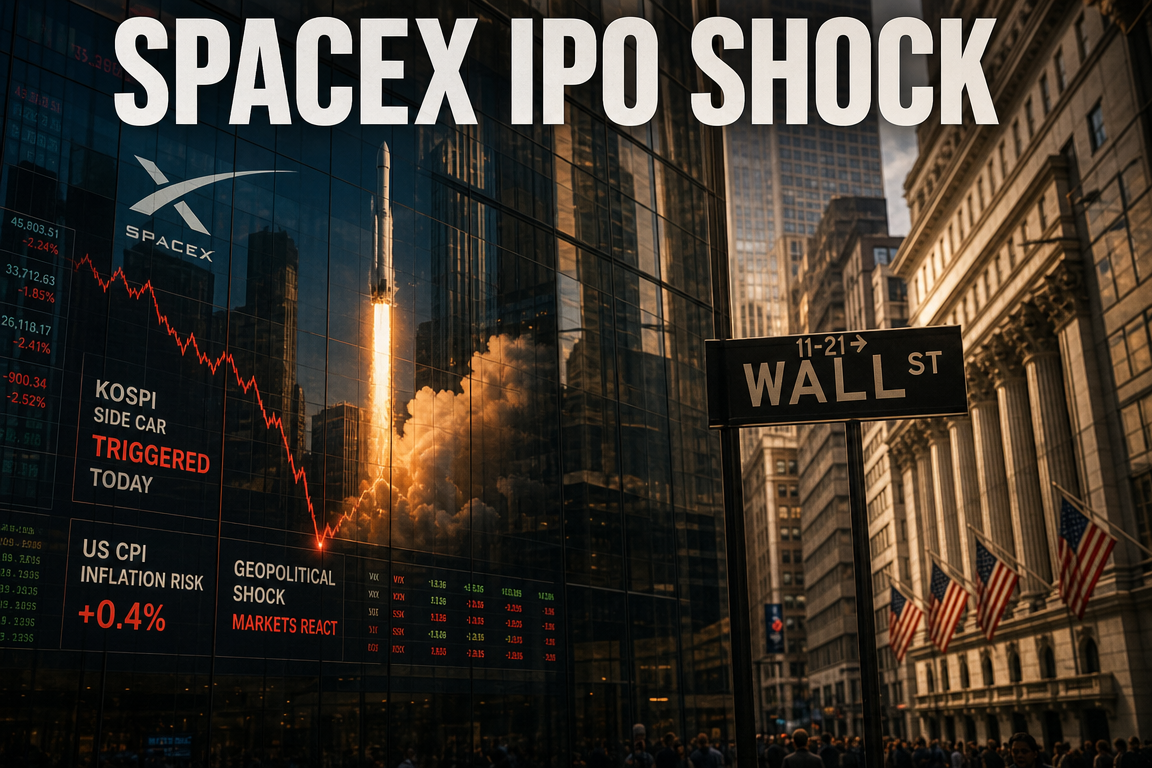
Today’s decline in Korean equities reflected a concurrent deterioration in multiple global macro and risk factors rather than a single domestic catalyst. The sidecar trigger, sharp drawdowns in Samsung Electronics and SK hynix, and an expansion in foreign selling occurred simultaneously, amplifying downside momentum and intraday volatility.
This report consolidates the primary drivers: (i) inflation concerns ahead of the U.S. CPI release, (ii) geopolitical risk tied to U.S.-Iran tensions, (iii) Japan producer-price strength and the associated risk of yen-funded flows reversing, and (iv) the disproportionate impact on Korean semiconductor bellwethers.
Market Snapshot
What the KOSPI sidecar mechanism indicates
A KOSPI sidecar is a market-stabilization measure that temporarily restricts program trading when index futures move sharply within a short time window. In practical terms, it functions as a volatility brake during disorderly price action.
A sidecar trigger typically signals elevated risk aversion and constrained liquidity conditions, particularly when index-heavyweights drive the decline. Given the KOSPI’s high concentration in semiconductor mega-caps, weakness in U.S. technology and semiconductor shares often transmits directly into Korean index performance, increasing the probability of abrupt index-level moves.
Headwind 1
Pre-CPI inflation anxiety in the U.S.
The most immediate driver was positioning and risk reduction ahead of the U.S. CPI print. Markets remain highly sensitive to the timing and pace of Federal Reserve rate cuts; an upside CPI surprise would reinforce the “higher-for-longer” narrative.
This matters because recent global equity gains have been concentrated in AI-linked growth segments, where valuations are more rate-sensitive. Higher discount rates compress the present value of future earnings, raising valuation risk and encouraging pre-emptive profit-taking. Weakness in U.S. semiconductors and technology contributed to a risk-off tone ahead of the Korean open, with foreign and institutional investors reducing exposure to Korean semiconductor leaders accordingly.
Given their index weight, simultaneous declines in Samsung Electronics and SK hynix materially weaken KOSPI resilience, increasing the likelihood of volatility events around macro catalysts.
Headwind 2
U.S.-Iran escalation and broader geopolitical risk
Geopolitical headlines related to U.S. action involving Iran increased risk premia and reinforced deleveraging in risk assets. While difficult to quantify, such shocks often deteriorate sentiment rapidly and can trigger cross-asset repositioning.
A key transmission channel is crude oil. Rising oil prices can re-ignite inflation concerns, complicating the path to policy easing and tightening financial conditions through rates, FX, and risk appetite. With markets already cautious into CPI, incremental geopolitical risk had an outsized effect.
In risk-off environments, capital tends to rotate away from high-beta growth exposures toward more defensive assets, making AI, semiconductor, and technology leaders frequent first-order sources of liquidity and profit-taking.
Headwind 3
Japan producer prices: implications for policy normalization and yen-funded flows
Japan’s producer-price strength was a relevant global liquidity signal. Persistent inflation pressure increases the probability of further Bank of Japan normalization.
Japan’s prolonged low-rate regime supported yen-funded carry trades, with borrowing in yen to invest in higher-yielding overseas assets. If Japanese rates rise or expectations for hikes strengthen, these trades can unwind, potentially pulling capital back toward Japan and increasing selling pressure across global risk assets.
Korean equities are structurally sensitive to foreign flows; sectors with high foreign ownership and concentrated liquidity, including semiconductors, can experience amplified price moves under a global flow reversal scenario.
Why Samsung Electronics and SK hynix moved more sharply
Korean indices are highly semiconductor-weighted; when semiconductors decline, index-level drawdowns can accelerate. Semiconductor equities had also rallied materially on AI demand expectations (HBM, AI servers, data-center capex, and Nvidia-linked supply-chain optimism). When expectations are elevated, the market tends to react more asymmetrically to negative macro shocks.
While both names are associated with the AI cycle, SK hynix is more directly perceived as a beneficiary of HBM demand, which can increase sensitivity to global risk repricing when the trade becomes crowded. The concurrent macro shock increased the probability of systematic and program-driven selling in the most liquid index constituents.
Event Flow (Chronological)
- Inflation concerns intensified ahead of the U.S. CPI release.
- U.S. semiconductors and technology saw pre-emptive selling.
- Korean equities opened with weakened risk sentiment, reflecting the prior U.S. session.
- U.S.-Iran tensions added geopolitical risk.
- Potential upside pressure on crude oil strengthened inflation concerns.
- Japan producer-price data increased focus on potential BoJ policy shifts.
- Carry-trade unwind risk weighed on global risk assets.
- Foreign selling concentrated in Korean semiconductor mega-caps, increasing index volatility.
- The KOSPI sidecar trigger reflected a rapid escalation in risk-off positioning and market impact.
Key Takeaways (Often Underemphasized)
-
The sell-off was driven by a confluence of risks rather than a single catalyst; in such regimes, markets typically prioritize de-risking over granular attribution, which can amplify drawdowns.
-
The move does not, by itself, indicate an immediate deterioration in semiconductor fundamentals. The primary driver was macro risk (rates, geopolitics, cross-border flows) and valuation repricing rather than near-term earnings impairment.
-
Japan-related policy expectations are likely to remain an increasingly important global driver. As low-rate liquidity trades potentially unwind, spillovers into global equities can be non-linear.
-
Structural AI and semiconductor themes do not negate macro constraints. Equity pricing remains highly dependent on rates, liquidity, FX, and risk premia; entry point and valuation discipline remain critical.
Is this a short-term shock or the start of a broader correction?
The near-term inflection depends primarily on the U.S. CPI outcome. A benign print could re-anchor rate-cut expectations and support a tactical rebound, particularly in semiconductors. Conversely, an upside surprise could reprice the easing path, extend valuation compression in growth equities, and sustain elevated volatility.
If geopolitical risk persists and Japan normalization expectations strengthen further, the episode could evolve into a broader global risk repricing rather than a single-session event.
Investor Checklist (Near-Term Monitoring)
- U.S. CPI vs. consensus and market-implied expectations.
- CPI components, particularly energy and shelter dynamics.
- U.S. Treasury yields and the direction of USD strength.
- Crude oil trajectory as geopolitical risk is priced.
- BoJ-related communication and JPY moves.
- Foreign flow persistence in Samsung Electronics and SK hynix.
- Whether declines broaden beyond semiconductors into other KOSPI sectors.
Bottom Line
Today’s action is best characterized as a macro-driven shock transmitted through Korea’s most index-concentrated and liquid exposures. The sell-off reflects the market’s rapid repricing of inflation, geopolitical, and cross-border liquidity risks, with semiconductors serving as the primary conduit rather than the underlying source of weakness.
< Summary >
- Today’s KOSPI decline and sidecar trigger reflected overlapping risks: U.S. CPI-related inflation concerns, U.S.-Iran geopolitical escalation, and Japan producer-price strength increasing the probability of policy normalization and a reversal in yen-funded flows.
- Korea’s semiconductor-heavy index structure magnifies downside when Samsung Electronics and SK hynix decline.
- The move was driven more by macro variables (rates, oil, FX, global flows) than by immediate semiconductor fundamental deterioration.
- The key near-term breakpoint is U.S. CPI; outcomes will influence whether volatility normalizes or extends.
*Source: [ 내일은 투자왕 – 김단테 ]
– 코스피 사이드카 3가지 악재
● SpaceX IPO-Global Shock, AI Reset
Why a SpaceX IPO Could Disrupt Broad Markets: Capital Rotation, Index Effects, and a Potential Reset of AI Infrastructure
A SpaceX IPO should not be viewed as a routine large-cap technology listing. The market relevance concentrates in three areas:
1) Index inclusion and passive inflows could force large-scale rebalancing across global portfolios.
2) A structurally strong long-term business may still exhibit elevated equity volatility due to the risk profile of the space industry.
3) Ecosystem linkages spanning Starlink, space-based data centers, xAI, Tesla, and robotics could reshape AI infrastructure investment and value chains.
This report summarizes how a SpaceX listing could influence U.S. equities, global flows, semiconductor demand expectations, and AI capex trends. It also highlights under-discussed factors with potential market impact.
1. Key Takeaways
A SpaceX IPO could be a historically large issuance. This implies not only incremental inflows, but also forced funding via sales of existing assets to create capacity for new exposure.
If index inclusion occurs, ETFs and major asset managers tracking those indices would be required to purchase SpaceX to match weights. The funding source is typically portfolio reallocation, affecting other equities, fixed income, crypto, or regional allocations.
Accordingly, the IPO functions less as a single-stock event and more as a catalyst for market-wide capital rotation.
2. Why Capital Rotation Becomes Likely: The Power of Index Inclusion
The primary mechanism is index inclusion. If SpaceX is added rapidly to major benchmarks post-listing, index funds and passive vehicles must acquire shares according to rules-based mandates.
Most large institutions maintain limited idle cash. In practice, they fund purchases by selling other holdings. This can transmit price effects across:
- U.S. mega-cap technology
- International equities
- Semiconductor sector allocations
- Bonds and other alternatives
This dynamic is observable when market capitalizations shift materially: portfolio rules can generate selling pressure in regions or sectors that become overweight. A SpaceX listing at scale could amplify this effect.
3. How Mega-Managers Raise Cash (e.g., BlackRock-Scale Behavior)
When large managers state an intent to deploy $10B+ into a new listing, they typically do not draw from bank deposits. They liquidate existing positions to build cash.
As a result, positioning adjustments may begin months before the IPO, even if headlines focus on “IPO momentum.” Investors should monitor pre-IPO flow signals such as:
- Changes in institutional cash levels
- Relative underperformance in sectors used as funding sources
- Risk reduction in crowded exposures
4. Why SpaceX Equity Could Be Strong Long-Term Yet Volatile
From a business standpoint, SpaceX may benefit from multiple long-duration growth drivers:
- Launch services
- Starlink satellite communications
- Potential space-based data center infrastructure
- AI infrastructure optionality
- Defense and government contracts
From an equity perspective, volatility risk remains structurally high. Space activities are exposed to frequent, high-salience events:
- Launch or deployment failures
- Satellite loss
- Technology delays
- Regulatory constraints
- Geopolitical shocks
Price behavior may therefore be heavily influenced by news flow rather than fundamentals alone.
5. Post-IPO Price Path: Why “Continuous Upside” Is Not a Base Case
IPO windows often coincide with peak expectations and may embed elevated valuation assumptions. For very large IPOs, early trading can be dominated by imbalanced demand, followed by short-term corrections.
A pullback within days or weeks is plausible. Timing such moves is difficult because positive catalysts (successful launches, contract wins, AI-infrastructure narratives) can reverse sentiment quickly.
For longer-horizon investors, risk management approaches may include:
- Staged entry (dollar-cost averaging)
- Time diversification
- Position sizing discipline
6. Early Investors’ Profit-Taking and Secondary Flow Effects
SpaceX has substantial pre-IPO capital. After lockups expire, some early investors may realize gains. The released liquidity can rotate into other assets, potentially including:
- U.S. growth equities
- AI semiconductor supply chain
- Data center and power infrastructure
- Select non-U.S. technology exposures
Therefore, the IPO can act both as a liquidity sink initially and, later, a liquidity source for other segments, contributing to multi-phase volatility.
7. Core Thesis: Why SpaceX Focuses on Space-Based Data Centers
The strategic interest in space-based data centers links to constraints facing terrestrial data center expansion:
- Power availability limits
- Cooling costs and water constraints
- Land scarcity in key hubs
- Permitting and regulatory friction
As AI workloads scale, “build more on Earth” becomes increasingly constrained in major clusters. Alternative infrastructure concepts, including space-based capacity, emerge as potential long-term responses to these bottlenecks.
8. Space Data Center Leasing as a High-Leverage Model
A key model is infrastructure leasing: SpaceX would not need to operate all AI services directly to generate substantial revenue. This resembles early cloud evolution, where internal capacity expanded into third-party infrastructure services.
In an environment where GPUs, HBM, power, and data center capacity are bottlenecks, infrastructure providers can obtain enhanced pricing power. Space-based capacity, if realized, would likely exhibit similar economics.
This framing connects to the margin dynamics observed in constrained supply chains, including high-performance compute components.
9. xAI: Why It Should Be Assessed Differently Than Model Rankings
Relative to leading AI labs, xAI may appear behind on certain metrics. However, evaluation based solely on model rankings can miss the structural advantage of captive demand and integrated distribution:
- Tesla: vehicles, autonomy stack, and robotics (physical AI)
- SpaceX: data center and launch infrastructure optionality
- Starlink: global connectivity and enterprise distribution
An AI company with immediate internal customers can scale deployments differently from one that must build external distribution from scratch.
10. AI Competition: First Place Is Not the Only Economically Relevant Outcome
Enterprise AI purchasing decisions often prioritize:
- Reliability and uptime
- Long-running task stability
- Domain specialization
- Cost structure and total cost of ownership
- Integration and customization
Different workloads (coding, customer service, logistics, manufacturing automation, autonomy, robotics control) require different optimization targets. xAI could achieve economically meaningful scale without holding the top benchmark position, particularly through vertical integration across hardware, connectivity, and applications.
11. Starlink, Connectivity, and AI Bundling: A Durable Monetization Path
Connectivity markets are structurally conducive to bundling. Packaging internet connectivity with AI services (enterprise assistants, automation, security, connectivity management) can:
- Reduce churn
- Increase ARPU
- Create lock-in via integrated workflows
In B2B, bundled offerings can be especially durable. Over time, SpaceX could increasingly resemble a hybrid of:
- Connectivity provider
- AI infrastructure supplier
- Data center platform
- Multi-service ecosystem operator
This supports the market’s willingness to assign premium valuations to platform-like business structures.
12. Linkage to Semiconductors and AI Hardware Demand
The SpaceX theme should not be separated from semiconductor outlooks. Expansion in space-based compute, satellite networking, autonomy, and robotics implies higher demand for:
- High-performance GPUs
- HBM
- Power semiconductors
- Connectivity and networking silicon
Even without direct chip manufacturing, SpaceX could function as an upstream demand driver influencing the broader AI infrastructure cycle. Persistent data center bottlenecks may reinforce a structural growth narrative beyond typical cyclical frameworks.
13. Practical Investor Framing
SpaceX may be attractive on long-duration fundamentals, but a stable post-listing upward trajectory should not be assumed.
- Short-horizon participants may focus on volatility and liquidity regimes.
- Long-horizon investors should prioritize scenario discipline, sizing, and staged execution.
Opportunity cost should also be considered: capital waiting for an entry point may miss parallel moves across AI infrastructure and semiconductor beneficiaries.
14. Under-Discussed High-Impact Points
14-1. The IPO is less about “a new listing” and more about global asset reallocation
The central market impact is the sourcing of capital: where funds are sold and where new exposure is built. At sufficient scale, SpaceX can affect prices beyond its own shares.
14-2. Space-based data centers are a response to terrestrial constraints, not solely a speculative theme
Power, land, regulatory, and cooling limitations are already binding in key regions, making alternative infrastructure concepts increasingly relevant.
14-3. xAI’s key advantage is internal ecosystem demand, not headline model rankings
Distribution and repeatable demand from an integrated ecosystem can be a durable competitive advantage.
14-4. The primary beneficiaries may be the AI infrastructure ecosystem, not only SpaceX
Potential repricing could extend across GPUs, HBM, data center equipment, power infrastructure, satellite connectivity, robotics, and physical AI.
15. Conclusion: A SpaceX IPO as a Regime Signal
A SpaceX IPO could represent a convergence of:
- Large-scale portfolio rebalancing driven by passive flows
- A new public-market proxy for the space and connectivity complex
- A potential inflection in AI infrastructure constraints and solutions
- Expanded platform competition across connectivity, compute, and applications
Over time, focus may shift from listing valuation to the degree of ecosystem integration across communications, compute capacity, AI services, robotics, and the semiconductor supply chain.
< Summary >
- A SpaceX IPO could be a historically large listing; index inclusion could trigger forced passive buying and market-wide rotation funded by sales of other assets.
- Long-term fundamentals may be strong, but space-industry risk and event-driven news flow imply elevated equity volatility; short-term post-IPO corrections are plausible.
- Key growth vectors include Starlink, potential space-based data centers, AI infrastructure optionality, and integration with xAI and the broader Tesla ecosystem.
- The most material implication may be ecosystem-wide repricing across AI semiconductors (GPU, HBM), data center and power infrastructure, connectivity, robotics, and physical AI, rather than SpaceX alone.
*Source: [ 경제 읽어주는 남자(김광석TV) ]
– 스페이스X 상장, 시장이 흔들릴 수밖에 없는 이유 | 경읽남과 토론합시다 | 강정수 박사님 [3편]