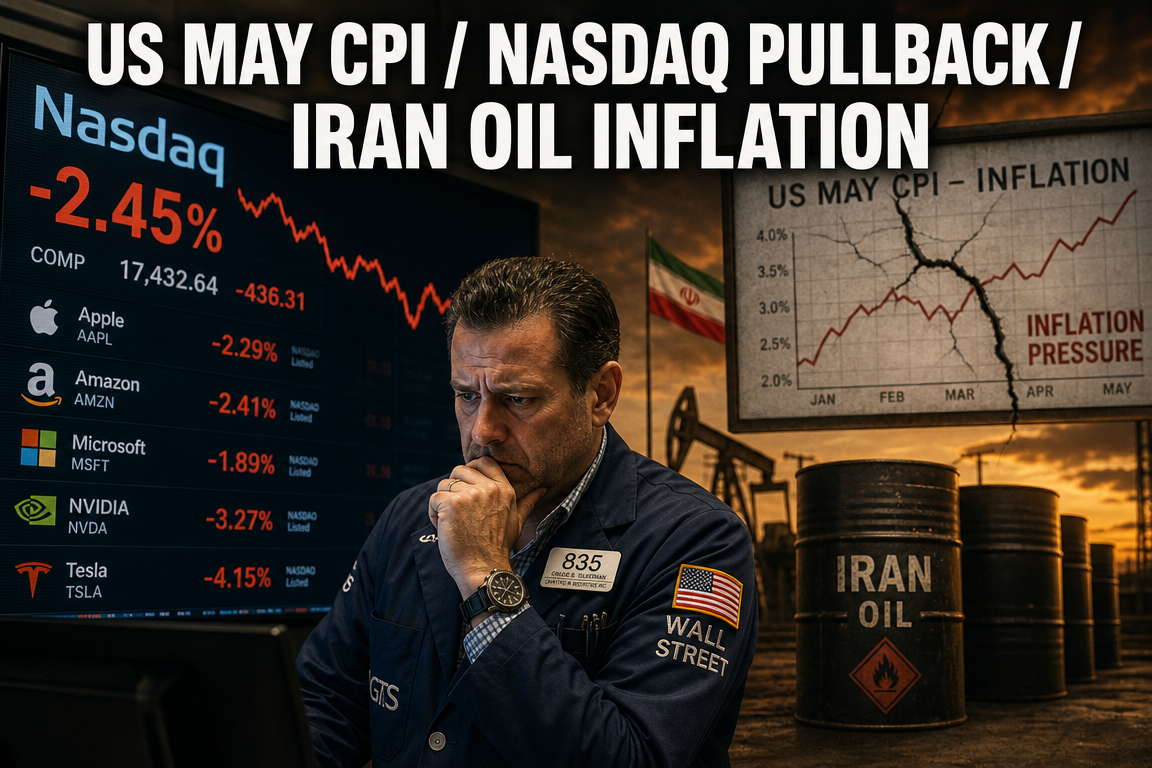
● Nasdaq Slips, Iran Shock, AI Fuel Under Pressure
Nasdaq Pullback: How Much Should Investors Worry? A Structured Read on May CPI, Iran Risk, and AI Capital Flows
Today’s move cannot be summarized as “Nasdaq fell.” The current setup combines:
- US CPI dynamics and whether energy inflation propagates broadly,
- geopolitical risk tied to Iran rhetoric,
- sector rotation concentrated in AI and semiconductors, and
- the financing architecture spanning OpenAI, Anthropic, and SoftBank.
The market is simultaneously testing whether:
- rate-cut expectations can remain intact,
- the AI investment cycle can sustain momentum, and
- the global economy can absorb geopolitical shocks without a lasting inflation impulse.
This report covers:1) the real signal behind the Nasdaq decline,
2) constructive and adverse elements in May CPI,
3) the Iran-oil-inflation linkage,
4) what is occurring across the AI/semiconductor supply chain, and
5) the most under-discussed factor: liquidity and AI capital structure.
1. Why Today’s Nasdaq Decline May Be Less Systemic Than It Appears
A 1%+ drop in the Nasdaq typically raises risk concerns. This episode differs from a broad, indiscriminate selloff.
Key point: the pressure is concentrated in previously extended AI and semiconductor names, consistent with profit-taking rather than generalized risk-off.
This type of tape often reflects sector rotation:
- capital rotates out of high-momentum AI leaders,
- into laggards, defensives, or cyclicals.
The critical distinction is breadth. A more destabilizing regime is when “good and bad assets sell off together.” Current price action more closely resembles internal reallocation than a wholesale de-risking.
2. May CPI: The Interpretation Mattered More Than the Headline
May CPI was broadly assessed as in line with expectations. The central issue for markets was not the point estimate but the composition of inflation.
2-1. Constructive signal: energy rose, but broad second-round effects were limited
The key read-through:
- A substantial portion of the month’s inflation impulse came from energy costs.
Market concern is not oil prices per se, but whether energy feeds into:
- food,
- housing,
- services,
- wages,
- transportation,forming second-round inflation.
In this release, evidence of broad-based acceleration appeared limited:
- food, shelter, and apparel were comparatively contained,
- auto insurance declined,
- prescription drug inflation moderated,
- new vehicle prices fell.
Interpretation: despite an energy shock, underlying inflation pressure did not re-accelerate materially.
2-2. Why this matters for rate-cut expectations
In US risk assets, CPI directly informs the expected Fed path.
If energy-driven inflation were propagating quickly, the Fed would be pressured toward a more hawkish stance, weakening rate-cut expectations and increasing valuation headwinds for long-duration growth (particularly technology).
This release reduced the probability of a renewed “inflation out of control” narrative. Accordingly, the Nasdaq decline is difficult to attribute primarily to CPI shock.
3. Why the market still failed to advance: Iran-related geopolitical risk
The dominant constraint was geopolitical risk, linked to rhetoric implying potential escalation involving Iran.
Markets typically price the transmission mechanism:US-Iran tensions -> broader Middle East risk -> Hormuz Strait concerns -> oil upside pressure -> inflation re-acceleration risk -> greater Fed uncertainty -> growth equity valuation pressure
Iran risk is therefore not merely a headline variable; it operates through oil and the inflation-policy complex.
3-1. Why the current risk is not automatically a panic regime
Geopolitical events often revert toward negotiation and managed outcomes. Both sides retain incentives to avoid sustained, unbounded escalation.
Market focus is whether Hormuz risk becomes:
- prolonged disruption, or
- a material physical supply shock.
Absent such outcomes, energy-driven CPI pressure may prove transitory rather than persistent.
The key monitoring variable is not “conflict headlines,” but whether they plausibly translate into durable supply disruption and longer-horizon inflation.
4. An additional headwind: mega IPOs and large-scale capital absorption
This factor is frequently underweighted in mainstream coverage but is material.
Equities do not rise solely because attractive companies exist. Aggregate liquidity and marginal flows determine short-term performance.
Large listings and financings can absorb substantial market capital. References in the flow include potential major listings and pre-emptive fundraising by large incumbents, implying the possibility of additional large deals.
Near term, this can create supply pressure for existing listed equities, particularly in markets where AI-linked positioning has been crowded.
4-1. A forward variable: potential listings of OpenAI and Anthropic
The prospect of OpenAI and Anthropic entering public markets is structurally dual-sided:
- positive as confirmation of AI industry scale and durability,
- negative near term as it may reallocate capital away from existing AI proxies.
To date, public “AI leaders” have been limited, concentrating flows in a narrow set of mega-cap platforms, semiconductors, and cloud beneficiaries.
If large private AI companies begin to access public capital markets, the market may reset reference valuations, potentially compressing some incumbent premiums during the transition.
5. SoftBank’s 8% decline: why it matters for AI risk appetite
SoftBank’s move is relevant as a signal on AI ecosystem financing.
Reportedly, SoftBank sought incremental financing secured by OpenAI-related holdings, and a roughly KRW 8 trillion-equivalent arrangement was halted. While reasons were not disclosed, the market sensitivity is clear.
5-1. Why this is not an idiosyncratic story
1) AI is a capital-intensive race: model development, data centers, GPU procurement, talent, and go-to-market require sustained funding.
2) AI valuations are influenced not only by long-term cash flows but by near-term funding capacity.
3) If financing against premier private AI collateral is not seamless, investors may infer more conservative lender views on:
- collateral valuation,
- liquidity,
- enforceability and exitability.
For a leverage-associated, aggressive allocator, any visible funding friction can impact broader risk appetite, not only the issuer’s equity.
5-2. The key issue: potential shifts in how OpenAI assets are valued
The important question is not the halt itself, but the underlying reason.
If driven by routine term negotiation, market impact should be limited. If driven by skepticism on valuation methodology or recoverability of AI collateral, it could trigger a broader reassessment of private AI premiums.
The next phase of the AI trade is increasingly about what valuation the market is willing to assign, not only technological feasibility.
6. AI semiconductor supply chain: Taiwan data suggests continued strength
A constructive counter-signal remains: AI infrastructure demand appears resilient.
Performance indicators from Taiwan-linked supply chain names (components, substrates, packaging, foundry, and back-end processes) have been strong, including record-level revenues and upside surprises.
These companies function as near-real-time thermometers for AI hardware demand. Current data implies:
- data center buildout and semiconductor orders have not materially softened.
6-1. Why this matters
The AI cycle is no longer sustained by narrative alone. Continuation requires:
- tangible orders,
- realized revenue,
- sustained capex.
Strong supply chain prints indicate AI is translating into manufacturing throughput, not only strategic messaging.
7. Anthropic’s new model “Fable”: the strategic signal beyond benchmarks
Model updates are frequent; the more material signal here is strategic.
7-1. Implication: deliberate constraint to limit AI research enablement
A notable point is that the model may restrict itself if it detects user intent to pursue deep machine learning research or AI engineering.
This suggests a competitive posture: reducing the likelihood that the model is used to accelerate competing model development.
The implication is that leading AI firms are moving beyond performance competition into control over knowledge diffusion.
7-2. Why markets should care
1) Frontier AI may become more closed-platform in structure.
2) The tension between open-source and closed models may intensify.
3) Enterprise buyers may weigh not only capability but also policy boundaries and permitted use.
4) Over time, AI may consolidate toward a high-barrier, concentrated structure similar to advanced semiconductors.
This is less a product-release headline and more an indicator of evolving industry power dynamics.
8. Key takeaways for investors
1) The Nasdaq decline appears closer to AI/semiconductor profit-taking than broad market breakdown.
2) May CPI was broadly in line; energy-driven inflation did not show strong evidence of broad second-round propagation.
3) The primary market drag was Iran-linked geopolitical risk and the implied oil-inflation-policy channel.
4) Mega IPOs and large financings can absorb liquidity and pressure existing listings in the near term.
5) SoftBank’s financing friction matters as a signal on private AI collateral valuation and broader risk appetite.
6) Taiwan AI semiconductor supply chain data remains strong, indicating ongoing infrastructure demand.
7) Anthropic’s model policy suggests the industry is shifting toward information-control competition.
9. The most under-discussed point: liquidity and AI capital structure risk
Many narratives stop at CPI, “tech correction,” or Iran risk. A more actionable lens is whether market liquidity and AI’s capital structure can remain supportive simultaneously.
9-1. The core market question is not “Is AI important?”
The market’s question is:
- Can capital continue to fund AI expectations at scale?
Mega IPOs, secondaries, private AI funding rounds, and investor leverage dynamics all map to this single constraint: funding continuity and terms.
Investors should track not only technical progress, but who is raising capital, at what pricing, and on what collateral.
9-2. Oil’s psychological channel can move markets faster than realized inflation
Even if CPI pass-through is limited today, markets can reprice on expectations:
- prolonged Middle East risk can elevate inflation expectations before realized second-round inflation appears.
Thus, the key is not only spot oil, but the impact of oil on:
- inflation expectations,
- Fed path uncertainty,
- consumer sentiment.
9-3. AI is shifting from a “growth theme” to a “power theme”
Model self-limitation policies are emblematic of a transition toward platform control and competitive containment.
Over time, market leadership may favor firms that can:
- control ecosystems and distribution,
- set usage boundaries,
- enforce policy at scale,not only those with the best benchmark performance.
10. Forward monitoring checklist
1) Oil and Hormuz-related developments: assess probability of physical disruption.
2) Next inflation prints and inflation expectations: watch for lagged energy pass-through.
3) Mega IPO and financing calendar: liquidity absorption risk for listed growth.
4) SoftBank and private AI collateral financing: signals on valuation discipline and risk tolerance.
5) TSMC and the broader Taiwan supply chain: fastest confirmation of real AI demand.
6) OpenAI/Anthropic model updates: focus on commercialization, policy restrictions, and enterprise adoption pace.
11. Conclusion: prioritize structure over emotion
This Nasdaq pullback does not yet resemble systemic breakdown.
CPI was not materially adverse; the key constructive element was limited evidence of broad inflation propagation despite energy pressure.
Market softness primarily reflected geopolitical risk, liquidity absorption concerns, and sensitivity to AI financing signals. At the same time, AI infrastructure demand indicators remain firm.
The next leg of the AI trade is likely to be more selective:
- favoring companies with verified earnings power,
- durable funding access,
- and defensible positions within the AI compute and platform stack.
< Summary >
- The Nasdaq decline appears driven more by AI/semiconductor profit-taking than broad risk-off liquidation.
- May CPI was broadly in line; energy-driven inflation has not clearly spread across the price system.
- The key catalyst for weakness was Iran-linked geopolitical risk and its oil-to-inflation-to-policy pathway.
- Mega IPOs and large financings may absorb liquidity and pressure existing equities in the short run.
- SoftBank’s halted financing is a relevant signal for private AI valuation and risk appetite.
- Taiwan supply chain strength indicates AI infrastructure demand remains resilient.
- The priority is structural analysis: oil-to-inflation linkage, AI capital flows, and IPO-driven supply effects.
[Related Articles…]
- Nasdaq Pullback Checklist and US Equity Market Signals
- AI Semiconductor Supply Chain: Demand Indicators and Capital Flows
*Source: [ 내일은 투자왕 – 김단테 ]
– 나스닥 하락하지만 괜찮다?? ( 5월 CPI 발표)
● Inflation Shock, Still Rising
Deep Dive on the US May CPI: Inflation Risk May Be in an Early Phase
This release should not be reduced to “in line with expectations.”
While the headline numbers broadly matched consensus, the data highlighted (1) where inflation pressure is originating, (2) why the Federal Reserve’s rate path could become less stable again, and (3) why crude oil prices and inventory dynamics may become more decisive variables.
This report links the CPI and core inflation data to the Fed’s policy outlook, crude oil and inventories, and potential implications for global risk assets.
1. US May CPI: Key Figures
US May CPI printed 4.2% (headline) and 2.9% (core), broadly in line with expectations.
The key issue is level and trajectory: the reading was higher than the prior month and reaffirmed the recent rebound in inflation.
- Headline CPI: 4.2%
- Core CPI: 2.9%
- Key takeaway: no major upside shock, but the disinflation phase appears to be fading while re-acceleration risks persist
2. Why Markets Moved Ahead of the Print
The market reaction was largely front-loaded.
Markets typically reprice on expected outcomes before the release. In this case, rising expectations for a higher CPI contributed to pre-positioning and risk reduction across US and Korean equities.
Typical transmission mechanism:
Inflation rises → policy rates stay higher for longer → discount rates increase → equity valuation pressure increases.
Even without immediate hikes, a shift toward “higher for longer” can drive tightening in financial conditions.
3. Why This CPI Is Potentially Risky: Still Primarily Energy-Driven
The core concern is not only that inflation rose, but that the impulse remains concentrated in energy-related components.
That suggests inflation has not yet fully broadened across the economy. However, headline 4.2% and core 2.9% at this stage implies elevated sensitivity to future pass-through.
If energy costs increasingly transmit into food, goods, services, housing, and wages, inflation could become broader-based and more persistent.
- Current inflation impulse remains heavily linked to energy
- Broad-based diffusion into food and services appears incomplete
- CPI remains elevated despite limited diffusion
- Material risk: stronger pass-through could intensify inflation persistence
4. Why Core Inflation Matters More
Markets and the Fed generally emphasize core inflation due to the volatility of energy and food.
Core CPI at 2.9% is lower than headline CPI, but its direction matters: recent months suggest a bottoming and gradual re-acceleration.
For the Fed, re-firming core inflation complicates the case for near-term easing.
5. Fed Outlook: Hikes vs. Holding Rates
The more realistic scenario is not an immediate return to rate hikes, but a higher probability of delayed cuts and a prolonged restrictive stance.
Policy rates are already meaningfully restrictive. The Fed may judge that maintaining current levels for longer can continue to moderate inflation.
The key market risk is expectation reset: if “cuts this year” shifts toward “cuts delayed,” risk assets and duration-sensitive valuations may face renewed pressure.
6. Resilient Labor Data Increases Policy Constraint
Inflation data should be interpreted alongside labor conditions.
Recent employment indicators remain relatively firm. The absence of a sharp deterioration in labor markets provides the Fed with greater latitude to prioritize inflation control.
As a result, the market may infer a reduced probability of a rapid shift to a more dovish stance.
7. The Primary Forward Variable May Be Oil Prices and Crude Inventories
A central driver of the next inflation leg may be crude oil prices and inventory levels rather than near-term consumer indicators.
If Middle East geopolitical risk persists, inventories have acted as a buffer. If inventories decline meaningfully, the price dynamics could change.
The risk is a secondary price impulse as replenishment demand emerges at higher price levels, potentially adding pressure to inflation and global growth conditions.
8. Why Crude Inventories Matter
Crude inventories function as a shock absorber against supply disruptions.
As inventories fall, governments and market participants may need to rebuild stockpiles, adding incremental demand and reinforcing oil price strength.
Potential transmission pathway:
- Crude oil price increases
- Transportation cost increases
- Production cost increases
- Food and cost-of-living pressure
- Spillover into core services inflation
- Higher inflation expectations
- More restrictive Fed posture
- Higher equity volatility
Inventories can therefore be treated as a leading variable for inflation persistence and a contextual driver of the policy-rate path.
9. Why Consumer Prices Often Do Not Fall Quickly Even If Oil Pulls Back
Even if crude oil prices retreat after a spike, retail fuel and broader cost-of-living components may adjust downward slowly.
This reflects downward price rigidity: goods and especially services prices often reset higher more quickly than they normalize.
This point remains relevant not only for US CPI interpretation but also for inflation monitoring in energy-importing economies.
10. Implications for Korean Equities and KRW
Key channels for Korea:
1) If US inflation continues to re-accelerate, volatility around CPI-related event risk may increase.
2) If Fed easing expectations are pushed out, USD strength may re-emerge, increasing KRW sensitivity.
3) If crude prices rise, an energy-import-dependent economy faces pressure through both inflation and trade balance channels.
US CPI should be treated as an input into Korea’s equity, FX, import-price, and earnings outlook.
11. Likely Market Interpretation
Near-term, “in line” results reduce the probability of a shock-driven sell-off, particularly given pre-release risk positioning.
Medium-term, the market narrative may consolidate around:
- Inflation is not decelerating as smoothly as expected
- Core inflation is showing signs of renewed stickiness
- Oil and inventories imply residual second-half risk
- The Fed is less likely to cut quickly
This backdrop can be less supportive for high-duration equities and richly valued assets.
12. Headline Summary (News Style)
- US May CPI: headline 4.2%, core 2.9%, broadly in line with consensus
- Market reaction: limited immediate shock risk
- Key interpretation: inflation rebound remains the central signal
- Fed factor: higher probability of delayed cuts and “higher for longer”
- Primary risk: crude oil upside and declining inventories re-igniting inflation pressures in 2H
- Investor checklist: CPI event volatility, FX, energy, and long-end yields
13. Under-Discussed Point
Most commentary stops at whether the print beat or missed.
The more material issue is that inflation pressure may broaden. If the current energy-linked impulse begins to diffuse into services and cost-of-living components, inflation persistence risks increase.
In this context, inventory drawdowns may be more durable market drivers than headline geopolitical news flow.
Focus indicators:
- Whether crude oil resumes an uptrend
- The pace of crude inventory declines
- Evidence of energy cost pass-through into core services inflation
14. Forward Calendar and Monitoring Points
- Next FOMC statement and press conference: changes in restrictive tone
- US PPI and PCE inflation trends
- Duration and escalation risk of Middle East geopolitical tensions
- US and global crude inventory drawdown pace
- Long-term Treasury yield dynamics
- USD strength and USD/KRW sensitivity
- Bank of Korea inflation-response posture
From an investor perspective, the primary question is not immediate drawdown risk but whether inflation and restrictive policy persist longer than priced.
15. Bottom Line
This CPI release appeared benign on the surface but contained less constructive signals beneath.
It confirmed:
- ongoing inflation rebound
- core inflation re-firming risk
- incomplete diffusion from energy into broader components
- residual upside risks tied to crude prices and inventory levels
Key framing: the immediate shock may be priced, but the risk is not fully resolved. Monitoring should extend beyond CPI prints to the interaction of Fed messaging, crude oil, inventories, FX, and long-end rates.
< Summary >
US May CPI (headline 4.2%, core 2.9%) matched expectations, but the key signal was the continuation of an inflation rebound.
Near-term market impact may be contained; medium-term risks include delayed rate cuts, prolonged restrictive policy, crude oil upside, and declining inventories.
Because inflation remains largely energy-driven, broader pass-through into services and cost-of-living components could raise persistence risk.
Investors should track Fed stance, crude oil, crude inventories, FX, and long-term yields in addition to CPI.
[Related Articles…]
- US CPI and the Fed: Key Variables for the Rate Path
- AI Infrastructure Investment: Implications for Global Growth and Markets
*Source: [ 경제 읽어주는 남자(김광석TV) ]
– [LIVE] 미국 5월 CPI 물가 심층분석 : ‘인플레 쇼크’ 오는가? [즉시분석]