● Iran War Threat, CPI Surprise, Data Center Projects Halt
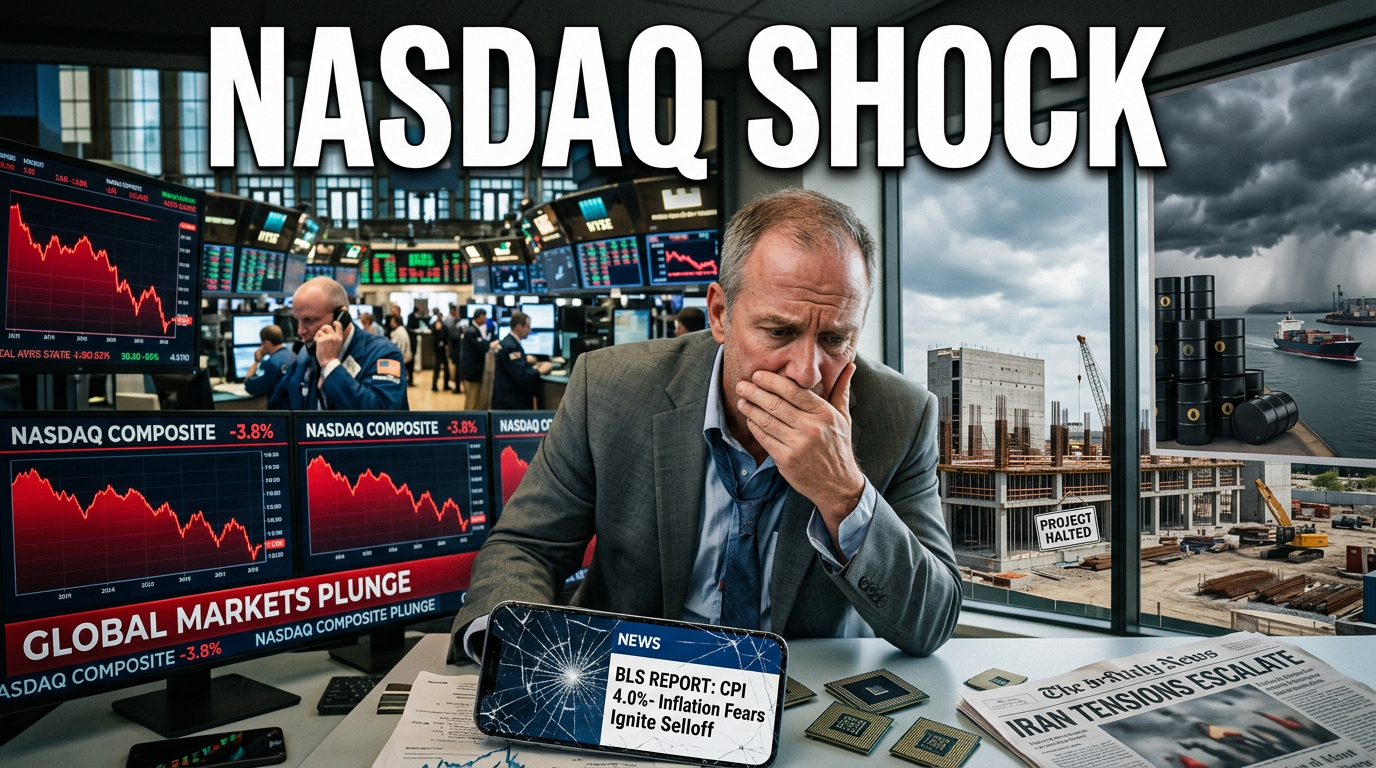
“Iran escalation + CPI surpasses 4% + data center ‘construction cancellation’” all hit at once… why the Nasdaq fell 2%, and how investors should think about decision-making
Three major market shocks today—on the surface, fear; underneath, it’s closer to a ‘timing issue’
- 1) Concerns over escalating conflict between Iran and the U.S.
The thing the market reacted to most sensitively overnight was geopolitics (war risk).
The core is that as sensational interpretations like “Has a full-scale war started?” spread, selling pressure piled up across risk assets. - 2) CPI came in above market expectations
In the consumer price index (CPI) release, there was a nuance that the “core” part did not cool as much as expected,
and with the impact of oil prices overlapping, worries spread that “inflation might feel sticky again.” - 3) The ‘data center construction halt’ issue is being over-interpreted as bad news
As news spread that a project at a certain neo-cloud company was paused,
it made it look as if the data center investment cycle was being shaken,
and this flow also pressed investor sentiment by rattling expectations for AI and cloud infrastructure at the same time.
So, to put it plainly, this decline is less about the “collapse of the AI growth story,” and more abouta sudden draining of ‘sentiment’ caused by war, inflation, and infrastructure news piling up in the span of one night.
Key takeaway: 4 points investors are likely to misunderstand
- Misunderstanding 1) ‘If war escalates, AI is over’
Even if short-term volatility can increase, AI investment continues structurally. - Misunderstanding 2) ‘CPI rising = confirmed rate surge’
If the upside factor in CPI is a temporary shock centered on oil prices, there will be periods when the market settles. - Misunderstanding 3) ‘Data center shutdown = collapse of the data center industry’
In reality, some cases are mixed in where projects stalled due to regional variables (power, water, public sentiment, etc.). - Misunderstanding 4) ‘A whole narrative flips because of one line of news’
Markets are sensitive to short-term news, but if you look further out, narratives often survive and repeat.
1) Iran escalation issue—why “negotiation” matters, and why the market overreacts
- Even though there were comments related to attacks and bombing, the impact on key facilities may be limited
What lit a fuse under the market was wording like “additional attacks,” but
the interpretive point is: “Does that mean there’s no negotiation room anymore?”
Since negotiation itself becomes difficult if key facilities are struck, you can also consider the possibility of adjusting the stages. - Strong statements like a ‘shipping blockade’ in the Strait of Hormuz may have limited real-world change
It’s a region that has had constraints even before,
and a viewpoint emerged that it may be an exaggeration to interpret it as “change on the level of a full blockade.” - The market’s real question: where exactly is the ‘nuclear negotiation’ getting blocked versus the ‘strait transit toll’
The key comes down to two things.1) Nuclear negotiations (conditions/timeline)
2) Costs and control related to transit through the Strait of HormuzIf these two axes don’t converge, the tug-of-war could last a long time.
That’s precisely why it adds a “premium” to risk assets.
But in the same context,there’s a push to carry the narrative that the war is likely to eventually end and AI investment continues.
2) CPI (inflation) issue—why the “surpass 4%” is scary, and why it might be less scary
- The point that the core (core) inflation was slightly higher than expected spurred sentiment
The market wants rate expectations to stabilize as inflation cools.
So if the core component doesn’t fall as much as thought, markets wobble in the short term. - But an interpretation is that the majority of the overall CPI rise came from oil prices (a temporary shock)
In fact, analyses came out that the gasoline price accounted for a large share of the total increase in prices.
In other words, if the war calms down or oil prices stabilize, there may be room to reverse again. - Conclusion on market reaction: it may not turn into a confirmed signal of “a rate explosion”
So if the war issue created price swings,
there could be a period over time when the inflation shock eases.
3) Data center ‘construction halt’—the real causes are regional power/water and public sentiment; it’s premature to view it as a collapse of the entire industry
- The point in question: rumors that a 1.8GW-scale data center in Wyoming was paused
As the story that a particular company’s (Cruzo) project was stopped spread,
concerns grew that “maybe they won’t be building data centers.” - However, the reason isn’t a ‘collapse in technical demand’ but regional policy and infrastructure constraints
The key is issues around power and water shortages, as well as local public sentiment (e.g., data centers raising electricity bills).This should be viewed as a different conclusion from “AI demand disappeared.”
- There were also good-news items on the same day, like ‘5GW of new contracts,’ but the market reacted more strongly to the bad news
With good news not being seen as much while bad news spreads faster,
it could be a structure that creates an overheated selling sentiment in the short term.
So, a data center shutdown is less of an “industry cycle break,” and more aboutreal-world variables like location, permits/approvals, and constraints on power and water resources.
4) So should we “sell now?”—this article’s perspective: the drop is more likely “the Nasdaq’s normal growing pains”
- There’s controversy about an AI bubble, but it’s too early to call it a ‘collapse phase’
There was an explanation that real bubble collapses often begin in a state where even the suspicion doesn’t exist.
This is a view that the evidence is still weak that we’ve reached that stage. - More weight is placed on the idea that technological change (investment) continues
The view is that AI is actually changing industries, and the pace of technological acceleration could become even faster. - From a market statistics perspective: when the Nasdaq drops sharply by -4%, there can exist a rebound possibility the following week compared to historical averages
According to BTIG statistics,
“In the past 30 years, when the Nasdaq recorded a Friday -4% plunge,” the probability that it went even lower after a fresh low was higher,
and at the same time, it was mentioned that after 20 days there was an average upswing (around the 4% range). - Core message: the big trend (e.g., AI, semiconductors, cloud infrastructure) is maintained, but short-term volatility is ‘managed’
Therefore, rather than “fully exiting out of fear,”
the conclusion is to respond to the AI beneficiary period while reducing risk.
From an SEO perspective as well, if you naturally re-anchor the key keywords here,the variable that disrupts the global economic outlook is geopolitical risk (war),and next is the path of interest rates and inflation,and the truly long-term theme is AI semiconductors, data centers, and cloud infrastructure.
The super core takeaway you want to emphasize when reading the news “only in this article” (separate summary)
- War news often makes markets overreact when ‘negotiation room’ remains
- CPI can reverse if it’s driven by oil price shocks—key is distinguishing “temporary shock vs. structural sticky inflation”
- Data center shutdowns are likely more about infrastructure bottlenecks like regional power, water, and public sentiment rather than demand collapse
- Even if the AI investment narrative is bent by short-term shocks, it’s hard to say it’s ‘completely over’
- With a sharp Nasdaq selloff, a rebound pattern may appear statistically, making strategies other than panic selling more advantageous at times
Final conclusion (one line for investment judgment)
“Right now, rather than selling in fear, break down what is a temporary shock and decide the timing accordingly”.
< Summary >
- The Nasdaq’s -2% decline was largely due to Iran escalation concerns, the upside of CPI (inflation), and bad news about data center construction halts all hitting at once.
- There’s a view that war-related issues can trigger overreaction because there’s still room for negotiation (the possibility that strikes on key facilities may be limited).
- For CPI, if the rise is heavily influenced by oil price effects (a temporary shock), easing may be possible later.
- A data center shutdown is an infrastructure bottleneck issue (regional power/water and public sentiment), not demand collapse.
- Even with short-term turbulence, the AI investment narrative is likely to continue in the long run, and the possibility of a rebound after a selloff has also been observed in past statistics.
[Related Articles…]
- CPI Volatility and Its Impact on Rate Expectations Summary
- Latest Trends: Data Center Investment Cycles and Infrastructure Bottleneck Issues
*Source: [ 월텍남 – 월스트리트 테크남 ]
– 다시 시작된 미사일 폭격…”데이터센터 건설 취소” 악재까지 ㄷㄷ..