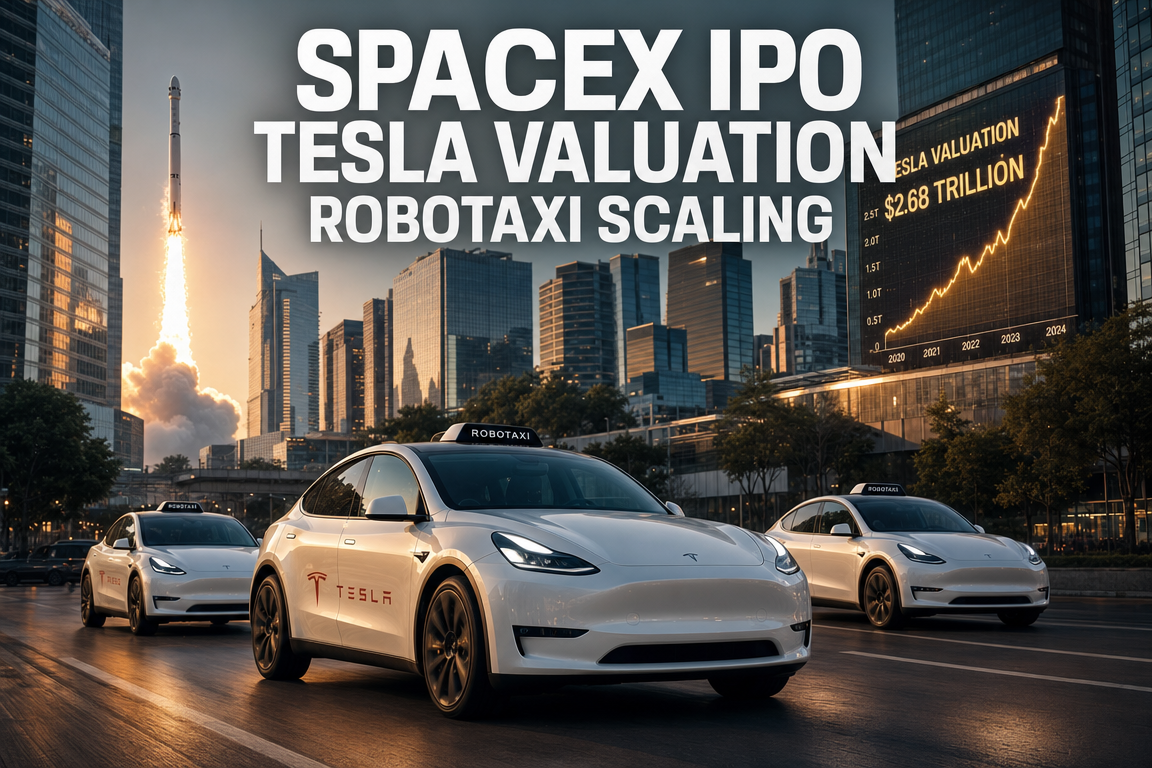
● Musk Shock, Tesla Hit, SpaceX Surge
On the Day SpaceX Surpassed Tesla in Market Capitalization: What Tesla Shareholders Should Focus on Now
SpaceX’s first-day IPO surge, Tesla’s close at $406, Elon Musk’s time allocation, the pace of robotaxi scaling, Optimus production conversion, and the key variables for Tesla’s valuation over the next quarter.
While headlines frame this as “SpaceX has become larger,” the investor-relevant implications are:
- First, markets are increasingly attributing Musk’s long-duration optionality to SpaceX rather than Tesla.
- Second, Tesla’s core investment thesis has shifted from EV unit growth to AI, autonomy, and humanoid robotics.
- Third, valuation is likely to be driven less by narrative and more by operational execution and measurable milestones.
This development should be interpreted in the context of global risk sentiment, growth-stock repricing within U.S. equities, and capital rotation toward AI-adjacent platforms.
Below is a news-style summary of key figures, followed by the primary items Tesla shareholders should monitor.
1. Market Snapshot: U.S. Equities and SpaceX IPO Tone
U.S. equities broadly advanced in a stable risk-on session.
- S&P 500: ~+0.5%
- Dow Jones: ~+0.7%
- Nasdaq: ~+0.3%
Two widely cited supports:
- Positive sentiment around the SpaceX listing
- Expectations of easing Middle East geopolitical risk, contributing to lower energy prices
Lower oil prices can reduce inflation pressure, which is often supportive for growth and technology equities. The session’s move appears consistent with broader risk appetite rather than a single-stock catalyst.
2. SpaceX IPO: First-Day Performance and Market Interpretation
SpaceX reportedly priced at $135, opened at $150, and closed at $160.95.
- Intraday high: ~ $176
- First-day gain: ~19%
Key figures cited:
- Market capitalization: ~ $2.1 trillion
- IPO proceeds: ~ $75 billion
- Indicated demand: ~ $350 billion
If accurate, investors are valuing SpaceX not as a launch-provider but as a multi-domain strategic platform spanning space infrastructure, satellite connectivity, defense, data networks, and longer-term logistics.
3. Tesla Closed at $406: Why Sentiment Remains Mixed
Tesla closed at $406.43 (+1.82%).
Despite the gain, sentiment is more complex because many Tesla shareholders have treated the investment as exposure to Musk-led frontier technology platforms (EVs, batteries, autonomy, AI, robotics, energy). The market’s willingness to assign higher forward value to SpaceX creates questions about relative attention and where incremental optionality is being priced.
This does not mechanically reduce Tesla’s intrinsic value; it raises the bar for Tesla to demonstrate execution in its next-phase thesis.
4. The Core Issue Is Not Market Cap; It Is Musk’s Time
The central implication is that Musk is effectively operating two large public-market entities simultaneously. Public companies require recurring disclosure, guidance, and investor communication.
At a minimum:
- Eight earnings calls per year across two companies
- Ongoing time demands from:
- Operating reviews
- Strategic planning
- Product roadmap alignment
- Regulatory engagement
- Institutional investor communications
- Key talent management
- External partnerships
Markets may increasingly evaluate not “which is larger,” but where leadership attention is concentrated.
5. Tesla’s Ability to Retain Strategic Focus May Depend More on Mission-Critical Execution Than Compensation
Tesla historically used equity-based compensation to align incentives (e.g., the 2018 performance-based option package). As Musk’s wealth and platform influence expand, incremental financial incentives may have diminishing marginal impact.
Accordingly, Tesla’s ability to sustain strategic focus may hinge on delivering tangible progress in:
- Scalable robotaxi operations
- FSD demonstrating both safety and economic viability
- Optimus transitioning from prototypes to production and factory deployment
6. Tesla Robotaxi Status: Validation Stage Matters More Than Raw Counts
Figures cited indicate:
- 69 vehicles: administratively registered for unsupervised autonomous operation (Texas DMV registration basis)
- 39 vehicles: externally observed/verified as active on-road
Interpretation: enabling infrastructure appears partially in place, but operational scale remains limited. Markets are likely to focus on whether the system can scale rapidly, broadly, and safely.
7. Why Tesla May Be Scaling Robotaxis Slowly
A slower ramp can be interpreted as risk-managed execution. The discussion references FSD v15 as a potentially significant architectural transition (including parameter scaling and broader restructuring), implying fleet expansion may be constrained until performance and reliability are validated.
In autonomy, intervention rates and incident outcomes can be more valuation-relevant than rapid fleet growth, because high-profile failures can materially delay adoption and regulatory acceptance.
8. Is Tesla Behind Waymo?
By fleet size and near-term commercial footprint, comparisons suggest Waymo is ahead:
- Waymo: reported >500 vehicles in Texas; thousands nationwide
- Tesla: still at tens of vehicles
However, the models differ:
- Waymo: high-reliability operations in constrained geographies
- Tesla: camera-centric approach aimed at generalized autonomy and mass-scale economics
The investor-relevant question is less “who started earlier” and more “who can achieve superior unit economics and scalable operations,” including operating cost, maintenance, insurance structure, and expansion efficiency.
9. Three Key Checkpoints for 2H and Beyond
9-1. FSD Version 15
A primary event for autonomy-related repricing. If v15 demonstrates structural performance improvements, markets may re-emphasize Tesla as an AI platform rather than an auto manufacturer. Autonomy also carries a higher-margin potential than vehicle sales.
9-2. Robotaxi Fleet Expansion Rate
Near-term revenue contribution may be limited; the slope of scaling is more important than the absolute number. Visible progression from ~39 to ~69, then to hundreds and thousands would be consistent with a shift from auto valuation multiples toward platform valuation multiples.
9-3. Optimus Production Start
The discussion cites a production start around July–August 2026 at Fremont, with Model S/X line conversion toward Optimus production.
If accurate, this signals movement from demonstration to manufacturing integration. Humanoid robotics remains early-stage, but it represents a potential productivity lever that could reshape industrial labor economics over time.
10. SpaceX–Tesla Merger Speculation: The Practical Variables
Market commentary has referenced potential merger discussions around 2027. This should be treated as speculative; however, the question arises due to:
- High dependence on the same key individual
- Overlapping long-duration technology narratives
- Connectivity across AI, robotics, communications, infrastructure, data, and energy
If serious consideration ever emerged, the central issue would be exchange terms rather than narrative. With SpaceX publicly traded, relative pricing becomes explicit. Markets would likely focus on:
- Whether SpaceX sustains current market capitalization levels
- Whether Tesla is repriced through robotaxi and Optimus execution
- Whether an acceptable premium structure exists for both shareholder bases
The more material factor is each company’s ability to validate its standalone value through operational results.
11. News-Style Key Takeaways
- SpaceX reportedly surged on IPO day and was valued around $2.1 trillion, exceeding Tesla’s market capitalization.
- Tesla closed at $406.43, up on the day, but investor sentiment is complicated by direct comparison.
- The market may be attributing more of Musk’s forward optionality to SpaceX at present.
- The central variable is likely Musk’s time allocation and operational focus, not headline market-cap rankings.
- Tesla’s premium is increasingly tied to execution in AI/autonomy/robotics rather than EV volume alone.
- Robotaxi figures (69 registered vs. 39 externally verified active) indicate an early validation phase rather than broad deployment.
- FSD v15, robotaxi scaling rate, and Optimus production timing are key investor checkpoints into next year.
12. Under-Discussed Investor-Relevant Points
- Key-person concentration risk now applies across two public-market entities simultaneously.
- Tesla’s valuation premium is less defensible via auto fundamentals alone and increasingly requires measurable AI/robotics deliverables.
- The SpaceX IPO indicates capital markets are willing to pay for long-duration “future platform” narratives; the same standard may be applied more rigorously to Tesla.
- For Tesla to achieve multiple expansion, it likely needs credible transition from EV manufacturer to autonomy platform and robotics company.
- This development is less a direct negative for Tesla than a signal that the market’s evidentiary threshold has increased.
13. What Tesla Shareholders Should Monitor Now
- Around $406 per share, near-term price action may be increasingly driven by autonomy and robotics execution rather than quarterly delivery figures alone.
- SpaceX’s listing does not invalidate Tesla’s thesis; it clarifies what Tesla must demonstrate to sustain or expand its valuation framework.
- From 2H onward, FSD progress, robotaxi scaling, and Optimus production readiness may become more consequential price drivers than EV deliveries.
- Long-horizon investors should monitor whether Tesla can credibly transition toward AI- and robotics-linked valuation multiples through verifiable operating data.
< Summary >
SpaceX’s IPO surge and resulting market capitalization lead suggest markets are currently assigning more forward value to space, communications, and infrastructure optionality. Tesla’s core value proposition remains intact but is increasingly contingent on demonstrable progress in robotaxis, FSD, and Optimus.
Key variables ahead include Musk’s time allocation, the pace and safety of autonomy scaling, the realism of Optimus production plans, and whether Tesla can be credibly repriced from an auto company toward an AI/robotics platform.
[Related Articles…]
- Tesla Robotaxi Scaling: Key Metrics Investors Monitor
- SpaceX Valuation After IPO: Implications for AI Infrastructure Capital Flows
*Source: [ 오늘의 테슬라 뉴스 ]
– 분명 우리 CEO였는데 — SpaceX에 추월당한 날, 테슬라 주주가 지금 봐야 할 것, $406 주주는?
● SpaceX-IPO-AI-Shock
SpaceX IPO: $2.2T Market Cap at Listing; the Core Thesis Is Not “Space” but “AI Infrastructure”
Viewing the SpaceX IPO only as a “record-breaking listing,” a “Musk beneficiary,” or “growth in the space industry” is incomplete.
The central implications can be framed in three points:
1) SpaceX is being re-rated from a launch provider to an AI infrastructure company.
2) Starlink is evolving beyond satellite broadband into a global connectivity layer for autonomous driving, robotics, defense, and physical AI.
3) A mega-IPO of this scale can transmit through U.S. equities into semiconductors, data-center capex, global capital flows, and large-cap Korean technology stocks.
To assess the full picture, investors should also track: orbital data centers, potential re-rating of legacy semiconductors, Nvidia–Korea collaboration dynamics, and the expansion of AI PCs and physical AI.
1. Why the Market Reacted Strongly to This Listing
SpaceX executed one of the largest IPOs on record and demonstrated robust first-day demand.
Headline impact included a sharp move above the offering price, a surge in market capitalization, and rapid entry into the top tier of U.S. equities.
However, the key market question was not valuation alone, but the company’s evolving identity:
- From a rocket launch company
- To a satellite communications company
- To an AI infrastructure platform
Accordingly, the valuation is increasingly difficult to justify using launch services alone. The premium reflects expectations that future revenue composition shifts toward Starlink and AI data-center infrastructure.
2. The Three Core Businesses: Surface Narrative vs. Strategic Context
2-1. Launch Services: The Original Base Business
SpaceX began as a launch-services company. The core innovation was reusable rockets, lowering cost per launch.
Historically, limited launch cadence constrained economies of scale. SpaceX altered the structure by vertically integrating demand: manufacturing its own satellites and launching them at high volume. Starlink is the principal outcome of this strategy.
2-2. Starlink: The Cash-Generating Engine That Improved Launch Economics
Starlink is not a peripheral initiative; it is a key mechanism that scaled launch frequency and reduced unit costs.
Starlink is also increasingly viewed as a cash-generating business that has moved beyond break-even dynamics.
Current areas of strength include:
- Large geographies where terrestrial buildout is inefficient (e.g., U.S., Australia, Brazil, Indonesia)
- Regions with coverage gaps
- Mobility connectivity (aviation and maritime)
- Military and secure-network demand
Starlink’s competitive edge is more pronounced in underserved and hard-to-connect environments than in dense urban markets.
2-3. AI Data Centers: A Forward Revenue Pool Potentially Dominating the Long-Term Mix
The most material strategic point is the growing interpretation that the company’s forward addressable revenue pool is predominantly AI-related.
This reframes SpaceX not primarily as a space-launch company, but as an AI infrastructure operator. This positioning is central to the IPO narrative.
3. Why Starlink Matters in the AI Era
3-1. From Satellite Broadband to an “AI Connectivity Layer”
Starlink currently leads with wireless internet access, but expanded communications capability could extend direct connectivity to smartphones, vehicles, and robots.
In the AI era, differentiation is not only model intelligence; it is also the connectivity of real-world devices.
Autonomous vehicles, industrial robots, humanoids, drones, and smart devices require reliable, low-latency connectivity. Terrestrial base-station networks alone face cost and deployment-speed constraints at global scale. Starlink addresses this through space-based coverage.
3-2. Why Low Earth Orbit Matters: Latency
Geostationary satellites offer broad coverage but suffer higher latency. Low Earth orbit materially reduces latency.
This has implications beyond faster internet:
- Defense: potential shift from reconnaissance-centric to operations-capable satellite roles
- Autonomy/robotics: improved feasibility of near-real-time control and decision support
Starlink can be viewed as a candidate “nervous system” for AI-enabled physical systems operating in the real world.
4. Why Orbital Data Centers Are Being Discussed as a Practical Option
4-1. U.S. Data-Center Buildout Is Constrained by Power, Cooling Water, and Permitting
The U.S. is expanding data-center capacity rapidly, with large volumes of additional permitting in progress.
Constraints are emerging simultaneously:
- Power availability and grid constraints
- Cooling water demand
- Local community and political resistance
AI requires continued infrastructure buildout, while the marginal difficulty of siting new facilities on the ground is rising.
4-2. This Is a Structural Driver Behind Orbital Data Centers
As terrestrial constraints intensify, moving portions of compute infrastructure off-world can be positioned as an alternative path for scale.
Commonly cited potential advantages:
- Reduced exposure to local permitting conflicts
- Potential for re-architected large-scale power solutions
- Faster infrastructure expansion in constrained regions
- Direct integration with global satellite networks
Significant engineering barriers remain.
4-3. Technical Challenge 1: Thermal Management
Space is cold, but cooling is not inherently easier. In vacuum, heat transfer lacks a conductive medium, making radiative heat rejection and thermal design critical.
4-4. Technical Challenge 2: Radiation
Radiation can induce bit flips and other semiconductor reliability issues, risking compute and storage stability.
This constraint introduces a non-obvious investment angle.
5. Under-Discussed Implication: Legacy Semiconductors Could Regain Strategic Value
Leading-edge GPUs and HBM remain essential for high-performance AI workloads. However, in high-radiation environments, older-generation components may exhibit relative resilience in certain use cases.
The thesis is that some legacy DRAM, general-purpose CPUs, and storage devices could be less sensitive to specific radiation-induced failure modes, potentially creating incremental demand vectors.
If early orbital data-center configurations adopt such architectures, parts of the memory, storage, and general-purpose compute supply chain could be re-evaluated.
6. Market-Structure Impact: Effects on U.S. Equities and Global Capital Flows
6-1. Capital Rotation Risk Is Structural in a Mega-IPO
A listing of this scale can drive portfolio rebalancing.
If major index inclusion occurs quickly, ETFs and passive strategies may be forced buyers. Funding those purchases requires selling elsewhere, potentially pressuring other large-cap technology, semiconductors, growth equities, and possibly broader risk assets.
This is primarily a liquidity reallocation event, not a single-stock event.
6-2. Why Korea Could Be Affected
Large global asset managers must maintain target weights. A higher allocation to SpaceX can increase the probability of partial profit-taking in other positions.
Korean semiconductor large caps could experience short-term flow-driven volatility. Medium-term effects may differ if SpaceX-driven AI infrastructure growth increases demand across relevant supply chains.
7. Post-IPO Price Path: Upward Thesis vs. High Volatility
Long-horizon strategic narrative strength does not eliminate near-term volatility.
Key drivers:
- Large market opportunity
- Uncertain execution path
- Space-sector event risk (failures and accidents can reprice risk rapidly)
- AI data-center strategy remains in a validation phase
Launch failures, satellite losses, technical delays, and regulatory developments can produce larger sentiment shocks than typical software-first technology companies.
8. Portfolio Approach: Long-Term vs. Short-Term Positioning
8-1. Long-Term Investors
If the AI infrastructure thesis is accepted, staged entry may be more practical than single-point allocation given typical IPO overhangs and sentiment cycles. Scenario management is likely more important than entry price alone.
8-2. Short-Term Investors
Volatility can create tactical opportunities, but risk is elevated. Space-sector technical events can drive abrupt repricing. Leverage and momentum chasing increase downside exposure.
9. xAI: Weak Link or Optionality Within an Internal Demand Ecosystem
In isolation, xAI may be viewed as less competitive versus leading model providers due to relative gaps in model performance or user distribution.
Within an integrated SpaceX–Tesla–Starlink ecosystem, the strategic framing changes: internal demand can sustain iteration and reduce early commercialization pressure.
Potential internal demand anchors:
- Tesla vehicles
- Optimus robotics
- Starlink network services
- Proprietary data-center utilization
This resembles the early AWS dynamic where internal consumption supported capability buildout. xAI is therefore better assessed as a system-level “brain” component than as a standalone chatbot ranking.
10. Nvidia and Korea: Increased Relevance in the AI Infrastructure Cycle
10-1. Nvidia’s Positioning: From GPU Vendor to Full-Stack AI Infrastructure Supplier
Recent strategic messaging implies a move beyond discrete GPUs toward complete AI data-center stacks: GPU, HBM, CPU, networking, racks, and software sold as an integrated system.
10-2. Why Korea Matters
Korea is not only an end-market; it is a supply-chain and deployment partner for AI infrastructure and physical AI validation.
Key nodes:
- SK hynix, Samsung Electronics: HBM supply chain
- Hyundai Motor Group: autonomy, robotics, physical AI
- LG Electronics: devices, manufacturing AI
- Naver: AI services ecosystem and strategic signaling
Physical AI remains heavily weighted toward R&D and real-world validation. Manufacturing data and deployment environments are strategic assets; Korea’s industrial base increases its relevance as a partner.
11. Why AI Demand Dynamics Shifted Into 2026
AI demand has moved from “who builds the smartest model” toward “can AI complete real work reliably.”
Agentic AI and long-duration task execution are becoming central requirements.
This shift changes semiconductor demand composition:
- High-performance GPUs and HBM remain necessary
- CPU demand may regain importance
- Mainstream memory and SSDs may increase in relevance
- AI PCs and local compute devices expand the addressable market
The industry is moving from a single-chip-centric phase to a broader reconfiguration of the full computing stack.
12. Key Points Often Underemphasized in Mainstream Coverage
12-1. SpaceX Is Better Framed as an AI Infrastructure Reconfiguration Entity
Launch and IPO headlines are secondary to the infrastructure strategy.
12-2. Orbital Data Centers Are a Response to Terrestrial Constraints, Not Science Fiction
The driver is power, permitting, and political friction on the ground.
12-3. Potential Re-Rating of Legacy Semiconductors
Certain legacy components may regain utility in constrained environments and low-cost AI operations.
12-4. Starlink as Connectivity Infrastructure for Physical AI
If it becomes a foundational layer for autonomy, robotics, defense, and industrial automation, valuation frameworks may shift materially.
12-5. Mega-IPO as a Systemic Liquidity Event
Investors should monitor what assets are sold to fund forced or discretionary allocations into the new large index constituent.
13. Investor Checklist
- Pace of SpaceX revenue mix transition
- Starlink capability expansion and service evolution
- Regulatory and test milestones for orbital data centers
- Launch success rate and technical event risk
- Nvidia-driven supply-chain demand expansion
- Degree of Korean firms’ integration into the AI infrastructure value chain
- Power availability constraints tied to data-center capex
14. One-Line Summary
This listing is less a space-industry headline than a convergence event across AI infrastructure, data-center capex, semiconductor cycles, and global capital reallocation, with Starlink and potential orbital compute playing central roles.
< Summary >
The core investment framing is a transition from space launch to AI infrastructure.
Starlink is positioned to evolve from satellite broadband into a global connectivity layer for autonomous driving, robotics, defense, and physical AI.
Orbital data centers are being discussed as a potential alternative to terrestrial constraints in power, cooling, and permitting.
In orbital environments, legacy semiconductors and mainstream memory may see renewed relevance in certain architectures.
This IPO can catalyze liquidity rotation in U.S. equities and global capital flows, with direct and indirect implications for Korean semiconductors and AI value chains.
Nvidia–Korea collaboration, AI PCs, and physical AI expansion are key variables that can amplify the broader cycle.
[Related Articles…]
- SpaceX AI Infrastructure: Key Investment Takeaways
- Starlink and the Future of Global AI Connectivity
*Source: [ 경제 읽어주는 남자(김광석TV) ]
– [풀버전] 상장 직후 시총 2조 2000억 달러, 미국 증시 6위. 스페이스X의 큰 그림 | 경읽남과 토론합시다 | 강정수 박사님