● AI, Memory, Shock, Selloff
Big Tech Begins Pressuring Memory Semiconductors; Is the Correction in AI Infrastructure Stocks a Market Sentiment Reversal Signal?
The three key points in this article are straightforward.
First, why Apple, Microsoft, and Tesla are suddenly and publicly pressuring memory semiconductor pricing.
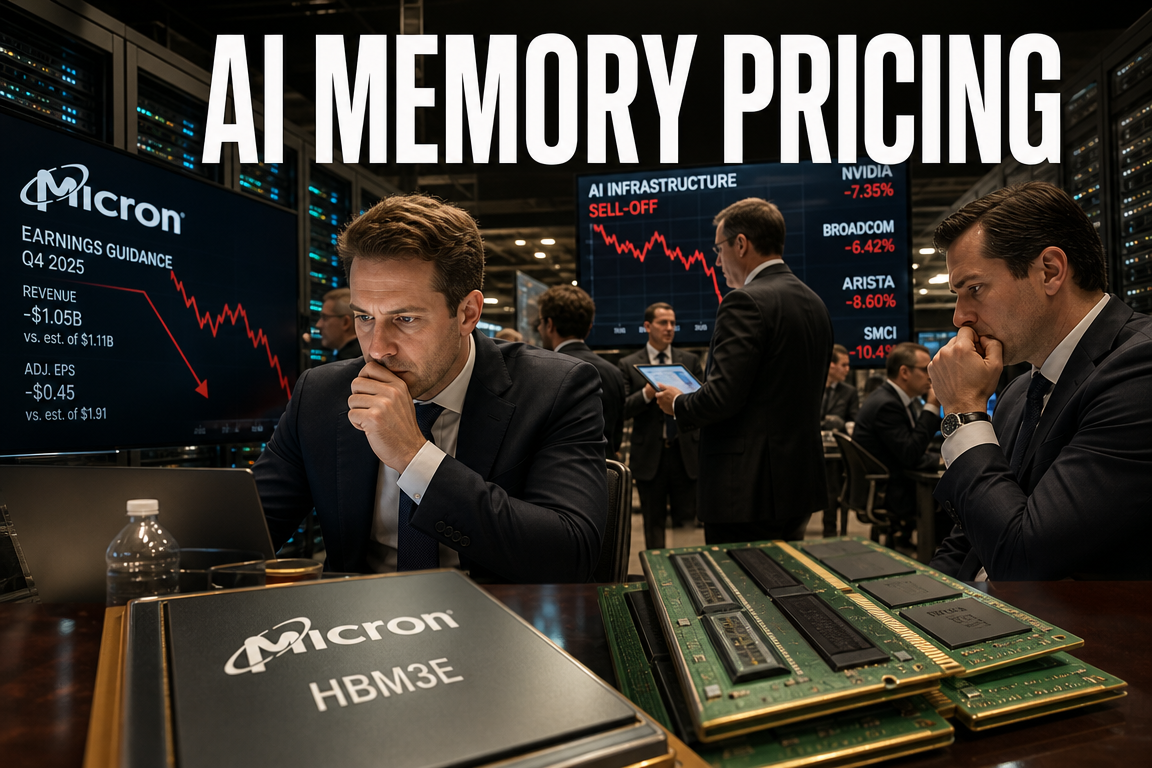
Second, why Micron’s record-breaking earnings surprise still failed to prevent weakness in AI semiconductors and the Nasdaq.
Third, whether the current correction reflects only short-term overheating relief or a warning sign of a late-cycle U.S. equity bull market.
1. Market backdrop this week: volatility spikes in AI infrastructure stocks
U.S. equities have recently shown alternating sessions of sharp gains and losses.
Volatility has expanded significantly, particularly in AI semiconductors, memory semiconductors, data centers, and power infrastructure stocks.
- The semiconductor sector fell by nearly 8% on a weekly basis.
- The Nasdaq declined by nearly 4% on a weekly basis.
- Memory ETFs, semiconductor ETFs, data center ETFs, and power infrastructure ETFs all corrected meaningfully from recent highs.
- Micron reported very strong results, but the stock reacted more sensitively to adverse news flow.
At face value, the market appears to be asking whether the AI infrastructure cycle is peaking.
However, the evidence suggests this is more likely a combination of profit-taking and portfolio rebalancing rather than an immediate end to the bull market.
2. Three direct drivers of the correction: rebalancing, OpenAI IPO delay risk, and Big Tech pushback
This correction appears to reflect several overlapping factors rather than a single negative catalyst.
2-1. Quarter-end rebalancing: selling outperformers, buying laggards
Institutional investors often adjust portfolio weights around quarter-end.
This can lead to reduced exposure to this year’s outperformers in AI infrastructure and semiconductors, while adding exposure to less extended cyclical or value segments.
As a result, memory semiconductors, AI server names, and data center stocks came under short-term selling pressure.
2-2. OpenAI IPO delay risk: concerns about slower AI investment momentum
The market also used reports suggesting a possible delay in OpenAI’s listing plans as a corrective catalyst.
OpenAI is one of the most important demand drivers in the AI infrastructure cycle.
It plays a central role in orders for data centers, GPUs, memory, and power infrastructure.
- Reports indicated OpenAI may not want to list at a valuation below $1 trillion.
- There were also comments that advisors raised caution over weak post-IPO share performance.
- The news affected sentiment toward companies closely tied to OpenAI, including SoftBank and Oracle.
For investors, the concern is that a delay in OpenAI’s IPO could imply slower AI infrastructure investment momentum.
That said, news flow of this type is likely to recur during the broader AI upcycle.
Reports of delayed data center projects, postponed IPOs, or reduced investment plans may continue to provide periodic excuses for corrections.
2-3. Apple and Microsoft begin pushing back on memory pricing
The most important development in this correction is that Big Tech has begun directly challenging memory semiconductor pricing.
Historically, Apple, Microsoft, and Tesla were dominant buyers with strong bargaining power across supply chains.
That dynamic is now changing as AI infrastructure spending accelerates.
With shortages emerging in HBM, DRAM, and NAND, memory vendors have gained significant pricing power.
Big Tech can no longer easily force pricing lower.
3. Apple’s complaint: memory prices have become too high
Apple CEO Tim Cook recently acknowledged the burden of rising memory prices.
The original text suggested that Apple quickly raised prices on some products, with potential increases of 20% to 40% depending on the product category.
- Memory cost pressure has become more visible in higher-spec product lines such as MacBooks and iPads.
- Apple appears to have left room for further price increases.
- The market is also discussing possible iPhone price increases.
It is important to note that Apple is not only a victim in this situation.
Companies often use rising input costs as a rationale for higher retail pricing.
Once product prices rise, they rarely decline even if input costs later ease.
For example, even if memory prices fall later, Apple is unlikely to reduce iPhone prices materially.
Rising memory prices therefore create both cost pressure and pricing justification for Apple.
4. Apple’s China memory lobbying narrative: practical limits remain
A Financial Times report said Apple has been lobbying the Trump administration to allow the use of Chinese memory chips.
The rationale is simple.
If the pricing of Samsung Electronics, SK Hynix, and Micron is too high, Apple would prefer lower-cost Chinese alternatives.
However, the feasibility of this outcome remains limited.
- U.S.-China tensions remain a central variable in semiconductor supply chains.
- The U.S. government has little incentive to allow broad adoption of Chinese memory chips.
- Chinese vendors also face political and regulatory risks in supplying U.S. Big Tech on a stable basis.
This issue is therefore better interpreted as pressure on the existing memory suppliers rather than a likely shift to Chinese memory sourcing.
5. Microsoft joins the pushback: AI spending is becoming more burdensome
Microsoft’s CEO also made remarks emphasizing caution about a future in which a small number of AI firms dominate the economy.
The wording was broad, but the market interpreted it as pushback against AI model providers such as OpenAI and Anthropic.
Microsoft is both a major OpenAI investor and a core participant in the AI race.
However, the cost of AI investment is becoming increasingly heavy.
- AI data center spending includes not only GPUs, but also memory, power, cooling, and networking costs.
- From Big Tech’s perspective, a significant share of AI spending is flowing into memory and infrastructure.
- Microsoft also signaled that it may evaluate lower-cost AI model alternatives for products such as Copilot.
- Low-cost Chinese AI models such as DeepSeek were mentioned as possible alternatives, which added to market concerns.
Microsoft also indicated that Xbox console prices may rise by 15% to 35%.
This is another example of passing through higher memory costs to consumers.
6. Elon Musk also joins the complaints about memory pricing
Elon Musk, who leads Tesla and xAI, also expressed dissatisfaction with rising memory prices.
For Musk, expanding AI, autonomous driving, robotics, and supercomputer infrastructure requires substantial semiconductor and memory capacity.
Tesla’s autonomous driving systems, humanoid robotics, and xAI model training all face direct cost pressure from higher memory prices.
As a result, major Big Tech CEOs are now publicly pressuring memory suppliers in parallel.
7. The real issue: bargaining power has shifted
The core issue is not simply that memory prices have risen.
The more important point is that bargaining power in the global supply chain is shifting.
In the past, Big Tech used its scale and cash generation to pressure component suppliers aggressively.
Now, with AI infrastructure spending intensifying, memory suppliers have gained pricing power.
- Big Tech cannot easily slow investment without risking competitive disadvantage in AI.
- Memory suppliers can demand higher prices and longer-term contracts due to supply shortages.
- Customers must wait in line, while suppliers can set tighter pricing and contract terms.
This is similar to the pricing power Nvidia enjoyed in the GPU market from 2023 to 2025.
Some memory semiconductor vendors are now exhibiting a comparable level of leverage.
8. Micron earnings: fundamentals remained strong despite the correction
Micron’s earnings were very strong and remained one of the clearest indicators that the cycle has not broken.
- Micron reported an exceptionally high gross margin.
- Based on the original text, it was described as retaining roughly 85% of revenue per 100 units sold.
- There is also an expectation that margins could improve further next quarter.
- This level of profitability can be compared with the peak economics of Nvidia.
Such margins indicate that supply conditions remain very tight in memory semiconductors.
This is not merely a price increase; it also suggests customers still need to secure volume at elevated prices.
9. Micron’s long-term contract strategy: reducing downside pricing risk
Micron said it is expanding 3- to 5-year long-term contracts with customers.
This matters for investors.
- A significant share of volume is being moved under long-term agreements.
- These contracts include pricing floors and ceilings.
- Contracts may be difficult to cancel and can require prepayments or deposits.
- Micron indicated that even the minimum contracted price remains above prior levels.
This structure reduces one of the memory industry’s historical weaknesses: severe price collapses.
Traditionally, oversupply caused sharp price declines and rapid earnings deterioration.
This cycle may behave differently because long-term contracts and AI demand are reinforcing each other.
10. Demand is expanding from AI agents to autonomous driving and robotics
Micron management emphasized that memory demand is not limited to near-term AI servers.
It pointed to a longer demand cycle extending into AI agents, autonomous driving, and robotics.
- AI agents require more compute and memory.
- Autonomous vehicles require substantially more high-performance memory than conventional vehicles.
- Humanoid and industrial robotics could further expand memory demand.
In other words, current memory demand may not be confined to a single data center cycle.
That said, there is no guarantee that all of these forecasts will materialize.
Nevertheless, this is one reason the market is not ready to declare the end of the memory cycle.
11. Big Tech cash flow pressure: 2026 may be the most difficult period
AI infrastructure spending is also becoming a burden for Big Tech.
Microsoft, Apple, Google, Meta, and Amazon have historically used strong cash flow to support buybacks and dividends.
Now, however, they are allocating substantial capital to AI data centers.
Higher capex, debt issuance, and investment intensity are pressuring free cash flow.
- Big Tech cash flow may weaken the most around 2026.
- Concerns over return on equity are increasing.
- Lower buyback capacity could weaken share price support.
- Shareholders may increasingly pressure management to slow AI spending.
As a result, some Big Tech stocks have already corrected by more than 10% from recent highs.
Microsoft has experienced an even larger decline.
12. Why the market did not collapse more broadly
In the past, a move like this in Big Tech could have caused a much broader decline in the Nasdaq and the S&P 500.
This time, however, semiconductors, memory, and AI infrastructure stocks helped stabilize the market.
In that sense, leadership in U.S. equities has partially shifted away from legacy platform companies toward AI infrastructure names.
This is a significant structural change.
Previously, the leading stocks were platform companies such as Apple, Microsoft, and Amazon.
Today, leadership is more broadly distributed across Nvidia, Micron, Broadcom, data center names, power infrastructure, and memory semiconductor companies.
13. Clear signs of overheating remain: IPO and capital-raising activity
That said, the market should not be viewed too optimistically.
Strong interest in AI infrastructure and memory semiconductors is also producing classic overheating signals.
- The possibility of a U.S. ADR listing for SK Hynix was mentioned.
- Potential listing plans for China’s ChangXin Memory Technologies were also discussed.
- Kioxia in Japan has strengthened shareholder-return policies through stock splits and higher dividends.
- IPO expectations for AI companies such as Anthropic and OpenAI remain a major market focus.
Companies typically pursue listings when market conditions are strongest.
High valuations and easier capital access are the main incentives.
Accordingly, a concentration of IPO and capital-raising activity in one sector can be read as both a sign of strength and a warning of excess.
14. The most important point that is often underemphasized
The most important but least discussed issue is the shift in pricing power.
Many reports focus only on the surface-level narrative that Apple is criticizing memory prices or that Microsoft is concerned about AI spending.
But the deeper issue is this.
The distribution of profits in the AI era is changing.
In the past, consumer-facing platform companies captured most of the economic value.
Apple did so through the iPhone ecosystem, Microsoft through Windows and cloud services, and Google through search and advertising.
In the AI era, however, infrastructure is a prerequisite for service delivery.
GPU, HBM, DRAM, data centers, and power networks have become bottlenecks.
That means a portion of the profits previously retained by Big Tech is now shifting toward infrastructure suppliers.
Apple and Microsoft are pushing back not only because costs are rising, but because they are being forced to share more margin with memory and infrastructure vendors.
That is the core of the current market dynamic.
This is not just a semiconductor price increase; it is a shift in the global profit allocation structure.
15. Investment view: this appears closer to a late-stage bull market than an early-stage one
It is difficult to characterize the current environment as an early-stage bull market.
AI semiconductors and memory stocks have already delivered strong gains, and volatility is now characteristic of late-cycle behavior.
However, late-stage does not mean the cycle is immediately over.
Late-stage phases can end quickly, or they can last longer than expected.
The key is to participate while remaining close to the exit.
In other words, upside may still exist, but risk management is essential.
- AI infrastructure stocks still have solid earnings momentum.
- Memory semiconductors continue to benefit from supply shortages and long-term contracts.
- At the same time, IPO activity and capital raising are signs of overheating.
- Big Tech spending discipline must continue to be monitored.
- Any increase in shareholder pressure could disrupt the AI investment cycle.
16. Key indicators to watch next
The following factors are likely to influence market direction in the next phase:
- The scale of investment announcements from Samsung Electronics and SK Hynix
- Upcoming earnings and guidance from other memory semiconductor companies after Micron
- Whether Big Tech maintains AI capex guidance during earnings season
- Capex outlooks from Microsoft, Apple, Google, and Meta
- Changes in IPO timing for OpenAI, Anthropic, and similar AI model companies
- U.S.-China semiconductor tensions and restrictions on Chinese memory usage
- The pace of data center power infrastructure investment
For now, the AI infrastructure investment cycle is a more direct market driver than standard employment or manufacturing data.
While rates, inflation, and Federal Reserve messaging remain important, Big Tech’s willingness to sustain AI spending is likely to have a more immediate impact in the short term.
17. Conclusion: a correction has occurred, but it is too early to call the cycle over
This correction looks more like a cooling-off period for an overheated AI infrastructure rally than evidence that the cycle has ended.
OpenAI IPO delay speculation, Apple’s criticism of memory pricing, and Microsoft’s concerns about AI investment costs all contributed to the selloff.
However, Micron’s results show that memory fundamentals remain strong.
Given long-term contracts, high margins, supply shortages, and potential demand from AI agents, autonomous driving, and robotics, it is too early to conclude that the cycle is over.
At the same time, overheating signals are visible.
IPO activity, aggressive capital raising, weakening Big Tech cash flow, and potential shareholder pressure all warrant close monitoring.
In summary, this is not a market where investors should fully exit, nor is it a market where any AI-related stock can be bought without discipline.
The earnings backdrop for AI semiconductors and memory remains constructive, but investors must be prepared for the higher volatility typical of a late-stage bull market.
< Summary >
AI infrastructure stocks and semiconductor shares have recently corrected amid sharp volatility.
The main drivers have been quarter-end rebalancing, possible delays in OpenAI’s IPO, and pushback from Apple and Microsoft on memory prices.
Big Tech is publicly challenging memory suppliers as AI investment costs rise.
Nevertheless, Micron’s earnings remained very strong, and the combination of supply shortages and long-term contracts suggests the memory cycle is not yet over.
At the same time, IPO activity and weakening Big Tech cash flow should be viewed as late-cycle overheating signals.
This is a phase that requires both upside participation and disciplined risk management.
[Related Articles…]
*Source: [ 소수몽키 ]
– 빅테크의 메모리 집중 견제 시작? 증시 분위기 반전될까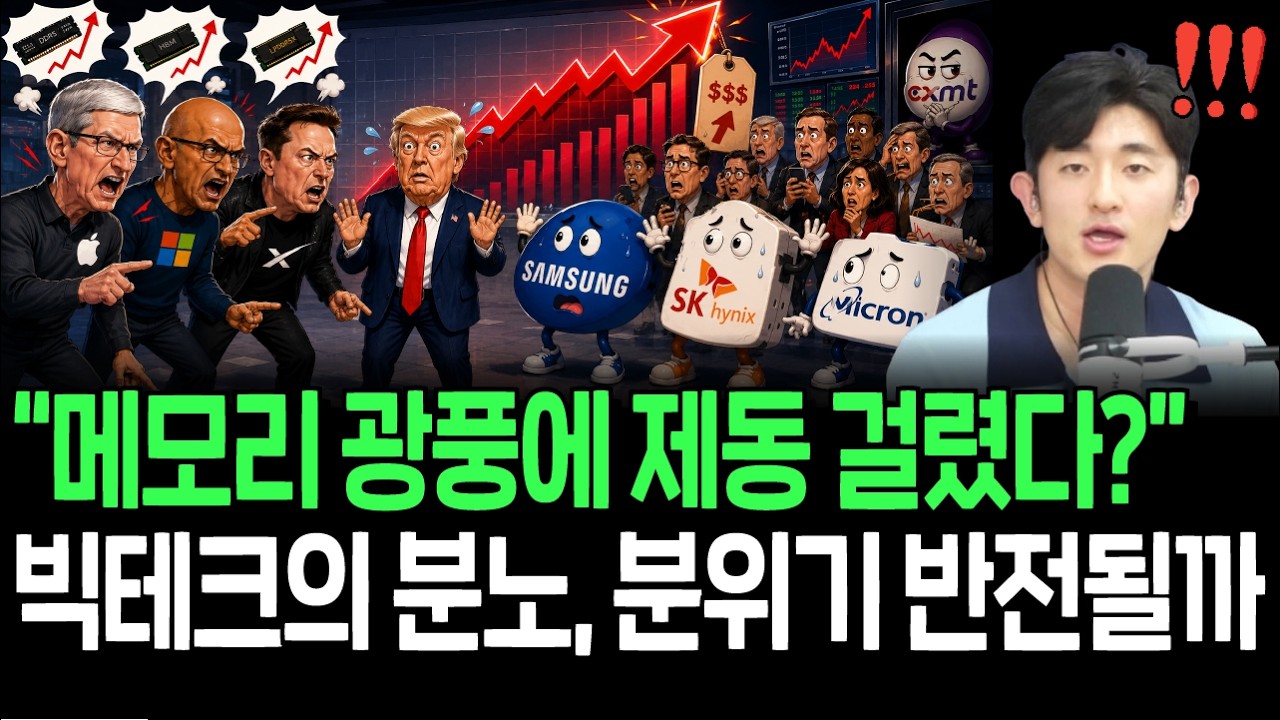
● AI-Driven Shock, SP 500 Soars, Bitcoin Slips
RBC Raises S&P 500 12-Month Target to 8,150; Key U.S. Market Risks in H2 Are AI Semiconductors, Corporate Earnings, and Bitcoin
The key question for U.S. equities in the second half is not whether markets will rise or fall, but where volatility may emerge and where opportunities may reappear.
RBC raised its 12-month S&P 500 target to 8,150, while Bank of America warned of a summer correction.
Although these views appear to conflict, both point to a similar conclusion: avoid near-term volatility and rely on long-term corporate earnings.
At the same time, AI semiconductor momentum, deteriorating free cash flow among the M7, large-scale memory investments, Bitcoin ETF outflows, and Trump’s remarks on a potential Iran meeting are all influencing markets.
The central issue is no longer whether the Nasdaq can continue higher, but whether the AI investment cycle can be sustained by actual cash flow.
1. U.S. Market Performance: Nasdaq and S&P 500 Rebound, Russell 2000 Underperforms
U.S. equities opened with strength led by technology stocks.
The Nasdaq rose about 1.3% at one point, and the S&P 500 gained about 0.82%.
The Dow Jones added about 0.5%, while the Russell 2000 remained negative, highlighting a clear divergence between large caps and small caps.
By late session, the Nasdaq’s gain narrowed to around 0.7%, and the S&P 500 and Dow also gave back part of their earlier advances.
In contrast, the Russell 2000 fell more than 1%, indicating continued weakness in small-cap sentiment.
- Nasdaq: about +1.3% early in the session, later around +0.7%.
- S&P 500: about +0.82% early in the session, later around +0.4%.
- Dow Jones: about +0.5%.
- Russell 2000: continued weakness, with rising pressure on small caps.
The session was defined by clear stock-specific divergence.
Large-cap technology and select AI-related names rebounded, while some semiconductor names and small caps sold off sharply.
In other words, this was not a broad-based rally, but rather a highly selective market.
2. Major Stock Moves: Google, Amazon, and Tesla Firm; Micron Falls Sharply
Among individual stocks, Alphabet rose nearly 3% and helped support the market.
Broadcom and AMD also advanced, while Oracle and Palantir posted gains.
Amazon rose more than 4% intraday and led the rebound in large-cap technology.
Tesla gained about 3%, partially recovering recent weakness.
- Alphabet: about +3%, leading the rebound in large-cap technology.
- Amazon: more than +4%.
- Tesla: about +3%.
- AMD: about +2%.
- Broadcom: higher on AI semiconductor expectations.
- Oracle and Palantir: supported by AI software expectations.
- Eli Lilly: higher on GLP-1 obesity treatment demand.
By contrast, Micron fell about 7%, weighing on the semiconductor sector.
Intel dropped about 5%, and SanDisk declined by roughly 8%.
Semiconductor ETFs and leveraged products also weakened, reflecting fatigue after the strong AI semiconductor rally.
This does not indicate a deterioration in fundamentals.
Rather, the market is reacting to the pace of gains by signaling that valuations may have moved too far, too fast.
AI semiconductors remain a structurally strong growth theme, but near-term volatility has increased materially.
3. Key Events This Week: Jobs Report, Fed Remarks, and Independence Day Holiday
This week covers the transition from late June into early July.
It marks the end of the first half and the start of a more active second-half investment period.
For U.S. equities, corporate earnings, labor data, and rate expectations may all influence trading.
- July 1: Key Fed-related remarks expected at the ECB Forum on Central Banking.
- July 2: U.S. June employment report.
- July 3: Market closure in observance of the Independence Day holiday.
- July 4: U.S. Independence Day.
Markets have recently become more sensitive to inflation than to labor conditions.
Employment has slowed, but not to the point of a sharp deterioration.
As a result, inflation and oil prices remain the main variables for the Federal Reserve’s policy outlook.
If oil remains stable and inflation pressure eases, expectations for rate cuts could strengthen again.
4. S&P 500 Outlook: Bank of America Warns of a Summer Correction, RBC Raises Target to 8,150
The S&P 500 outlook is the main theme for the second half.
With the index already sharply higher in the first half, the market is asking how much further it can run.
Bank of America warned of a near-term correction.
RBC, by contrast, raised its 12-month S&P 500 target from 7,900 to 8,150.
Three Risks Highlighted by Bank of America
- High valuations: The S&P 500 has already moved quickly above what it sees as fair value.
- Slowing momentum: Technical upside momentum is weakening.
- Seasonal weakness: Lower summer trading volumes could amplify volatility.
Bank of America said the S&P 500 could temporarily fall into the low 7,000s.
It also cited political uncertainty ahead of the midterm election cycle.
Why RBC Raised Its Target
- Strong U.S. corporate earnings: Large-cap technology and AI supply-chain companies continue to generate real profits.
- Higher 2027 earnings expectations: Street estimates for future earnings have been revised higher.
- Easing inflation: Lower oil prices are reducing inflation pressure.
- Improving macro backdrop: Soft-landing expectations are strengthening relative to recession fears.
These two views are not necessarily contradictory.
Bank of America is referring to near-term 3Q volatility, while RBC is referring to the 12-month direction.
In practical terms, the message is that the market may correct in the summer, but could resume its advance if earnings hold up.
5. Oil Stabilization: WTI at 69-70 Dollars, Easing Inflation Pressure
WTI is trading around 69-70 dollars per barrel.
Brent is near 72 dollars.
While Middle East risk has not disappeared, the market is currently assigning a lower probability to a full-scale conflict.
Lower oil prices are directly felt by U.S. consumers.
When gasoline prices decline, household pressure eases and consumer sentiment can stabilize.
Oil stability also supports disinflation and improves the case for rate cuts.
That said, a sustained decline below 70 dollars would likely require further improvement in supply conditions and diplomacy.
6. The M7 Investment Case Is Changing: Free Cash Flow Matters More Than AI Revenue
The most important shift in the market is the changing logic around the M7.
In the past, investors could simply buy Apple, Microsoft, Alphabet, Amazon, Meta, Nvidia, and Tesla as a group.
That broad premium is now harder to justify.
AI investment is expanding at a historically rapid pace.
According to BIS data, the scale of AI investment has increased by roughly 4.5 times in just three years.
This pace is steeper than prior cycles such as railroads, canals, or the dot-com era.
The issue is that this level of investment is pressuring free cash flow at large-cap technology firms.
Amazon, Alphabet, Microsoft, and Meta are spending heavily on AI data centers, GPUs, and network infrastructure.
The rationale for the M7 premium has long been that these companies generate substantial profits and still retain excess cash.
That cushion is shrinking as capital expenditures accelerate.
M7 and S&P 493 Earnings Growth Are Converging
Another key development is the narrowing gap in earnings growth.
In 2026, M7 EPS growth is expected to be around 20%, while the rest of the S&P 493 is projected at about 11%.
By 2027, M7 growth is expected to slow to around 15%, while the S&P 493 is also projected to reach about 15%.
If the two groups converge, investors may have less reason to pay a large valuation premium for the M7 alone.
The key question for second-half M7 investing is therefore:
Can AI investment support not only revenue growth, but also free cash flow?
In upcoming earnings reports, free cash flow may matter more than revenue growth.
7. Memory Semiconductors: Large-Scale Investment by Samsung and SK Hynix, and a Pullback in Micron
Memory is becoming increasingly important in the AI semiconductor market.
Samsung Electronics and SK Hynix are pursuing large investment plans aimed at becoming major AI export players.
Based on the source material, Samsung’s planned investment was cited at around 2,600 trillion won, and SK’s at around 2,100 trillion won.
Given the scale, markets have raised concerns about oversupply and aggressive competition.
In the near term, however, supply shortage remains a more immediate issue than oversupply.
Semiconductor fabs cannot be expanded overnight.
Even if the SK Hynix Yongin cluster is being accelerated, meaningful production will still take time.
Micron is also advancing a major factory project in New York, but significant supply expansion is not expected to affect the market meaningfully until after 2030.
As a result, it remains difficult for supply to catch up with AI demand in the near term.
This supports the view that memory pricing and HBM demand are unlikely to weaken quickly.
Micron’s Weakness Does Not Yet Signal an End to the Memory Cycle
Micron fell about 7% on the day.
However, it is reportedly securing more than 40% of revenue through long-term supply agreements with large technology customers.
This suggests that memory semiconductors may no longer behave only as a classic cyclical industry.
Apple’s price increases also provide an important signal.
Rising memory and component costs are ultimately being passed through to consumers.
Large technology companies appear more concerned about falling behind in AI than about continuing to invest aggressively.
As a result, competition in AI infrastructure is unlikely to slow meaningfully in the near term.
8. Bitcoin: ETF Outflows and the Possibility of MSTR Sales Hurt Sentiment
Bitcoin is trading in a fragile range around 60,000 dollars.
It briefly dipped into the 50,000s before recovering to the 60,000 level, but momentum remains weak.
In the recent AI and large-cap technology rally, Bitcoin and crypto-related equities have remained notably weak.
The biggest issue is MSTR, led by Michael Saylor.
MSTR has long symbolized the commitment to never sell Bitcoin.
However, reports that it may monetize part of its Bitcoin holdings to fund operations have created a negative psychological impact.
Bitcoin ETF Outflows Add Pressure
- About 1.7 billion dollars in net outflows from 12 U.S. spot Bitcoin ETFs last week.
- Seven consecutive weeks of net outflows.
- Seven straight trading days of outflows.
- About 1.3 billion dollars of selling pressure at BlackRock’s IBIT alone.
- More than 200 million dollars of outflows from spot Ethereum ETFs as well.
ETFs have served as an important support for the Bitcoin market.
Outflows from that channel suggest more than a routine correction.
If the 60,000-dollar level breaks again, technical selling and disappointment-driven liquidation could open a move toward 40,000 dollars.
The broader risk is that Bitcoin weakness may spill over beyond crypto.
The digital asset market is now closely linked to ETFs, equity markets, and liquidity conditions.
A sharp decline in Bitcoin could weigh on U.S. equity sentiment as well.
9. Eli Lilly: GLP-1 Expansion and Medicare Support Drive Strong Momentum
Eli Lilly rose to around 1,200 dollars and continued to trade near record highs.
Its momentum in the obesity treatment market is increasingly challenging Novo Nordisk.
The key driver is Medicare.
From July 1, eligible U.S. Medicare beneficiaries can receive GLP-1 obesity treatments at roughly 50 dollars per month.
Previously, drugs such as Wegovy or Zepbound cost more than 1,000 dollars per month.
This effectively removes a major price barrier.
- Potential eligible older adults: about 3 million.
- About 82% of U.S. seniors are still unaware of the Medicare benefit.
- Demand could accelerate once broader public awareness improves.
- Initial supply constraints had previously limited promotion, which may become a future demand catalyst.
Eli Lilly is also expanding beyond obesity treatment into oncology.
A European Medicines Agency committee recommended approval of one of Lilly’s leukemia treatments.
Chronic lymphocytic leukemia is one of the most common adult leukemia types.
With additional FDA approval expected later this half, Eli Lilly remains one of the strongest growth names outside technology.
10. Trump Says Iran Meeting May Take Place in Doha, Qatar; Middle East Risk Eases
President Trump said on Truth Social that Iran had requested a meeting and that talks would take place in Doha, Qatar.
Although the Iranian side offered a mixed response, markets are paying close attention because the U.S. president has publicly acknowledged the possibility.
The two sides are reportedly discussing a 60-day negotiation period for a comprehensive and lasting peace agreement.
While tensions among the U.S., Israel, and Iran have recently risen, markets are leaning more toward a negotiated outcome than a broader conflict.
This has been reflected in oil prices.
WTI’s move toward 69-70 dollars and Brent’s stabilization near 72 dollars indicate a decline in the geopolitical risk premium.
That said, Middle East risk can re-emerge quickly on any headline.
11. The Most Important Points Not Fully Captured Elsewhere
First, the RBC and Bank of America outlooks are not truly contradictory.
One refers to near-term correction risk, while the other refers to longer-term upside potential.
Investors should focus less on which view is “correct” and more on when volatility may create entry points.
Second, the real risk for the AI rally is free cash flow, not revenue.
Large technology companies are generating AI-related revenue, but they are also spending more to build AI infrastructure.
In the next earnings season, free cash flow may matter more than headline growth rates.
Third, large memory investments point to durable AI demand rather than immediate oversupply.
Samsung, SK Hynix, and Micron are investing heavily because AI demand is substantial.
Because new capacity takes time to come online, near-term HBM oversupply remains unlikely.
Fourth, Bitcoin risk can spread into equity markets.
If Bitcoin ETF outflows continue and MSTR selling becomes a concern, the issue may extend beyond crypto.
Tighter liquidity conditions could also weigh on the Nasdaq and other high-beta growth stocks.
Fifth, oil stabilization is an indirect positive for rate-cut expectations.
While the market may view Middle East talks as a geopolitical headline, the actual transmission is through inflation and the Federal Reserve outlook.
Stable oil prices reduce inflation pressure and support S&P 500 valuation levels.
12. Investment Strategy: In the Second Half, Focus on AI With Cash Flow, Not AI Alone
Second-half strategy in U.S. equities requires more than simply buying AI-related names.
Investors should focus on AI semiconductors, cloud services, data centers, power infrastructure, and memory companies that can demonstrate real earnings and cash flow.
- In the short term, prepare for summer volatility and earnings-related swings.
- In the medium to long term, focus on AI infrastructure companies with durable earnings.
- For the M7, assess free cash flow and investment efficiency rather than treating them as a single group.
- Semiconductors may correct after a sharp advance, but the AI demand structure remains intact.
- For Bitcoin, monitor the 60,000-dollar support level and ETF flow trends.
- Oil remains a key variable for inflation and rate expectations.
Markets are currently showing a pattern in which some stocks fall despite positive news, while others rise despite weak headlines.
In this environment, investors should focus not only on index direction but also on capital flow.
The second-half theme is the balance among AI growth, corporate earnings, interest rates, inflation, and liquidity.
< Summary >
RBC raised its 12-month S&P 500 target to 8,150.
Bank of America warned of a summer correction, but this does not conflict with a longer-term bullish view.
The AI semiconductor rally remains intact, but the M7 must now be evaluated through the lens of free cash flow pressure and slowing earnings growth.
Large-scale investment by Samsung, SK Hynix, and Micron points to sustained AI demand rather than immediate oversupply.
Bitcoin sentiment has weakened due to ETF outflows and the possibility of MSTR sales.
Eli Lilly continues to show strong momentum on the back of GLP-1 expansion and new drug expectations.
Trump’s comments on an Iran meeting are supporting expectations for lower oil risk and easing inflation pressure.
The second-half investment approach should emphasize companies with resilient earnings and cash flow rather than relying on broad market gains.
[Related Articles…]
*Source: [ Maeil Business Newspaper ]
– RBC, S&P500 12개월 목표치 상향 8,150ㅣ트럼프 “30일 카타르서 이란과 회담”ㅣ홍키자의 매일뉴욕