● Shock, Samsung, SK Hynix, Tumble, DRAM, Data, Jolt
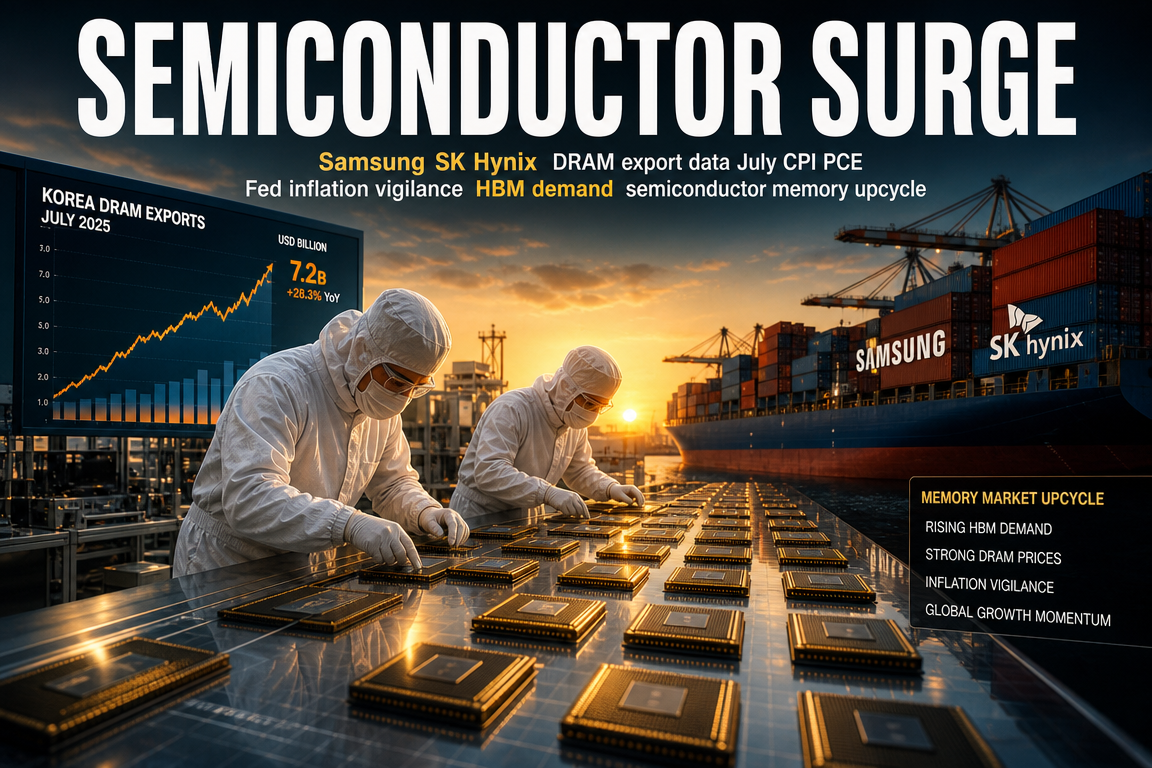
The real reason Samsung Electronics and SK Hynix fell sharply: More important than the KOSPI was memory semiconductor export data
The key point in today’s market is not simply that Samsung Electronics declined or that SK Hynix declined.
The core issue is why Korean benchmark semiconductor stocks weakened even though the Philadelphia Semiconductor Index held up reasonably well.
Today’s focus should be on memory semiconductor export data, DRAM price interpretation, the distinction between HBM and conventional DRAM, and the difference in stock sensitivity between Samsung Electronics and SK Hynix.
Although the move may appear to be a KOSPI correction, it was more accurately a day when a single memory semiconductor export data point weighed on investor sentiment.
1. Today’s KOSPI trend: Samsung Electronics and SK Hynix were notably weaker than the broader market
The most visible feature of today’s KOSPI session was not the index decline itself, but the relative weakness of Samsung Electronics and SK Hynix.
In the U.S. market, the Philadelphia Semiconductor Index, a key benchmark for the semiconductor sector, was not materially weak the previous day.
Normally, that would have supported a constructive tone for Korean semiconductor large caps.
That was not the case today.
Samsung Electronics and SK Hynix traded as though they were detached from the broader market.
In other words, today’s decline is better understood as a company-specific issue affecting Korean memory semiconductors rather than a broad deterioration in U.S. semiconductor fundamentals.
- U.S. semiconductor index: relatively stable
- KOSPI: higher volatility
- Samsung Electronics and SK Hynix: highly sensitive to memory semiconductor export data
- Key driver: weaker DRAM export unit value and related sentiment pressure
2. The trigger: lower DRAM export value and unit price by weight
The market’s main point of concern was memory semiconductor export data.
In particular, the decline in DRAM export value and the unit price by weight compared with a year earlier heightened investor caution.
Here, unit price by weight is a simple measure of how much value was generated per unit of weight shipped.
When this figure declines, the market quickly interprets it as follows:
“Has the DRAM price upcycle started to lose momentum?”
The recent memory semiconductor cycle has been supported by expectations of AI server investment, data center expansion, and stronger HBM demand.
As a result, even a modestly negative data point can have an outsized impact on share prices.
3. A lower unit price does not necessarily mean DRAM prices have fallen
It is important not to overstate the meaning of the export unit price decline.
If lower-priced products were shipped in greater volume this month, the average unit price would naturally decline.
In other words, if the mix shifted from premium products toward mainstream DRAM, the average price can appear weaker.
That does not necessarily mean that market prices for DRAM have entered a broad decline.
Put simply, if more standard wine is sold and less premium wine is shipped, the average selling price falls even if wine prices themselves have not collapsed.
- Possible cause 1: higher shipments of lower-priced DRAM
- Possible cause 2: product-mix changes
- Possible cause 3: concentration of shipments to specific customers
- Possible cause 4: timing differences between high-value and mainstream product shipments
Accordingly, it is not reasonable to conclude from this data alone that the memory semiconductor price recovery cycle is over.
That said, equity markets always price expectations ahead of fundamentals.
After a strong run in semiconductor shares, even a single cautionary data point can be enough to trigger profit-taking.
4. Why Samsung Electronics weakened more than SK Hynix
Another important point is that Samsung Electronics moved more weakly than SK Hynix.
The reason lies in their business structures.
Samsung Electronics has greater sensitivity to mainstream DRAM, NAND, and the traditional memory cycle.
SK Hynix, by contrast, has recently been viewed by the market as a leading beneficiary of HBM demand.
HBM is a high-value memory product used in AI semiconductors and data center servers.
It is one of the most closely watched areas in the current global AI investment cycle.
As a result, the market tends to view Samsung Electronics through the lens of overall DRAM pricing, while SK Hynix is evaluated more on HBM growth potential.
| Category | Samsung Electronics | SK Hynix |
|---|---|---|
| Market sensitivity | High exposure to mainstream DRAM and NAND trends | High exposure to HBM growth expectations |
| Today’s pressure | More sensitive to concerns over weaker DRAM export pricing | Weaker, but partially supported by HBM-related resilience |
| Investment focus | Memory price recovery and earnings improvement | AI server demand and HBM supply competitiveness |
Accordingly, the two stocks were not treated identically today.
Samsung Electronics reflected concerns about conventional memory pricing more directly, while SK Hynix was partly supported by HBM expectations.
5. HBM export data remained relatively solid
A key detail in today’s data is that HBM-related trends remained relatively firm.
While mainstream DRAM export unit prices appeared weaker, the HBM segment, where SK Hynix has a competitive advantage, still showed constructive signals.
This is one reason the market does not assess SK Hynix in the same way as Samsung Electronics.
In the AI semiconductor market, GPUs are not the only critical component.
HBM, which enables fast data processing alongside GPUs, has become an essential part of the stack.
As long as AI infrastructure investment led by Nvidia continues, HBM demand is likely to remain structurally strong.
Today therefore reflects a day when near-term concerns over mainstream DRAM collided with medium-term expectations for HBM.
6. SK Hynix also benefited from U.S. ADR listing expectations
Market participants also referred to expectations for SK Hynix’s U.S. ADR listing on July 10.
An ADR is a depositary receipt that allows shares of a foreign company to be traded in the U.S. market.
It can improve accessibility for U.S. investors and support sentiment through a potential liquidity effect.
This factor alone does not determine the stock’s direction.
However, alongside HBM growth expectations, it may provide incremental support to investor sentiment.
By contrast, Samsung Electronics had relatively fewer short-term catalysts to offset the concern over DRAM pricing.
7. Other stocks were not particularly weak
One favorable point today is that the broader market did not collapse outside Samsung Electronics and SK Hynix.
In other words, this was not a systemic market selloff, but rather one centered on large-cap semiconductor names.
Stocks facing company-specific issues, such as EcoPro amid a capital increase, were weak on separate factors.
This distinction matters for investors.
Trading decisions differ depending on whether the issue is a broad market risk or an industry-specific one.
- Broad market breakdown: not evident yet
- Large-cap semiconductor pressure: amplified by export data
- Company-specific weakness: separate funding and event risks
- Investment focus: sector rotation matters more than the KOSPI headline
8. The key point often missed: markets fear the pace of expectations more than price moves themselves
The main issue today is not the unit price decline itself.
The more important factor is that investor expectations had already risen too quickly.
Recent semiconductor valuations have incorporated recovery in memory prices, AI server investment, HBM demand, and earnings recovery at the same time.
In such an environment, even good news can struggle to move shares higher, while small negative signals can trigger disproportionate reactions.
Today’s decline therefore looks less like evidence of a collapse in DRAM pricing and more like a temporary pause in a highly elevated expectation cycle.
Investors should focus not on one day’s price action, but on whether the next two to three months show a one-off fluctuation or the beginning of a broader slowdown in semiconductor exports.
9. Key indicators to watch going forward
Investors in Samsung Electronics and SK Hynix should continue to monitor the following indicators:
- DRAM contract prices: whether the recovery trend remains intact
- Semiconductor export value: whether both price and volume continue to rise
- Product mix: whether mainstream DRAM or higher-value memory products dominate shipments
- HBM supply contracts: a critical indicator tied to AI server demand
- Samsung Electronics’ HBM competitiveness: a key variable for future re-rating
- SK Hynix HBM market share: essential to sustaining its premium valuation
- Foreign investor flows into the KOSPI: directly relevant to large-cap semiconductor direction
For Samsung Electronics, the pace of improvement in HBM competitiveness remains important.
For SK Hynix, the central question is how long it can maintain its leadership premium in HBM.
Although both are semiconductor stocks, the drivers of future share performance are not identical.
10. Investment view: how should today’s weakness be interpreted?
Today’s decline in Samsung Electronics and SK Hynix is negative in the short term.
However, it is premature to conclude that the memory semiconductor cycle has ended.
Rather, it may represent a healthy consolidation phase after expectations had become overly optimistic.
That said, short-term trading conditions may become more volatile.
If the next semiconductor export release is also weak, the market may interpret it as a trend rather than a one-off event.
Conversely, if export value and unit prices recover in the next release, today’s move may be seen as simple profit-taking.
- Short term: prepare for higher volatility
- Medium term: focus on memory prices and HBM demand
- Long term: AI infrastructure investment remains supportive for the semiconductor cycle
- Risk: elevated expectations can also lead to faster disappointment
< Summary >
The main reason Samsung Electronics and SK Hynix weakened today was a decline in DRAM export value and unit price by weight.
However, a lower unit price does not necessarily imply a broad decline in DRAM market prices.
Average pricing can weaken if the shipment mix shifts toward lower-priced products.
Samsung Electronics was more affected because of its higher sensitivity to mainstream DRAM conditions.
SK Hynix was partly supported by HBM-related export trends and U.S. ADR expectations.
Today’s decline is better understood as a short-term reassessment of elevated expectations rather than the end of the memory semiconductor cycle.
Going forward, investors should monitor DRAM prices, semiconductor export data, HBM demand, and foreign investor flows.
[Related Articles…]
- Semiconductor Cycle and Key Watchpoints for Korean Equities
- AI Infrastructure Investment and the Outlook for HBM Demand
*Source: [ 내일은 투자왕 – 김단테 ]
– 삼전 닉스만 나락간 진짜 이유 #하이닉스 #삼성전자 #코스피
● Inflation Shock, Fed Pivot, July Market Risk
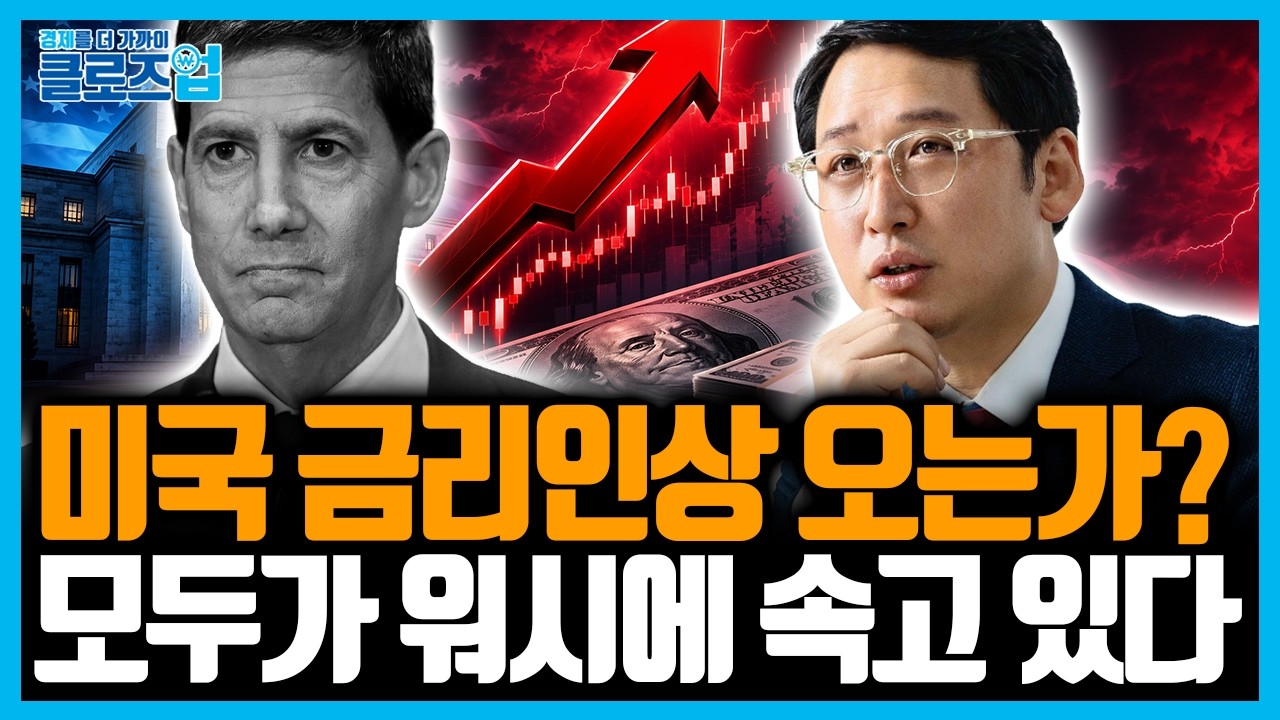
July Market Risks Are Driven Less by Rate Hikes Than by Inflation Vigilance and a Shift in the Fed’s Rulebook
The key issue for the July market is not simply whether the U.S. policy rate will rise or fall.
The more important question is whether July CPI and PCE inflation data will reawaken market fears of higher rates.
At the same time, the market is facing a combination of higher crude prices, the Strait of Hormuz risk, rising AI semiconductor prices, and the possibility of a shift in the Federal Reserve’s policy framework.
In the end, the direction of U.S. equities, the Nasdaq, and the S&P 500 in July will depend less on the actual rate path than on how the Fed interprets inflation.
1. The main July variable is not the rate hike itself
Markets are increasingly focused on the possibility that the Fed could raise rates again.
However, the more important issue is not whether a hike is ultimately delivered, but how long the market continues to price in that possibility.
Equity markets tend to dislike uncertainty more than confirmed bad news.
In particular, investors may begin to position defensively ahead of the mid-July CPI release and the late-July FOMC meeting.
- If the U.S. CPI released in mid-July comes in above expectations, rate-hike concerns could intensify.
- At the late-July FOMC meeting, the Fed’s inflation assessment and policy guidance could increase volatility.
- U.S. rate expectations should be judged by the voting stance of FOMC members, not only by the median dot plot.
- Nasdaq and growth stocks may be more sensitive to a prolonged rate-hike scare than to an actual hike.
In short, July is less about whether rates will actually rise and more about whether markets will reprice the risk of higher rates.
2. The Fed already sees room for inflation to move higher
The most important point is that the Fed is already factoring in the possibility of higher inflation ahead.
Current inflation data are released with a lag.
For example, PCE data reported in June reflect May conditions.
As a result, even at the late-July FOMC meeting, the Fed will still be making decisions without fully current inflation information.
The Fed’s projection of core PCE at around 3.3% is not just a numerical estimate.
It implies that inflation may remain above recent levels through June, July, and August.
- Both headline PCE and core PCE appear to be moving away from recent lows.
- Since U.S. employment remains resilient, the Fed is likely to prioritize inflation over labor market conditions for now.
- As inflation moves farther from the 2% target, the case for rate cuts weakens.
- Accordingly, markets will remain highly sensitive to July CPI and PCE releases.
The key question for July is therefore not whether inflation has peaked, but whether higher energy prices are spreading into other components.
3. Energy prices are not immediately reflected in inflation data
Even if geopolitical conflict or crude price spikes occur, the full impact does not appear in the next month’s inflation figures.
Typically, higher energy prices feed into goods inflation after three to four months and into services after four to five months.
Prices do not change immediately the day after a conflict, but over time input costs, logistics costs, and labor costs are transmitted into final prices.
- Higher crude prices first affect gasoline and electricity costs.
- They then feed into goods prices through transportation and logistics costs.
- They can also affect fertilizer, agricultural chemicals, grains, and feed, which may pass through to food inflation.
- Restaurant prices and wage negotiations can also transmit the shock into services inflation.
For that reason, July CPI is not just one data point. It may be the first test of whether an energy shock is broadening into general inflation.
4. What matters for crude oil is not whether it falls, but whether it returns to pre-war levels
Markets are hoping for a peak in crude prices followed by stabilization.
From an inflation perspective, however, the key question is not whether oil declines from the prior month, but how far it remains above year-ago levels.
If damage to parts of the Gulf region’s production, storage, and refining chain has occurred after the conflict, crude may not easily return to the $50 to $60 range seen before the war.
Even if tanker traffic through the Strait of Hormuz partially recovers, prices may remain elevated unless supply chains normalize fully.
- The Strait of Hormuz risk increases uncertainty in global crude supply.
- Production disruptions in Gulf states can limit downside in oil prices.
- Natural disasters in producing countries such as Venezuela can also add upside pressure.
- The Bank of Korea has also indicated that a return to pre-war oil levels may be difficult.
Accordingly, a modest decline in oil prices should not be treated as proof that inflation risk has disappeared.
5. The view that AI lowers inflation is only partly correct
AI can improve productivity over the long term and reduce costs.
For example, in legal, accounting, software, and content industries, AI can allow the same services to be delivered at lower cost.
In that sense, AI adoption can exert disinflationary pressure over time.
But in the near term, the opposite is happening in some segments.
Rapid expansion in AI data centers and generative AI has driven strong demand for GPUs, HBM, and DRAM, pushing semiconductor prices higher.
This is effectively chipflation.
- Rising AI semiconductor demand is supporting higher GPU prices.
- HBM and DRAM price increases can flow through to servers, PCs, and consumer electronics.
- Higher semiconductor prices can raise goods inflation.
- AI productivity gains are a long-term factor, while chipflation is a near-term inflation variable.
In other words, AI may eventually reduce inflation, but in the short run it can still lift prices in selected categories.
6. The Fed is already divided internally
The dot plot shows clear disagreement among Fed members.
Some support further hikes, while others favor cuts.
The key issue is that the members who set the dots are not identical to those who vote on policy decisions.
The original analysis suggests that if only the voting FOMC members are considered, the balance may lean more toward a hike than the dot plot implies.
In that setting, a stronger-than-expected CPI release in July could shift previously neutral members toward a more hawkish position.
- Relying only on the median dot plot can lead to an inaccurate market view.
- The stance of voting FOMC members is more important.
- Higher inflation data can strengthen the hawkish camp within the Fed.
- Rate-cut expectations can fade quickly after a single inflation release.
When assessing the U.S. rate outlook, investors should focus less on simple year-end cut counts and more on the likelihood of a shift in internal Fed voting dynamics.
7. The key issue investors often miss: the Fed may change its decision framework, not just rates
This is the most important point.
Markets usually focus only on whether rates will rise or fall.
However, a larger variable may be how the Fed decides rates going forward.
The original analysis gives significant weight to the possibility of a shift in the Fed’s policy framework.
If that occurs, markets would need to reinterpret not just the policy rate, but the Fed’s entire decision-making process.
8. Five possible changes in the Fed’s policy framework
First, communication may be reduced.
The Fed statement could become shorter, while the role of the dot plot and press conference could diminish.
This would reduce signaling to markets and may reflect a desire for greater policy independence.
Second, balance-sheet reduction may be linked to rate cuts.
Reducing the Fed’s holdings already tightens financial conditions.
As a result, the Fed could lower rates while continuing to shrink the balance sheet.
In that case, the policy mix may appear dovish on rates but remain neutral or restrictive in overall effect.
Third, the Fed may rely more on real-time data.
Current PCE data are delayed.
At the late-July FOMC meeting, making decisions based on May data has clear limitations.
The Fed may therefore seek real-time inflation, labor, and growth indicators for policy decisions.
Fourth, AI productivity effects may be incorporated.
The Fed may increasingly consider the argument that AI boosts productivity and lowers inflation over time.
However, this debate remains unsettled because short-term chipflation may be stronger.
Fifth, the inflation metric itself may change.
Core PCE has traditionally been the key reference.
But the Fed may place greater weight on alternative measures such as trimmed-mean PCE, which exclude extreme price increases and declines.
Depending on the chosen measure, the case for rate cuts could change materially.
9. Key indicators investors should monitor in July
- July CPI: Check whether energy price increases are spreading into goods and services inflation.
- July PCE: Track whether the Fed’s preferred inflation gauge is moving further away from the 2% target.
- Crude oil: The key issue is not short-term declines, but whether prices return to pre-war levels.
- FOMC communication: The Fed’s inflation interpretation and any framework shift matter more than the rate decision alone.
- AI semiconductor prices: Watch whether HBM, GPU, and DRAM price gains pass through to goods prices.
- U.S. equity valuation: Nasdaq and the S&P 500 may face higher volatility if rate-cut expectations weaken.
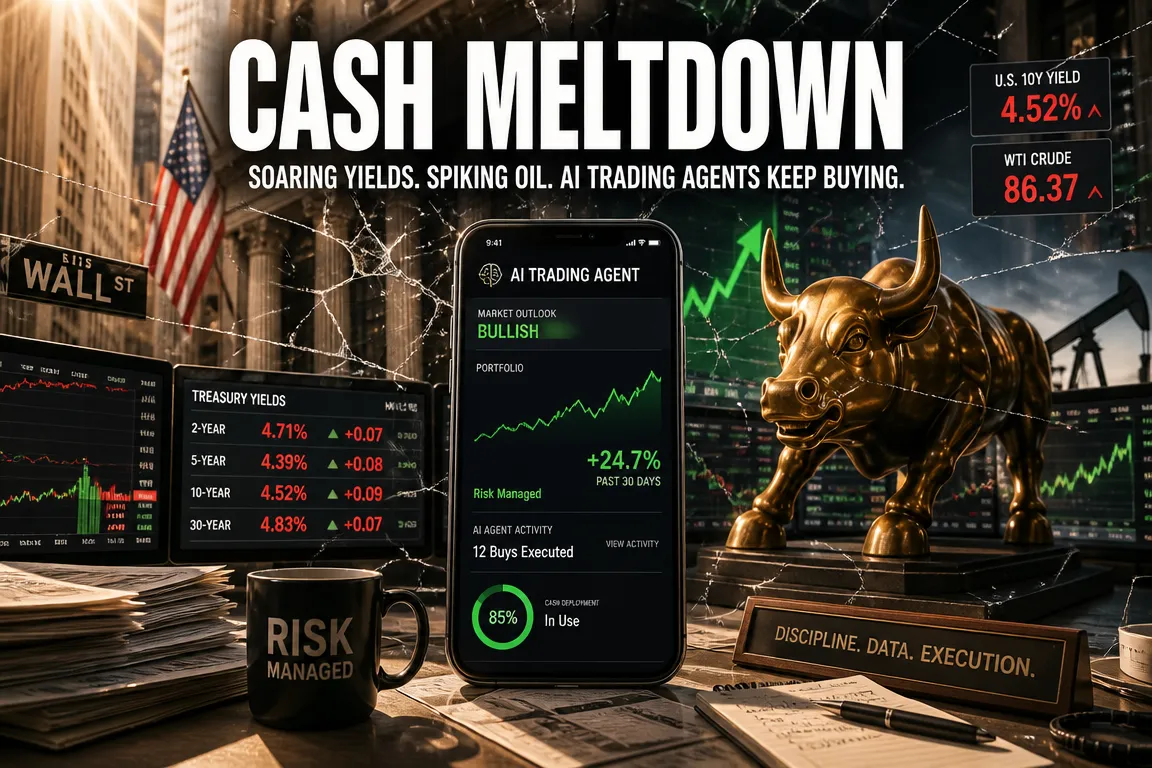
For July, a more practical approach is to manage volatility around inflation releases rather than either fully exiting cash or taking aggressive directional risk.
AI semiconductor stocks should be viewed through both long-term growth and short-term valuation pressure.
Energy, materials, defense, and consumer staples deserve continued attention as inflation hedges.
10. Conclusion: July is a month for inflation interpretation, not just rates
It remains too early to conclude that an actual rate hike is likely this year.
However, the fear of a hike can still move markets materially.
If inflation data come in hotter than expected, U.S. equities may correct in the short term. If pass-through remains limited, rate-cut expectations could recover.
More important is how the Fed chooses to judge inflation going forward, and how it combines balance-sheet policy with the policy rate.
That shift could affect not only the next FOMC meeting, but also the broader 2026 economic outlook.
When assessing July markets, investors should move beyond the binary question of rate hikes versus cuts and focus on the interaction between inflation data, crude prices, AI chipflation, and potential changes in the Fed’s framework.
< Summary >
The key July market variable is the fear of higher rates, not necessarily an actual hike.
The Fed is already factoring in the possibility that inflation may remain elevated through June and July.
If crude does not return to pre-war levels, inflation pressure is likely to persist.
AI may lower inflation over the long term, but in the near term it can contribute to chipflation through higher GPU, HBM, and DRAM prices.
The most important hidden variable is the possibility that the Fed may change both its inflation metrics and its policy decision framework.
Investors should monitor July CPI, PCE, FOMC commentary, crude oil, and AI semiconductor prices together to assess the outlook for U.S. rates and equities.
[Related Articles…]
- July FOMC Outlook and U.S. Rate Path: Key Watchpoints
- AI Semiconductor Cycle and Chipflation Investment Strategy
*Source: [ 경제 읽어주는 남자(김광석TV) ]
– 7월 시장, 진짜 변수는 ‘금리 인상’이 아닙니다 | 경제학교 월간특강 [2편]