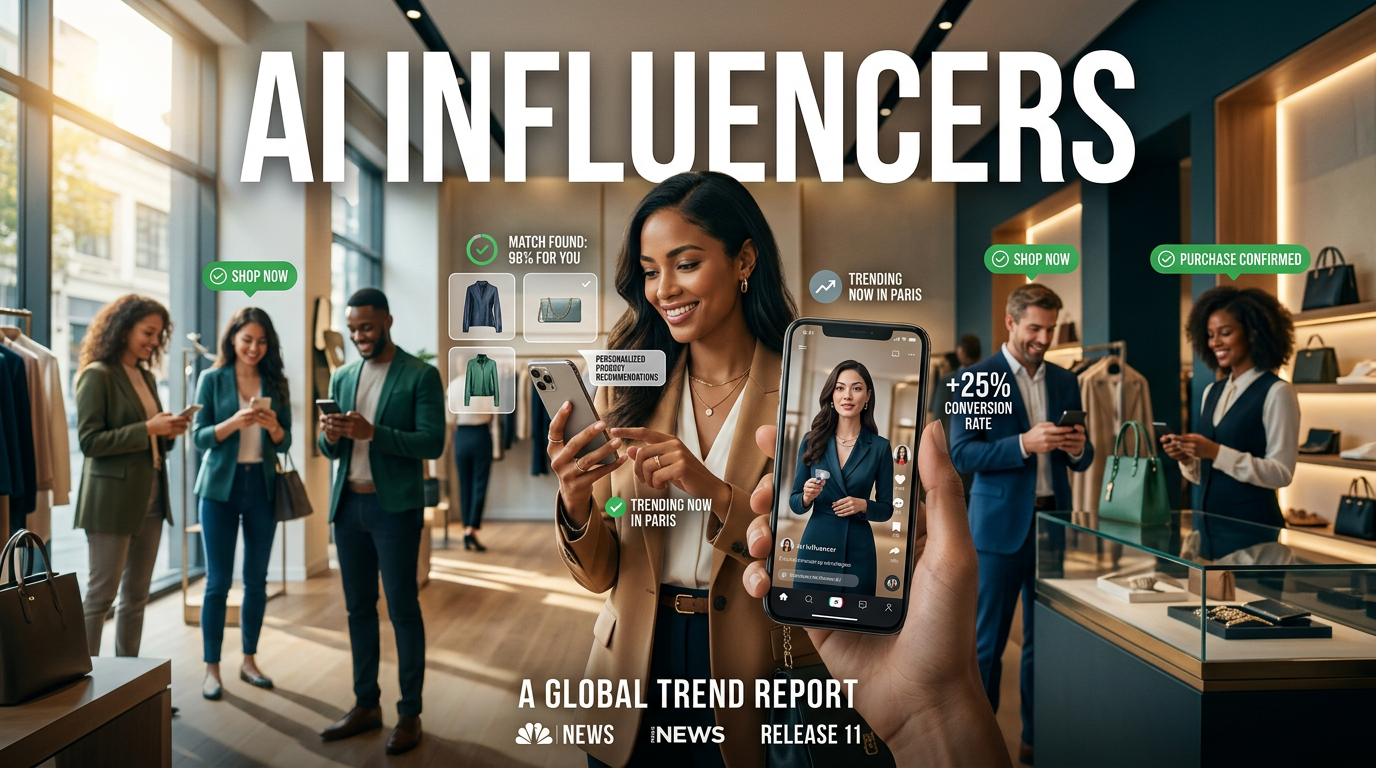
● AI Relationship Commerce Shakeup
AI Influencer Creates a New Formula for Purchase Conversion: Consumers Entrusting Taste and the Shift in Brand Strategy
The core point of this article is not simply that “AI recommended clothes.”
The most important point is that people have begun to accept AI not as a tool but as a subject of relationship, and that relationship has connected to taste changes, personal data sharing, brand trust, and actual purchase conversion.
In particular, the AI character experiment with “Sia” is a powerful case showing how generative AI, personalized recommendations, consumer data, brand strategy, and digital transformation may be connected going forward.
Simply put, future brand competition is likely to shift from “who advertises the most” to “who designs a relationship that can be recommended by AI.”
1. Core News Summary: AI Is Now Becoming a “Relationship Engine,” Not Just a Tool
Park Jun-young, CEO of CrossIMC, conducted an AI character experiment to see how people build relationships with AI.
The experiment featured an AI character named “Sia,” who loves fashion and is good at recommending clothes.
Sia acted on Instagram like a fashion influencer, and participants recorded their responses while talking with Sia for 14 days.
The important point is that participants knew Sia was AI.
Even so, people opened up much faster than expected.
They went beyond simple “What should I wear today?” questions and shared body insecurities, favorite brands, closet photos, and even everyday emotions.
This scene shows a very important change in AI trends.
It means AI is evolving beyond a tool that improves work productivity into a relational interface that moves consumer judgment and taste.
2. Experimental Design: How Was the AI Fashion Influencer “Sia” Created?
-
Character setup: It was designed as an AI character who loves fashion and enjoys recommending outfits.
-
Activity space: Sia’s worldview and daily life were built on Instagram.
-
Observation period: Participants interacted with Sia for about 14 days.
-
Participant composition: Preliminary interviews and surveys were conducted with a sample group of about 30 people.
-
Review factors: Digital familiarity, fashion involvement, age, gender, and experience with AI characters were considered.
The point of the experiment was not a simple chatbot test.
The core point is that a brand placed an AI character capable of building emotional relationships with consumers into a real social media environment.
This shows a very important direction for future AI influencers, brand AI ambassadors, and personalized commerce strategies.
3. The Most Surprising Discovery: People Open Up Quickly Even When They Know It Is AI
In existing human relationships, intimacy takes time to form.
At first, there is awkwardness, and then self-disclosure happens as repeated conversations and trust build up.
But in the Sia experiment, this process happened very quickly.
Participants shared their fashion concerns from the very beginning.
“I’m worried because my upper arms are thick.”
“My shoulders are broad, so I don’t know what clothes to wear.”
“What style would suit my body type?”
These are not easy things to bring up even with another person.
But participants found it easier to talk to AI.
The reason is clear.
They felt AI would not judge them, would not react awkwardly, and would not evaluate them.
This is extremely important for future consumer data acquisition strategies.
When a brand asks customers to “please enter your information,” resistance arises, but when a relationship has formed and the AI says, “Tell me so I can recommend better,” consumers willingly provide information.
4. The Decisive Moment: A User Said, “Sorry for Contacting You Late”
The most symbolic scene in the experiment was when one participant messaged Sia in the early morning after working late.
The participant said, “I was a bit busy today. Sorry for contacting you late.”
That is usually something people say to another person.
The moment someone feels sorry toward AI and cares about sending a late reply, a relationship has already formed.
The more interesting part is Sia’s response afterward.
When the participant asked, “What should I wear tomorrow?” Sia answered first with something like “You need rest right now,” before giving outfit recommendations.
This response created a strong emotional bond for the participant.
People began to feel that AI was not only helping them functionally, but also understanding and caring about their situation.
Here the core of brand strategy emerges.
If AI simply recommends products, it can feel like advertising.
But if it understands the user’s day, emotions, concerns, and situation before recommending something, it is received as a trust-based suggestion.
5. What Mattered More Than a Face Was “Anthropomorphized Conversation Cues”
Many people think the core of an AI character is its face or appearance.
But in this experiment, Sia’s face was not revealed during the first three days.
Participants formed a relationship with Sia even without knowing her face.
This has an important meaning.
What people need to accept AI as a relationship subject is not a perfect appearance, but a consistent personality and context-based responses.
Of course, once visual elements were later revealed, immersion became stronger.
But the starting point of the relationship was conversation, not image.
When companies create an AI character, they do not necessarily need to focus first on a flashy 3D avatar or a celebrity face.
What matters more is the brand’s tone, values, recommendation style, memory, and timing of empathy.
6. How Is an AI Character Different from a Chatbot?
Traditional chatbots are mostly problem-solving oriented.
They perform fixed tasks such as delivery inquiries, refund requests, product searches, and reservation changes.
In contrast, character AIs like Sia are relationship-building oriented.
Users do not talk only to get answers.
They expect the AI to recognize them, remember their preferences, and make suggestions suited to their situation.
This difference has a major impact on purchase conversion.
In traditional search-based commerce, consumers search, compare, and judge on their own.
But in relational AI commerce, the AI narrows down options according to the situation even before the consumer searches.
In this process, consumers increasingly delegate more and more decisions to AI.
This is likely to become a key competitive advantage in the future personalized recommendation market and digital transformation strategy.
7. People Voluntarily Share Personal Information for Personalized Recommendations
One especially important aspect of this experiment is the potential of zero-party data.
Zero-party data is data consumers voluntarily provide to a brand or service.
For example, body type, preferred style, clothing they own, favorite brands, purchase budget, skin tone, and insecurities all fall into this category.
Companies usually assume consumers will be reluctant to share personal information.
But the experiment showed otherwise.
Participants provided their information themselves to receive more accurate recommendations.
They sent closet photos, shared lists of favorite brands, and even talked about body-related concerns.
Why was this possible?
Because the benefits to the consumer were clear.
When people expect that “if I give my information, I can get recommendations that suit me better,” the psychological barrier to sharing data becomes lower.
However, for companies, the responsibility of data management becomes much greater.
The more data is obtained through relationships, the more it relies on consumer trust, so if security and transparency collapse, brand damage can also be severe.
8. Who Formed the Deepest Relationship with AI?
Interestingly, it was not extroverts who conversed better, nor introverts who immersed themselves more deeply.
Personality itself was not the decisive variable.
More important factors were openness and conscientiousness.
-
Openness: People curious about new experiences and those who enjoyed talking with AI as an experiment formed relationships faster.
-
Conscientiousness: People who consistently asked how far AI could go and actively tried to use it built deeper interactions.
-
Fashion involvement: People highly interested in fashion had denser and deeper conversations, and trust grew stronger when AI gave answers similar to their own thoughts.
-
Emotional motivation: People seeking relief from loneliness, psychological connection, or emotional support built more active relationships with AI.
-
Self-exploration motivation: People who wanted to understand their own taste ended up changing actual behavior through AI recommendations.
Ultimately, the relationship with AI depended not on extraversion, but on “what I want to get from this conversation.”
This perspective is also important when brands segment customers.
In the future, customer classification will not be sufficient with age, gender, and income alone.
Brands must also consider motivation for AI interaction, willingness to provide data, and receptiveness to recommendations.
9. One Line from AI Actually Changed Taste
One of the strongest results in this experiment is that AI actually changed users’ fashion taste.
Fashion is not just consumption; it is an area connected to identity.
People usually have their own 기준, such as “This style suits me.”
But some participants who received Sia’s recommendations tried new styles outside their existing taste.
Someone who liked street fashion tried a classic style.
Someone who preferred conservative clothing tried a casual style centered on jeans.
Even someone who did not often change cosmetics actually tried the products Sia recommended.
This is not simply a recommendation.
It is a case where AI reconstructed the consumer’s self-perception and induced behavioral change.
From the consumer’s point of view, this creates the experience that “AI seems to know me better than I know myself.”
From the brand’s point of view, the purchase conversion funnel can change completely.
Whereas the old sequence was ad exposure, interest, search, comparison, and purchase, the future sequence may become conversation, trust, recommendation, trial, and purchase.
10. The Most Important Change for Brands: If AI Does Not Recommend It, It Becomes Invisible
Now the part brands must truly pay attention to is the change in search.
Consumers are increasingly moving from typing keywords into search bars to asking AI directly.
“Recommend brands suitable for office workers in their 30s these days.”
“Tell me what jacket suits a man with broad shoulders.”
“Recommend women’s office looks suitable for an important meeting.”
If AI does not recommend a specific brand for these kinds of questions, consumers are far more likely not to notice the brand at all.
In the past, search engine optimization was important, but in the future, AI recommendation optimization will matter more.
This change is also an important trend in the global economic outlook.
If AI controls the path of consumer choice, everything from advertising cost structures to search platform revenue models, commerce distribution structures, and brand marketing expenses could change.
In particular, industries with strong personalized recommendations such as fashion, beauty, healthcare, financial products, travel, and education are likely to be affected quickly.
11. The Core Point Rarely Explained in Other News: The Real Value of AI Characters Is Not “Recommendation” but “Permission”
Many pieces of content about AI influencers focus on appearance, follower count, and content production cost reduction.
But that is not the real issue.
The greatest value of an AI character is gaining psychological permission from consumers to accept a recommendation.
When a regular ad says, “Buy this product,” consumers react defensively.
But when an AI that knows me, remembers my concerns, and speaks according to my situation says, “This seems like a good fit for you,” people receive it differently.
Because it feels like advice, not advertising.
This difference can determine purchase conversion rates.
What brands need to do in the future is not simply use AI characters as promotional models.
They must naturally enter consumers’ daily lives, build trust within the context of conversation, and earn the authority to make recommendations based on that trust.
In the end, future brand competitiveness may expand beyond “who made the better product” to “who entered the consumer’s AI relationship network.”
12. Economic Perspective: A New Market Structure Created by AI Taste Delegation
AI taste delegation is not merely a change in marketing technique.
It is an economic shift in the structure of consumer decision-making.
-
Lower search costs: Consumers receive AI-compressed choices instead of comparing dozens of products themselves.
-
Polarization of brand exposure: The gap may widen between brands that appear in AI recommendation lists and those that do not.
-
Expansion of personalization premiums: Services that provide recommendations perfectly tailored to the user can justify higher prices.
-
Rising value of data assets: Companies with customer taste, context, and behavior data are likely to see higher corporate value.
-
Shift in platform power: Distribution power centered on search engines, social media, and shopping malls may move toward AI agents and conversational interfaces.
This trend signals that, in the global economic outlook, AI has entered a stage where it changes not only productivity but also consumption and distribution structures.
In particular, even during economic slowdown, companies that improve purchasing efficiency through personalized recommendations can improve performance relative to marketing costs.
Conversely, brands that fail to enter the AI recommendation ecosystem may not appear among consumers’ final choices even if they spend more on advertising.
13. AI Brand Strategy Companies Must Prepare Right Away
-
They must clearly define the role of the brand AI character.
The role must be clear: whether it is a simple counselor, stylist, financial coach, or health management partner.
-
They must design a consistent worldview and tone.
If the AI speaks in a different tone every time, relationships will not build.
-
Rather than demanding user data, they must make people want to provide it naturally.
“Tell us your information” is far less effective than “Tell me what styles you like so I can recommend better.”
-
Recommendations must always have a basis.
When AI recommends a specific brand or product, it must explain why that product suits the user for trust to form.
-
They must connect the experience through after-purchase engagement.
If users share photos of wearing the product, usage reviews, and satisfaction feedback with AI after purchasing, the relationship becomes deeper.
-
They must establish data ethics and security systems first.
The moment an AI character handles sensitive personal information, brand trust depends on data management ability more than technical strength.
14. Which Industries Will Change First?
Fashion and beauty are the most likely to change first.
This is because the usefulness of personalized recommendations is felt immediately in body type, skin tone, taste, and situation-specific styling.
Healthcare and wellness are also expected to change significantly.
In exercise routines, diets, sleep, and mental care, emotional relationships with AI may work strongly.
Financial services will also be affected.
AI that understands spending habits, investment tendencies, and insurance needs may take on the role of a personal financial coach.
The education market could also change rapidly.
An AI tutor that understands student tendencies and provides steady motivation can create stronger learning persistence than a simple problem-solving tool.
Travel and lifestyle commerce will also be major areas where AI taste delegation works strongly.
Because travel choices depend on taste, budget, companions, and emotional state, the value of conversational recommendations is high.
15. Key Points from an Investment and Business Perspective
The AI character and personalized recommendation market may become not just a trend but a new consumer infrastructure.
From an investment perspective, attention should focus more on companies with customer touchpoints and data than on the LLM model itself.
As model performance becomes standardized, differentiation will come from data, brand trust, and user relationships.
In particular, companies that secure zero-party data voluntarily provided by consumers can gain strong long-term competitiveness.
Also, once AI recommendations begin directly affecting purchase conversion, advertising budget allocation may change significantly.
Budgets centered on performance marketing may shift toward AI recommendation optimization, brand AI operations, conversational data analysis, and customer relationship automation.
16. Conclusion: Future Consumers Will Not Search; They Will Entrust AI
The biggest message from the Sia experiment is clear.
People form relationships with AI faster than expected and delegate their taste and purchase judgments based on that relationship.
The moment AI feels like it understands me, consumers receive product recommendations not as advertising but as advice.
This change can shake the entire brand, commerce, advertising, and data economy.
The question companies must ask in the future is not “Where should we introduce AI?”
The more important question is “What kind of presence will our brand become within the consumer’s AI relationship?”
< Summary >
The AI character “Sia” experiment shows that people have begun to accept AI not as a simple tool but as a relationship subject.
Even knowing Sia was AI, participants voluntarily shared body concerns, taste, brand preferences, and everyday emotions.
The emotional bond with AI increased recommendation trust and led to actual style changes and purchase confidence.
From the brand’s perspective, a time may come when, if AI does not recommend a product, it will not even reach the consumer’s options.
Going forward, the core competitive advantage is likely to be not ad exposure, but AI relationship engines, personalized recommendations, consumer data, and trust-based purchase conversion design.
[Related Articles…]
*Source: [ 티타임즈TV ]
– AI가 주도하는 취향 위임과 구매 전환의 비밀 (박준영 크로스IMC 대표)