● Tesla, Optimus, AI Shift
Musk’s “Optimus Production Line” Photo Raises Questions About Tesla’s $425 Valuation
The key issue is not simply that Elon Musk posted a photo.
What matters is that Tesla is beginning to show visible evidence of a transition from an automotive company to an AI manufacturing platform.
This report reviews the main variables behind Tesla’s $425 valuation, the practical significance of the Optimus production line, the debate over AI chip demand, the OpenAI cost-reduction issue, and the structure connecting FSD and robotaxi.
For investors, the question is whether this photo could alter the trajectory of Tesla’s valuation.
1. Tesla closes at $425.3; the market is looking beyond vehicle sales
Tesla closed at $425.3, up 1.12% from the previous day.
By contrast, several technology and semiconductor stocks corrected, and the Philadelphia Semiconductor Index also weakened sharply.
In this context, Tesla’s relative strength is difficult to explain by EV sales expectations alone.
- First, second-quarter delivery expectations remain supportive.
Bloomberg consensus is approximately 396,000 units, while Tesla’s own internal estimates have been cited at around 406,000 units.
Some prediction markets suggest expectations for a stronger result. - Second, the Optimus production line disclosure shifted attention back to robotics.
Musk posted a photo on X showing him walking through the Optimus production line at the Fremont facility, which investors interpreted as a signal that Tesla is moving toward humanoid robot production. - Third, Tesla’s long-term valuation framework extends beyond auto sales.
The stock already reflects a premium that is difficult to justify on vehicle deliveries alone.
A significant portion of that premium is tied to autonomy, robotaxi, Optimus, and AI infrastructure.
In other words, Tesla’s $425 valuation should be viewed as pricing for a company moving beyond EVs toward AI and robotics manufacturing.
2. OpenAI cost-reduction reports and the shock to the AI semiconductor market
Another important element in this news flow is the OpenAI report.
According to external reporting, OpenAI engineers identified a software method that could cut inference costs for services such as ChatGPT by more than half.
The technique was reportedly applied to unauthenticated visitor traffic, reducing the number of Nvidia GPUs required at a given time.
The market reacted quickly.
Concerns emerged that AI semiconductor demand may not expand without limit, and semiconductor indices declined sharply.
The report also revived debate about AI chips, GPUs, and data-center spending.
- This has not been officially confirmed.
The report was based on unnamed sources and not on an official OpenAI statement.
OpenAI has neither confirmed nor denied the details publicly. - The technical method has not been disclosed.
Market participants have speculated about combinations of quantization, caching, batching, and model optimization.
The exact approach remains unverified. - The timing also intersects with IPO expectations.
Because the report emerged while OpenAI is preparing for a potential IPO, the market viewed the timing as notable.
Lower costs do not necessarily mean lower semiconductor demand.
If AI usage becomes cheaper, enterprise and consumer demand may rise materially, potentially increasing total GPU demand.
This is consistent with Jevons paradox in the AI infrastructure market.
3. Tesla is following the same direction: HW3, FSD 14 Lite, and model compression
The OpenAI cost-efficiency discussion is relevant to Tesla because Tesla is addressing a similar problem.
Tesla is trying to maximize FSD performance on legacy Hardware 3 vehicles through software optimization.
Current discussion centers on compressing a model built for Hardware 4 so that it can operate within Hardware 3 constraints.
This includes techniques such as model distillation to make functionality possible within smaller memory budgets.
- Hardware 3 has significantly less memory headroom than Hardware 4.
Even so, Tesla is trying to expand the usable life of existing vehicles through approaches such as FSD 14 Lite. - This does not imply full unsupervised autonomy immediately.
However, improving practical performance on legacy hardware is strategically important. - The central issue is efficiency, not simply more chips.
This may become an important variable in future AI semiconductor investment cycles.
Tesla’s autonomy strategy is not based only on adding more high-performance chips.
It is built around improving existing vehicles through software updates.
That is a core part of Tesla’s economic moat and one of the hardest advantages for other automakers to replicate.
4. AI5 and GDDR strategy challenge the assumption that HBM is the only answer
Tesla has said that its next-generation AI5 chip will be used for Optimus and data-center applications.
A notable point is Tesla’s plan to use standard GDDR memory rather than HBM, or high-bandwidth memory, which has become the industry norm in many AI systems.
Musk has previously argued that using conventional memory allows more RAM to be placed on the board at lower cost.
This is not just a component choice; it reflects a different cost structure for AI infrastructure.
- HBM offers strong performance but is expensive.
In the Nvidia-centric AI ecosystem, demand for HBM has grown rapidly. - GDDR is cheaper and has a broader supply base.
If Tesla can achieve sufficient performance through its own design and optimization, it may improve cost competitiveness. - This matters for macro-level AI investment assumptions.
It suggests that AI infrastructure spending may not remain centered exclusively on premium chips and HBM.
The market has largely assumed that AI growth implies unlimited semiconductor demand.
However, taken together, OpenAI’s cost-reduction report and Tesla’s GDDR strategy suggest that future competition may be defined less by how many chips are purchased and more by how efficiently AI is run.
5. Why Musk’s Fremont photo triggered a strong market response
Musk posted a photo on X indicating that he was walking the Optimus production line in Fremont.
The image showed him standing in what appeared to be a production environment alongside a worker wearing safety gear.
The post drew substantial attention within hours and quickly became a focal point for Tesla investors.
The location matters.
The Fremont plant had been a key site for Model S and Model X production.
Those two models completed their final production run in May, and the space is now reportedly being converted into a dedicated third-generation Optimus line.
- The Model S and Model X footprint is being repurposed for Optimus.
This indicates that Tesla is reallocating part of its premium EV manufacturing capacity to humanoid robot production. - The first Optimus production line has reportedly arrived and installation has begun.
Tesla vice president Lars Moravy has also discussed this in recent interviews. - The project is now in the field acceptance testing stage.
That suggests Tesla is beyond the concept phase and closer to actual production validation.
If Tesla is truly preparing to mass-produce Optimus, the implication is far larger than vehicle unit sales.
The EV market is highly competitive, while the humanoid robotics market still lacks a clear global winner.
6. Why the July-to-August Optimus timeline matters
At Tesla’s Q1 2026 earnings call, the company reportedly indicated that Optimus production in Fremont would begin between late July and early August.
Given that the production-line photo was posted in early July, the timing is significant.
If the Model S and Model X line stopped in early May, Tesla appears to have completed the transition from vehicle production to robot production in roughly three months.
That pace reflects Tesla’s manufacturing execution capability.
- The first line is reportedly modular.
Once testing is complete, power connection could occur within 2 to 4 days, with startup possible within about a week. - This is only the beginning.
Additional lines are said to be needed for actuators, arms, legs, torsos, batteries, and other components. - Production ramp remains uncertain.
Optimus reportedly contains roughly 10,000 unique parts, implying a highly complex manufacturing challenge.
Tesla has previously indicated a long-term annual output target of 1 million units for the Fremont site.
A larger second Optimus factory in Texas is also planned, with a 2027 summer target mentioned.
However, initial production is likely to be slow, and meaningful ramp-up will take time.
7. Why Optimus Version 3 has not yet been revealed: a possible Apple-style strategy
Many investors are focused on Optimus Version 3.
It has been discussed for months, but no formal reveal has taken place.
This has led to two competing views: either the product is not ready, or Tesla is deliberately delaying disclosure.
The competitive landscape is relevant here.
Chinese companies have become increasingly visible in the global humanoid robotics market.
Musk has acknowledged that Chinese firms are strong in both AI and manufacturing and could become serious competitors.
- Early disclosure increases replication risk.
After the original Optimus design was shown, similar robots began appearing quickly in the market. - An Apple-style launch approach may be more effective.
Apple typically announces products close to launch, leaving competitors little time to respond. - Tesla may be aligning product disclosure with production start.
The pattern of showing the Fremont line before the product itself is consistent with that approach.
Accordingly, the absence of a Version 3 reveal should not automatically be viewed negatively.
It may instead indicate that Tesla is adjusting its disclosure strategy to protect intellectual property and manufacturing lead time.
8. For Optimus, the key issue is not flashy movement
The humanoid robotics industry often highlights walking, running, dancing, and kicking demonstrations.
Boston Dynamics’ Atlas, for example, has emphasized advanced motion capabilities.
These demonstrations are impressive and generate strong media attention.
However, industrial value lies elsewhere.
The more important question is not whether a robot can perform a kick, but whether it can check tickets, hand over items, assess human flow, and reliably perform repetitive factory tasks.
- Predefined movements can be trained in simulation.
Actions such as kicking or choreographed routines can be reproduced through repeated training. - Real-world work contains constant variability.
Robots must respond to changing human positions, object conditions, surrounding environments, and exceptions in real time. - The hand remains the critical component.
A robot must have sufficiently precise hands to use tools, equipment, and instruments designed for human workers.
When Version 3 is revealed, investors should focus less on performance theatrics and more on finger control, object recognition, real-time judgment, battery life, repetitive-task stability, and factory readiness.
A humanoid robot must do work economically, not merely resemble a human.
9. Tesla’s AI monetization sequence: robotaxi first, Optimus second
One of the main challenges in AI is monetization.
Many companies are deploying AI, but relatively few are generating meaningful new revenue from it.
Most are still using AI mainly to reduce labor costs and improve efficiency.
Tesla is different in that it aims to connect AI to the physical world and generate revenue through real operations.
- The first monetization candidate is Cybercab robotaxi.
If autonomy is commercialized, vehicles could provide transportation services and generate recurring revenue. - The second monetization candidate is Optimus.
If it can replace human labor in factories, logistics, services, or household support, the addressable market could exceed that of EVs. - The two initiatives are connected.
Vision AI, real-time decision-making, edge computing, and manufacturing automation developed for autonomy also support Optimus.
Tesla’s AI strategy is therefore different from a chatbot or cloud software model.
Its objective is to use AI to move vehicles, robots, and factory systems.
That is a major reason the stock continues to trade at a long-term premium.
10. The most important point that is often missed
The central issue is not simply that Musk posted a photo.
The more important signal is that Tesla appears to be changing the priority of its manufacturing assets.
Repurposing the space once used for Model S and Model X production toward Optimus suggests that robotics now has a materially higher internal priority.
- First, Tesla is turning AI into a manufacturing asset, not just software.
Many AI firms build models and sell APIs.
Tesla is embedding AI directly into vehicles, robots, and production lines. - Second, the idea of infinite semiconductor demand is becoming more nuanced.
OpenAI’s cost-reduction report and Tesla’s GDDR approach suggest that AI growth may not be defined solely by higher chip purchases. - Third, delayed Optimus disclosure may reflect strategy rather than weakness.
Given rapid competition from Chinese manufacturers, Tesla may be choosing to align product disclosure with production launch. - Fourth, 2026 is likely to be a validation period for Tesla’s AI valuation.
Whether robotaxi and Optimus arrive as real products will help determine whether investors classify Tesla as an automaker or an AI robotics platform.
In short, the photo is less a promotional gesture than a clue about Tesla’s capital allocation and manufacturing strategy.
Investors should focus on that structural shift rather than on a single day’s share-price move.
11. What Tesla investors at $425 should monitor now
For Tesla holders, the question is no longer only whether the stock goes up or down.
At this level, the market is already pricing in significant future expectations, so investors need to monitor whether those expectations are becoming tangible results.
- Second-quarter delivery results should be checked against consensus.
Near-term trading remains sensitive to deliveries and margins. - Optimus production should begin on schedule between late July and early August.
After the photo, the key issue is whether the line actually becomes operational. - Version 3 should be assessed on hand function, decision-making, and real task performance.
Practical factory use matters more than a polished demonstration. - FSD 14 and robotaxi progress also remain important.
Autonomy monetization must advance for Tesla’s AI valuation to become more credible. - AI chip cost structure should remain under review.
If Tesla can improve cost competitiveness through AI5, GDDR, and optimization, its long-term margin profile could change.
Risks remain significant.
Early Optimus production could ramp slowly and take longer than expected to stabilize.
Robotaxi regulation, FSD safety, EV demand moderation, interest rates, and global growth conditions also remain relevant to Tesla’s valuation.
This photo alone does not confirm the thesis.
However, it does indicate that Tesla’s direction is changing.
12. Conclusion: Tesla’s key long-term value drivers are still Optimus and autonomy
Musk has consistently argued that Tesla’s long-term value will come less from vehicle sales and more from AI, autonomy, and robotics.
The Fremont Optimus production-line photo suggests that this thesis is moving from narrative toward execution.
For Tesla to be re-rated from an automaker to an AI manufacturing company, two things must happen.
First, Cybercab and FSD must demonstrate commercial autonomy.
Second, Optimus must prove that humanoid robotics can be economically deployed in real industrial settings.
Tesla’s $425 valuation already reflects high expectations.
The market now appears to be demanding evidence in the form of production lines, product launches, real work, and recurring revenue.
The Fremont photo may be the first visible step in that process.
< Summary >
- Tesla closed at $425.3, supported by Optimus and second-quarter delivery expectations.
- OpenAI’s reported inference-cost reduction raised questions about AI semiconductor demand growth.
- Tesla is pursuing AI efficiency through HW3 support, FSD 14 Lite, and model compression.
- Tesla’s AI5 GDDR strategy challenges the assumption that HBM is the only viable path.
- Musk’s Fremont photo suggests that Optimus production-line installation is under way.
- Delayed disclosure of Optimus Version 3 may reflect a strategy to reduce copying risk.
- The critical factors for Optimus are hand precision, real-time judgment, and task execution, not visual theatrics.
- Tesla’s long-term value depends more on robotaxi autonomy and humanoid robotics monetization than on EV sales alone.
[Related Articles…]
*Source: [ 오늘의 테슬라 뉴스 ]
– 머스크 “테슬라 가치 80%는 이것” — 오늘 그 증거 사진이 올라왔다, $425 주주는 지금 어떻게?
● AI Shock, Micron Slump, Kospi Risk
The Real Question Raised by Micron’s Sharp Decline: What “AI Compute Remains” Means for KOSPI and Samsung Electronics and SK hynix
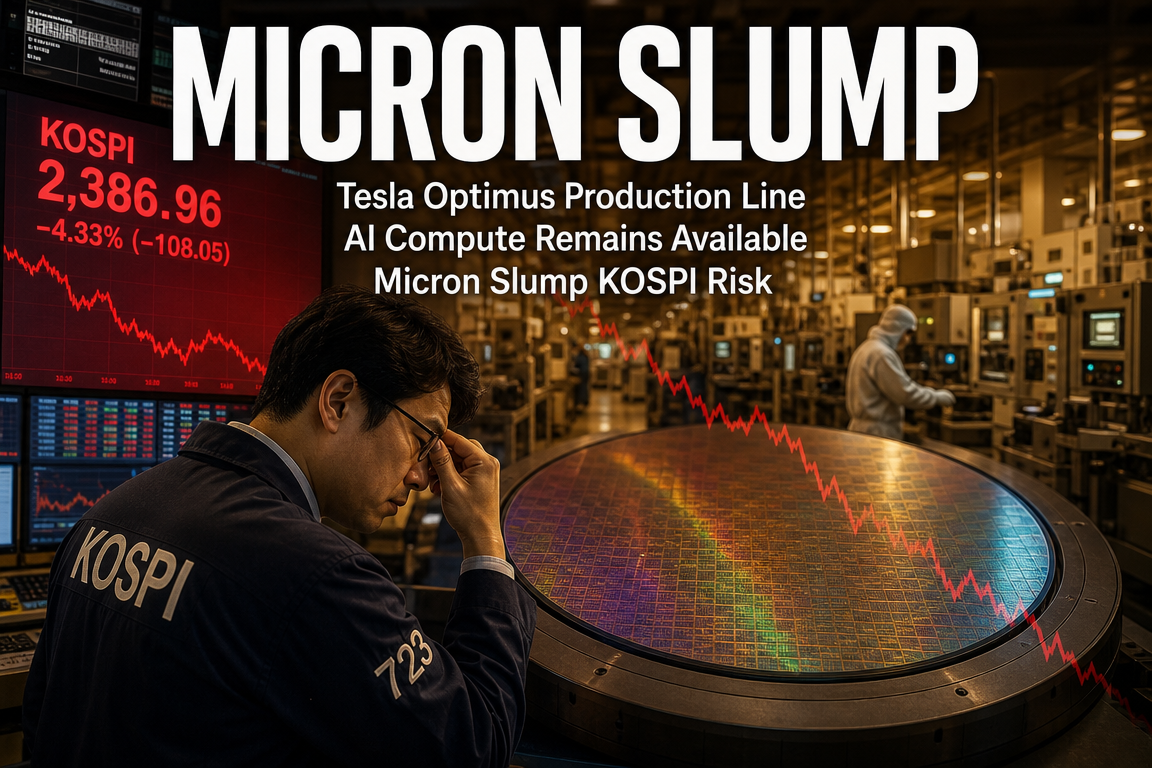
The key point in today’s market was not simply that Micron fell nearly 10%.
The main issue was that news about Meta’s potential cloud-computing sales was interpreted as a sign of slowing AI infrastructure investment, prompting global markets to reprice the entire memory semiconductor sector.
However, the story is more complex than the apparent message that “compute remains available.”
Meta has recently signed computing contracts with external neocloud providers, while Amazon announced plans to raise GPU utilization by 20%.
In other words, the market is receiving two opposing signals at the same time: one suggesting excess compute supply, and the other indicating continued scarcity.
Accordingly, this issue should be analyzed not only through Micron’s decline, but also in connection with the AI infrastructure investment cycle, memory semiconductor demand, the KOSPI outlook, and the stock performance of Samsung Electronics and SK hynix.
1. What Happened in the U.S. Market Overnight: Micron and SanDisk Fall Sharply
Micron and SanDisk both declined by roughly 10% in U.S. trading.
The direct trigger was reporting related to Meta.
News circulated that Meta could sell external cloud services because its own computing resources were in surplus.
The market reacted strongly to the phrase “compute remains available.”
Investors quickly interpreted this as a sign that AI data center investment may have peaked.
That interpretation immediately led to selling across semiconductor stocks.
Micron, in particular, has been a representative beneficiary of expectations for HBM demand in AI servers.
SanDisk was also pressured because it had been priced on expectations of a recovery in NAND and storage demand.
As a result, the market moved on the sequence: “slower AI investment → weaker data center demand → weaker memory semiconductor demand → selling of Micron and SanDisk.”
2. The Sentence the Market Focused on Most: “Compute Remains Available”
The phrase that captured investor attention was simple: “compute resources remain available.”
In the AI industry, compute resources include GPUs, servers, data centers, power, networks, and memory semiconductors.
Until now, the market had believed that major technology firms would continue making large-scale AI infrastructure investments to avoid falling behind in the AI competition.
This belief has supported the strong performance of stocks such as Nvidia, Broadcom, Micron, SK hynix, and Samsung Electronics.
But once the message emerged that Meta could have excess compute to sell externally, the market began questioning that investment thesis.
In simple terms, the logic was as follows.
“Compute remains available?”
“Then are big tech firms no longer buying GPUs aggressively?”
“Then are HBM and DRAM demand also slowing?”
“Then should highly valued memory semiconductor stocks be sold?”
That sequence was reflected directly in the U.S. market overnight.
3. The Contradiction: Meta Recently Signed External Computing Contracts
There is a reason why this decline is difficult to explain in a simple way.
As noted in the underlying report, Meta signed computing contracts with neocloud firms in March and June.
If Meta truly had enough internal compute capacity to spare, there would be little reason to enter into additional contracts with external cloud providers.
This is the core contradiction in the story.
In other words, the idea that Meta may be able to sell some compute externally coexists with the fact that it continues to secure external compute resources.
This makes it difficult to conclude that overall AI compute demand has clearly weakened.
A more plausible interpretation is that some forms of compute are in surplus while others remain constrained.
For example, certain regional data centers may have spare capacity while advanced GPU clusters remain tight.
Training compute may also be temporarily underutilized, while inference demand continues to grow rapidly.
Some idle capacity may simply reflect project timing rather than a structural demand shift.
Accordingly, “compute remains available” should be read less as a sign that AI demand has ended and more as an indication that AI infrastructure allocation and utilization efficiency are becoming the next issue.
4. The Opposite Signal from Amazon: GPU Utilization to Rise by 20%
Another signal should not be overlooked.
Amazon recently said it would raise GPU utilization by 20%.
If AI compute were truly abundant, there would be little reason to push utilization higher.
Higher utilization implies that existing resources will be used more intensively, which can indicate sustained demand.
In cloud computing, utilization matters more than simple installed capacity.
Even if a company owns a large number of GPUs, profitability suffers if customer demand and workload allocation do not match.
Conversely, even with limited GPU supply, high utilization can support stronger revenue and margins.
From that perspective, Amazon’s move appears less like a sign of weaker AI demand and more like an effort to monetize AI compute assets more efficiently.
This may indicate not the end of AI infrastructure investment, but a transition from the first phase of capital expansion to a second phase focused on operating efficiency.
5. The Core Point: Compute Is Not a Single Category
The most important point in this issue is that “compute” should not be treated as a single concept.
Markets often think of compute simply as total GPU supply.
In practice, however, AI infrastructure consists of several distinct categories.
First, there is high-end GPU compute for AI training.
This segment depends on high-performance GPUs such as Nvidia’s H100, H200, and B200, as well as HBM.
Second, there is AI inference compute.
This is used for chatbots, search, advertising, recommendation systems, and video generation services.
Third, there is general cloud compute.
This includes legacy web services, data processing, and enterprise IT workloads.
Fourth, there is internal R&D compute.
This is used by major tech firms for proprietary model training and experimentation.
Fifth, there is cloud compute that can be sold externally.
This Meta-related news may refer only to a portion of that capacity.
However, the market interpreted it as evidence of excess supply across the entire AI compute stack.
That is the essence of the short-term selloff.
6. What Does This Mean for Memory Semiconductors?
Micron fell sharply because expectations for the memory semiconductor cycle had already been heavily reflected in its share price.
AI servers use substantially more DRAM and HBM than conventional servers.
As a result, increased AI data center investment tends to support memory semiconductor demand.
Conversely, if investors believe AI data center investment is slowing, memory semiconductor stocks can weaken quickly.
Micron, SK hynix, and Samsung Electronics are all connected to this same dynamic.
However, their sensitivity differs.
SK hynix has been the most direct beneficiary of HBM demand, making it especially sensitive to concerns about slower AI investment.
Samsung Electronics also benefits from HBM expectations, but its portfolio is broader, spanning DRAM, NAND, foundry, smartphones, and consumer electronics.
Micron, meanwhile, has been trading with particularly strong exposure to AI memory expectations in the U.S. market, which increases its volatility.
In other words, this decline is better understood as a valuation adjustment against elevated expectations rather than proof that the cycle has already peaked.
7. What Does This Mean for the KOSPI?
The KOSPI has a large weighting in Samsung Electronics and SK hynix.
As a result, Micron’s sharp decline has direct implications for the KOSPI outlook.
Foreign investors also tend to view global semiconductor stocks as a single basket.
When Micron falls sharply in the U.S., selling pressure on Samsung Electronics and SK hynix can follow when the Korean market opens.
That said, it is too early to assume that the KOSPI will necessarily weaken materially.
Three factors matter most.
First, whether Micron’s decline is limited to a company-specific issue.
Second, whether Nvidia and other major AI stocks also come under pressure.
Third, how the KRW/USD exchange rate and foreign investor futures trading develop.
If Micron falls sharply while Nvidia, Amazon, Meta, and Microsoft remain resilient, the impact on the KOSPI may be limited.
By contrast, if concern over slower AI infrastructure investment spreads across major technology firms, Korean large-cap semiconductor stocks could face a deeper correction.
8. What Samsung Electronics and SK hynix Investors Should Watch
Investors in Samsung Electronics and SK hynix should avoid reducing this to a simple “Micron fell, so Korean semiconductors are at risk” conclusion.
Instead, this event clarifies which indicators matter most.
First, watch whether HBM demand translates into actual order cancellations.
So far, the issue is still about market interpretation rather than confirmed large-scale order cuts.
Second, monitor whether big tech CAPEX guidance remains intact.
If Meta, Amazon, Microsoft, and Google maintain their capital expenditure plans, the AI infrastructure cycle likely remains in place.
Third, track the trend in conventional DRAM pricing.
AI memory is not the only factor; DRAM pricing for PCs, servers, and mobile devices remains important.
Fourth, check whether NAND recovery continues.
SanDisk’s decline could also weigh on expectations for the NAND cycle.
Fifth, observe foreign investor net buying in Korean semiconductor stocks.
In the KOSPI, foreign capital flows remain a key driver of Samsung Electronics and SK hynix.
9. A Point Often Understated Elsewhere: This May Be the Start of AI Investment Efficiency, Not the End of AI Investment
One of the most important and less-discussed aspects of this news is that AI infrastructure investment may be moving from a phase of simple accumulation to a phase of efficiency optimization.
In 2023 and 2024, the central theme was the race to secure GPUs.
Owning more GPUs appeared to be synonymous with stronger AI competitiveness.
Now, however, the market is asking different questions.
“How much revenue is being generated from those GPUs?”
“Is utilization high enough?”
“Do AI service revenues justify the investment?”
“Can excess compute be monetized externally?”
These questions do not signal the end of the AI industry.
Rather, they suggest that AI is entering a more mature phase in which investors are paying closer attention to profitability and cash flow.
This shift may increase short-term volatility in semiconductor stocks, but it also helps distinguish genuinely competitive companies over time.
10. Three Scenarios for Interpreting the Selloff
Scenario 1. Short-Term Overreaction
The most constructive scenario is that the market overreacted to the phrase “compute remains available.”
If investors expanded a limited signal about Meta’s spare capacity into a broader AI infrastructure slowdown narrative, semiconductor stocks could stabilize quickly.
In that case, the KOSPI may recover part of its early-session losses.
Scenario 2. Slower AI Infrastructure Investment
A more neutral scenario is that big tech is not cutting AI spending, but rather moderating the pace of investment.
In that case, HBM and high-performance DRAM demand would likely remain intact, although valuation pressure on stocks could ease somewhat.
Korean large-cap semiconductor names could enter a consolidation phase.
Scenario 3. A Real Demand Slowdown Signal
The most negative scenario is that this news foreshadows a broader peak in AI investment.
If Meta is followed by Amazon, Microsoft, and Google reducing CAPEX, the semiconductor sector could face significant pressure.
In that case, Micron’s decline would not be a one-off event but the beginning of a broader revaluation of the memory semiconductor cycle.
11. What to Monitor in the KOSPI Today
In the Korean market today, the following items should be monitored first.
First, the size of the opening gap down in Samsung Electronics and SK hynix.
Second, whether foreign investors are selling both spot shares and futures.
Third, the direction of the KOSPI 200 futures contract.
Fourth, whether the KRW/USD exchange rate comes under upward pressure.
Fifth, whether selling spreads to semiconductor equipment, materials, and component stocks.
Sixth, Nvidia’s after-hours trading and the broader tone of U.S. AI-related stocks.
Seventh, the resilience of domestic stocks linked to the HBM supply chain.
If large-cap semiconductor names weaken but selected HBM equipment, materials, and back-end process stocks remain firm, the market is not yet fully rejecting AI demand.
By contrast, if the entire semiconductor complex sells off together, short-term risk management becomes more important.
12. Conclusion: It Is Too Early to Say the AI Cycle Is Over Based Only on “Compute Remains Available”
Micron’s sharp decline is clearly a negative development for the KOSPI.
In particular, the Korean market, centered on Samsung Electronics and SK hynix, is highly sensitive to sentiment in the U.S. memory semiconductor sector.
However, it is too early to conclude that AI infrastructure investment has ended.
Meta’s external cloud contracts and Amazon’s higher GPU utilization target suggest that AI compute demand has not weakened uniformly.
The more reasonable interpretation is that the market is moving from an era of aggressive AI capacity expansion to one of resource optimization.
During this transition, semiconductor stocks will likely be judged more strictly on earnings and demand data.
For today’s KOSPI, the key issue is not simply whether the market falls, but who recovers first after the selloff.
Whether SK hynix holds up, whether Samsung Electronics limits its decline, whether foreign investors return, and whether the AI semiconductor supply chain remains intact are the core questions.
In the short term, higher volatility should be expected, but over the medium to long term, investors should track AI infrastructure spending and the memory semiconductor pricing cycle together.
< Summary >
Micron and SanDisk fell sharply after reports that Meta may have excess compute capacity available for sale.
The market interpreted this as a sign of slowing AI infrastructure investment and sold memory semiconductor stocks.
However, Meta has recently signed external compute contracts, while Amazon said it would raise GPU utilization by 20%.
This suggests that AI compute demand may not be ending, but rather moving into a phase of resource allocation and efficiency optimization.
The KOSPI is likely to face near-term pressure because of the high weight of Samsung Electronics and SK hynix, but foreign flows and big tech CAPEX guidance remain the key variables.
This event is better viewed as the start of an AI investment efficiency phase rather than the end of the AI cycle.
[Related Articles…]
Micron Selloff and the Outlook for Semiconductor Stocks
AI Infrastructure Investment and Global Market Shifts
*Source: [ 내일은 투자왕 – 김단테 ]
– 마이크론 대폭락! 컴퓨팅이 남아돈다? 코스피의 운명은? #코스피 #마이크론 #메타 #하이닉스 #삼성전자