● Split-Bet, Pelosi, Intel, Burry, Microsoft
Stock Market Power Investors Take Diverging Bets: Nancy Pelosi Bought Intel, Michael Burry Bought Microsoft
The key point here is not simply “who bought what.”
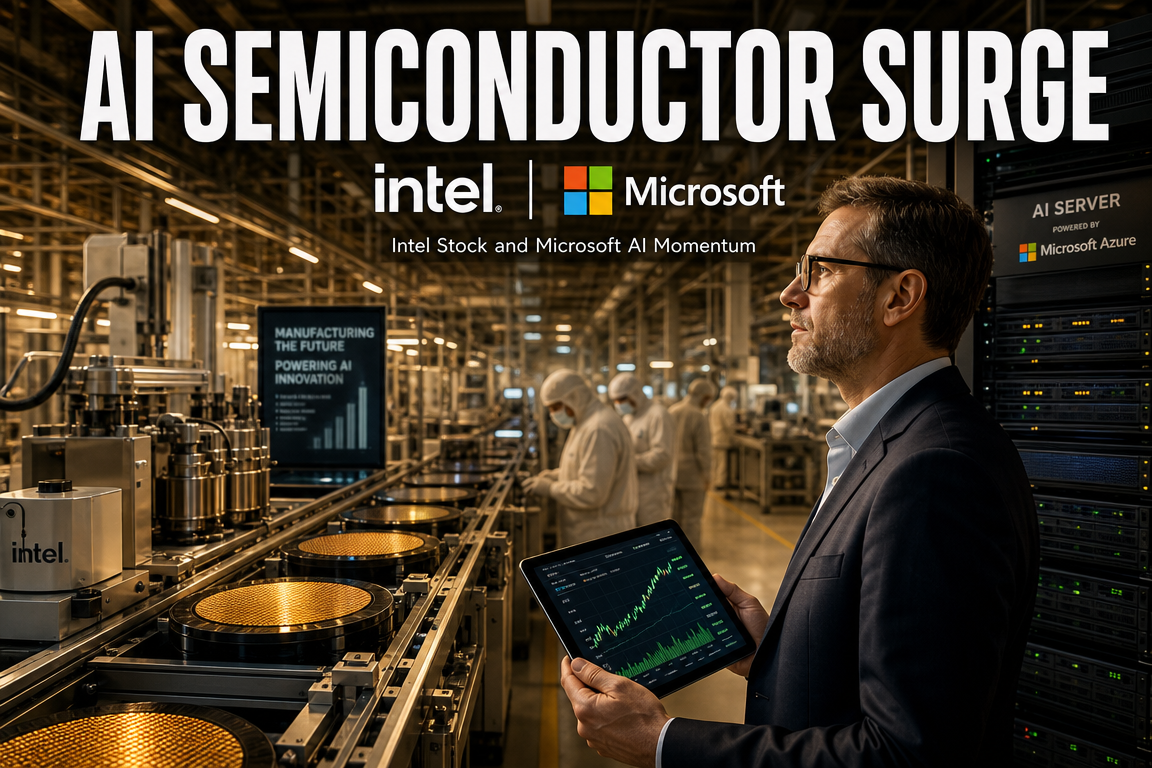
Nancy Pelosi appeared to make a final set of publicly reported trades before retirement, taking bullish positions in Intel and Uber, while Michael Burry partially monetized gains from his Palantir short and added to Microsoft.
One side is betting on U.S. semiconductor industrial policy and potential regulatory easing for autonomous vehicles; the other is arguing that, even amid concerns over AI infrastructure excess, large software companies are relatively undervalued.
In that sense, this news offers an interesting signal for whether the next leadership in U.S. equities will come from semiconductors or from corrected megacap technology stocks.
1. Nancy Pelosi’s New Bets: Bullish Positions in Intel and Uber
Nancy Pelosi, one of the best-known investor-politicians in the United States, disclosed new trades after a long hiatus.
The stocks that drew market attention were Intel and Uber.
The key focus is Intel.
Pelosi is reported to have bought Intel call options, a directional bet that the stock will rise over a defined period.
With expiry reportedly set for next March, the position appears to reflect a medium-term bullish view rather than a short-term trade.
- Core holdings: Intel, Uber
- Main bet: Intel call option purchase
- Market interpretation: expectation of support from U.S. semiconductor policy
- Investment style: medium-term bullish positioning based on policy momentum
2. Why Pelosi’s Trades Continue to Draw Attention
Nancy Pelosi served as Speaker of the U.S. House of Representatives and held one of the highest-ranking positions in U.S. politics.
She is widely regarded as having extensive political experience and a strong Washington network.
The main reason her trades attract attention is the perceived precision of her timing.
Examples often cited by investors include Tesla purchases before EV subsidy policy became prominent, and Nvidia purchases before U.S. semiconductor support legislation gained traction.
This has led to the term “Pelosi mirroring,” as well as ETFs designed to track her trading activity.
That said, public disclosures by politicians are delayed.
Because trades are reported only after some time has passed, following the disclosure mechanically can be risky.
Even so, Pelosi’s trades continue to attract attention because her historical performance is perceived to have outpaced the market significantly.
The original article referenced annualized returns above 20% and years in which she outperformed the broader market.
3. The Real Background to the Intel Bet: Rebuilding the U.S. Semiconductor Industry
Pelosi’s Intel bet should be viewed less as a single-stock trade and more as a position tied to the restructuring of the U.S. semiconductor supply chain.
The United States is trying to reduce its reliance on TSMC in Taiwan and Samsung in South Korea for advanced chip production.
Intel sits at the center of that effort.
From the U.S. perspective, domestic foundry capacity must expand, and Intel is the symbolic company in that policy agenda.
Accordingly, Intel sits at the intersection of semiconductor subsidies, regulatory easing, national security, and AI infrastructure spending.
The original article noted that Intel has been one of the strongest names in the U.S. equity market this year.
Rather than buying a beaten-down stock, Pelosi appears to have been adding to a policy-driven leader with room for further momentum.
That distinction matters.
At a time when many investors are reluctant to chase stocks that have already risen, Pelosi appears to be assuming that policy support remains in place.
4. The Uber Bet: Robotaxis and Looser Labor Regulation
The Uber purchase is also notable.
Uber is not just a ride-hailing company; it is a name linked to autonomous driving, robotaxis, and platform labor regulation.
If U.S. regulation on robotaxis is eased, Uber could benefit directly or indirectly.
Changes in driver classification, worker protections, insurance, and safety rules can also materially affect profitability.
The original article mentioned expectations that robotaxi regulations could be eased in the second half of the year.
Given Uber’s exposure to autonomous vehicle themes and the sensitivity of ride-sharing economics to regulatory shifts, Pelosi’s Uber position appears to reflect a view that policy changes may support the business.
5. Michael Burry’s Counter-Bet: Partial Palantir Profit-Taking, Additional Microsoft Buying
Another major figure in this story is Michael Burry, the investor made famous by the film The Big Short.
Burry became well known for betting against the housing market ahead of the 2008 financial crisis and profiting substantially from that call.
He has since repeatedly warned about market excess, bubbles, and the risk of asset repricing.
However, in recent years, his warnings have not always aligned with immediate market declines, which has also drawn criticism.
According to the original article, Burry took short positions in Palantir and Nvidia, both viewed as high-valuation AI-related names.
Palantir experienced a sharp correction, and Burry reportedly closed roughly half of that short position, realizing gains.
Market attention then shifted to the new stock he bought: Microsoft.
The stock he added was Microsoft.
6. Why Michael Burry Bought Microsoft
Burry reportedly viewed Microsoft around the $350 level as an attractive entry point.
The article indicated that he made a second additional purchase and could hold the position through 2028.
This suggests not a short-term rebound trade, but a contrarian position held until the market revalues the company.
The core logic is straightforward.
Microsoft is not merely a company burdened by AI spending; it is a long-term beneficiary of AI adoption.
When cloud, Office software, Copilot, enterprise AI, and the developer ecosystem are considered together, Microsoft remains one of the clearest ways to monetize AI.
The market is currently concerned about rising AI capex and delayed monetization, but Burry appears to believe those concerns are overstated.
- Michael Burry’s key purchase: Microsoft
- Reported purchase area: around $350
- Investment thesis: AI beneficiary rather than AI casualty
- Time horizon: potentially through 2028
- Style: contrarian buying during periods of fear
7. The Pullback in Software Stocks and Microsoft’s Dilemma
In the U.S. market, performance has recently diverged between AI infrastructure names and software companies.
Direct AI infrastructure beneficiaries such as Nvidia, semiconductor names, data center providers, and power infrastructure stocks have been strong, while Microsoft, Salesforce, Adobe, and Oracle have lagged.
The market’s concern is clear.
AI investment is rising, but revenue realization may not be keeping pace.
However, this divergence may also create opportunity.
If megacap technology companies slow the pace of AI spending or use lower-cost AI models to reduce expenses, pressure on cash flow could ease.
The original article also suggested that Microsoft could step back somewhat from the AI investment race or use lower-cost models, including Chinese alternatives, to manage spending.
In that case, the market may interpret reduced AI spending not as a negative, but as improved cost discipline.
8. Pelosi and Burry Are Taking Completely Different Approaches
The two investors are positioned in opposite ways.
Nancy Pelosi appears to be aligning with policy momentum and market leaders.
Michael Burry, by contrast, is buying into a period of fear, targeting large-cap software names that he views as undervalued.
| Category | Nancy Pelosi | Michael Burry |
|---|---|---|
| Key stocks | Intel, Uber | Microsoft |
| Investment style | Policy beneficiaries and leadership momentum | Contrarian buying of undervalued assets |
| Themes | Semiconductors, robotaxis, regulatory easing | AI software, cloud, megacap technology |
| Market view | Strong names can continue higher | Excessive fear can create opportunities |
| Risk | Valuation pressure after strong gains | Prolonged weakness in software stocks |
9. The Most Important Point That Is Easy to Miss
The real significance of this story is not the names themselves.
The key point is that capital in U.S. equities is splitting between AI infrastructure leaders and corrected large-cap software names.
Pelosi’s Intel bet reflects the possibility that the U.S. government will continue treating semiconductor production and AI infrastructure as strategic industries.
Burry’s Microsoft purchase reflects the view that the market may be overly negative on AI investment costs, and that large-cap technology companies with real monetization capabilities may eventually be re-rated.
In other words, the issue is not simply whether AI is a bubble.
Some AI companies may already be overpriced, while others may be discounted too heavily.
That distinction could materially affect future returns.
10. Late-Stage Bull Markets Tend to Bring Higher Volatility
The original article described the current environment as typical of a later-stage bull market.
Stocks can rise sharply, but they can also fall sharply.
For investors, the increased volatility can be mentally exhausting.
Historically, however, later-stage bull markets can still offer attractive returns for those who remain invested.
The challenge is that staying the course is often harder than it sounds.
AI infrastructure names in particular face both valuation pressure and high earnings expectations.
Capital spending announcements from memory-chip makers such as Samsung Electronics and SK Hynix, as well as global data center investment plans, are likely to continue influencing market sentiment.
Interest rate expectations, corporate earnings, AI capex levels, and semiconductor supply-chain policy remain closely intertwined, suggesting that short-term volatility may persist.
11. Key Variables for Investors to Watch
- Announcements on U.S. semiconductor subsidies and regulatory easing
- Intel’s actual foundry orders and the pace of profitability improvement
- Regulatory changes affecting Uber and robotaxis
- Whether Microsoft slows the pace of AI investment
- AI monetization metrics and cloud growth rates at major technology firms
- Further corrections in high-valuation AI names such as Palantir and Nvidia
- Broader market volatility and changes in interest rate expectations
12. Blindly Copying Trades Is Risky
Nancy Pelosi and Michael Burry are both highly influential market figures.
However, copying their trades directly is risky.
By the time their disclosures are public, prices may already have moved, and retail investors cannot know the full size or exit plan of the positions.
Options, short positions, and leveraged strategies are also far riskier than ordinary equity purchases.
As a result, these disclosures are best viewed as sources of investment ideas rather than trade signals.
Investment decisions should reflect each investor’s time horizon, risk tolerance, and portfolio allocation.
13. The Original Article’s Telegram Channel Promotion
The original article also included a promotion for a Telegram channel called Sokeuiop.
The channel was presented as a fast-moving source of market data, key indicators, risk reviews, and market briefings that could not all be covered on YouTube.
It was positioned as useful for investors who feel overwhelmed by information, are studying markets on their own, or need help maintaining discipline during volatility.
However, investment information services should be treated as reference material only, and final decisions should remain with the investor.
< Summary >
Nancy Pelosi bought bullish exposure to Intel and Uber, with the Intel call purchase drawing the most attention.
The Intel trade is tied to U.S. semiconductor industrial policy, AI infrastructure expansion, and expected policy support.
The Uber position appears to reflect expectations for robotaxi regulatory easing and shifts in platform labor regulation.
Michael Burry partially closed his Palantir short and added to Microsoft.
He views Microsoft as a long-term AI beneficiary rather than an AI casualty.
The broader message is not to copy famous investors, but to recognize that capital is splitting between AI infrastructure leaders and discounted large-cap software companies.
Short-term volatility may continue, but investors should monitor semiconductor stocks, megacap technology, interest-rate expectations, and AI capex trends together to better assess the next market direction.
[Related Articles…]
- AI Infrastructure Cycle and Semiconductor Leadership: Key Watch Points
- Megacap Technology Earnings and U.S. Market Volatility Outlook
*Source: [ 소수몽키 ]
– 주식 초고수들의 엇갈린 베팅, 승자는 누가 될까
● AI-Driven Market Shock, Oil Slides, Bitcoin Breaks, Semis Sell Off
Volatility at the Start of H2 in New York: WTI at $68, Bitcoin Breaks Below 58K, and the Real Meaning of the Semiconductor Correction
The key takeaway from today’s market is not simply that the Nasdaq declined.
On the first trading day of the second half, the AI semiconductor rally weakened, WTI crude fell to the $68-$69 range, and Bitcoin briefly broke below 58K for the first time in 22 months.
At the same time, slower ADP payroll growth, the Fed’s policy path, midterm election variables, Meta’s potential move into AI cloud services, Micron and SK Hynix ADR-related issues, and competition around Circle and stablecoins all came into play.
Superficially, this looked like another down day for U.S. equities. In reality, the main issues are whether the AI investment cycle can continue, whether capital rotates away from semiconductor leaders into other sectors, and how lower crude prices affect inflation and interest rates.
1. U.S. Equity Market Overview: A Weak Start to the Second Half, Led by Semiconductors
U.S. equities traded under pressure from the open on the first day of H2.
The Nasdaq was down as much as 0.89% at one point, while the S&P 500 fell about 0.6%, the Dow Jones Industrial Average declined about 0.43%, and the Russell 2000 also weakened.
Losses narrowed later in the session.
The Dow and Russell 2000 briefly turned positive, and the S&P 500 recovered toward flat.
In other words, today’s decline was more a sector-specific correction than a broad market selloff.
-
Nasdaq: down about 0.89% at the open before narrowing losses
-
S&P 500: down about 0.6% before recovering toward flat
-
Dow Jones Industrial Average: turned positive intraday
-
Russell 2000: partial recovery in small caps
-
SOXX and other semiconductor ETFs: under pressure by about 3%
In one sentence, today was not a market-wide collapse but a reflection of fatigue in the narrow AI semiconductor rally.
2. Semiconductor Selloff: Why Nvidia, Micron, and Broadcom Were Weaker
Semiconductors were the main source of weakness today.
Nvidia fell more than 3% intraday, while Broadcom declined nearly 2%.
Micron dropped as much as 7% intraday, becoming a focal point of the semiconductor correction.
AMD, Intel, Marvell, and semiconductor equipment names also moved lower.
-
Nvidia: down in the 3% range
-
Broadcom: down about 1%-2%
-
Micron: down about 7% intraday
-
AMD, Intel, Marvell: broadly weaker
-
Semiconductor equipment stocks: broadly lower
The important point is that there was no clear evidence of fundamental deterioration.
The main reason semiconductors sold off is that the group had already risen too far, too fast.
In Q2, the Philadelphia Semiconductor Index surged about 88%, while some memory and chip names gained 180%-250% in a single quarter.
-
SanDisk: up about 258% in Q2
-
Micron: up about 242% in Q2
-
Intel: up about 216% in Q2
-
Marvell Technology: up about 200% in Q2
-
AMD: up about 186% in Q2
After such a move, a 5%-8% pullback can look severe, but it is still consistent with profit-taking.
From an AI investment perspective, it is important to distinguish between weakening demand and stretched valuations.
3. Why Meta’s Rally Added Pressure to Semiconductors: The Market Read AI Compute as Excess Supply
Another notable move today was Meta’s 7%-9% gain.
Meta rose sharply on speculation around a possible expansion into AI cloud services and plans to monetize its large data center infrastructure base.
The issue is that this news was interpreted as mildly negative for semiconductors.
Meta’s message that it could sell surplus compute capacity into the cloud market, if that interpretation holds, prompted a key market question:
If AI data centers remain capacity constrained, why would Meta suggest that compute is available to sell?
That was the point that made semiconductor investors particularly sensitive today.
The rally in Nvidia, Micron, Broadcom, and AMD has been built on the premise that AI infrastructure spending will keep expanding. Any suggestion that a large platform company may have excess compute capacity can raise near-term valuation concerns.
That said, it is premature to interpret this as the end of the AI semiconductor cycle.
Meta’s cloud-related ambitions have been discussed before, and large-scale AI data center investment is still ongoing.
The key issue today was not demand destruction, but a more cautious market reaction to elevated semiconductor valuations.
4. U.S. Equity Performance in H1: One of the Strongest Quarterly Rallies Since the Pandemic
U.S. equities posted a strong second quarter in 2026.
The S&P 500 rose about 15% in Q2, the Nasdaq advanced about 21%, and the Dow gained about 13%, marking the strongest quarterly performance since 2022.
-
S&P 500: up about 15% in Q2
-
Nasdaq: up about 21% in Q2
-
Dow Jones Industrial Average: up about 13% in Q2
-
S&P 500: 24 record highs this year
-
Nasdaq: 20 record highs this year
What matters to Wall Street is not only the magnitude of the gains, but also whether the rally broadens beyond technology.
If leadership expands into financials, healthcare, and small caps, the bull market can last longer.
If the market continues to rely mainly on semiconductors, volatility will remain elevated.
5. H2 Outlook: Volatility Ahead of the Midterms, with Potential for a Post-Election Rally
The most important variable for the second half is the midterm election cycle.
CFRA expects the S&P 500 to extend its gains and potentially reach the 7,730-7,750 range in H2.
The argument is based on historical patterns.
In years when the market set multiple record highs in H1, H2 has typically delivered additional gains.
-
Average additional H2 gain after a strong H1: about 6%
-
Probability of H2 gains: about 80%
-
S&P 500 12-month gain after midterms: 100% since 1942
-
Average 12-month return after midterms: about 15%
However, policy uncertainty may increase from August through October.
That is typically when fiscal policy, tariffs, industrial policy, and energy policy receive greater attention.
President Trump’s plan to hold a midterm convention in Dallas, Texas, starting September 9 also matters for market sentiment.
Accordingly, the H2 strategy is not simply to assume higher prices, but to use 8-10月 volatility as a potential entry point.
6. Crude Oil Decline: What WTI at $68 Means for Inflation and Rates
Crude prices have moved lower.
WTI has fallen to around $68-$69, while Brent is near $71.
Brent crude has declined about 38% during the second quarter.
Lower oil prices are important for U.S. equities.
They ease inflation pressure and may reduce the need for additional Fed tightening.
Growth and technology stocks are especially sensitive to long-term yields, so stable energy prices can support valuations.
Geopolitical tensions also appear to be easing somewhat.
Market commentary has referenced talks in Doha, Qatar, coordination involving Pakistan, and the possibility of normalized traffic through the Strait of Hormuz.
Some investors are already discussing the possibility of an oil supply surplus.
Another factor is rising U.S. crude exports.
As Middle East tensions persisted, U.S. producers gained access to global niche markets, creating an opportunity for domestic energy companies.
In that sense, the recent decline in oil is not only a function of reduced geopolitical risk, but also of a shift in the global energy supply chain.
7. Bitcoin Breaks Below 58K: Momentum in Digital Assets Has Weakened
Bitcoin briefly fell below 58K for the first time in 22 months before recovering modestly.
Even so, market sentiment remains weak.
Concerns about potential Bitcoin sales by MSTR pressured sentiment, while inflows into crypto ETFs have become less forceful.
The reason for the weakness is straightforward.
Capital has moved toward faster-moving opportunities, especially AI semiconductors and selected growth stocks.
Because names such as Micron, SanDisk, and Intel delivered stronger short-term returns than Bitcoin or Ethereum ETFs, near-term capital rotated away from digital assets.
At this point, the crypto market is better described as having a momentum gap rather than facing collapse.
A sustained rebound would likely require catalysts such as lower rates, renewed ETF inflows, institutional buying, or stronger stablecoin liquidity.
8. Circle’s Sharp Decline and Stablecoin Competition: Headwind or Institutionalization Signal
Circle Internet Group, the issuer of USDC, declined sharply.
The immediate trigger was news that Visa, BlackRock, and Coinbase are collaborating on an “Open USD” consortium.
The market interpreted this as a competitive threat to Circle, and the stock fell about 17% in one day.
However, some on Wall Street argue that the decline may have been excessive.
USDC has a market capitalization of about $73 billion, giving it a substantial liquidity base relative to major competitors.
In stablecoins, liquidity and trust remain the main barriers to entry.
More importantly, the participation of Visa and BlackRock suggests that stablecoins are moving further into the financial mainstream.
That is a near-term competitive headwind for Circle, but a long-term positive for the stablecoin industry as a whole.
Stablecoins may expand beyond crypto trading and into payments, remittances, and financial infrastructure.
9. Slower ADP Payroll Growth: A Small Shift in the Fed Outlook
June ADP private payrolls rose by 98,000, below the consensus estimate of 118,000 and down from the prior 122,000.
This indicates slower employment growth.
-
June ADP private payrolls: +98,000
-
Market estimate: +118,000
-
Prior reading: +122,000
Slower job growth has two implications.
It can signal economic moderation, but it also reduces inflation and rate pressure, which is constructive for technology stocks.
For the Fed, it may reduce the pressure to tighten further and reinforce expectations for a pause or eventual easing.
That said, one ADP release is not enough to change the Fed’s policy path.
Nonfarm payrolls, wage growth, consumption, and inflation data remain necessary for confirmation.
10. Micron vs. SK Hynix: Why Wall Street Often Prefers Micron
Even during today’s semiconductor correction, the Micron-SK Hynix comparison remains important.
On fundamentals and technology, SK Hynix appears stronger.
It also holds the dominant position in HBM market share.
Still, Wall Street often assigns a higher premium to Micron.
The reasons are broadly fourfold.
-
First, the Korea discount.
Micron trades at a forward P/E of about 11.2x, while SK Hynix trades at about 6.6x.
That implies a discount of roughly 56%.
If SK Hynix ADRs list on Nasdaq, access improves, but country risk, governance concerns, and foreign ownership constraints do not disappear completely.
-
Second, the premium for U.S.-based memory exposure.
Micron is a pure-play memory company headquartered in the U.S.
It may benefit more directly from U.S. pension capital, ETFs, policy support, and CHIPS Act incentives.
-
Third, the pace of catch-up.
Micron’s recent revenue growth is about 196% year over year.
Investors also note that its 2026 HBM allocations and next-generation HBM4 appear effectively sold out.
-
Fourth, the quality of long-term supply agreements.
Some analysts argue that Micron can secure gross margins of 70%-75% through long-term contracts.
That is well above the low-60% gross margin peaks seen in previous memory cycles, suggesting a structural change in the industry.
Even so, SK Hynix remains stronger in core HBM competitiveness.
Its HBM market share is estimated at around 58%, and it is expected to retain a high share in HBM4 for Nvidia’s next-generation Rubin platform.
If the SK Hynix ADR listing becomes reality on July 10, broader global investor access could become a re-rating catalyst.
11. The Most Important Points Often Missed in Other Coverage
First, today’s semiconductor decline reflects higher valuation sensitivity rather than a breakdown in fundamentals.
AI chip demand has not disappeared; the issue is that share prices rose so quickly that even small changes in interpretation now trigger larger moves.
Second, the Meta news was not just a cloud expansion story; it also questioned the AI infrastructure investment cycle.
The phrase “compute may be available” is highly sensitive for semiconductor investors.
Going forward, data center utilization, AI investment efficiency, and GPU demand guidance will matter more in big tech earnings.
Third, the decline in crude oil is not only about easing Middle East risk.
Rising U.S. exports and global supply-chain rebalancing are also part of the story.
If that trend continues, it could support lower inflation, more stable long-term yields, and a recovery in technology valuations.
Fourth, stablecoin competition is a near-term negative for Circle but may be a long-term positive for the sector.
Visa and BlackRock’s involvement signals that stablecoins are moving beyond the margins of crypto.
As stablecoins expand into payments, remittances, and trade finance, the market opportunity could become materially larger.
Fifth, H2 volatility should be viewed not only as risk, but also as an opportunity for prepared investors.
The period from August through October may be choppy, but historically the 12 months after midterms have been strong for the S&P 500.
12. Investment Perspective: How the Market Should Be Positioned
This is not a time to chase risk aggressively; it is a time to assess sector-by-sector positioning.
Semiconductors still have strong long-term growth potential, but short-term valuation risk remains elevated.
Lower oil prices are supportive for growth stocks through inflation and rates.
Bitcoin has lost momentum, but the long-term stablecoin theme remains intact.
Midterm-related volatility may create opportunities for investors with cash to deploy gradually.
-
AI semiconductors: long-term growth remains intact, short-term profit-taking risk has increased
-
Memory semiconductors: watch Micron and the SK Hynix ADR event
-
Crude oil: WTI in the $68 range is favorable for inflation moderation
-
Bitcoin: recovery momentum after losing 58K remains to be confirmed
-
Stablecoins: short-term volatility for Circle, but long-term industry growth remains intact
-
U.S. equities: volatility ahead of the midterms, with the potential for a post-election rally
< Summary >
U.S. equities weakened on the first trading day of the second half, led by semiconductors.
Nvidia, Micron, Broadcom, and other AI chip leaders corrected, but the move appears to reflect profit-taking after a sharp run rather than a fundamental breakdown.
WTI crude fell to the $68-$69 range, which may ease inflation and rate pressure.
Bitcoin fell below 58K for the first time in 22 months, signaling weaker momentum in digital assets.
Circle sold off sharply on competitive concerns, although the entry of Visa and BlackRock also points to stablecoin institutionalization.
Volatility may rise ahead of the midterms, but history suggests U.S. equities have tended to perform strongly in the 12 months after the election.
[Related Articles…]
- AI Semiconductor Supercycle and U.S. Equity Strategy
- Bitcoin Correction and Stablecoin Market Shift Analysis
*Source: [ Maeil Business Newspaper ]
– 국제유가 WTI 68불까지 하락ㅣ비트코인 22개월만에 58k 붕괴ㅣ홍키자의 매일뉴욕