● AI Glass Hidden Power Play
Why Is the Next AI Form Factor After Smartphones “AI Glasses”: The Hidden Champion to Watch Beyond Meta, China, and Samsung
The real key point in today’s AI glasses market is not simply that “Meta is ahead,” “Samsung is jumping in,” or “China can make them cheaply.”
The core point is that control over the AI agent era could shift from smartphone makers to companies that hold the eyewear distribution network and lens ecosystem.
In this article, we will cover the global AI glasses market size, the strategic differences between Meta and China, the entry directions of Samsung, Google, and Apple, the Chinese manufacturing value chain, and why the European eyewear giant EssilorLuxottica could shake up the Big Tech investment landscape.
Especially important, and often overlooked in other coverage, is that the battleground for AI glasses is not only semiconductors and displays, but also prescription lenses, eyewear retail networks, brand licensing, and medical device regulation.
1. AI Glasses Market Status: Still Small, but Its Growth Pace Resembles the Early Smartphone Market
Based on Omdia, a market research firm, the global AI glasses market is said to be around 8.7 million units in 2025.
That is not easy to compare with the smartphone market in absolute terms, but considering that this is an early market, it is by no means a small number.
Even after the iPhone appeared, it took several years for the smartphone market to grow into a scale of more than 100 million units.
AI glasses may currently look like experimental devices, but once AI agents become part of daily life, they could be rapidly re-evaluated as a smartphone replacement form factor.
- 2025 global AI glasses market: estimated at around 8.7 million units.
- Meta market share: about 85% of the total market, or roughly 7.4 million units, effectively dominating the early market.
- U.S. market: around 5 million units, currently the largest consumer market.
- China market: around 1 million units, but mentioned as growing more than 3,500% year over year.
- Growth background: China’s consumer stimulus policy and IT device replacement subsidies have strongly supported market expansion.
What matters here is that the U.S. market opened first around Meta’s consumer ecosystem, while China is rapidly building a mass-production market based on government policy and its manufacturing value chain.
This trend also has important implications for the future economic outlook.
If AI hardware can create a new consumer goods cycle after smartphones, it could move the semiconductor supply chain, the display industry, optical materials, batteries, and sensors all at once.
2. Meta Dominates the Market, but China Leads in Display-Equipped Models
The AI glasses market can be broadly divided into smart glasses without displays and AR glasses with displays.
Meta’s Ray-Ban AI glasses are the representative product that expanded the market.
They include a camera, microphone, speaker, and AI calling functions, but fundamentally started as a display-free form.
By contrast, China is moving far more aggressively in the AI glasses segment with displays.
- AI glasses without displays: Meta is leading with Ray-Ban.
- Display-equipped AI glasses: Chinese companies account for about 70% or more and are growing quickly.
- China’s strength: a supply chain linking micro OLED, birdbath optics, optical components, and finished-product manufacturing.
- U.S. and Korea’s approach: focusing first on everyday wearability, fashion appeal, and privacy concerns with display-free models.
Chinese products feel much more futuristic because they show a screen.
But with current technology, they require additional optical systems inside the lens, and there are still challenges with brightness and field of view.
So rather than being suited for walking around all day, they are closer to being used while seated for video or work screens.
In other words, China is pursuing a strategy of “using the technology that is available now to grow the market as fast as possible,” while Meta and Samsung are pursuing a strategy of “securing everyday wearability first.”
3. Why Glasses Are Called the Best Form Factor in the AI Agent Era
The reason AI glasses are attracting attention is not simply because they bring the smartphone screen to your eyes.
The real core point is that an AI agent can naturally understand a person’s vision, voice, location, and context in real time through them.
With smartphones, you have to take them out with your hand, open an app, and look at the screen.
But with AI glasses, the AI can see what the user sees, hear what the user hears, and respond immediately.
- Visual information: AI can understand in context the objects, places, documents, people, and price tags I am looking at.
- Voice interface: You can ask the AI agent directly without using your hands.
- Always-on wearability: It can become a personal computing device more closely attached to the body than a smartphone.
- Enhanced accessibility: It has strong use cases for presbyopia, vision assistance, document reading, real-time translation, and navigation.
- Connection between reality and digital: It can evolve into a system where product prices, discounts, reviews, and ingredient information appear instantly when you look at an item in a store.
In the end, AI glasses are not devices that replace people, but devices that augment people.
Because they are a form factor that raises intelligence, connectivity, and accessibility at the same time, Big Tech continues to invest for the long term.
That is why some forecast that if smartphones were the center of the mobile era, AI glasses could become the center of the AI era.
4. Technical Limits: Battery, Display, Field of View, and Weight Are Still Unresolved
For AI glasses to become mainstream, there are many technical hurdles to overcome.
Inside the small space of eyeglasses, they have to fit a battery, communication module, memory, camera, microphone, speaker, sensors, and display.
At the same time, they must be light and attractive, and comfortable enough to wear all day.
- Battery: Usage time must be secured without increasing weight.
- Heat: Since it touches the face, it is more sensitive to heat than a smartphone.
- Display: Micro LED, micro OLED, LCOS, and waveguide technologies all need further advancement.
- Field of view: Some current products have a narrow information display area, limiting immersive experiences.
- Wear comfort: If the temples become too thick, the natural feel of eyeglasses declines.
- Optical structure: Birdbath systems can be implemented quickly, but they still leave discomfort for everyday glasses use.
Meta’s next-generation prototype, Orion, aims for a wider field of view, but it is not yet a commercial product.
Current commercial products are closer to simply displaying a small information window over reality.
The true essence of AI glasses is completed when reality and digital content blend without boundaries.
The final goal is close to a stage where information naturally overlaps the real space like an Iron Man helmet, and AI understands the context and shows the needed information first.
5. China’s AI Glasses Ecosystem: Rokid, Xreal, Xiaomi, and Goertek Are in Motion
China’s AI glasses market should not be viewed only through finished-product brands.
The truly formidable part is that the manufacturing value chain, from components and optics to ODM production and white-label manufacturing, is already highly developed.
This is very similar to the way Chinese manufacturing has operated in electric vehicles, robots, and drones.
5-1. Rokid: Expanding from AI Voice Assistant to AI Glasses
Rokid was founded in 2014 in Hangzhou, China.
It started as an AI voice assistant service and later expanded into AI glasses hardware.
In particular, the scene in which a presenter reads from the glasses screen without holding a script became a hot topic, helping create the image of “AI glasses that can actually be used.”
- Starting point: AI voice assistant service.
- Expansion direction: AI glasses with displays.
- Feature: Strong usability for work-related functions such as prompting, real-time translation, and information display.
- Regional base: It can be seen as a representative part of the Hangzhou AI and hardware ecosystem alongside DeepSeek and Unitree.
5-2. Xreal: A Key Player Connected to Google’s Project Aura
Xreal is a Chinese company with high global recognition in the AR glasses field.
It is notable that Google’s effort to build the Android XR ecosystem is connected with Project Aura and Xreal.
While Samsung Electronics has first emphasized display-free AI eyewear, Xreal is actively trying to seize the display-based market by essentially saying, “We will deliver the mobile computing experience.”
- Strength: Display-based AR glasses technology and developer ecosystem.
- Strategy: Aiming to secure the Android XR-based content ecosystem first.
- Limitation: Without enough content, it could end up like the VR market, with devices but not enough reason to use them.
5-3. Xiaomi: AI Glasses That Control the Smart Home Ecosystem
Xiaomi approaches the AI glasses market with low prices and a massive IoT ecosystem.
For Xiaomi, the core point is not the glasses themselves, but the experience of controlling smartphones and smart-home devices by voice through the glasses.
This is why they can still be meaningful even without a display.
- Pricing strategy: Targets the mass market with relatively affordable pricing.
- Core functions: AI assistant, voice control, and smart-home integration.
- Strategic meaning: Within Xiaomi’s ecosystem, AI glasses become a new kind of remote control.
5-4. Goertek: The Hidden TSMC of AI Glasses Manufacturing
A Chinese company that must be watched in AI glasses manufacturing is Goertek.
Goertek started as an audio component company and built its capabilities in Apple Watch, AirPods ODM, and VR device manufacturing.
It later became connected to major XR device production such as Meta Quest, the Meta Ray-Ban series, and Sony PlayStation VR, rising as a key company in the AI glasses supply chain.
- Main role: ODM manufacturing for XR and AI glasses.
- Meta-related: It is known to be deeply involved in the Quest series and the Ray-Ban smart glasses manufacturing network.
- Sony-related: It also has PlayStation VR manufacturing experience.
- Xiaomi-related: It is mentioned as handling some AI glasses production volume.
- OpenAI device rumor: It is also mentioned as a candidate manufacturer for AI hardware pursued by Jony Ive and OpenAI.
In the AI glasses market, the brands may appear to be Meta, Xiaomi, Google, and Samsung, but the actual manufacturing base is likely to be controlled by ODM companies like Goertek.
This structure can be interpreted similarly to TSMC’s position in the semiconductor industry.
However, AI glasses are more complex because they combine not only semiconductors, but also optics, lenses, acoustics, batteries, and assembly technology.
6. The Real Hidden Champion: Why EssilorLuxottica Is the Gatekeeper of the AI Glasses Market
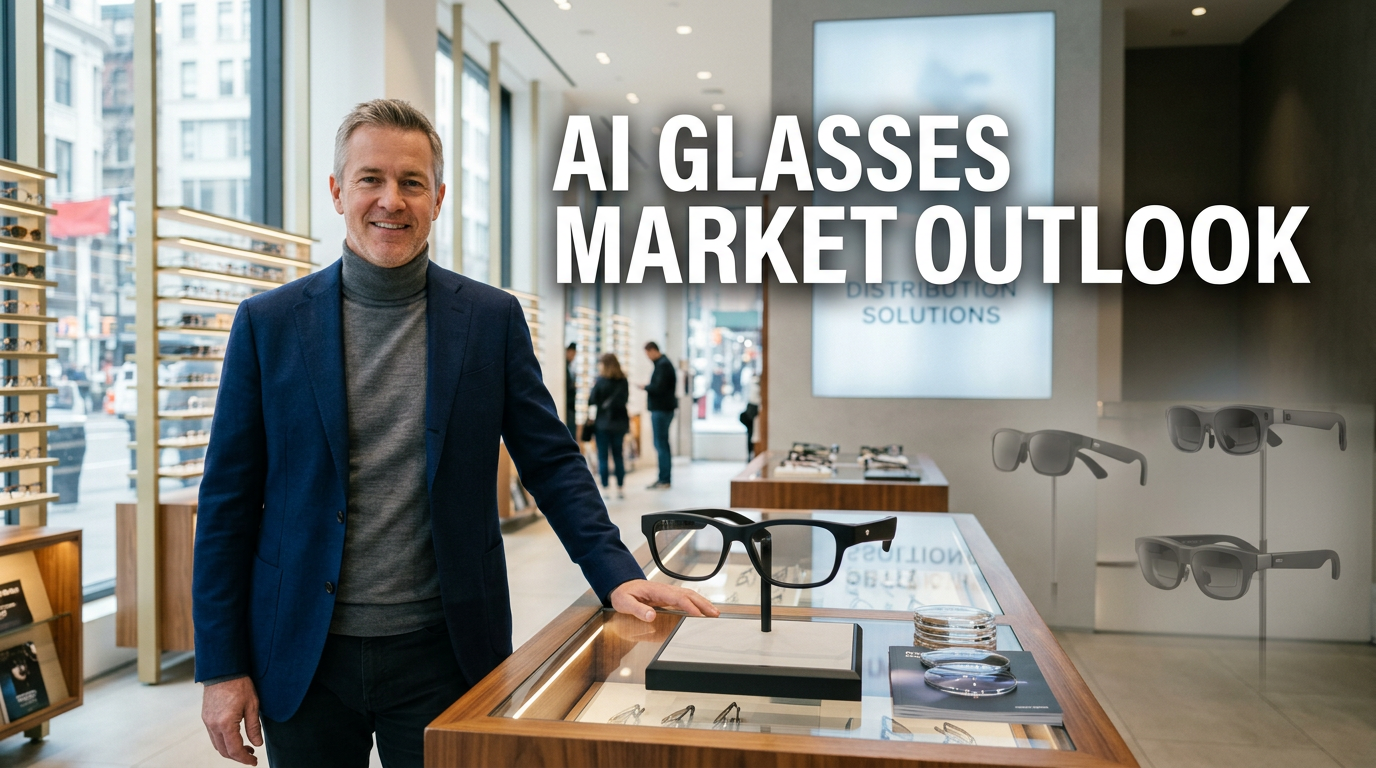
The most interesting company in this market is not Meta, Samsung, or Google, but EssilorLuxottica.
EssilorLuxottica is the global eyewear giant formed by the merger of France’s lens company Essilor and Italy’s eyewear company Luxottica.
This is exactly why, in the AI era, you should not only look at semiconductor companies.
AI glasses are electronic devices, but they are also eyeglasses at the same time.
In other words, companies with brands, prescription lenses, and distribution networks that consumers can wear on their faces every day can control the market’s entry point.
- Global eyewear market share: mentioned at around 25% to 30%.
- Luxury designer brands: known to produce and manage 70% to 80% of major luxury eyewear and sunglasses.
- Corrective lens market: has influence at around 42%.
- Photochromic lens market: also holds strong share in automatic tinting lenses.
- Distribution network: owns global eyewear retail chains such as Sunglass Hut.
- Brand power: holds mass-market and fashion brands like Ray-Ban and Oakley, which fit AI glasses especially well.
Meta’s partnership with Ray-Ban is not just a simple brand collaboration.
It is securing the most difficult part of the AI glasses market: eyeglasses that people actually want to wear.
Smartwatches allowed companies like Apple and Samsung to create a market directly.
But eyeglasses are different.
Eyeglasses are fashion products worn directly on the face, and for people who need prescription lenses, they also have the nature of a medical device.
7. The Core Point Rarely Explained in Other Coverage: The Battleground for AI Glasses Is the Eyewear Retail Network
Many analyses view AI glasses mainly through displays, semiconductors, AI models, and camera performance.
Of course, those matter.
But at the mass adoption stage, what matters more is where prescription lenses are fitted, who sells them, and which brand convinces consumers.
- Prescription lens issue: People with poor eyesight cannot easily use ordinary AI glasses as-is.
- Medical device regulation: Prescription eyewear is often classified by country as a medical device or a professional sales category.
- Offline eyewear stores: They handle prescriptions, fitting, lens processing, and after-sales service, so the distribution network is critical.
- Restrictions on online sales: In Korea, online sales of prescription glasses are limited, while the U.S. and Japan are relatively more permissive.
- Big Tech weakness: Smartphones can be sold well, but an eyewear-store network is hard to build overnight.
This is where EssilorLuxottica’s power becomes larger.
That is because the company controlling global eyewear distribution and lens supply chains could become the gatekeeper of the AI glasses market.
Meta’s move to hold some equity in EssilorLuxottica and strengthen strategic cooperation should be viewed in this context.
If EssilorLuxottica additionally secures fashion eyewear brands like Gentle Monster or online eyewear retailers like Warby Parker, Samsung, Google, and Apple may all be forced to pay attention to it.
8. Samsung, Google, and Apple’s Dilemma: Strong Smartphone Ecosystems, Weak Eyewear Ecosystems
Samsung Electronics and Google have powerful assets in the Android ecosystem, smartphones, AI, cloud, and semiconductor supply chains.
Apple also has a solid hardware ecosystem spanning the iPhone, Apple Watch, AirPods, and Vision Pro.
But AI glasses introduce another problem.
That problem is eyewear brands and distribution networks.
- Meta’s strength: It already cooperates with fashion eyewear brands like Ray-Ban and Oakley.
- Samsung’s strength: Galaxy smartphones, Galaxy AI, Android connectivity, and semiconductor and display capabilities.
- Google’s strength: Gemini, Android XR, Search, Maps, YouTube, and the AI agent ecosystem.
- Apple’s strength: iPhone user base, iOS ecosystem, and wearable design capability.
- Common weakness: Limited eyewear-store networks, prescription lens processing, and fashion brand persuasion.
Meta does not have a smartphone operating system, but it has already secured the fashion appeal and early market for AI glasses.
Samsung, Google, and Apple are strong in smartphone and AI service connectivity, but they need partners when it comes to making glasses that people actually want to wear on their faces.
That is why the AI glasses market is likely to expand into strategic alliances, equity investments, and competition to secure brand licenses between technology companies and eyewear companies.
9. Privacy Issues: Glasses with Cameras Require Social Consensus
The first problem AI glasses will face as they become mainstream is privacy.
If a camera is built into glasses, people nearby cannot easily tell whether they are being recorded.
Meta products include a light indicator during recording, but concerns remain about malfunction and misuse.
- Recording indicator light: A device is needed to show externally when the camera is operating.
- Cheating on tests: Concerns about cheating with AI glasses are already being raised.
- Public-space rules: Wearing rules may emerge in schools, companies, meeting rooms, hospitals, and similar places.
- Differences in national regulation: Europe has strong privacy rules, while the U.S. and China may see faster technology diffusion.
- Social adaptation: Smartphone cameras also faced major concerns at first, but institutions and usage rules developed over time.
AI glasses will ultimately need technology development and social rules to move together.
They may feel uncomfortable and unfamiliar at first, but if their value grows in real-time translation, visual assistance, work productivity, and responses to aging societies, acceptance could gradually rise.
10. Economic Perspective: AI Glasses Could Become a New Consumer Goods Cycle
The AI glasses market is still in an early investment phase in which most companies are accepting losses.
But smartphones also grew into a massive platform industry after huge investments and early losses.
AI glasses are likewise a market aiming for long-term platform dominance rather than short-term profits.
- Expanded Big Tech investment: Meta, Google, Samsung, and Apple are all reviewing or entering the AI glasses market.
- Expansion of Chinese manufacturing: Vertical integration is progressing rapidly from optical materials and displays to ODM and finished-product production.
- Semiconductor supply-chain impact: Demand for on-device AI, low-power chips, sensors, and memory could increase together.
- Consumer goods cycle: It could create new replacement demand in an IT consumer market that has been stagnant since smartphones.
- Corporate digital transformation: It can be used in industrial sites, remote support, education, healthcare, and logistics as a tool for AX and ROI measurement.
In particular, for companies, it is becoming more important not just how much AI they have adopted, but how much value they create with AI and how they measure that performance.
AI glasses can become a practical tool for corporate AX strategies in areas such as on-site worker support, remote collaboration, real-time manual guidance, quality inspection, and customer response.
Therefore, AI glasses should be seen not merely as consumer devices, but as hardware connecting productivity gains and industrial digital transformation.
11. Key Watch Points Ahead
- First, it is important to see how far Meta expands the Ray-Ban and Oakley ecosystem.
- Second, we need to watch how Samsung and Google secure eyewear brands and distribution networks.
- Third, attention should be paid to how Apple’s AI glasses will connect with the iPhone ecosystem.
- Fourth, we need to see whether China’s display-based AI glasses can succeed globally.
- Fifth, we should watch how much ODM companies like Goertek grow within the AI hardware supply chain.
- Sixth, we must not overlook the possibility that EssilorLuxottica becomes the gatekeeper of AI glasses distribution.
- Seventh, privacy regulation and online sales restrictions for prescription lenses could determine the pace of market expansion.
In conclusion, the AI glasses market is a competition in Big Tech AI, a competition in China’s manufacturing supply chain, and at the same time a competition for distribution rights in the traditional eyewear industry.
If you only hear the phrase “smartphone replacement form factor,” it may sound like a very distant future.
But considering that Meta is already selling millions of units, China is rapidly mass-producing display-based products, and Samsung, Google, and Apple are all moving in, this market has already begun.
When looking at AI glasses in the future, do not just examine product specs; also look at who makes the lenses, who places them in eyewear stores, and who holds the brands.
< Summary >
AI glasses are attracting attention as the key form factor in the AI agent era.
Meta has dominated the early market with Ray-Ban, and China has rapidly risen to the top in display-equipped AI glasses.
Samsung, Google, and Apple are also preparing to enter the market, but the real variable is eyewear brands and distribution networks.
EssilorLuxottica holds the global eyewear market, luxury brand licenses, lenses, and eyewear retail networks, so it could emerge as the hidden champion of the AI glasses market.
The coming battle is likely to hinge not only on semiconductors and AI models, but also on prescription lenses, privacy regulation, eyewear-store distribution, and fashion brand collaborations.
[Related Articles…]
- Why Big Tech Is Returning to Hardware in the AI Agent Era
- Global AI Hardware Investment Outlook Amid Semiconductor Supply Chain Restructuring
*Source: [ 티타임즈TV ]
– 스마트폰 대체할 AI 폼팩터, 빅테크 아닌 안경회사에 주목해야 하는 이유 (신동형 알서포트 전략기획팀장)